
Variety Comparison
Black Obsidian and Dark Obsidian Varieties
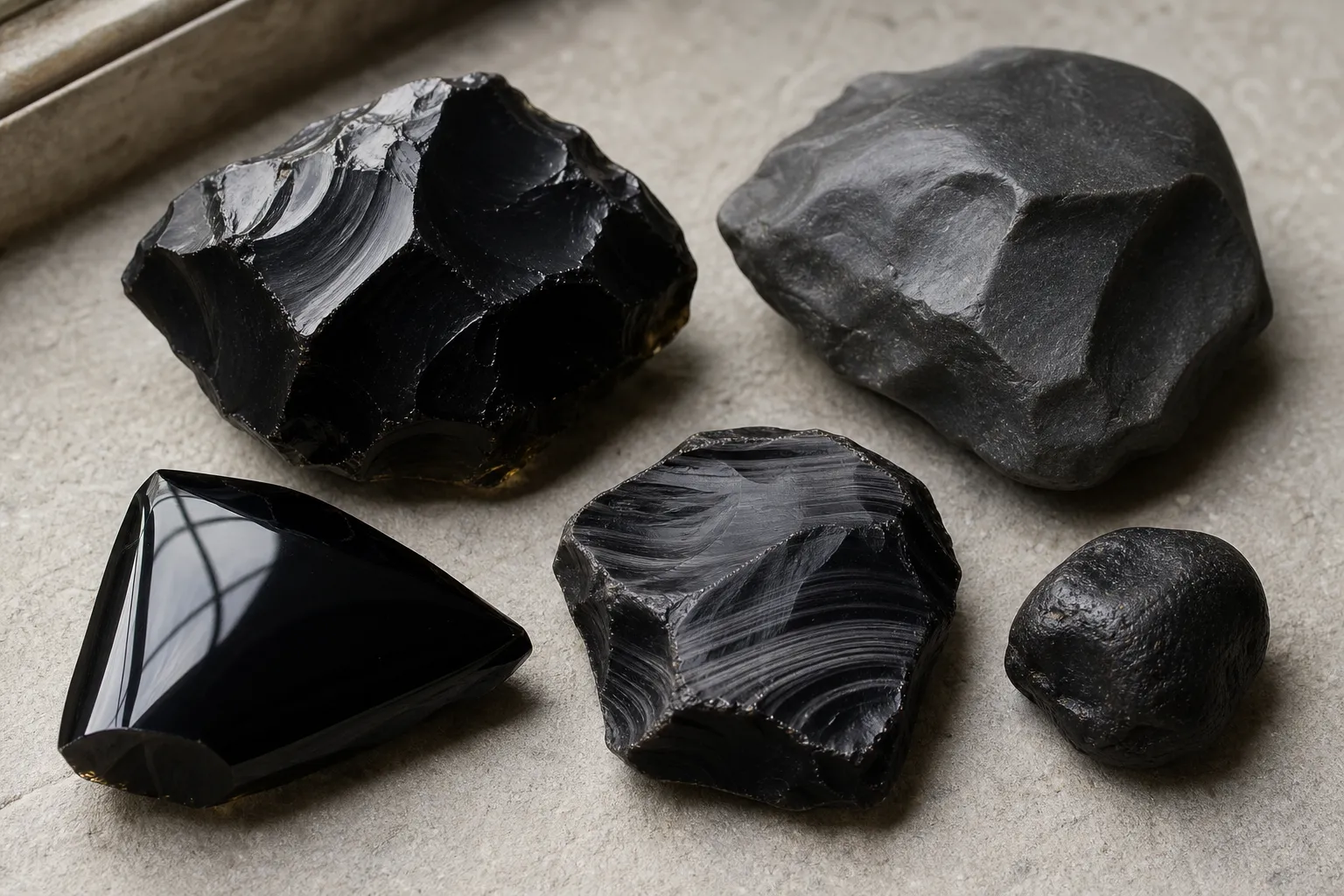
A dark piece of obsidian can look simple at first: black, glossy, and glass-like. The label is where the confusion begins. One seller may call it plain black obsidian, another may use dark obsidian, dark gray obsidian, Apache Tears, mirror black obsidian, or black obsidian with flow bands.
This guide to black obsidian varieties is for that comparison stage. Instead of treating every phrase as a fixed variety name, start with what the piece shows: color depth, polish, translucency at thin edges, surface shine, banding, form, and condition.
The available reference pool for this page does not support a formal taxonomy for every dark obsidian name. A practical approach is more useful: some names describe appearance, some describe shape or finish, and some are seller language. Keep those categories separate.
upward
Start with the broader guide
Use the broader guide first if you need the full scope before this page.
What Is Black Obsidian as a Variety?
Black obsidian is usually used by collectors for a dark, glassy obsidian piece whose main visual identity is black body color. It is different from names that depend on stronger secondary features, such as a snowflake pattern, mahogany coloring, rainbow sheen, or a clear gold or silver surface effect.
That does not mean every black-looking piece is a formally verified variety. On a collection tray, “black obsidian” often works as a descriptive starting point: dark volcanic glass with no dominant secondary pattern visible in normal inspection.
A better first question is not “Which variety is this?” but “What visible feature is doing the naming?”
Seller Labels and What to Check
Plain black obsidian
May point to dark body color with few visible patterns. View it in daylight and check thin edges.
Dark obsidian
May point to a general dark appearance. Ask whether it means black, gray, smoky, or just low-light photos.
Dark gray obsidian
May point to a softer gray-black tone. Check whether polish, dust, or lighting is muting the color.
Mirror black obsidian
May point to strong surface reflectivity. Separate polish quality from body color.
Soft black obsidian
May point to a muted or less reflective appearance. Check whether the surface is raw, worn, matte, or poorly lit.
Apache Tears black obsidian
May point to small rounded dark pieces often sold under that name. Treat it as form-and-market language unless provenance is clearer.
Black obsidian flow bands
May point to a dark piece with gray or tonal banding. Decide whether the bands are strong enough to lead the name.
The most reliable habit is to describe the specimen in layers: body color, edge behavior, surface finish, pattern, and form. A name becomes more useful when it matches those visible layers.
Why Black Obsidian Can Look Different From Piece to Piece
A black obsidian variety does not always look equally black. The same piece may look dense and mirror-like under a lamp, softer in indirect daylight, and grayish along thin edges or chips. That does not automatically make it a different variety.
Several variables can change the look:
- Lighting: Direct light can reveal reflections, gray bands, or slight translucency near thin areas.
- Polish: A polished surface may look deeper, darker, and more reflective than a raw surface.
- Thickness: Thin edges can look lighter than the main body.
- Surface condition: Dust, abrasion, residue, or handling marks can mute shine.
- Cut and shape: A cabochon, palm stone, bead, rough shard, and tumbled piece can all present color differently.
- Background color: A black piece on a white surface may show edge color more clearly than the same piece on dark cloth.
“Why is black obsidian black?” is more complicated than it sounds. Without stronger source support, this page should not make precise composition or formation claims. For practical identification, the useful answer is visual: the specimen reads black because its main body appears dark in hand. Polish, thickness, and light then decide how much variation you notice inside that dark range.
Does Black Obsidian Have to Be Completely Opaque?
Not always in collector use. A hand sample may look black through most of its body but show gray, smoky, brownish, or translucent hints at thin edges. That edge behavior matters, but it does not automatically rule out a practical black obsidian label.
A clearer description would be: “black in the main body, with lighter or more translucent edges.” That is more useful than forcing a yes-or-no answer from a photo.
Plain Black Obsidian vs Dark Gray Obsidian
Plain black obsidian and dark gray obsidian often overlap in seller language. One listing may call a piece black because it appears dark overall. Another may call a similar piece dark gray because the tone is softer or less reflective.
If the difference is subtle, use a descriptive phrase instead of a hard variety claim: “black obsidian with gray areas,” “dark gray-black obsidian,” or “dark obsidian sold as black.” That keeps the uncertainty visible.
Check These Details Before Choosing a Label
- Main body tone: Does the center look deep black, charcoal, smoky gray, or uneven?
- Edge response: Do thin areas stay dark, or do they lighten strongly?
- Surface reflection: Is the darkness coming from polish, or from the body color itself?
- Pattern strength: Are gray areas broad enough to feel like banding, or only lighting effects?
Raw Black Obsidian vs Polished Black Obsidian
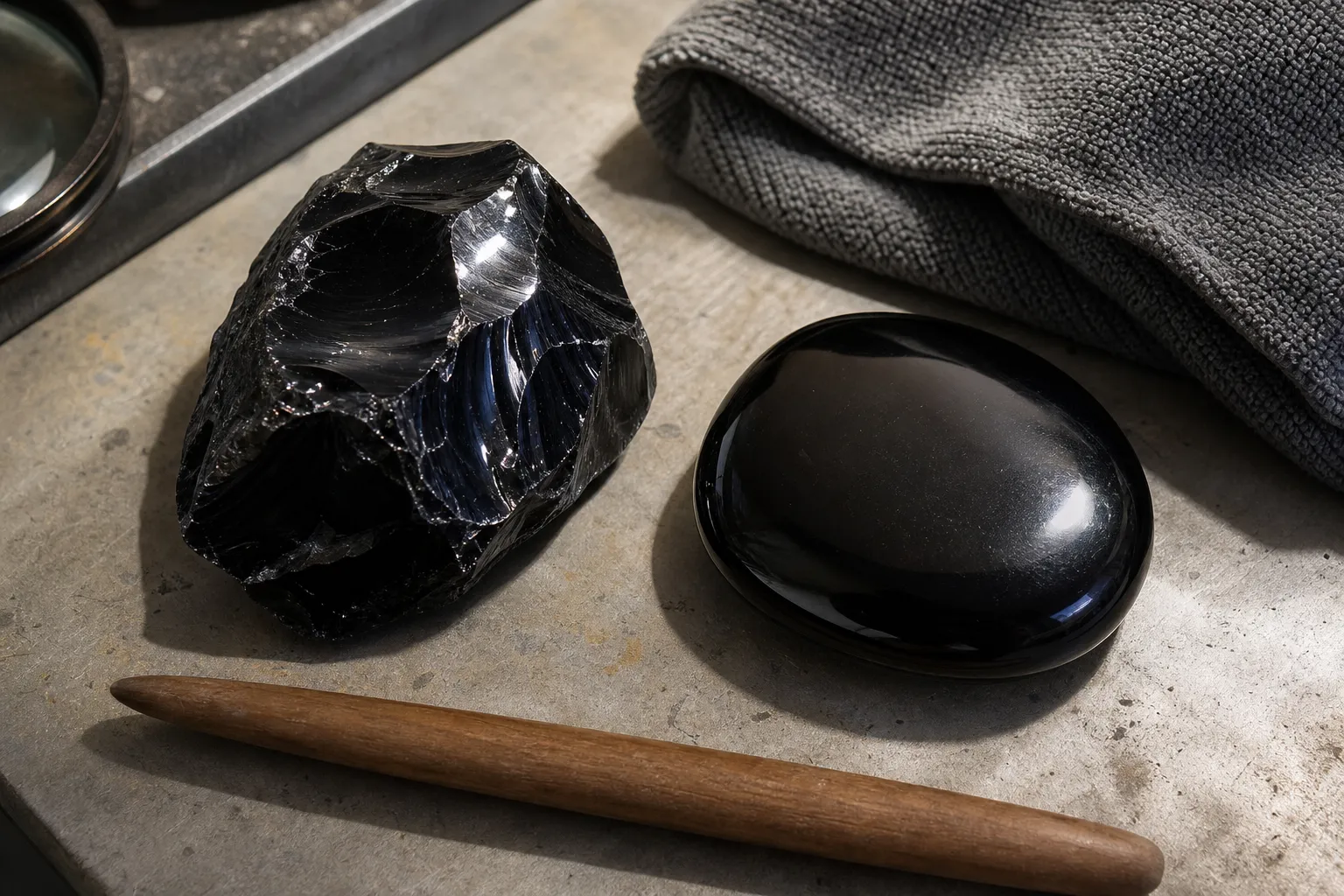
Raw black obsidian and polished black obsidian can look like different materials even when sold under the same broad name. Raw pieces may show sharper edges, irregular breaks, duller patches, chips, or uneven surfaces. Polished pieces may look smoother, darker, and more reflective because the surface has been shaped and finished.
The finish affects three collector decisions.
First, it changes visibility. A polished face can make reflections obvious, but it can also hide small surface irregularities. A raw face may show texture and fracture surfaces more clearly, but it may not show the deepest black tone unless viewed under good light.
Second, it changes handling. Sharp or chipped edges deserve more care than rounded beads, spheres, palm stones, or tumbled pieces. A display specimen with jagged areas should be handled by stable sections and stored so it does not knock against softer or more delicate pieces.
Third, it changes naming confidence. A polished black cabochon may be marketed as mirror black obsidian because its surface is reflective. A raw piece of similar color may be called soft black, rough black, or simply dark obsidian. Those names may describe finish and appearance more than a separate variety.
For ordinary display pieces, keep cleaning gentle. A soft dry cloth or lightly damp cloth is usually the conservative choice. Avoid aggressive scrubbing, harsh household products, or storage that lets sharp edges strike other stones.
Dark Obsidian Names and Seller Label Uncertainty
“Dark obsidian” is one of the broadest labels a buyer may see. It can mean a piece that appears black, dark gray, smoky, or simply underlit in a product photo. It can also be used when the seller does not want to assign a more specific variety name.
That makes the dark obsidian seller label useful but incomplete. It tells you the piece is being presented as dark, not which feature should matter most.
Before relying on the label, check:
- Photo range: Does the listing show more than one angle?
- Thin edges: Are edge color and translucency visible?
- Surface finish: Is the piece raw, tumbled, carved, or polished?
- Secondary features: Are bands, spots, clouds, or sheen visible?
- Claim strength: Does the seller separate visible traits from origin, rarity, or special-result language?
A stronger listing description would read: “polished dark obsidian, black in the main body, with faint gray banding visible under direct light.” That tells you more than “rare dark obsidian” without visual explanation.
Does Black Obsidian With Gray Flow Bands Need a Different Name?
Not always. If the piece is mostly black but shows faint gray flow-like bands, “black obsidian with gray flow bands” may be the clearest description. If the banding becomes the dominant visual feature, a more pattern-focused label may be reasonable, but this page does not have source support to define a formal cutoff.
Use the strength of the feature as the guide:
- Faint bands: Keep black obsidian as the main name and mention the bands.
- Moderate bands: Use a combined description, such as black and gray banded obsidian.
- Dominant bands: Let the pattern lead the description, but avoid inventing a formal variety name.
The branch-level question is not only “What is it called?” It is “Which visible feature deserves to lead the name?”
Apache Tears, Nodules, and Form-Based Names
Apache Tears are often discussed in the same shopping and collecting space as black obsidian. In practical collector language, the phrase is commonly associated with small, rounded, dark obsidian pieces or nodules. Because the available material does not provide a validated formal definition for this page, the term should be handled with care.
The key distinction is that “Apache Tears black obsidian” may be doing different naming work from “plain black obsidian.” It may point to shape, size, rounded form, or market tradition rather than a separate material category confirmed by the label alone.
When looking at a piece sold under that name, focus on observable traits:
- Is it a small rounded nodule rather than a cut slab or polished palm stone?
- Does it appear black in the main body?
- Are thin edges or chips lighter when held to strong light?
- Is the surface naturally rounded, tumbled, polished, or broken?
- Does the seller explain the term, or only use it as a familiar name?
Do not treat the phrase as proof of origin, age, rarity, or special effect. It can be a useful collecting term, but a listing name is not a complete identification record.
Mirror Black, Soft Black, and the Color Range in Hand Samples
The black obsidian color range is easier to read when you separate body color from surface behavior.
A mirror black obsidian piece usually looks highly reflective. The eye reads it as deep black partly because the polished surface reflects light sharply. A soft black obsidian piece may look more subdued, with gentler reflection or a slightly matte surface. That difference can come from finish, wear, lighting, or shaping.
A simple inspection route helps:
- Place the piece in indirect daylight.
- Look at the main body color before the brightest reflection.
- Tilt it slowly to check for gray bands, clouds, or edge translucency.
- Check thin edges separately from thick areas.
- Note whether the shine is even or only present on polished faces.
- Write a description before choosing a variety name.
This process keeps a dramatic photo from doing too much work. A glossy black bead, a rough shard, and a matte tumbled stone may all fit black or dark obsidian language, but they do not communicate the same collecting details.
Is Plain Black Obsidian Less Rare Than Other Obsidian Varieties?
Many collectors assume plain black obsidian is less rare because it looks simpler than patterned or sheen-bearing pieces. The available material for this page does not support a firm rarity claim. Rarity can depend on location, quality, size, condition, market supply, and how the seller defines the variety.
It is safer to say that plain black obsidian may be presented as a more basic category in many collecting contexts, while visually dramatic pieces may attract more attention. That does not prove scarcity, value, or desirability.
For collecting decisions, “rare” should not be the first filter. Look instead at:
- clarity of label
- visible condition
- stable shape for display or handling
- whether the polish suits your purpose
- whether bands, sheen, or inclusions are honestly described
- whether the price depends on unsupported claims
Plain black obsidian collecting can be rewarding because subtle differences matter: edge tone, polish depth, surface condition, and faint banding. A quiet piece can still be a useful reference sample if it is clearly described.
What to Look For When Collecting Plain Black Obsidian
A branch page cannot identify a specimen from a label or photo alone, but it can give you a better decision frame. For black obsidian varieties and dark obsidian names, choose the label that matches the strongest visible feature, then keep notes on what remains uncertain.
Use this checklist when comparing pieces:
- Main color: Is the body black, gray-black, smoky, or uneven?
- Edge translucency: Do thin areas stay dark or show lighter tones?
- Finish: Is it raw, tumbled, carved, polished, or partly matte?
- Reflection: Does it look mirror black because of polish, or dark even without strong reflection?
- Pattern: Are gray flow bands, clouds, spots, or other features visible?
- Form: Is it a shard, nodule, bead, cabochon, sphere, palm stone, or display piece?
- Condition: Are there chips, sharp edges, scratches, or unstable fractures?
- Label quality: Does the seller describe visible traits, or rely on broad terms?
- Extra claims: Are origin, rarity, or special-result claims being made without enough detail?
If two names seem possible, the more transparent description is usually better. “Polished plain black obsidian with faint gray edge translucency” tells a future collector more than a dramatic but vague variety name.
Symbolic meanings may appear around black obsidian in shops, books, or personal collections. Treat that language as cultural or personal interpretation, not as a substitute for visual identification, careful handling, or ordinary judgment about condition.
A Practical Way to Name Dark Obsidian Pieces
When a piece sits between plain black, dark gray, banded, raw, polished, and form-based labels, use a three-part naming method.
1. Start with the broad visual description.
If the piece is being considered as obsidian and appears dark and glass-like, begin with “dark obsidian” or “black obsidian” as a working label.
2. Add the strongest visible modifier.
Use words such as polished, raw, gray-banded, rounded nodule, mirror-like, matte, or translucent at thin edges. These terms explain what your eyes can check.
3. Keep uncertain names secondary.
If a seller calls it Apache Tears, rare black, or another market phrase, record that as the seller label unless you have stronger support. For example: “sold as Apache Tears; visually a small rounded dark obsidian piece.”
This method gives you a more useful collection record and prevents a common mistake: treating every attractive phrase as a separate verified variety.
Black obsidian and dark obsidian pieces are best compared slowly. Look at the main body, then the edges, then the surface, then the pattern, then the label. The name should follow the object, not the other way around.