
Collector guide
Obsidian Varieties and Colors
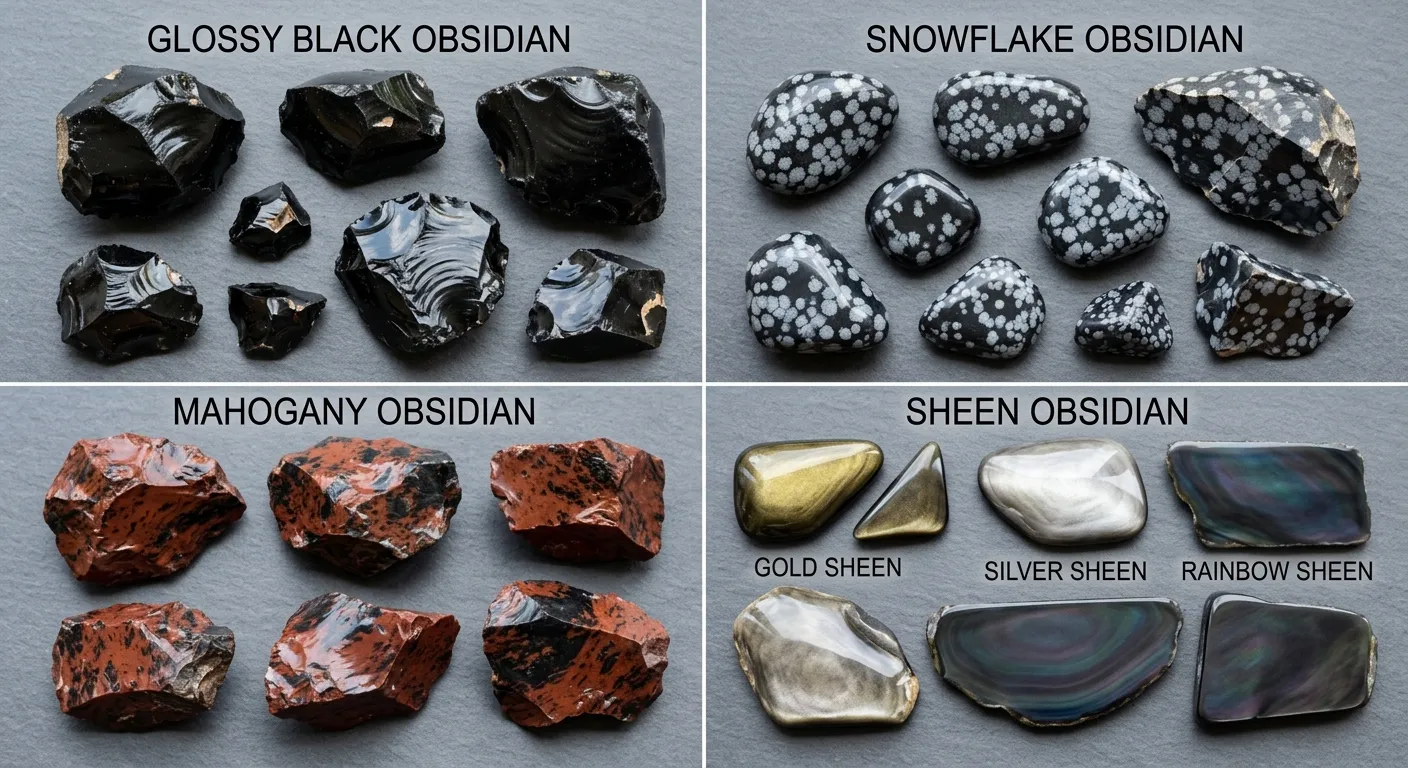
Obsidian varieties and colors are easiest to understand when you start with what the piece shows: a glassy surface, dark body color, thin-edge translucency, reflective sheen, pale internal patterning, or red-brown mottling. Most collector names begin there—black obsidian, rainbow obsidian, gold sheen obsidian, silver sheen obsidian, snowflake obsidian, mahogany obsidian—but the name is only a starting point.
Lighting, polish, thickness, camera settings, seller wording, and lookalike materials can all change what obsidian appears to be. Use this root guide as a map: it shows the main visual families, the traits worth comparing, and the points where a narrower variety guide or in-person inspection becomes more useful.
How to Read Obsidian Before You Name It
Obsidian is commonly described as volcanic glass. For a collector, that description matters because obsidian is usually read through surface gloss, fracture, edge color, translucency, and internal effects rather than through crystal faces or grainy mineral texture.
A practical first pass looks like this:
- Check the body color. Is the piece black, gray-black, smoky, brown, red-brown, greenish, or mixed?
- Tilt it under steady light. Does a reflection, rainbow band, or metallic sheen appear only at certain angles?
- Look at thin edges or chips if present. Some dark pieces show smoky, gray, or brownish translucency where the material is thin.
- Separate surface glare from internal effect. A rainbow flash, metallic sheen, and pale snowflake-like pattern are different clues.
- Ask what the label is doing. Some names describe a visible trait; others are trade wording, locality claims, or poetic seller language.
- Notice the finish. Raw, tumbled, carved, and highly polished pieces reveal different kinds of information.
This process will not confirm origin, rarity, or authenticity from one photo. It gives you a disciplined way to describe what can actually be seen.
The Main Visual Axes: Color, Sheen, Pattern, and Transparency
Most obsidian varieties and colors discussed by collectors fall along a few visual axes. A strong description often combines more than one: “black polished obsidian with a silver sheen,” “red-brown and black mottled mahogany obsidian,” or “dark obsidian with pale snowflake-like patterns.”
Body color
Look for: Black, gray, smoky, brown, red-brown, or mixed tones.
Common variety language: Black obsidian, mahogany obsidian, dark obsidian varieties.
Naming caution: Thick pieces can look darker than thin edges.
Reflective sheen
Look for: Metallic or colored reflection when tilted.
Common variety language: Gold sheen obsidian, silver sheen obsidian, rainbow obsidian.
Naming caution: Lighting angle and polish strongly affect visibility.
Patterned inclusions or internal features
Look for: Pale spots, clusters, streaks, mottling, or cloud-like areas.
Common variety language: Snowflake obsidian, patterned obsidian.
Naming caution: Pattern density alone does not prove rarity.
Transparency or translucency
Look for: Light passing through thin edges or small chips.
Common variety language: Smoky, gray, bottle-like, or dark glassy obsidian.
Naming caution: Photos can exaggerate or hide this trait.
Surface condition
Look for: Raw fracture, tumbled finish, carved polish, scratches.
Common variety language: Raw obsidian, polished obsidian.
Naming caution: Polish can clarify sheen but hide fracture clues.
Seller label
Look for: Trade name, color name, locality-style name, or symbolic name.
Common variety language: Natural obsidian colors, obsidian trade names, obsidian lookalikes.
Naming caution: A label is useful, but it is not verification by itself.
The most reliable collector notes describe the feature first and use the variety name second.
Black Obsidian and Dark Obsidian Varieties
Black obsidian is the starting point for many collections because it looks simple: dark, glassy, and often strongly polished. But “black” can hide variation. Some pieces appear deep black in normal light, while thin edges may show smoky gray, brown, or translucent hints. A polished sphere or bead can look uniform because its surface is curved and glossy; a raw chip may reveal more about fracture and edge color.
When evaluating black obsidian varieties, compare:
- Gloss: mirror-like, satin, scratched, weathered, or freshly broken
- Edge color: black, smoky, gray, brownish, or translucent at thin points
- Fracture texture: glassy and curved rather than grainy
- Uniformity: evenly dark, subtly banded, cloudy, or patchy
- Form: raw, tumbled, carved, bead-grade, cabochon, or display material
- Context: seller label, photos, source note, and any uncertainty
Dark obsidian varieties can overlap visually with other dark stones, manufactured glass, slag-like material, coated pieces, or dyed products. A collector can describe visible traits with confidence, but stronger conclusions need more than a dramatic label or a polished surface.
A dark piece deserves closer checking when the surface looks unusually uniform, the seller name combines several desirable terms, the color changes drastically between photos, or a chip does not match the polished exterior. None of those signs proves a problem; they simply mean the label should be treated as a prompt, not the final answer.
Rainbow, Gold Sheen, and Silver Sheen Obsidian
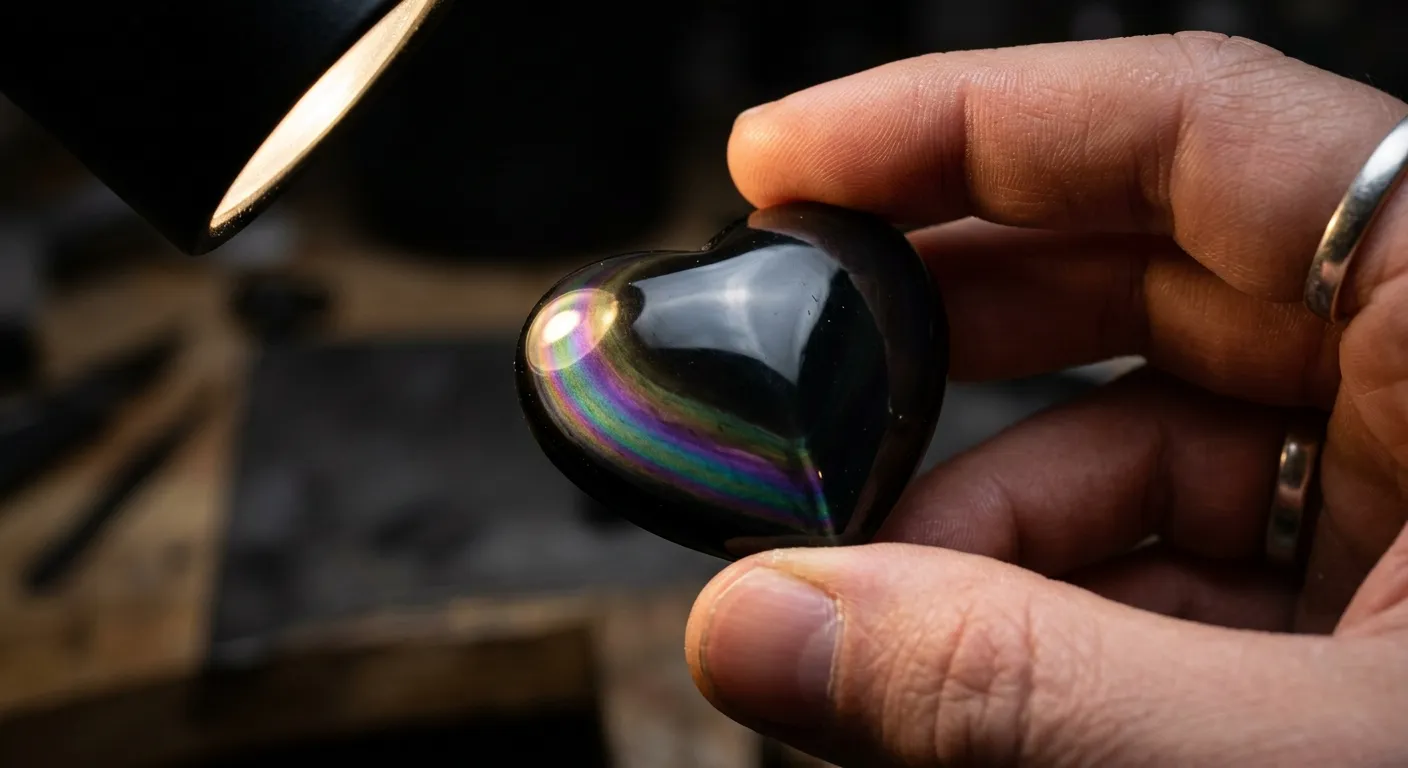
Rainbow obsidian, gold sheen obsidian, and silver sheen obsidian depend heavily on reflected light. They are not read like flat body colors. A piece may look nearly black from one angle, then show bands, arcs, or metallic reflection when tilted.
For this family, movement is part of identification.
Rainbow obsidian
Main visible cue: Colored bands or arcs, often seen only at certain angles.
Inspect it: Tilt slowly under one light source and watch for layered color changes.
Common confusion: It can look like plain black obsidian when viewed straight on.
Gold sheen obsidian
Main visible cue: Warm metallic reflection, often golden or bronze-like.
Inspect it: Rotate the polished face and look for a broad directional glow.
Common confusion: It can be confused with glare or over-bright photography.
Silver sheen obsidian
Main visible cue: Cool metallic reflection, often silvery or gray-white.
Inspect it: Use side lighting and compare the reflection against the dark body.
Common confusion: It can be confused with scratches, haze, or surface shine.
Subtle sheen pieces
Main visible cue: Faint reflection rather than strong color.
Inspect it: Compare under a few light angles before naming.
Common confusion: They may be over-labeled in seller descriptions.
Rainbow obsidian identification usually starts with a simple question: does the color appear and disappear as the piece moves? Look for directional color, layered arcs, and a dark glassy base that may appear plain without the right angle. A still photo can either catch one spectacular flash or miss the effect entirely.
Gold and silver sheen pieces need the same angle control. Use one steady light, move the stone rather than only the camera, and check whether the reflection seems tied to the material rather than just the surface. “Dark obsidian with a warm gold sheen under side light” is often more useful than repeating a trade name without description.
Snowflake Obsidian and Other Patterned Pieces
Snowflake obsidian is beginner-friendly because the contrast is usually obvious: a dark ground with pale spots, clusters, or soft gray-white markings. The name “snowflake” describes appearance, not identical shape. Some pieces show tiny scattered dots; others have large pale clusters, cloudy zones, or dense patterning.
Useful pattern notes include:
- Spot size: tiny specks, medium spots, or large patches
- Density: sparse, balanced, or heavily patterned
- Shape: round, star-like, flower-like, irregular, clustered, or cloudy
- Contrast: bright white-gray markings or softer gray markings
- Placement: evenly scattered, concentrated, streaked, or zoned
- Finish: raw, tumbled, cabochon, bead, carving, or polished slab
A piece with more pale patterning is not automatically more important, more collectible, or more natural. Visual appeal often depends on cutting orientation, contrast, finish, and personal preference.
Collectors sometimes use broader phrases such as “patterned inclusions in obsidian” when a piece does not fit neatly into a standard variety name. That can be more accurate than forcing every pale mark into “snowflake.” Better wording might be:
- “dark obsidian with pale scattered spots”
- “black glassy base with gray-white clusters”
- “polished piece with dense snowflake-like patterning”
- “mottled dark and pale piece, seller labeled as snowflake obsidian”
Those descriptions keep the record tied to visible evidence while leaving room for later confirmation.
Mahogany Obsidian and Red-Brown Color Varieties
Mahogany obsidian is usually recognized by black or dark glassy areas mixed with red-brown, brownish, or rust-colored zones. The name points to the warm brown-red appearance, not to wood. The pattern may appear as patches, streaks, swirls, bands, or mottling.
The main question is whether the red-brown color appears to be part of the material’s internal pattern or whether it looks like surface stain, coating, or lighting.
Compare:
- Color relationship: black mixed with red-brown, or mostly brown overall
- Pattern shape: patchy, streaky, cloudy, banded, or mottled
- Continuity: whether the color continues across curves, edges, and chips
- Polish effect: glossy black zones may contrast with softer brown areas
- Edge view: thin or chipped areas may show the same color relationship
- Seller wording: plain “mahogany” versus added trade names
Mahogany obsidian differs from plain black obsidian mainly by stable red-brown body color. If a piece only shows warmth as a reflection under light, it may belong closer to the sheen family. If it shows consistent brown-red mottling from multiple angles, mahogany is the more natural comparison.
Natural Obsidian Colors, Trade Names, and Lookalikes
Natural obsidian colors are often described in collector settings as black, smoky, gray, brown, red-brown, and sometimes greenish or other muted shades. Some names describe optical effects or patterns rather than body color. At the same time, the marketplace includes trade names, poetic labels, altered glass, and lookalike materials.
A practical sorting method is to place each name into one of three buckets:
Visible variety description
What it means: The name points to a feature you can inspect.
Examples of wording: black, snowflake, mahogany, gold sheen, silver sheen, rainbow.
How to handle it: Compare the feature under neutral light.
Seller or trade label
What it means: The name may group appearance, finish, source language, or symbolic appeal.
Examples of wording: unusual color names, poetic names, locality-style wording.
How to handle it: Ask what visible trait supports the name.
Possible lookalike or altered material
What it means: The object resembles obsidian but needs more checking.
Examples of wording: colored glass, slag-like glass, coated pieces, other dark stones.
How to handle it: Do not identify from a label alone.
This framework is conservative by design. It does not mean every trade name is wrong. It means the name should connect back to visible traits and, when the claim matters, better documentation.
A useful question is: If the label were removed, what could I still describe?
If the answer is “black glassy material with pale spots,” you have a useful observation. If the answer is only “the listing called it rare,” the description needs more work.
Question a piece more carefully when the color is extremely bright or uniform, the surface shows decorative glass-like features, the name combines several desirable variety terms, or broken areas do not match the polished exterior. These are reasons to slow down, not final judgments.
Finish, Shape, and Lighting Change What You See
The same material can look very different as a raw chip, tumbled stone, cabochon, bead, sphere, carving, or blade-like fragment. Obsidian’s glassy character makes finish especially important.
A raw broken surface may show curved fracture, sharp edges, and edge translucency. It may also look dull if weathered or dusty. A polished surface can bring out dark gloss, sheen, and pattern contrast, but it can hide some clues that would be visible on a broken edge.
For comparison:
- Raw obsidian may show breakage and edge behavior more clearly.
- Tumbled obsidian is easier to handle but may soften surface details.
- Cabochons and beads usually emphasize color, sheen, or pattern.
- Carvings and spheres can show dramatic reflection, but curved surfaces create more glare.
- Thin pieces may reveal translucency that thick pieces hide.
Lighting affects nearly every obsidian category. Strong direct light can make black obsidian look more reflective; side light can reveal sheen; studio lighting can exaggerate color; low light can flatten patterns; phone cameras can shift contrast and color temperature.
A better viewing routine is simple: inspect in ordinary daylight or neutral indoor light, then tilt under one directional light. If a variety name depends on sheen or rainbow color, note that the effect appears at certain angles rather than treating it as a flat body color.
Care and Handling Basics for Collectors
Obsidian can take a beautiful polish and show strong contrast, but raw or broken pieces may have sharp edges. Basic collection care is enough for most pieces: avoid unnecessary impact, separate items that can chip one another, and handle thin edges with attention.
Good everyday habits include:
- Handle raw broken pieces slowly, especially along thin edges.
- Store polished pieces in soft pouches, divided trays, or padded boxes.
- Keep highly polished items from knocking against rougher or harder objects.
- Avoid dropping spheres, towers, carvings, beads, or cabochons onto hard surfaces.
- Dust gently with a soft cloth instead of abrasive scrubbing.
- Keep labels or notes with pieces when seller names, source claims, or variety details matter.
For a typical polished collector piece, a gentle wipe is often enough. If more cleaning is needed, use mild water contact, a soft cloth, and complete drying. Avoid harsh abrasives, aggressive scrubbing, and chemical treatments unless you have material-specific guidance.
Use extra care with fragile carvings, thin edges, attached metal settings, coated or uncertain materials, mixed-material jewelry, cracks, and old repairs. If a color wipes off, a coating flakes, or a surface changes unexpectedly, record that observation with the piece.
Symbolic Meanings Without Overstating Them
Many readers meet obsidian through symbolic or personal meaning language. Black obsidian may be discussed in crystal-interest communities as a stone of reflection, grounding, seriousness, or personal boundaries. Snowflake, rainbow, and sheen varieties may be associated with contrast, hidden color, or inner layers.
Those are cultural or personal interpretations, not guaranteed outcomes. They can be included as context, but they should not replace material description.
A balanced collection note might follow this order:
- Name the object: “polished black obsidian palm stone”
- Describe the visible feature: “dark glassy body with slight edge translucency”
- Record the seller label: “sold as black obsidian”
- Add meaning as context only: “often used symbolically for reflection in crystal-interest communities”
- Avoid outcome language: do not turn an association into a promised result
This keeps the record useful whether the reader approaches obsidian as a collectible volcanic glass, a lapidary material, a decorative stone, or a symbolic object.
Common Naming Mistakes and Better Descriptions
Most mistakes with obsidian varieties come from naming too quickly. A label may be correct, but the description should preserve what was seen and what remains uncertain.
“This is rainbow obsidian.”
What may be missing: Lighting angle, band visibility, polish condition.
Better collector wording: “Dark polished obsidian with rainbow-like bands visible when tilted.”
“This is rare gold obsidian.”
What may be missing: Whether the effect is body color, sheen, or lighting.
Better collector wording: “Dark obsidian with a warm gold sheen under side light.”
“This is snowflake obsidian.”
What may be missing: Pattern size, density, and contrast.
Better collector wording: “Black glassy piece with scattered pale snowflake-like spots.”
“This is mahogany.”
What may be missing: Whether red-brown color is internal, surface stain, or lighting.
Better collector wording: “Black and red-brown mottled obsidian-like piece, seller labeled mahogany.”
“This is natural because it is black.”
What may be missing: Lookalikes and altered materials not considered.
Better collector wording: “Black glassy material consistent in appearance with black obsidian, needs more context.”
“The photo proves the variety.”
What may be missing: Photos can distort color and sheen.
Better collector wording: “The photo suggests a sheen or pattern, but in-person angle checks would help.”
Cautious wording is not weaker. It is easier for another person to follow, compare, and question.
Choose the Next Guide by What You See
Mostly black or very dark
Start with black obsidian and dark obsidian varieties. Compare darkness, translucency, polish, fracture appearance, and possible confusion with other dark materials.
Color appears only when tilted
Move into rainbow obsidian identification, gold sheen obsidian, and silver sheen obsidian. These varieties depend strongly on light angle and polish.
Dark base with pale spots or clusters
Use the snowflake obsidian path. Focus on pattern size, density, contrast, finish, and whether the markings are best described as snowflake-like or more generally patterned.
Black mixed with red-brown areas
Compare mahogany obsidian colors and red brown obsidian varieties. Look for stable body color rather than a reflection that appears only under light.
Unusual name, unexpected color, or uncertain material
Use the broader trade-name and lookalike path. Separate visible natural obsidian colors from seller labels, altered glass, and materials that only resemble obsidian.
A Simple Field Note Template
A repeatable note format makes a collection more useful over time. Instead of recording only the seller name, write down the visible facts in the same order each time.
- Seller or given name: black obsidian, snowflake obsidian, mahogany obsidian, rainbow obsidian, or another label
- Body color: black, gray-black, smoky, red-brown, mixed, or other visible color
- Surface finish: raw, tumbled, polished, carved, bead, cabochon, sphere, or unknown
- Sheen or reflection: none seen, silver, gold, rainbow, subtle, strong, angle-dependent
- Pattern: uniform, snowflake-like spots, mottled, streaked, banded, cloudy, or mixed
- Edge observation: opaque, translucent at thin edge, chipped, sharp, or not visible
- Photos taken: daylight, side light, backlit edge, close-up pattern, seller image
- Uncertainties: label unverified, possible lookalike, needs in-person inspection, source unknown
This does not require specialized equipment. It simply keeps observation ahead of assumption.
What This Root Page Can and Cannot Decide
This page can help you recognize the main visual families of obsidian, compare black obsidian with sheen and patterned varieties, understand why snowflake and mahogany pieces are described the way they are, and treat seller labels with appropriate caution.
It cannot confirm every variety name, prove a source locality, determine rarity, identify all lookalikes, or verify a piece from one photograph. Stronger conclusions may require better documentation, in-person inspection, or specialist testing depending on the claim.
For most collectors, the first useful step is not a dramatic verdict. It is a clear description: color, gloss, translucency, sheen, pattern, finish, and label. Once those traits are recorded well, the variety name becomes easier to use—and easier to question when it is doing more work than the visible evidence supports.