Volcanic glass basics
What Obsidian Is: Volcanic Glass, Properties, and Basic Traits
Obsidian is naturally occurring volcanic glass. If you are asking what obsidian is while looking at a black polished stone, a raw chip, or a crystal-shop listing, the practical answer is this: obsidian forms when lava cools so quickly that it becomes glassy instead of developing visible mineral crystals.
For collectors, the important traits are easy to start with: obsidian is usually dark, glossy, brittle, and capable of breaking with smooth curved surfaces and very sharp edges. In geology, it is better described as volcanic glass, a glassy igneous rock, or sometimes a mineraloid. In shop language, you may still see “obsidian crystal” or “obsidian stone.” Those phrases are common, but they need translation rather than automatic acceptance.
This root guide gives the map: what obsidian is made of, how it forms, what you can observe, where look-alikes confuse people, and how to treat variety names, care advice, and symbolic meanings without overclaiming.
The practical definition: natural volcanic glass
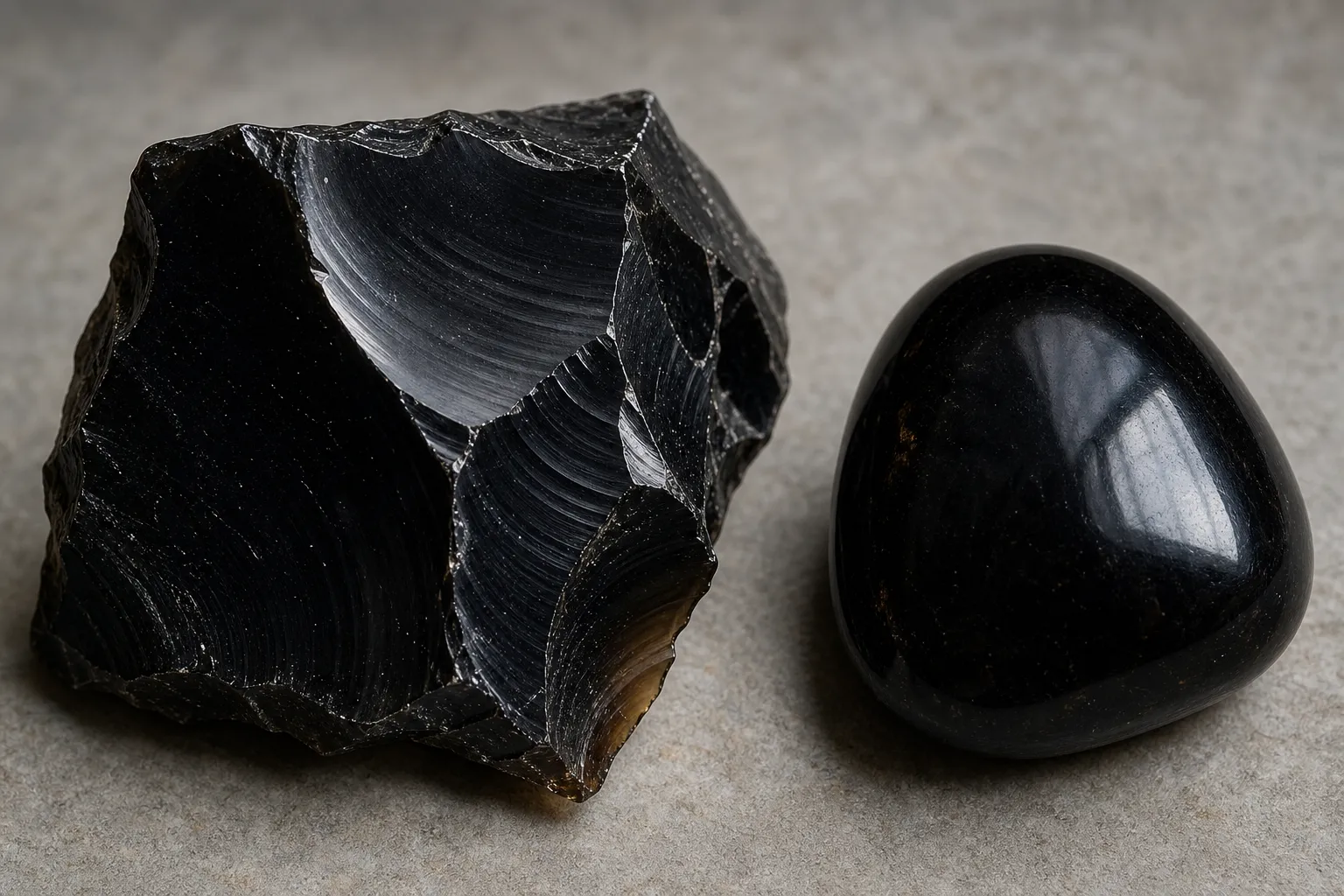
Obsidian is a natural glass created by volcanic activity. The word glass matters because obsidian lacks the regular internal crystal structure that defines a true mineral crystal. The word natural matters because obsidian is not ordinary bottle glass, window glass, decorative slag, or molded black glass, even though those materials can look similar at first glance.
A useful beginner definition is:
Obsidian is a glassy igneous material formed from rapidly cooled lava, commonly dark in color, with a smooth glass-like luster and a tendency to break into curved, sharp-edged fragments.
That definition covers the essentials without turning the answer into a petrology lecture.
Obsidian volcanic glass
The most precise beginner-friendly description.
Obsidian natural glass
Useful when distinguishing it from manufactured glass.
Obsidian rock
Reasonable broad wording; obsidian is a glassy igneous rock.
Obsidian stone
Everyday collector language for a specimen, bead, carving, or tumbled piece.
Obsidian crystal
Common retail category phrase, not strict mineralogy.
Is obsidian a crystal, mineral, rock, or glass?
Obsidian is glass first. It is also reasonable to call it a volcanic rock in a broad geological sense because it forms through igneous volcanic processes. It is not a true crystal in the strict mineralogical sense because its atoms are not arranged in a large repeating crystal structure.
Mineral references often place obsidian near the idea of a mineraloid: a natural material that resembles minerals in some contexts but does not meet every strict mineral requirement. That distinction matters when comparing collector language with geology.
A crystal shop may group obsidian with “crystals” because that aisle includes stones, minerals, carvings, and symbolic objects. That does not make obsidian a crystal structure. It means the word is being used as a retail category.
How obsidian forms from lava
Obsidian formation begins with molten rock. In the common formation model, the lava is silica-rich and relatively viscous, meaning it moves thickly rather than flowing freely. When that lava cools quickly near the surface, atoms have limited time and mobility to organize into visible mineral crystals. The result is glassy volcanic material.
A simple formation path looks like this:
- 1. Silica-rich lava erupts or is emplaced near the surface.
- 2. The lava cools quickly against air, water, or cooler rock.
- 3. Crystal growth is limited.
- 4. A glassy volcanic material forms.
- 5. Later cooling, movement, stress, or breakage can create curved fractures and sharp edges.
This explains why obsidian looks so different from a grainy igneous rock. Granite, for example, cooled slowly enough for visible crystals to grow. Obsidian cooled fast enough to preserve a glassy texture.
High silica content is part of the story because silica-rich lava is often more viscous. That thick behavior can help limit crystal development, especially when cooling is rapid. It also explains why many descriptions connect obsidian with rhyolitic or felsic volcanic settings.
Still, chemistry is not something a beginner can confirm by eye. A glossy black object might be natural obsidian, manufactured glass, slag, basalt, onyx, or another dark material. A product photo or seller name can suggest an identity, but it does not verify source or composition on its own.
Obsidian properties you can actually observe
The best beginner clues are visible and practical. None of them proves the identity alone, but together they can make a strong case.
Glassy luster
Look for shiny, vitreous surfaces, especially on fresh breaks or polished faces. This supports a glassy material, but does not separate natural obsidian from all manufactured glass.
Dark color
Look for black, smoky, brownish, gray, greenish, or banded appearance. Color is common for obsidian, but color alone is weak evidence.
Thin-edge translucency
Look for brown, gray, greenish, or smoky light transmission at a chip or edge. This is helpful when present; thick pieces may look opaque.
Conchoidal fracture
Look for smooth curved, shell-like break surfaces. This is a strong clue for glassy fracture, but it also occurs in manufactured glass.
Brittleness
Look for chips, flakes, or sharp broken margins. Brittleness explains handling concerns; sharpness does not mean toughness.
Inclusions or bands
Look for snowflake-like spots, flow bands, bubbles, sheen, or color play. These may support variety names, but lighting and polish affect appearance.
Glassy luster and smooth surfaces
Obsidian typically has a vitreous, glass-like luster. A freshly broken face may look smooth and glossy. A polished piece can look almost mirror-like, especially if it has been shaped into a palm stone, bead, cabochon, sphere, or carving.
Polish can also hide useful clues. A highly polished black stone may resemble onyx, dyed chalcedony, black glass, or other dark materials. A chipped corner, thin edge, or unpolished underside may reveal more about the texture than the main polished face.
Color: usually dark, not always plain black
Black obsidian is the best-known form, but obsidian is not limited to flat black. It may appear brown, gray, greenish, smoky, banded, or nearly opaque. Some pieces show gold, silver, rainbow, or fire-like optical effects when turned under strong light. Others look black in ordinary lighting but reveal brown translucency at a thin edge.
So if the question is “what color is obsidian,” the careful answer is: usually black or very dark, but not always one simple color.
Thin-edge translucency
A thick piece of obsidian may look opaque. A thin chip or edge may allow light through, sometimes showing smoky brown, gray, greenish, or amber tones. This is one of the more useful home observations for collectors.
Use common sense when checking this. Hold the piece near a strong light and look through a thin edge, but do not press broken edges into your fingers. Raw obsidian can behave like broken glass.
Conchoidal fracture
Obsidian often breaks with conchoidal fracture, meaning smooth curved surfaces similar to shells or broken glass. These curves may look like ripples, scoops, or arcs. Thin flakes can end in extremely sharp edges.
On a raw piece, you might see:
- smooth curved break surfaces;
- ripple-like fracture marks;
- scoop-shaped scars;
- thin flakes;
- glossy fresh breaks;
- sharp margins.
On a tumbled or carved stone, many of these signs may have been removed by polishing.
Hardness and weight are supporting details
Many summaries place obsidian around Mohs 5–6, with a specific gravity often described in the mid-2 range. Those values help describe the material, but they are not the best beginner tests.
Scratch testing can damage a specimen. Weight by hand is too subjective for confident identification. For most collectors, the better approach is to combine visible texture, fracture, translucency, polish, source context, and comparison with likely look-alikes.
Why obsidian breaks with sharp curved edges
Obsidian’s fracture behavior comes from its glassy structure. Because it does not have the same cleavage planes seen in many crystalline minerals, stress can move through it in curved patterns. The result is the shell-like break called conchoidal fracture.
This is also why broken glass can form curved, sharp edges. The comparison is useful because obsidian is natural glass. It is not the whole story, though. Composition, bubbles, internal stress, inclusions, hydration, weathering, and polish can all affect how a specific piece breaks.
Sharpness is part of obsidian’s historical importance. People in many regions used it for cutting tools, points, blades, ornaments, polished objects, and ritual or cultural items. For a modern collector, that history should stay in context. Obsidian can fracture into a fine edge, but it is brittle and not something to treat as a durable household tool.
For raw, chipped, or thin-edged pieces:
- do not run fingers along a broken edge;
- lift shards from the duller body of the piece when possible;
- wrap sharp fragments before placing them in a drawer or tray;
- keep small flakes away from children and pets;
- avoid storing sharp raw pieces loose with polished stones.
Tumbled obsidian is easier to handle, but chips can still expose sharp glassy edges. Inspect pieces after drops or hard knocks.
Obsidian compared with glass, onyx, basalt, and other black stones
Many mistakes begin with the phrase “black and shiny.” Obsidian often is black and shiny, but that description also fits several other materials. A better comparison starts with material category.
Obsidian
What it is: Natural volcanic glass. Why it gets confused: Dark color, glassy luster, curved fracture. Better way to compare: Look for combined clues, not one feature.
Manufactured glass
What it is: Human-made glass. Why it gets confused: Glossy, brittle, may show edge translucency. Better way to compare: Check for molded form, production marks, artificial color, or product context.
Onyx
What it is: Banded chalcedony, often black in jewelry contexts. Why it gets confused: Smooth polished black surface. Better way to compare: Look for chalcedony-like luster, banding, treatment context, and seller information.
Basalt
What it is: Fine-grained volcanic rock. Why it gets confused: Dark volcanic origin. Better way to compare: Usually more stony or granular, not glassy in the same way.
Black tourmaline
What it is: Crystalline mineral group. Why it gets confused: Common black stone in crystal shops. Better way to compare: Often has striated crystal form rather than glassy fracture.
Slag glass
What it is: Industrial byproduct or manufactured glassy material. Why it gets confused: Glassy, bubbly, sometimes dark. Better way to compare: Context, bubbles, color pattern, and provenance matter.
Obsidian vs manufactured glass
Obsidian is glass, but it is natural volcanic glass. Manufactured glass is made through human processes. Both can be glossy, brittle, translucent at thin edges, and conchoidally fractured.
Possible clues for obsidian include natural volcanic context, smoky thin-edge translucency, flow-like banding, and fracture surfaces consistent with natural glass. Possible clues for manufactured glass include molded shapes, uniform artificial color, production marks, decorative swirls, or a context that points to craft glass rather than geology.
None of those clues is absolute. The honest conclusion is often “this fits obsidian” or “this could be glassy material,” not “this photo proves it.”
Obsidian vs onyx
The search “obsidian vs onyx” usually comes from people comparing black polished stones. The simplest distinction is that obsidian is volcanic glass, while onyx is a form of chalcedony, a microcrystalline silica material. Both can be polished smooth and sold as beads, cabochons, or decorative objects.
Black onyx in the marketplace may be natural, treated, dyed, or simply described loosely depending on the item and seller. Obsidian can also be mislabeled or over-described by variety name. A single product photo of a black bead strand is rarely enough for a confident call unless the listing gives reliable material information.
Obsidian vs basalt
Basalt is also volcanic, but it is generally a fine-grained crystalline rock rather than natural glass. A dark volcanic rock is not automatically obsidian. Basalt often looks more stony, dull, or granular. Obsidian usually shows a glassier surface and smoother curved fracture.
Some dark volcanic rocks are still hard to judge without a fresh surface, magnification, or source information. For beginner collecting, modest language is more accurate: “these traits fit obsidian” is better than “black volcanic rock means obsidian.”
Names, varieties, and market language
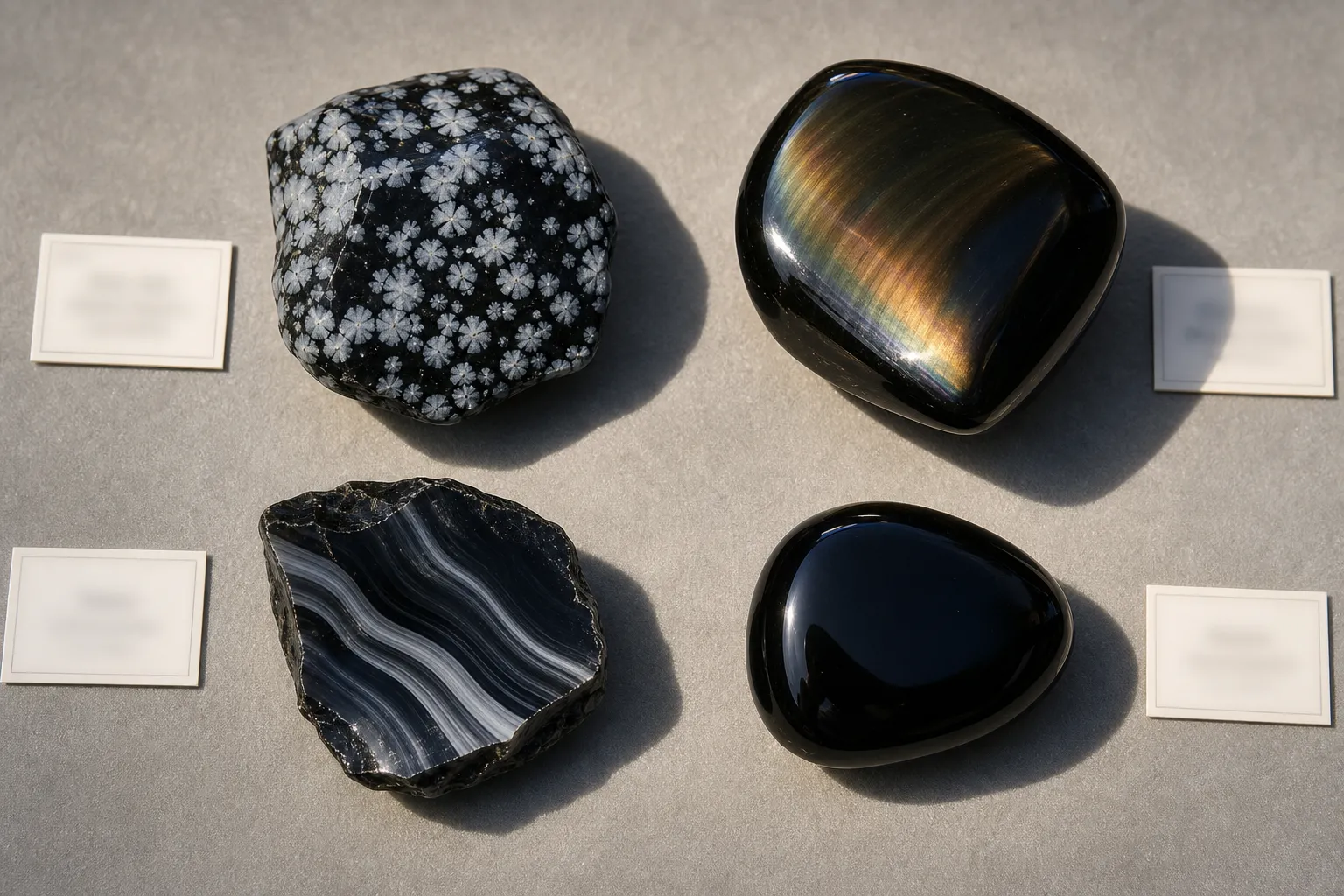
Obsidian variety names are useful, but they are not all equally strict. Some describe visible appearance. Some are collector conventions. Some are seller language. Treat the name as a clue to inspect, not as a conclusion.
Black obsidian
Usually points to dark, glossy obsidian. Read it as a broad label; still compare with other black materials.
Snowflake obsidian
Usually points to dark glass with pale snowflake-like spots, often linked to spherulitic growths in the glass.
Rainbow obsidian
Usually points to dark obsidian with colored bands or flashes. The effect depends strongly on light angle, polish, and internal structure.
Gold sheen or silver sheen obsidian
Usually points to metallic-looking reflection, often associated with bubbles, flow features, or tiny internal structures.
Fire obsidian
Usually points to bright color play in certain material. Read it as a specialized appearance label; photos may exaggerate the effect.
Apache tears
Usually points to small rounded obsidian nodules. It is a collector term, not proof of source or age.
Obsidian crystal
Retail category wording, not a true crystal in strict mineralogy.
Protective symbolism
Spiritual or personal meaning language. Read it as interpretation, not a measurable material property.
Some variety effects come from inclusions, bubbles, flow bands, or tiny internal structures that interact with light. Snowflake obsidian is commonly described as dark obsidian with pale spherulitic inclusions. Sheen, rainbow, and fire appearances can depend on how the piece is cut, polished, lit, and photographed.
That is why variety labels need humility. A “rainbow obsidian” piece may look dramatic under a seller’s light and nearly black on your desk. A polished face may show sheen from one angle while the side shows very little. A label may be accurate, approximate, exaggerated, or copied from a supplier.
When reading a listing, ask:
- What visible feature supports the name?
- Does the effect show in normal light or only at one angle?
- Are there photos from multiple angles?
- Is the item natural obsidian, treated material, manufactured glass, or uncertain?
- Is the seller naming an appearance or implying more than the material can show?
Good collecting language leaves room for uncertainty.
What obsidian is used for
People ask “what obsidian is used for” in different ways. Some mean historical use. Some mean modern collecting. Some mean symbolic meaning. Those answers should stay separate.
Historically, obsidian mattered because it could fracture into sharp edges and could also be polished into striking objects. It appears in archaeological, museum, and cultural contexts as tools, points, blades, mirrors, ornaments, and ceremonial objects. That history shows that people recognized useful material traits; it does not turn every modern statement about obsidian into a material fact.
Today, collectors usually encounter obsidian as:
- raw chunks and display specimens;
- tumbled stones;
- palm stones;
- beads and jewelry;
- cabochons;
- carvings;
- spheres, towers, and decorative forms;
- variety specimens such as snowflake, rainbow, sheen, fire obsidian, or Apache tears.
For practical collecting, the main tasks are recognition, comparison, storage, and care. Obsidian’s glossy surface can scratch or chip. Thin points and exposed edges deserve extra attention. Polished pieces should be protected from hard knocks and from rubbing against rougher materials.
Symbolic uses belong in a different category. Obsidian is often discussed in spiritual or reflective settings, especially around themes such as protection, grounding, or self-examination. On an information page, those meanings should be treated as cultural, traditional, marketplace, or personal interpretations. They are not physical properties of volcanic glass, and they should not be framed as guaranteed outcomes.
A quick note on “Obsidian” searches
The word Obsidian also refers to a note-taking app. Searches such as “Obsidian app,” “Obsidian notes,” “Obsidian MD,” or “Obsidian vault” are about software, not volcanic glass.
This page is about obsidian stone: the natural volcanic glass collected as specimens, beads, carvings, and crystal-shop items in the broad retail sense.
A beginner path for identifying obsidian without overclaiming
Visual identification works best as a series of observations. One photo, one color, or one seller phrase is not enough.
-
1. Start with the surface.
Does the piece look vitreous and glass-like, especially on a fresh break or polished face? If it looks dull, grainy, or visibly crystalline, consider other materials.
-
2. Check color and thin edges.
Most obsidian is dark, but thin edges may show smoky brown, gray, or greenish translucency. This clue helps when present, but thick pieces may appear opaque.
-
3. Look for conchoidal fracture.
Curved, shell-like fracture scars support a glassy material. Remember that manufactured glass can also break this way.
-
4. Notice bands, bubbles, inclusions, and sheen.
These features may support variety names, but they can be hard to judge from photos. Light angle and polish matter.
-
5. Compare likely look-alikes.
Polished black beads may invite an obsidian vs onyx comparison. Rough dark volcanic-looking rocks may raise basalt questions. Bright artificial colors or molded shapes may point toward manufactured glass.
-
6. Keep the conclusion modest.
A strong beginner conclusion sounds like “the glassy luster and curved fracture fit obsidian” or “this could be obsidian, but the photo is not enough to rule out glass.” A weak conclusion sounds like “it is definitely obsidian because it is black.”
That modest approach is not less useful. It is usually more accurate.
Care and storage basics
Obsidian care follows from its material identity: glassy, brittle, polishable, and capable of sharp chips. It is not difficult to keep, but it does not like careless impact.
For polished obsidian
- wipe with a soft cloth;
- avoid banging pieces against harder stones or metal edges;
- store polished items so they do not rub against rough quartz points;
- inspect chips before handling;
- be gentler with thin carvings, points, or exposed settings.
For raw or broken obsidian
- treat sharp fragments like broken glass;
- wrap shards before storing them;
- keep flakes out of loose mixed trays;
- use a tool rather than bare hands when collecting tiny broken pieces;
- check the surrounding area if a specimen breaks.
Brief cleaning with minimal water is often enough for simple polished pieces, followed by drying. Be more cautious with jewelry, glued settings, dyed material, mixed-stone objects, or delicate carvings. In those cases, the care question is about the whole object, not just the obsidian.
Reader routes: where to go deeper from here
A root page gives the framework. The narrower guides take one question at a time instead of turning this page into a long list of subtopics.
Obsidian topic map
Use these entry points when your question moves from “what is it?” to a more specific identification, formation, or comparison problem.
Crystal, rock, mineral, or glass?
Use this route when you want the naming distinction: strict geology versus crystal-shop language, and why obsidian is best described as natural volcanic glass.
How obsidian forms from lava
Use this route for rapid cooling, silica-rich lava, viscosity, and why limited crystal growth creates a glassy texture.
Observable properties
Use this route for glassy luster, color depth, thin-edge translucency, fracture, polish, and surface clues.
Sharp curved edges
Use this route for conchoidal fracture, brittle behavior, and practical handling of raw chips or broken pieces.
Obsidian compared with look-alikes
Use this route for obsidian vs glass, obsidian vs onyx, basalt, black tourmaline, slag glass, and other dark materials.
Quick answers to common beginner questions
Is obsidian a mineral?
Not in the strictest sense. Obsidian is usually described as volcanic glass or a glassy igneous rock. Because it is amorphous rather than crystalline, it is often treated as a mineraloid.
Is obsidian a rock?
Yes, it is reasonable to call obsidian a glassy volcanic rock. The more precise beginner phrase is natural volcanic glass.
Is obsidian man-made glass?
No. Obsidian forms naturally through volcanic processes. It can resemble manufactured glass because both are glassy and brittle, but their origins are different.
Can you identify obsidian from a photo?
A photo can show clues such as glassy luster, curved fracture, edge translucency, or variety features. It usually cannot confirm identity by itself. Lighting, polish, seller labels, and look-alike materials all matter.
Why is obsidian black if it often comes from silica-rich lava?
Dark color can come from minor components, inclusions, oxidation states, thickness, and how light passes through the glass. A dark appearance does not automatically mean the material is basaltic.
What is obsidian good for in a collection?
It is useful for learning volcanic glass texture, conchoidal fracture, dark-stone comparisons, variety naming, polish differences, and careful handling. Symbolic meaning, when present, belongs to personal or cultural interpretation.
The core takeaway
Obsidian is natural volcanic glass: a glassy igneous material formed when lava cools quickly enough to limit crystal growth. For collectors, the most useful traits are visible and practical—glassy luster, dark color with possible thin-edge translucency, smooth curved fracture, brittleness, sharp broken edges, and variety effects shaped by inclusions, bubbles, bands, polish, and light.
The wording matters. Obsidian may be sold as a crystal, but it is not a true crystal in strict mineralogy. It may be black and shiny, but not every black shiny stone is obsidian. It may carry symbolic meanings in shops and traditions, but those meanings are interpretations, not material properties.
Start with what you can see. Then keep the conclusion modest. That habit will help you understand obsidian more accurately than any single label on a product listing.