
Care framework
Obsidian Care and Safe Handling
Obsidian care and safe handling starts with the piece in front of you, not with a universal crystal routine. A polished palm stone, a bead bracelet, a carved figure, and a raw shard can all be sold as obsidian, but they do not have the same surface, edges, weak points, or storage needs.
A cautious routine is simple: inspect the finish, avoid rough contact, clean only as much as needed, keep sharp or chipped edges away from skin and soft materials, and store pieces so they do not knock against harder objects. Because this page has no vetted public reference links attached to it, the guidance stays practical and observation-based rather than making firm material or safety guarantees.
Core rule
Care for the actual object in your hand: its finish, edge condition, setting, contact points, and storage risk matter more than the variety name on the label.
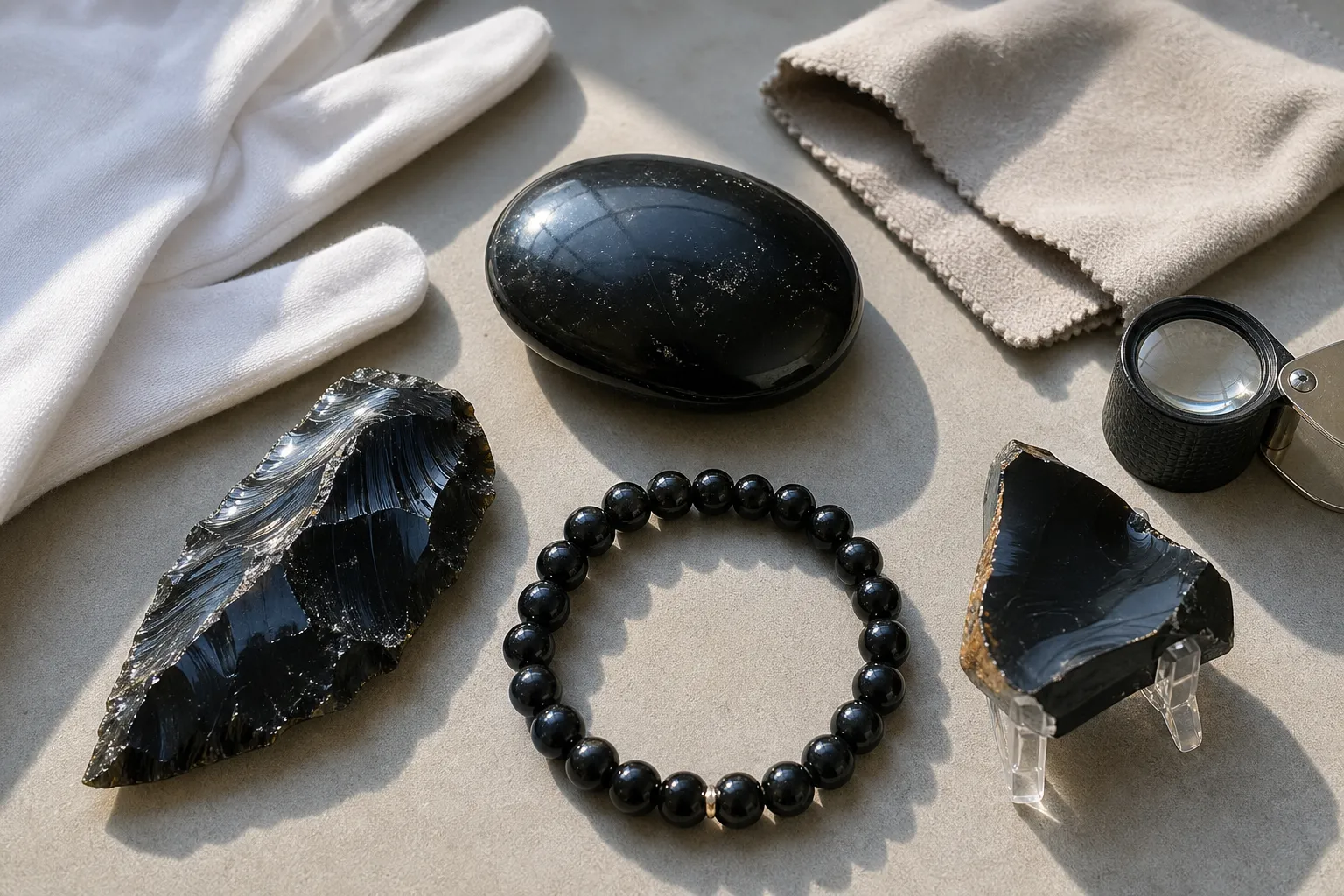
Start With the Piece, Not the Label
Collectors often ask about obsidian care as if the variety name decides everything. In practice, the better first step is to sort the object by visible condition.
A glossy tumbled stone may only need light dusting. A pendant may need attention to the cord, clasp, or setting as much as the stone. A raw piece may have thin edges, points, or small flakes that affect how it should be picked up. A chipped display stone may look stable on a shelf but still have a corner that can catch fabric or skin.
Smooth polish
Fine marks and fingerprints may show clearly. Use a clean soft cloth and separate storage.
Raw edge or point
The outline may be sharp, fragile, or uneven. Handle from broader areas and avoid gripping edges.
Fresh chip
A new contact point may be sharper than the old surface. Isolate the piece until you inspect it.
Jewelry setting
Cord, metal, glue, or elastic may be the weak part. Clean the whole item gently, not just the stone.
Dust, oil, or residue
Cleaning may not need water or products. Start dry and escalate slowly.
Display exposure
Rolling, falling, heat, glare, and contact matter over time. Use stable supports and low-contact placement.
The aim is not to make obsidian seem difficult. It is to avoid two common extremes: treating every piece like fragile museum material, or treating every piece like an ordinary pebble.
Why Obsidian Needs Attentive Care
Obsidian is commonly handled by collectors as a glassy volcanic material. That care lens matters because polish, chips, edges, and impact marks often affect both appearance and handling comfort. This page does not turn that broad description into technical certainty; it uses what an owner can observe directly.
Glossy Surfaces Show Small Changes
Polished obsidian often depends on reflection for its visual appeal. Dust, fingerprints, lint, dried residue, and fine scuffs can stand out on dark glossy pieces more than they would on a rougher specimen.
- Look at the surface under normal room light.
- Remove loose dust before rubbing.
- Use a clean, soft cloth rather than a gritty towel.
- Avoid scraping residue with blades or hard tools.
- Stop if the surface looks cloudy, abraded, or unstable.
Not every polished piece is delicate in the same way, but polish makes surface condition part of the object’s value and appearance.
Edges Matter More Than Variety Names
Seller names such as black obsidian, rainbow obsidian, snowflake obsidian, or mahogany obsidian may describe a color pattern or market category. They do not tell you whether the object has a sharp edge, a weak point, or a loose setting.
A raw specimen with a dull-looking area can still have a thin corner. A polished piece can become more difficult to handle if chipped. A bracelet bead may be smooth while the metal spacer beside it scratches nearby stones.
Look before you decide how to hold, clean, wrap, or display the item.
Breakage Is a Handling Question
This guide does not promise how easily obsidian will or will not break. A more useful collector question is: where could pressure, impact, or uncontrolled movement cause trouble?
Thin projections, narrow bases, existing chips, exposed points, and loose jewelry parts all deserve more care. A heavy sphere rolling off a shelf, a pendant striking tile, or a raw point dropped into a drawer can create damage regardless of variety name.
A Simple Obsidian Care Framework
Use this framework when you are unsure how to clean, store, or handle a piece.
1. Identify the finish
Polished, carved, tumbled, raw, matte, coated, repaired, or set in jewelry.
Match care to the actual surface, not the label.
2. Check edges and contact points
Thin margins, points, chips, cracks, drilled holes, prongs, wire, or wobbly bases.
Inspect with your eyes first; avoid sliding fingers along uncertain edges.
3. Clean with the least intervention
Dust, fingerprints, oil, residue, or grit.
Start dry, wipe lightly, and use minimal moisture only when needed.
4. Store by contact risk
Weight, polish, sharpness, metal parts, and movement.
Use compartments, trays, pouches, stands, or boxes that prevent rubbing and impact.
5. Reinspect after impact
Drops, knocks, shipping damage, loose beads, or tiny flakes.
Pause normal use until the piece and any setting are checked.
If you cannot tell whether something is a coating, residue, repair, or natural-looking texture, do not scrub it aggressively. Uncertainty is a reason to slow down.
Cleaning Obsidian Without Overdoing It
A good cleaning routine begins with restraint. If the surface is not dirty, you may not need water, soap, salt, soaking, brushes, or special products. For many collector pieces, the question is less “What can I use?” and more “What is the least I can do while still removing the problem?”
This is a root-level cleaning overview, not a detailed treatment protocol.
Start Dry
Dry cleaning is the better first move when the issue is dust, lint, or fingerprints.
Use a clean, soft cloth and light pressure. If dust or grit is visible, lift it away rather than grinding it across a polished face. A cloth that feels soft can still carry particles from earlier use, so avoid towels used for household cleaners, metal polish, outdoor dirt, or gritty surfaces.
Use Moisture Sparingly
If a dry wipe does not remove a smudge, a slightly damp cloth may be a reasonable next step for some finished pieces. The key word is “slightly.” You are not trying to soak the object, flood drilled holes, wet cords, or leave liquid in recesses.
After any damp wipe, dry the piece promptly with a clean cloth and let it sit where moisture is not trapped against fabric, cardboard, or metal.
Be More Cautious With
- Strung beads
- Pendants on cord
- Pieces with glue, labels, foil, paint, or unknown coatings
- Carvings with tight recesses
- Raw specimens with cracks or cavities
- Objects with unstable or chipped edges
Avoid Abrasive Shortcuts
Abrasive pads, gritty powders, hard brushes, scraping tools, and rough towels can change the surface before you realize it, especially on glossy areas. If residue will not come off with light care, set the piece aside and look for more specific guidance rather than escalating quickly.
For collector objects, cleaner is not always better. A slightly imperfect surface is often preferable to a permanently scuffed one.
Know When to Stop
Stop cleaning if the surface begins to look hazy, a chip seems to widen, a setting looks unstable, or the residue may be glue, coating, paint, or repair material. Also slow down if the piece has sentimental or collection value, or if you are unsure whether the material is actually obsidian.
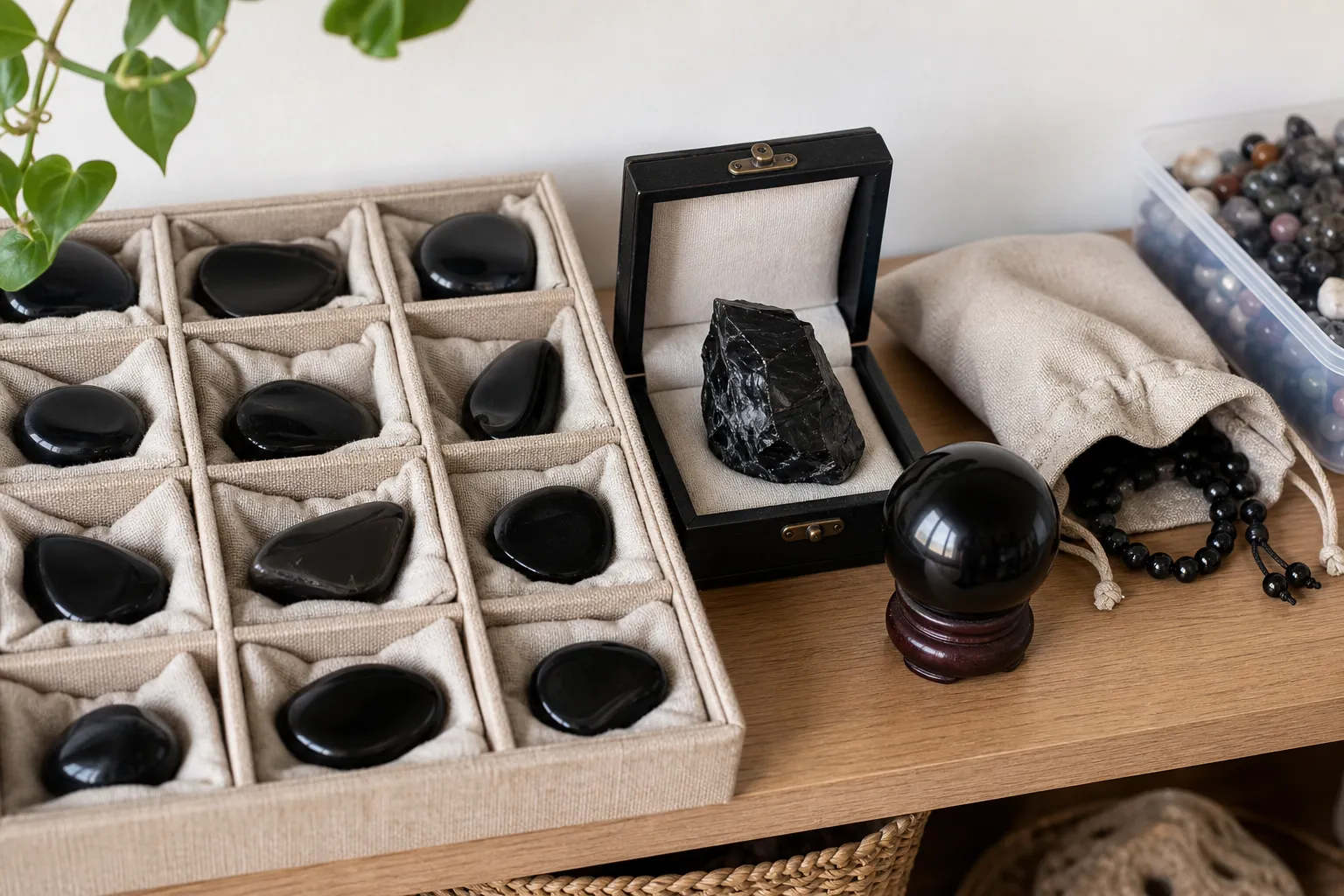
Handling Raw or Chipped Obsidian
Raw obsidian safety is mostly about respecting shape and uncertainty. A raw piece may have broken faces, thin margins, points, or uneven surfaces. Some pieces are easy to hold; others should be treated more like sharp display specimens than pocket stones.
This page is for general collector handling, not cutting, knapping, grinding, drilling, sanding, or workshop processing. In those settings, a short crystal-care paragraph is not enough; use activity-specific instruction and appropriate protection.
Ordinary Handling Checklist
- Look for the broadest stable area before lifting.
- Avoid pinching thin ridges.
- Do not slide skin along an edge to test it.
- Use both hands for large, heavy, or awkward pieces.
- Clear a landing space before moving a fragile object.
- Do not rummage blindly through bowls or drawers that contain raw pieces.
- Keep the sharpest or most fragile shapes separate.
A chip changes the care profile. Even a small missing corner can create a sharper contact point, a weak-looking edge, or loose fragments nearby. If a polished piece chips, it should no longer be handled exactly like an intact tumblestone.
After finding a chip, check the storage area for flakes, keep the piece away from fabric pouches until the edge is inspected, and avoid wearing or pocket-carrying it if the damaged area touches skin. Do not try to smooth a chipped edge with improvised tools unless you have suitable lapidary knowledge and equipment.
Storing and Displaying Obsidian
Storing obsidian is less about hiding it away and more about controlling contact. Many collection problems come from ordinary conditions: objects slide, knock, roll, scrape, snag, or fall.
Do not store every obsidian item together simply because they share a name. A raw piece with points should not sit loose against polished palm stones. A bracelet with metal spacers should not rub against a glossy cabochon. A heavy carved object should not be balanced above smaller stones where it can fall.
Display choices should begin with physical stability, not aesthetics. Ask whether the object can roll, tip, slide, or be bumped by a shelf edge, pet, sleeve, curtain, or nearby object. If a display requires constant adjustment, it is probably not a good display.
Storage materials can also create problems. A fuzzy pouch may catch on a chipped corner. A rough cardboard box can leave dust. A tight compartment can press pieces together. A dyed cloth may not suit every object, especially if moisture is present. When in doubt, choose clean, dry, low-abrasion contact and enough room that the piece does not scrape when removed.
Water, Sunlight, Salt, and Popular Care Routines
Searches about obsidian water, sunlight, and salt often mix practical care with symbolic routines. Those are separate questions. A personal practice may be meaningful to the owner, but it does not prove that an object is unaffected by water, light, salt, heat, repeated wetting, or rough handling.
Can obsidian go in water?
Do not make soaking the default. A brief damp wipe is different from leaving a carved, drilled, strung, glued, or chipped item in water.
What about sunlight?
Avoid display locations where heat, glare, or direct exposure creates avoidable stress for the whole object and setup.
Should salt be used?
Do not treat salt as a necessary cleaning material. Grains can be abrasive and may lodge in crevices or sit against metal, cord, or moisture.
What if the routine is symbolic?
Keep symbolic use separate from physical care. Do not let a ritual decide how to handle a chip, cord, coating, or polished face.
The stone is not always the only part of the object. Jewelry cord, metal findings, bead holes, labels, coatings, adhesives, repairs, stands, and nearby display materials may all change the decision.
Polished Pieces, Tumblestones, and Jewelry
Polished obsidian, tumblestones, beads, cabochons, and pendants are made for more handling than raw shards, but they are not immune to scratches, chips, oils, loose settings, or storage damage.
Polished palm stones and carvings
Glossy surfaces show dust, fingerprints, and scuffs.
Handle with clean, dry hands; wipe lightly; store away from grit.
Tumblestones and pocket pieces
Small pits, flat spots, or tiny chips may still exist.
Check edges before carrying; keep away from keys, coins, and metal tools.
Bead bracelets
Elastic, spacers, and bead holes may wear before the stone looks damaged.
Watch for stretched cord, rough metal, and rubbing between beads.
Pendants and cabochons
Settings, glue, jump rings, and cord can be weak points.
Remove before rough activity; inspect the setting, not only the stone.
Mixed-material pieces
Metal, labels, paint, foil, or coatings may react differently from the stone.
Clean gently and avoid soaking uncertain parts.
If a polished surface already has scratches or dull areas, routine cleaning may not change that. It may be a surface condition issue rather than dirt.
Common Mistakes in Obsidian Care
Most mistakes come from applying one general crystal habit to every object without checking the piece first.
- Treating all obsidian as smooth: a raw specimen, chipped tower, polished bead, and carved pendant can share a name while needing different handling.
- Cleaning before inspecting: wiping can move grit across a surface, push residue into recesses, or put pressure on a weak edge.
- Using display bowls for everything: mixed pieces can rub, chip, or hide sharp edges when crowded together.
- Confusing symbolic use with physical care: personal meaning should not decide whether a cord is wetted or salt is rubbed into a polished surface.
- Assuming a photo gives the whole answer: images may show shape and obvious damage, but not always thin edges, loose settings, coatings, or small cracks.
- Ignoring the non-stone parts: jewelry findings, labels, adhesives, stands, and storage materials often create the practical care problem.
When to Be More Cautious
Some situations call for slower handling and more specific guidance:
- The piece has a raw edge, point, or fresh chip.
- Damage seems to be spreading.
- The item is expensive, rare, sentimental, or difficult to replace.
- The object includes metal, cord, glue, paint, foil, labels, or unknown coatings.
- The piece may be handled by children or visitors.
- You plan to drill, cut, grind, sand, or reshape it.
- You cannot confidently identify the material.
- The care decision affects jewelry worn against skin or clothing.
This does not mean the piece is unusable. It means the next step should be more careful than a general routine.
Reader Path for Deeper Obsidian Care Topics
This page is the root map. Use narrower guides when you need a specific decision rather than a broad framework.
What is the gentlest way to clean this?
Go deeper with cleaning guidance focused on dry wiping, limited moisture, residue, polish, raw areas, and when to stop.
Is this raw edge a problem?
Go deeper with handling guidance for raw obsidian, chipped edges, points, flakes, and activity limits.
Where should I keep my pieces?
Go deeper with storage guidance on trays, pouches, shelves, stands, separation, weight, and contact control.
Can I use water, sunlight, or salt?
Go deeper with practical material concerns separated from symbolic routines.
How do I care for wearable pieces?
Go deeper with polished surfaces, pocket stones, beads, cabochons, cords, clasps, and settings.
These entry points are not separate rulebooks competing with each other. They are different angles on the same habit: inspect the object, reduce unnecessary contact, clean gently, and respect the limits of what you can verify.
Evidence Limits for This Page
The research packet available for this article did not include usable public reference links. That means this page should not pretend to offer lab-tested cleaning instructions, conservation standards, durability ratings, or universal safety conclusions.
Instead, it uses a narrower editorial approach: care choices are tied to visible condition; raw edges and chips are treated as reasons for caution; strong claims about water, sunlight, salt, and long-term surface change are avoided; symbolic language is kept separate from physical care; and detailed decisions are routed to more specific guides.
Future versions of this topic should be strengthened with vetted geology, museum, lapidary, mineral-collection, and safety-oriented sources. Until then, the most responsible advice is careful, modest, and based on what the owner can observe directly.
Practical Takeaway
Obsidian care does not need to be complicated, but it should be attentive. Start with the finish, edge condition, and setting. Clean only as much as needed. Keep polished surfaces away from grit and rough contact. Treat raw or chipped edges with caution. Store pieces so they cannot roll, scrape, or strike each other.
If you remember only one rule, make it this: care for the actual object in your hand, not the name on the label.