Collector overview
Obsidian Collecting and Meanings
Obsidian collecting and meanings starts with two separate questions: what can you observe in the specimen, and what meaning do you choose to attach to it?
For collectors, obsidian is best approached as volcanic glass: a material to inspect by color, sheen, translucency, polish, fracture, edge condition, label, and stated origin. For meaning, obsidian is often discussed through symbolism, tradition, shop language, and personal interpretation. Those meanings can be important to a collection, but they should not be treated as guaranteed physical, emotional, or spiritual outcomes.
A useful obsidian collection grows from visible comparison. A useful interpretation grows from context. The strongest approach keeps those layers separate: describe the object clearly, record what the label actually says, note uncertainty, then add symbolic meaning only where it belongs.
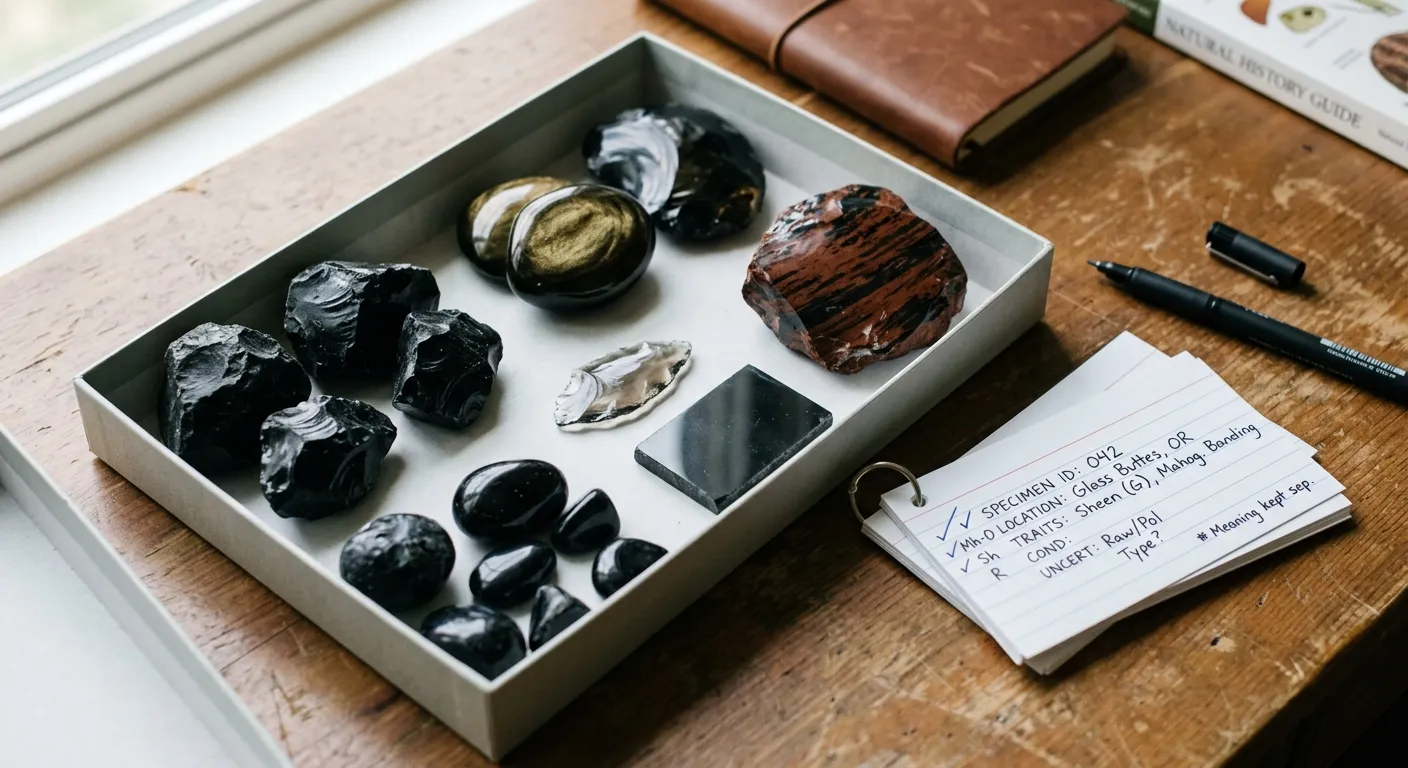
The collector-first way to look at obsidian
A root guide to obsidian should not begin with dramatic variety names. It should begin with the object in front of you.
When you pick up an obsidian specimen, ask:
- What do I see under normal light?
- What changes when I tilt it?
- Is the surface rough, broken, sawn, polished, tumbled, carved, or drilled?
- Are the edges sharp, rounded, chipped, cracked, or repaired?
- Does the label give a locality, a variety name, a seller phrase, or only a broad description?
- Am I describing a visible feature, or repeating a marketing term?
That habit keeps collecting obsidian practical. It lets a beginner enjoy variety names and symbolic language without treating every name as final.
Obsidian appears in collections as rough pieces, polished stones, carved forms, jewelry, display specimens, slabs, beads, cabochons, and locality-labeled pieces. Some collectors focus on sheen or pattern. Others care more about origin records, finish quality, cultural associations, or how a specimen fits a display. None of these approaches is automatically better. The stronger collection is the one with clearer records and fewer unsupported assumptions.
A useful order is:
- Observe the material — color, gloss, translucency, fracture, inclusions, sheen, pattern.
- Record the label — seller description, variety name, stated locality, date acquired.
- Note the limits — lighting, photo quality, vague naming, missing origin, possible lookalikes.
- Handle and store thoughtfully — protect edges, avoid rough storage, keep labels with records.
- Interpret carefully — treat obsidian symbolism as cultural or personal meaning, not as a promised result.
This page is a map, not the entire collection drawer. It gives an obsidian collector overview: what to inspect, how names work, where labels can be uncertain, how basic care and handling should be framed, and how symbolic meanings can be included without confusing the specimen record.
What collectors compare first
Collectors usually compare obsidian through visible traits. Some are obvious in the hand. Others depend heavily on lighting, polish, angle, or thickness.
A single photo is rarely enough for a confident conclusion. Even when a piece looks distinctive, a name may still depend on seller terminology, surface finish, and whether any locality information is available.
Base color
Look for black, smoky brown, gray, greenish, reddish, or mixed tones. Color is often the first sorting cue, but thickness, lighting, and polish can affect it.
Luster
Look for glassy shine, dull surface, satin-like polish, or worn finish. Obsidian is often valued visually for its glassy look, but finish changes appearance.
Translucency
Check whether thin edges or small chips pass light. Some pieces that look black in bulk show color at thinner areas.
Sheen
Look for silvery, golden, rainbow-like, or iridescent reflection when tilted. Sheen-based names often depend on angle, light, and polish.
Pattern
Look for spots, bands, streaks, snowflake-like marks, flow-like movement, or mottling. Patterns help group specimens, though names are not always standardized.
Internal features
Look for small crystals, bubbles, specks, cloudy zones, or visible inclusions. These can affect visual interest and naming, but should be described carefully.
Edge condition
Look for sharp edges, chips, bruises, cracks, and rounded areas. Condition affects handling, storage, display, and perceived collector quality.
Finish
Note whether the piece is rough, broken, sawn, polished, tumbled, carved, a cabochon, or a bead. The same material can look very different after cutting or polishing.
Size and form
Note thumbnail, palm stone, slab, sphere, point, carving, or jewelry part. Form affects display, storage, comparison, and use.
Label detail
Record variety name, locality, seller, acquisition date, and uncertainty notes. A clear label can be as useful as the specimen itself.
The point is not to force every piece into a perfect category. The point is to describe what is visible before accepting a name.
Lighting and polish can change the story
Obsidian is especially sensitive to presentation. A polished face may reveal sheen that a rough surface hides. Angled light may show colors that are nearly invisible under room light. A thin edge may look smoky or brown while the center of the piece appears black. A high polish can make pattern and depth seem stronger than they do on a duller surface.
Good notes separate the feature from the condition under which it was seen:
- “Bronze-looking sheen appears under angled light” is more useful than “gold obsidian” by itself.
- “Black in room light; brownish at thin edge” is more useful than “pure black.”
- “Seller label says rainbow obsidian; bands visible only when tilted” is more careful than treating the label as settled.
This does not make collecting less enjoyable. It makes the record more durable. If you revisit the piece later, your own notes will remind you how the label was understood.
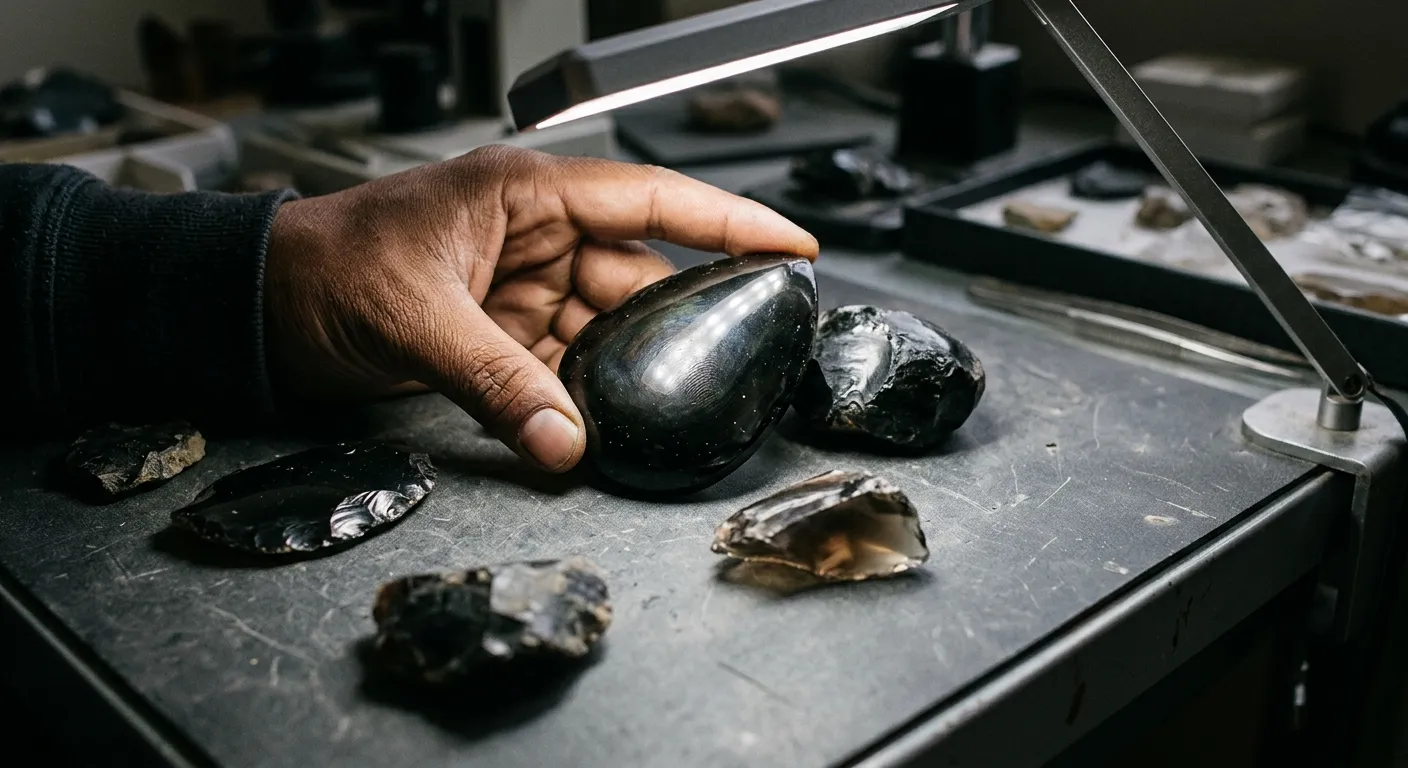
Common obsidian specimen types and naming limits
Obsidian specimen types are often grouped by color, sheen, pattern, finish, or stated origin. Some names describe visible appearance. Some are market terms. Some may be tied to locality when reliable records are available. A beginner does not need to memorize every name before collecting; it is more useful to learn what kind of naming problem each specimen presents.
Black obsidian
Collectors usually notice a glassy dark appearance, clean polish, and simple display value. Record that thin edges or strong lighting may reveal more color than expected.
Sheen obsidian
Collectors usually notice reflective color when tilted, such as silvery, golden, or rainbow-like flashes. Record that sheen may depend strongly on polish and viewing angle.
Patterned obsidian
Collectors usually notice snowflake-like marks, spots, flow lines, bands, mottling, or mixed textures. Record that pattern names vary between sellers.
Mahogany-like material
Collectors usually notice brown, red-brown, and black contrast. Record what you see because color descriptions may be broad.
Translucent-edge pieces
Collectors usually notice smoky or colored light transmission at thin areas. Record that bulk appearance can look much darker than edge appearance.
Rough specimens
Collectors usually notice broken faces, raw edges, and fracture surfaces. Record sharpness, chips, and incomplete labels.
Polished forms
Collectors usually notice palm stones, spheres, cabochons, carvings, beads, and points. Record that shape may reflect lapidary work more than natural specimen character.
Locality-labeled pieces
Collectors usually notice a stated place of origin, sometimes with a variety name. Record that locality certainty depends on documentation and seller reliability.
This grouping helps a collector decide what the specimen is doing in the collection. Is it there for color, sheen, label quality, locality, finish, symbolic meaning, or comparison with similar pieces?
A clear answer helps prevent a drawer full of stones whose only real difference is the seller’s wording.
Variety names are useful, but not always final
Variety names make collecting easier. They let people talk about visual categories without describing every feature from scratch. But they can also create false confidence.
A label such as “rainbow,” “golden,” “snowflake,” “mahogany,” or “silver sheen” may point toward a visible trait. It does not automatically prove origin, rarity, quality, or authenticity. Some names are descriptive. Some are commercial. Some are used more consistently than others. Some overlap when a specimen shows several features.
A collector-friendly label includes both the supplied name and the observed basis:
- “Seller label: silver sheen obsidian; silvery reflection appears on polished face when tilted.”
- “Seller label: snowflake obsidian; pale rounded markings visible across black base.”
- “Seller label: mahogany obsidian; brown and black patches visible on both sides.”
- “Unlabeled polished black obsidian-like stone; no locality given.”
The phrase “obsidian-like” may feel cautious, but caution is appropriate when the only evidence is a photo, a shop tag, or a brief listing.
What an obsidian name can and cannot tell you
Obsidian naming limits are not a failure of collecting. They are part of collecting.
Many beginner mistakes come from treating a name as if it carries more certainty than it does. A name might describe appearance. It might describe a seller category. It might be a traditional collector term. It might be tied to a claimed locality. Without supporting detail, those meanings should not be blended together.
Appearance name
Usually communicates visible color, sheen, pattern, or texture. It may not prove locality, age, rarity, or quality.
Form name
Usually communicates shape such as sphere, tower, bead, slab, carving, or palm stone. It may not prove natural formation shape or collector significance.
Locality name
Usually communicates a stated source area or collection location. It may not prove accuracy unless supported by reliable records.
Symbolic name
Usually communicates meaning used in shops, traditions, or personal practice. It may not prove any dependable outcome.
A single specimen may carry several names at once: “polished rainbow obsidian palm stone from Mexico,” for example. Each part should be evaluated separately. “Polished palm stone” describes form. “Rainbow” describes a visual effect. The locality claim depends on records. Any symbolic interpretation belongs in the meaning layer, not in the identification layer.
Photo-only identification should stay tentative
Photos can be helpful, but they are limited. They may hide chips, exaggerate shine, flatten color, or miss the angle where sheen appears. Backgrounds and lighting can also change how dark or colorful a piece looks.
A photo can support a description such as:
- “The piece appears black and glossy.”
- “A reflective band is visible in the seller’s angled photo.”
- “The label states a variety name, but the photos do not show enough detail to confirm the visual basis.”
- “The surface looks polished, though edge condition is unclear.”
If the specimen matters to your collection, ask for more views: front, back, side, close-up, thin edge if relevant, and a neutral-light image.
Descriptive labels age better than dramatic labels
Compare these two records:
“Powerful rainbow piece.”
“Polished obsidian, seller label ‘rainbow’; green-purple sheen visible on one face under angled light; no locality provided; acquired in 2026.”
The second record is more useful because it separates observation, seller language, acquisition detail, and uncertainty. It gives a future reader something to check. It also reduces the chance that symbolic or promotional wording will be mistaken for identification.
Care and handling basics for obsidian specimens
Obsidian should be handled as a glassy material that may have sharp edges, chipped corners, delicate polish, or vulnerable surfaces depending on the piece. This is a general collector overview, not a detailed conservation manual. When a specimen has repairs, metal settings, attached labels, unusual coatings, or historical value, use a more conservative approach and seek object-specific guidance.
For everyday collecting, focus on three habits: inspect edges, clean modestly, and protect both the stone and its label.
Handling
Check for sharp broken areas, tiny chips, points, cracks, and loose jewelry fittings. Rough or fractured obsidian can be sharp; polished forms can still chip.
Display
Use stable bases and avoid precarious shelf arrangements. Spheres, points, slabs, and carvings can fall if balanced poorly.
Cleaning
Start with dry dusting using a soft cloth or brush. Aggressive cleaning can affect polish, repairs, settings, or labels.
Storage
Keep sharp or polished pieces from rubbing against each other. Separate trays, soft wraps, pouches, or compartments reduce damage.
Labels
Store labels with the specimen record and photograph them when acquired. A collection loses context when the label history disappears.
If a piece needs more than dusting, keep the method mild unless you understand the finish and construction. Avoid abrasive powders, harsh chemicals, soaking, or device-based cleaning assumptions for pieces with cracks, repairs, jewelry settings, drilled holes, coatings, or old labels.
A collection becomes easier to understand when the stone and its information stay together. If you change a label later, do not erase the old information without noting the change. A record can include “original seller label,” “later relabeled,” “locality not confirmed,” or “visual name only.”
That is not fussy. It is the difference between a group of attractive stones and a collection that can be reviewed, compared, and improved.
Obsidian symbolism without overstatement
Obsidian symbolism is one reason many people are drawn to the material. Its dark glassy appearance, reflective surface, sharp fracture, and long association with tools, mirrors, and display objects make it easy to understand why people attach strong meanings to it.
On this page, obsidian symbolic meanings are treated as cultural interpretations, shop language, personal associations, and reflective practices. They can shape how someone displays, gifts, or thinks about a specimen. They should not be presented as promised effects.
Common symbolic themes include:
- Reflection
- Grounding as imagery
- Protection as a symbolic wish
- Truth-telling
- Shadow work as a personal or spiritual metaphor
- Cutting through confusion as imagery
- Boundary setting as a personal association
- Transformation as a narrative theme
- Strength, depth, or seriousness
- Connection to volcanic origins and inner pressure
These are meaning frameworks. They may be useful for journaling, display choices, gift language, meditation aesthetics, or personal rituals if the owner chooses to use them that way. They do not identify the specimen or prove anything about its origin.
A collector may choose a polished black piece because it feels quiet and direct. Another may prefer rainbow sheen because it suggests hidden color. Another may collect rough obsidian because the fractured surface feels closer to the material’s natural character. These interpretations are personal. They do not need to be turned into universal statements.
Keep cultural meaning and personal meaning separate
Cultural interpretations may come from historical uses, regional traditions, spiritual systems, craft contexts, or repeated symbolic language in communities. Personal interpretations come from the owner’s own experience, memory, taste, or intention.
Both can matter, but they should be recorded differently.
A careful collection note might say:
- “Displayed as a personal symbol of reflection.”
- “Purchased because the dark polished surface felt appropriate for a quiet desk object.”
- “Seller associated this variety with protective symbolism; recorded here as shop meaning, not physical identification.”
- “Used in personal practice as a reminder to pause before reacting.”
This keeps meaning in the collection without making the stone responsible for an outcome.
The cleanest collector habit is to keep three layers separate:
- Material layer — what the specimen is believed to be and what can be seen.
- Record layer — what the label says, where it came from, and what remains uncertain.
- Meaning layer — what the piece represents culturally or personally.
When those layers stay separate, symbolic meaning can enrich the collection without confusing the record.
How to build a coherent obsidian collection
A coherent collection is not necessarily large or expensive. It has a reason for existing. The pieces relate to each other in a way the collector can explain.
Some collections are visual. Some are locality-based. Some are organized by finish. Some focus on symbolic display. Some begin as a beginner tray and become more specific over time.
A focus helps prevent impulse buying and makes each new piece easier to judge.
Visual variety
Look for black, sheen, patterned, reddish-brown, translucent-edge, or mixed appearance. A good beginner move is to choose a few clearly different pieces instead of many similar ones.
Finish comparison
Look for rough, tumbled, polished, carved, cabochon, bead, and slab forms. Compare how the same material looks in different forms.
Label quality
Look for locality information, acquisition dates, and clear seller descriptions. Keep exact seller wording and add your own visible description.
Display purpose
Look for contrast, shape, scale, surface, and shelf arrangement. Build a small group that looks intentional together.
Study tray
Look for features that change under light, angle, or magnification. Photograph pieces under consistent lighting.
Meaning-based display
Look for personal or cultural symbolism. Keep meaning notes separate from identification notes.
Locality interest
Look for pieces grouped by stated origin. Prefer specimens with better documentation when locality matters.
A beginner collection might start with five to ten clearly different specimens rather than many similar polished stones. The aim is not to own every name. The aim is to learn what differences you can actually see and record.
Record the reason for each piece
A good collection note does not need to be complicated. Even a short record can preserve information that future-you will want.
Useful fields include:
- Specimen number
- Acquisition date
- Seller or source
- Seller label
- Visible description
- Stated locality, if provided
- Finish or form
- Size or measurements
- Condition notes
- Meaning note, if relevant
- Uncertainty note
Example:
Specimen 014. Polished black obsidian palm stone. Seller label: “black obsidian.” No locality provided. Glossy surface, rounded edges, small chip on one side. Acquired for comparison with rough black piece. Personal meaning: desk object for reflection.
This kind of record is plain, but it works. It gives the specimen a place in the collection beyond appearance alone.
Build comparison sets, not name piles
A name pile is a group of stones bought because each label sounded different. A comparison set is a group chosen because its features teach you something.
Useful comparison sets include:
- Rough black piece vs. polished black piece
- Dark specimen with translucent edge vs. fully opaque-looking specimen
- Sheen piece photographed under direct light vs. indirect light
- Patterned specimen with clear markings vs. vague mottled specimen
- Locality-labeled piece vs. unlabeled decorative piece
- Similar-size pieces with different finish quality
Comparison sets train the eye. They also make naming limits easier to accept because you can see how much presentation affects appearance.
Buying, value, and seller language
This page is not a transactional obsidian buying guide, and it does not provide appraisal conclusions. Still, collectors need a basic framework for evaluating listings and understanding perceived value. The goal is not to predict a price. The goal is to understand what information a listing gives you and what remains unclear.
Before buying or trading for an obsidian piece, ask:
- Are there multiple photos?
- Do the photos show the surface at more than one angle?
- Is there a close-up of pattern, sheen, edge, or damage?
- Is the size clearly stated?
- Is the finish described?
- Is the locality given, or only a variety name?
- Does the seller distinguish observation from symbolism?
- Are chips, cracks, repairs, or drilled areas visible?
- Does the listing use dramatic language where plain description would be more helpful?
The more a specimen costs or matters to your collection focus, the more these questions matter. For casual decorative pieces, limited information may be acceptable. For a labeled collector specimen, vague presentation is a reason to slow down.
Visual appeal
Collectors notice strong sheen, clear pattern, pleasing polish, and unusual contrast. Beauty is partly subjective and photo-dependent.
Condition
Collectors notice chips, cracks, bruised edges, dull polish, and repairs. Some rough specimens are valued for natural character, not perfect polish.
Size and form
Larger display pieces or well-made carvings can stand out. Bigger is not automatically better for every collection.
Finish quality
Smooth polish and clean shaping can improve display value. Finish reflects workmanship, not necessarily rarity.
Locality information
A stated origin can make records more meaningful. Locality claims need support to be more than a label.
Label clarity
Clear records help future comparison. A confident label may still be unsupported.
Pattern or sheen visibility
Distinctive features can define a specimen’s role. Lighting can exaggerate or hide these features.
Collection fit
A piece may be valuable to your focus. Personal collection value is not the same as market value.
Seller language can still be useful. It tells you how the piece is being presented. But it is not the same as independent support.
Record variety names, locality claims, rarity language, symbolic meanings, quality adjectives, and display suggestions if they matter. Then compare them with the specimen itself. If a listing says a piece has strong sheen, the photos should show that feature. If a listing names a locality, the record should ideally include more than a decorative tag. If a listing focuses only on meaning, you may still need basic specimen details before adding it to a collector record.
A simple framework for any obsidian specimen
When a new obsidian specimen enters your collection, slow down long enough to place it in a clear framework. This sequence works for rough pieces, polished stones, carvings, beads, jewelry, and display objects.
- 1. Describe before naming
Write what you see before relying on the label. Example note: “Black body, glossy polish, faint brown at thin edge, small chip on lower side.”
- 2. Record the supplied label exactly
Keep the seller’s wording separate from your interpretation. Example note: “Seller label: rainbow obsidian; no locality provided.”
- 3. Decide the specimen’s role
Give the piece a reason for being in the collection. Example note: “Study comparison for sheen under angled light.”
- 4. Add a care note
Record anything that affects handling, storage, or display. Example note: “Sharp broken edge; store separately.”
- 5. Add meaning only if it matters
Write symbolic language as interpretation, not identification. Example note: “Personal association: reflection; shop meaning recorded separately.”
Useful description prompts include main color, secondary color, surface finish, sheen, pattern, translucency at the edge, chips or cracks, shape, size, and visible inclusions or markings.
Possible label notes include:
- “Seller label only.”
- “Locality stated, no further documentation.”
- “Visual name matches visible feature under angled light.”
- “Meaning description supplied by seller; not used for identification.”
- “Photos before purchase did not show back side.”
A collection becomes clearer when every piece has a role: study comparison, display piece, variety example, finish example, locality-labeled specimen, gift, personal symbol, jewelry object, carving, or temporary placeholder until a better-documented piece is found.
There is nothing wrong with a beautiful decorative stone. Problems arise only when decorative appeal is mistaken for locality certainty, symbolic effect, or collector-grade documentation.
Common mistakes in obsidian collecting and meanings
Most collecting problems are not caused by lack of enthusiasm. They are caused by mixing categories too quickly.
Treating every variety name as exact
Better habit: record the name, then describe the visible basis and uncertainty.
Letting meaning replace identification
Better habit: keep symbolic notes separate from material description and label records.
Buying too many similar pieces too early
Better habit: choose pieces that differ in finish, edge, pattern, sheen, or label quality.
Ignoring labels and acquisition dates
Better habit: keep a basic record: date, seller, label, visible description.
Overtrusting photos
Better habit: ask for more views when the specimen matters.
Cleaning too aggressively
Better habit: keep cleaning modest unless you understand the finish, repair status, and setting.
Confusing personal value with market value
Better habit: let personal meaning matter without treating it as a price conclusion.
These are easy mistakes to make, especially when listings emphasize names and symbolism more than observable traits. A slower, more descriptive habit makes the collection easier to trust.
Quick answers for new collectors
Is obsidian collecting mainly about variety names?
No. Variety names are helpful, but collecting is stronger when names are supported by visible descriptions, label records, condition notes, and clear uncertainty. A collection built only around dramatic names can become confusing.
Can I identify obsidian from a photo alone?
A photo can support a tentative description, especially for color, polish, pattern, and visible sheen. It should not be treated as complete proof. Lighting, angle, surface finish, and missing views can all affect interpretation.
Are obsidian meanings part of collecting?
They can be. Many collectors include obsidian symbolic meanings as personal, cultural, or display notes. The important distinction is that meaning belongs in the interpretation layer, not the identification layer.
What should a beginner record first?
Start with the seller label, acquisition date, visible description, finish, size, condition, and any stated locality. Add a meaning note only if it matters to your collection.
What is the simplest care habit?
Inspect edges, avoid rough storage, protect polished surfaces, and keep labels with the specimen record. Use modest cleaning unless you have reliable guidance for the specific object and finish.
Next guides in the obsidian collecting path
Use these routes as entry points into narrower topics.
How to Start an Obsidian Collection
For beginners who need a simple way to choose a focus, compare specimen types, avoid vague name-chasing, and keep basic records from the beginning.
Obsidian Buying Guide for Collectors
For evaluating listings, comparing photos, checking finish and size, and deciding whether the stated variety matches visible traits.
Obsidian Meaning and Symbolism
For readers focused on symbolic associations, cultural language, personal interpretation, and keeping meaning separate from promised outcomes.
Obsidian Specimen Labels and Provenance
For improving collection records and understanding where locality, seller names, and variety terms remain uncertain.
What Affects Obsidian Value for Collectors
For a non-appraisal framework around size, condition, polish, visual pattern, locality information, and presentation.
These child topics are connected, but they are not the same task. A beginner may need collection planning. A shopper may need listing evaluation. A meaning-focused reader may need symbolism boundaries. A record-focused collector may need label discipline. A value-focused collector may need a framework that avoids false certainty.
The durable way to collect obsidian
A durable obsidian collection is built on clear seeing. It notices color, sheen, polish, chips, edges, labels, and uncertainty. It treats seller names as useful clues, not final answers. It allows symbolic meaning without turning personal interpretation into a promised result.
Start with a few specimens you can compare. Record what you see. Keep the label history. Handle the material with care. Let meaning remain meaningful, but keep it in its proper place.
Over time, your collection becomes more than a group of dark stones or dramatic names. It becomes a visible record of choices: what you noticed, what you questioned, what you valued, and what each specimen came to represent.