Collector classification guide
Is Obsidian a Crystal, Rock, Mineral, or Glass
If you have seen the same black material called an “obsidian crystal,” “obsidian rock,” “obsidian mineral,” and “volcanic glass,” the confusion is understandable. The answer depends on which label is being used: a strict geology term, a shop category, or a collector’s shorthand.
The clean answer: obsidian is natural volcanic glass. It is not a crystal in the mineral-structure sense, it is usually not treated as a true mineral, and it is often grouped with volcanic or igneous rocks because of how it forms.
Crystal
Best answer: No, not in the mineralogical sense.
Shops often use “crystal” for polished stones, towers, spheres, bracelets, and display pieces.
Mineral
Best answer: Usually no.
A true mineral normally has an ordered crystal structure; obsidian is mostly amorphous glass.
Rock
Best answer: Often yes in broad geology and collector language.
It forms from volcanic melt and is commonly discussed with volcanic rocks.
Glass
Best answer: Yes.
Obsidian is natural volcanic glass formed by rapid cooling of silica-rich melt.
upward
Read the full overview first
Use the broader guide first if you need the full scope before this page.
The strict answer: obsidian is natural volcanic glass
Obsidian forms when silica-rich volcanic melt cools so quickly that a regular crystal structure does not have time to develop. That rapid cooling is why obsidian usually looks glassy rather than grainy. Geology references commonly describe it as volcanic glass, especially in silica-rich volcanic settings.
“Glass” does not mean the piece is artificial, weak, or the same as manufactured window glass. Here, the word describes structure. Obsidian is largely amorphous, meaning its atoms are not arranged in the long-range repeating pattern expected in a crystal.
For collectors, that glassy structure explains several visible traits:
- Vitreous luster: a glass-like shine on fresh or polished surfaces.
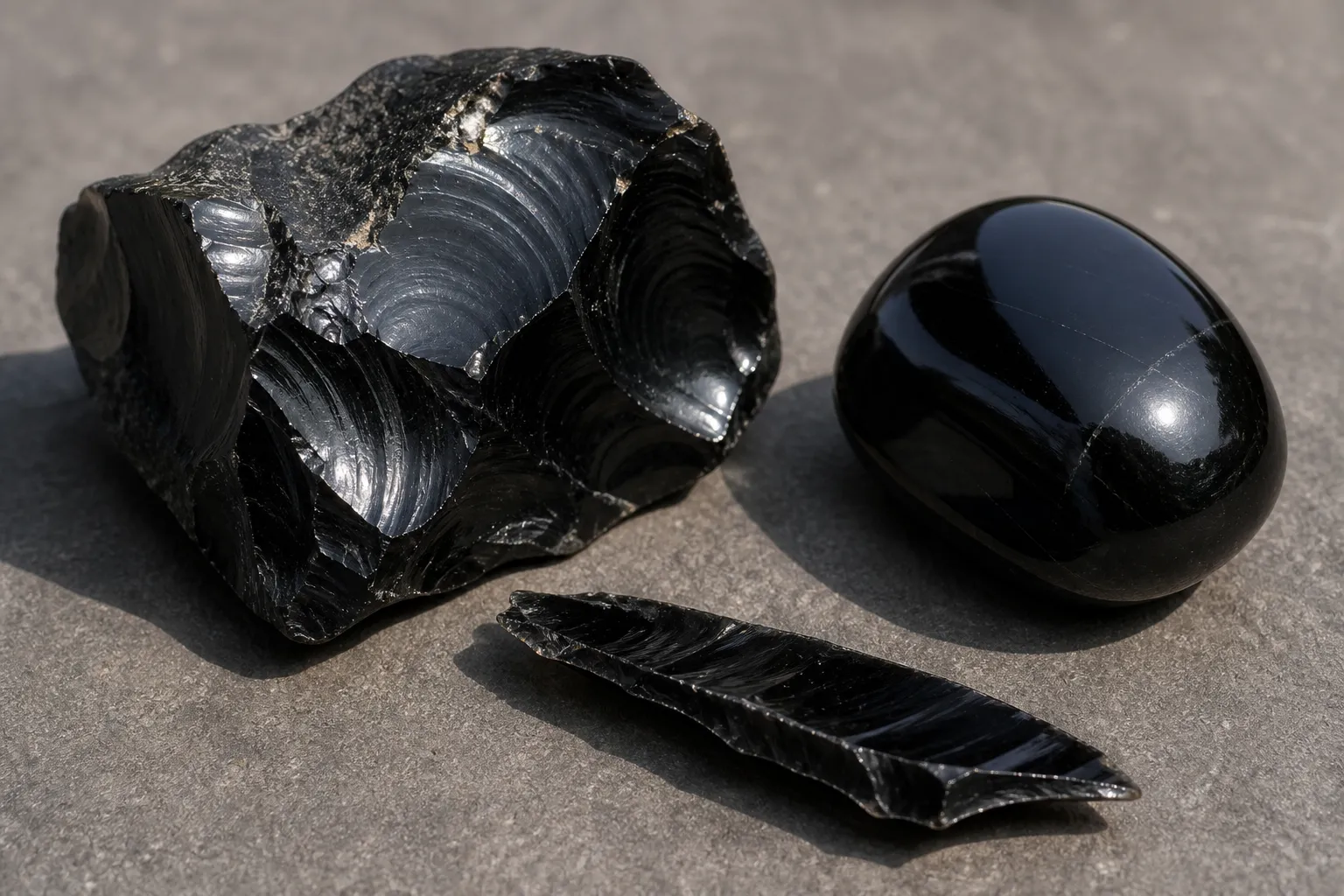
- Conchoidal fracture: smooth, curved break surfaces, often shell-like.
- Sharp broken edges: fresh breaks can form very fine edges.
- Flow bands or color zones: some pieces show streaks, layers, or banding from moving volcanic melt.
- Sheen or iridescence: rainbow, gold, or silver effects may relate to tiny internal structures, bubbles, flow features, or inclusions, depending on the specimen.
Those clues can support an obsidian identification, but they do not prove origin, value, age, treatment status, or authenticity by themselves. A seller name, a photo, or one attractive sheen is only part of the picture.
Is obsidian a crystal or volcanic glass?
In strict terms, obsidian is volcanic glass, not a crystal. A crystal has an ordered internal structure. Quartz and feldspar are crystalline because their atoms repeat in regular patterns. Obsidian’s main glassy body does not have that kind of long-range crystal lattice.
The confusion comes from the word “crystal” having two different uses.
In mineralogy, “crystal” refers to structure. In shops and collecting spaces, it often means a decorative stone object: a tumbled stone, palm stone, tower, sphere, carving, bead, or display specimen. Under that retail meaning, “black obsidian crystal” usually means “a piece of black obsidian sold in the crystal section,” not “a crystal like quartz.”
Black obsidian is commonly sold as a crystal in retail and collecting language, but geologically it is natural volcanic glass, not a crystal in the mineral-structure sense.
The same applies to mahogany obsidian, rainbow obsidian, gold sheen obsidian, silver sheen obsidian, and snowflake obsidian. Those names describe appearance or collector categories. They do not turn the material into a true crystal.
Is obsidian a mineral or mineraloid?
Obsidian is usually better described as a mineraloid or volcanic glass than as a true mineral.
A mineral is generally understood as a naturally occurring inorganic solid with a reasonably definite composition and an ordered crystalline structure. Obsidian is naturally occurring and inorganic, but it does not meet the crystal-structure part in the usual way. Its chemistry can also vary because it is a natural glass derived from volcanic melt rather than a single neatly defined mineral species.
That is why careful references often place obsidian with volcanic glass, mineraloids, or rock-related materials instead of treating it as a true mineral species.
In everyday collecting, people may use “mineral” more loosely. Someone might say “my minerals” and include obsidian, agate, quartz, jasper, and fossils in the same tray. That is normal collection language. But if the question is obsidian mineral or glass, the stricter answer is glass: obsidian is natural volcanic glass and is not usually classified as a true mineral.
There is one useful nuance. Obsidian can contain small mineral crystals, tiny crystallites, inclusions, or devitrified areas. That does not make the whole piece a mineral crystal. It means a glassy material can include crystalline features within it.
What type of rock is obsidian?
In common geology education, obsidian is often discussed as an igneous rock or volcanic rock because it forms from molten material associated with volcanic activity. If someone asks about the obsidian rock type, the practical answer is: obsidian is an extrusive volcanic material, more precisely a natural volcanic glass.
“Rock” is broader than “mineral.” Many rocks are made of multiple minerals. Granite, for example, contains visible mineral grains such as quartz, feldspar, and mica. Obsidian is different because it is not a typical aggregate of visible mineral crystals. It is glassy.
Granite
Slow cooling underground
Coarse visible mineral crystals
Rhyolite
Faster cooling at or near the surface
Fine-grained volcanic rock, sometimes with small crystals
Obsidian
Very rapid cooling of silica-rich melt
Glassy texture, little to no visible crystal grain
So, can obsidian be both a rock and glass? In ordinary collector and geology language, yes. “Rock” describes its broad geologic setting. “Glass” describes its structure more precisely. The two labels answer different parts of the question.
A careful display label could read: obsidian — natural volcanic glass commonly grouped with extrusive igneous rocks.
Why obsidian is called glass if it comes from a volcano
People often expect volcanic material to become stone, ash, pumice, or lava rock, so “glass” can sound surprising. The reason is cooling speed and composition.
Silica-rich volcanic melt can be very viscous. When it cools quickly enough, atoms do not settle into large, orderly crystals. The material instead freezes into a glassy state. That is why obsidian can show smooth curved fractures and bright reflective surfaces.
This also explains why broken obsidian can be extremely sharp. The fracture does not move around visible crystal grains the way it might in a more crystalline rock. It can break in smooth, curved surfaces that form fine edges. This property is one reason obsidian has a long history of being shaped into cutting edges and pointed tools.
For collectors, the practical lesson is simple: obsidian can look polished even when freshly broken, and broken pieces should be handled with care.
Does obsidian have crystals inside it?
Sometimes, yes. The wording matters.
Obsidian itself is mostly glassy and non-crystalline. Some specimens, however, can contain tiny crystals, mineral inclusions, microlites, phenocrysts, or later-formed crystalline areas. These features may be too small to see without magnification, or they may appear as visible patterns in certain varieties.
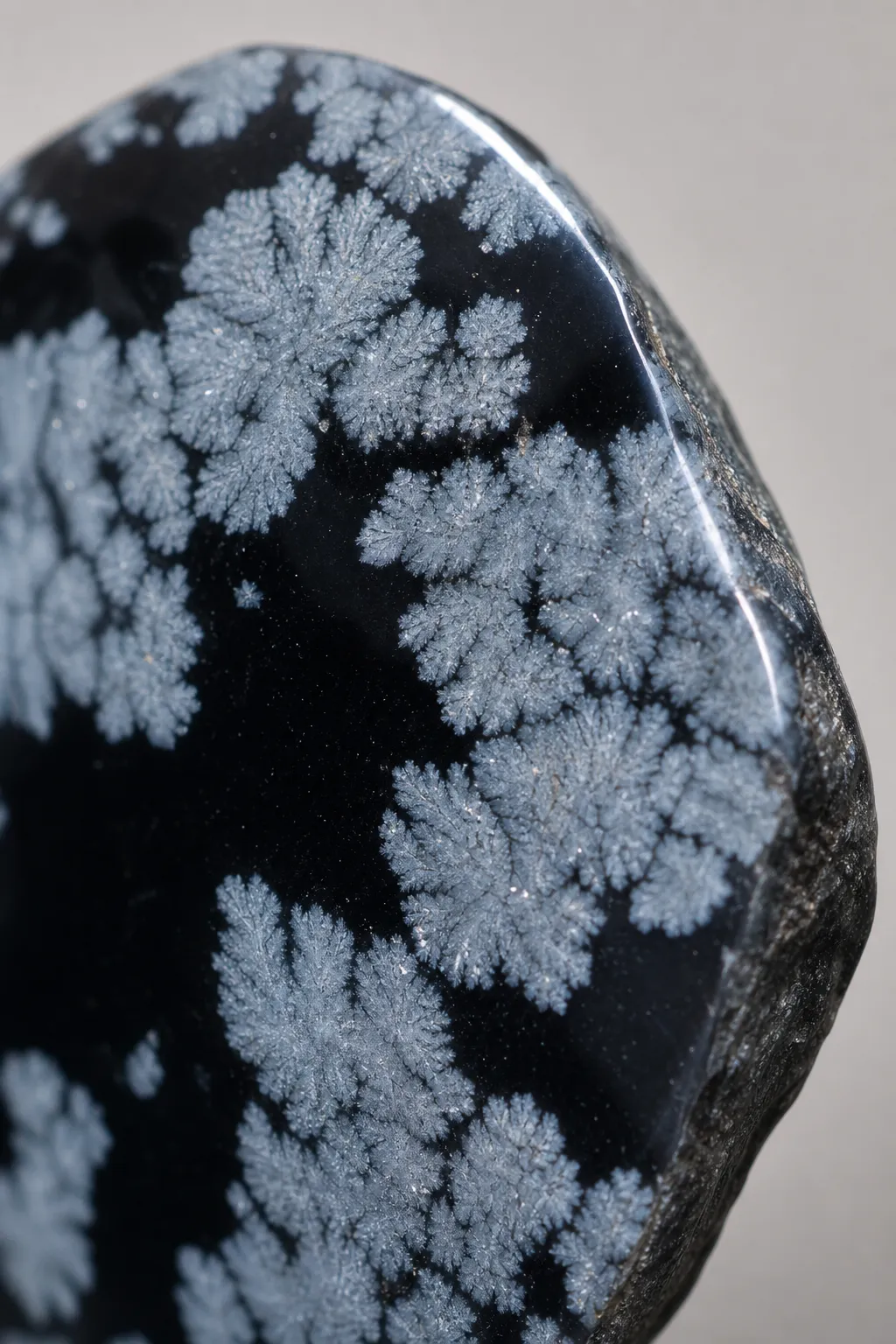
Snowflake obsidian is the easiest collector example. The pale gray or white “snowflakes” are commonly explained as areas where the glass has partly devitrified, meaning some of the glassy material has changed toward a more crystalline texture. The snowflake pattern does not mean the entire stone has become a crystal. It means the obsidian contains visible crystalline or crystal-like growths within a glassy matrix.
Other appearance-based varieties can also invite overconfident labeling. Rainbow obsidian, gold sheen obsidian, and silver sheen obsidian may show color effects related to internal structures, flow alignment, tiny bubbles, inclusions, or microscopic features, depending on the piece. Without closer examination, a color effect should be treated as an observation, not a complete identification.
Better collector wording:
- “This looks like snowflake obsidian.”
- “This has pale snowflake-like patches.”
- “This piece shows a gold sheen under direct light.”
Wording that goes too far:
- “This photo proves the exact source.”
- “This sheen confirms the value.”
- “This seller name proves the material.”
Why crystal shops call obsidian a crystal
Crystal shops usually organize objects by how customers browse and use them, not by strict mineral classification. In that setting, “obsidian crystal” may refer to:
- a polished palm stone,
- a carved point or tower,
- a sphere,
- a bracelet bead,
- a pendant,
- a tumbled stone,
- a display piece,
- or a stone associated with symbolic traditions.
That retail language can be useful for finding an item, but it should not be read as a structural claim.
The same applies to questions like “is obsidian a gemstone or a rock?” Obsidian can be cut, polished, carved, and used ornamentally, so it may appear in jewelry and gem settings. But “gemstone” is a use and appearance category. It does not replace the volcanic glass classification.
Symbolic language belongs in its own lane. Some shops and traditions associate obsidian with personal meaning, grounding imagery, or protective symbolism. Those are cultural or personal interpretations. They do not change the geology of the material, and they should not be presented as guaranteed results.
What volcanic glass means for collectors
The classification is not just trivia. It affects how you inspect, store, clean, and describe a piece.
Identification notes
Obsidian often shows a combination of glassy luster, dark body color, smooth curved fracture, and sharp edges where broken. Some pieces are jet black; others may be brown, reddish, mahogany-colored, gray, greenish, banded, or sheen-bearing.
Variety names can be helpful, but many are collector or trade labels rather than formal geologic categories. When looking at a piece, separate three questions:
- 1. Material: Is it consistent with natural volcanic glass?
- 2. Variety label: Does the appearance match a collector name such as snowflake, mahogany, rainbow, gold sheen, or silver sheen?
- 3. Proof level: What evidence supports the claimed origin, treatment status, or special label?
A visual check can support a tentative label. It cannot do everything.
Care and handling
Because obsidian is glassy, it can chip. Because it fractures sharply, broken edges can cut skin or snag fabric. Store sharp raw pieces so they do not scrape softer stones, sit loose in a crowded bowl, or end up where children or pets can handle them.
For display specimens, a stable tray, padded box, or divided case is usually more sensible than mixing raw obsidian with delicate polished stones.
Cleaning should be gentle. Dusting with a soft cloth or rinsing a stable polished piece with clean water is usually enough for ordinary display care. Be more cautious around points, thin edges, chips, old fractures, or glued settings.
Cutting, drilling, grinding, or polishing
Ordinary display and wearing are different from lapidary work. Cutting, grinding, drilling, or polishing silica-bearing materials can create fine dust. In workshop settings, wet methods, ventilation, eye protection, and suitable respiratory protection are commonly discussed because dust exposure is a different situation from simply owning a polished stone.
That caution belongs to the activity, not to the label “obsidian crystal.” A pendant in a jewelry box and a stone being ground on a wheel are not the same scenario.
A collector’s decision frame: which word should you use?
Use the word that matches the situation.
Strict geology or mineral classification
“Obsidian is natural volcanic glass, often treated as a mineraloid rather than a true mineral.”
Beginner collector explanation
“Obsidian forms from volcanic melt, but it cooled into glass instead of visible crystals.”
Shop or display context
“Obsidian crystal” can be understood as retail shorthand, but “obsidian volcanic glass” is more precise.
Snowflake obsidian label
“Snowflake obsidian is glassy obsidian with pale crystalline or devitrification patterns.”
Rock type question
“Obsidian is commonly grouped with extrusive volcanic rocks, but structurally it is glass.”
The most accurate short answer remains: obsidian is not a crystal in the mineral-structure sense; it is natural volcanic glass. It can be called a volcanic rock in broad context, and it is better described as a mineraloid than as a true mineral.
Quick answers to common wording questions
Is obsidian amorphous or crystalline?
Obsidian is mainly amorphous. Its glassy body lacks the long-range ordered structure of a true crystal, although some specimens can contain small crystals or devitrified areas.
Is snowflake obsidian a crystal, rock, or glass?
Snowflake obsidian is still obsidian, so its main identity is natural volcanic glass. The snowflake patterns are commonly linked to local crystalline growth or devitrification within the glassy material.
Is obsidian made of minerals?
Obsidian comes from mineral-rich volcanic melt and may contain small mineral crystals or inclusions, but the main material is glassy rather than a normal aggregate of visible mineral grains.
Is obsidian a gemstone or a rock?
It can be used as a gem material when cut, polished, carved, or set in jewelry. Geologically, it is natural volcanic glass and is commonly discussed with volcanic rocks. “Gemstone” describes use and appearance; it does not replace the volcanic glass classification.