Collector documentation
Obsidian Specimen Labels and Provenance
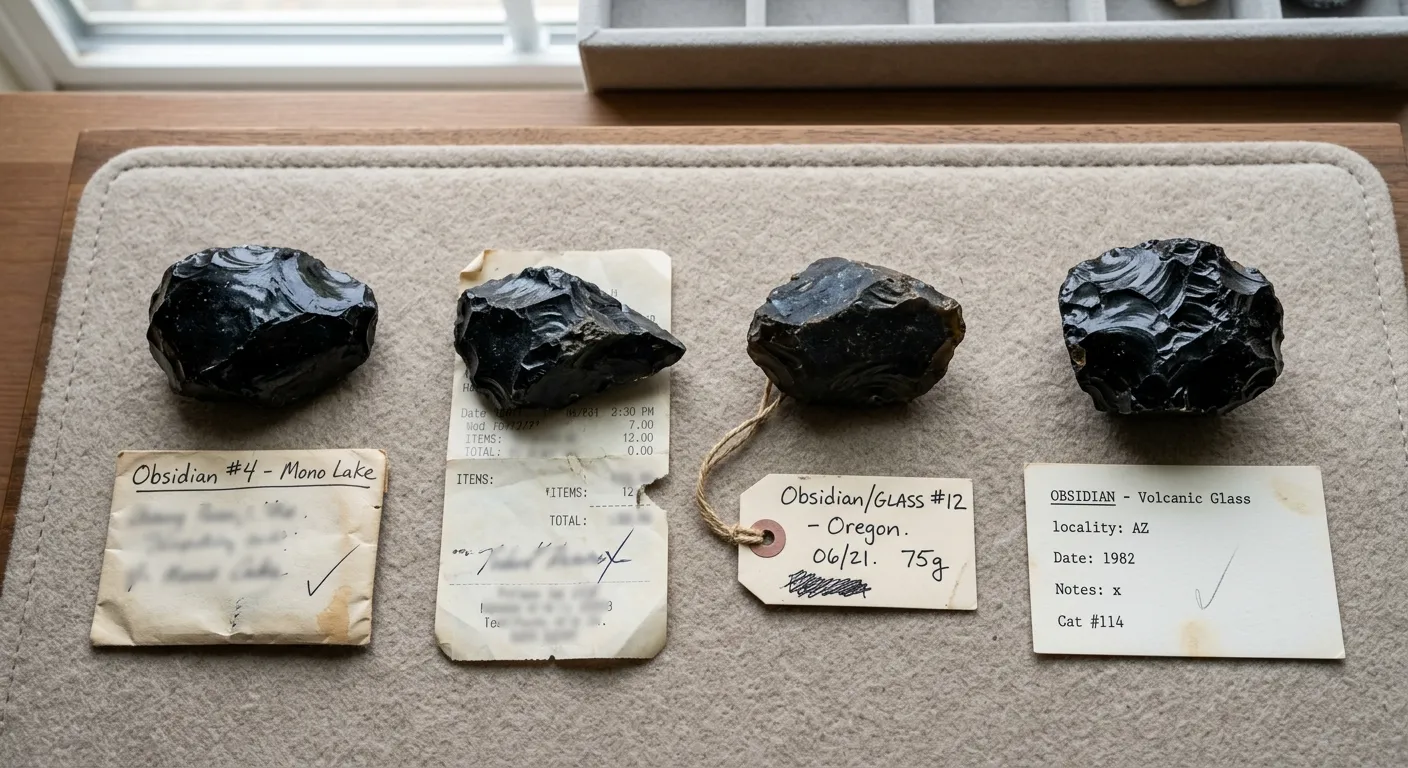
A loose stone marked only “obsidian” may be easy to enjoy, but it is not easy to place. Collectors search for obsidian specimen labels because a small card, packet note, receipt, or handwritten tag can change what is actually known about a piece: what it is, where it is said to be from, who handled it, and how strong the record is.
The useful habit is to keep those parts separate. Obsidian names a volcanic glass. A variety name, seller description, locality, and chain of ownership are different kinds of information. A good label does not need to sound grand. It needs to preserve what is known, show where the information came from, and stay connected to the specimen.
upward
Read the full overview first
Use the broader guide first if you need the full scope before this page.
What Provenance Means for an Obsidian Specimen
For a private obsidian collection, provenance is the recorded history attached to a specimen. It may include where the piece was collected, who collected it, when it entered a collection, where it was purchased or traded, and what older labels or records came with it.
Provenance is not the same as material identity. A label that says “obsidian” gives the broad material category: volcanic glass. It does not identify the exact flow, quarry area, collecting site, seller source, or earlier collection. A more detailed variety name, such as a color or sheen term, still does not establish origin unless the locality and supporting records are present.
Read a label as a stack of separate claims:
Material identity
Records that the piece is labeled as obsidian or volcanic glass. By itself, it does not show exact locality, age, source flow, or collection history.
Variety or shop name
Records a visual or market category, such as a sheen, color, or pattern name. By itself, it does not show that the piece came from a locality associated with that name.
Locality
Records a stated or claimed place of origin. By itself, it does not show that the locality is correct without supporting records.
Acquisition history
Records where the collector obtained it. By itself, it does not show the original geological source unless documented.
Original label or catalog number
Creates a link to an earlier collection or record system. By itself, it does not show automatic accuracy or institutional status.
Field notes or map reference
Adds context for a collected specimen. By itself, it does not show legal certainty or scientific sourcing beyond what the notes support.
The stronger the record, the more carefully you can describe the specimen. A piece with an original field label, collector name, date, map reference, and matching catalog entry carries more documentation than a tumbled stone from a mixed shop bin. Both can belong in a collection, but they should not be labeled with the same confidence.
What to Write on an Obsidian Specimen Label
A useful obsidian label is short enough to stay with the stone and structured enough to keep different facts from blurring together. The point is not to make every private collection look like a museum catalog. The point is to avoid losing information.
When available, record:
- Material: Obsidian, volcanic glass, or “labeled as obsidian” if identity has not been checked.
- Variety or appearance note: Black obsidian, snowflake obsidian, rainbow sheen, mahogany-colored, silver sheen, or another visual/shop term if relevant.
- Locality: The most specific place recorded with the specimen, with uncertainty kept visible.
- Source of the locality: Seller tag, old label, field note, prior collector, receipt, catalog card, or family note.
- Collector or prior owner: Name or initials if known and appropriate to keep.
- Date: Field collection date, purchase date, trade date, or approximate period.
- Acquisition source: Shop, show, trade, inherited collection, field trip, or prior collection.
- Catalog number: Your own number, especially for small stones or similar-looking pieces.
- Supporting records: Receipt, original label, photo of old packaging, map note, notebook page, or correspondence.
Obsidian, black volcanic glass. Labeled locality: Glass Buttes area, Oregon, USA. Locality from seller tag, 2024. Acquired at mineral show. Collection no. O-024. Original tag retained.
Obsidian, tumbled. Locality unknown. Purchased from mixed retail lot, 2025. No original locality label.
Obsidian, rough fragment. Family note reports collection in the western U.S.; exact locality undocumented. From prior collection of J.M., acquired 2026. Original envelope retained.
These phrases may feel less exciting than a confident place name, but they protect the specimen’s actual record. They also help a future reader see whether a statement came from a field note, seller, older collector, family memory, or later interpretation.
How to Read an Obsidian Locality Label
An obsidian locality label should be read as a record first, not as automatic proof. Some labels are precise and well supported. Others are broad, copied from seller language, or separated from the stone long before you received it.
Start with the wording. “Mexico” is broad. “Near a named town” is more useful, but still needs context. A specific collecting site, date, and collector name gives more to work with. If the note also matches a catalog number, receipt, or field notebook entry, the locality is better documented.
A locality statement may be:
- Documented locality: Supported by associated records such as field notes, original labels, collector information, a receipt with source details, a catalog card, or a mapped collecting note.
- Claimed locality: Stated on a seller tag, verbal note, or later label, but not backed by additional records.
- Undocumented locality: Missing, too vague to use, or attached only by assumption.
- Inferred locality: Guessed from appearance, variety name, or resemblance to other specimens; this should be marked as interpretation.
Visual comparison is tempting with obsidian because color, sheen, banding, snowflake-like cristobalite patterns, and mahogany tones are easy to notice. Those features can help describe a specimen, but they do not establish origin on their own. Similar-looking obsidian may be sold under different names, and polish can emphasize traits that are not locality-specific.
For most private collections, the right locality is the most specific wording that came with the specimen, without adding detail that is not documented. If an old label says “Oregon,” do not upgrade it to a specific collecting area because the piece resembles photos. Preserve the old wording and add a modern note: “Older label gives Oregon only; exact locality not recorded.”
Seller Label vs Collector Label for Obsidian
A seller label and a collector label serve different purposes. A seller label may identify a product, make a variety name recognizable, or give a broad source description. A collector label should preserve specimen information and separate fact, claim, and uncertainty.
A shop card might say “rainbow obsidian,” “gold sheen obsidian,” or “Mexican obsidian.” Those words can be useful as received language, but they should not automatically become your final provenance statement. “Rainbow obsidian” describes an appearance or market category. “Mexican obsidian” may be a broad seller-provided locality. Neither phrase, alone, records the collection site, collector, date, or chain of custody.
A collector label can keep the seller wording without overstating it:
Obsidian, rainbow sheen variety. Seller-provided locality: Mexico. Purchased 2026. No site-level documentation. Seller card retained.
This preserves what the seller said while keeping the level of support visible. Many collection errors begin when cautious wording such as “sold as” is copied later as a confirmed locality.
The same caution applies to private collection cards. A neat label in a tray may be useful evidence of what a prior collector recorded, but its strength depends on the information behind it.
Old Handwritten Labels: What They Can and Cannot Show
Old handwritten labels are often worth keeping even when they are messy, incomplete, or written in outdated terms. They can preserve earlier wording, prior ownership, older locality names, collection numbers, and the way a specimen moved through collections.
They do have limits. An old-looking label may have been copied from another label, written years after collection, or paired with the wrong specimen at some point. Age can make a label interesting, but not automatically accurate.
When you receive an obsidian specimen with an older note, resist the urge to replace it with a cleaner, more confident version. A better method is to keep both:
- Preserve the original label in a small envelope, bag compartment, or sleeve kept with the specimen.
- Add a modern label that transcribes the old wording and explains what is known.
- Mark uncertainty instead of smoothing it over.
- Photograph the specimen with the old label if there is any chance they may be separated.
Obsidian. Old handwritten label reads “Idaho obsidian.” No collector name or date. Exact locality undocumented. Original label retained in packet.
If the old label has abbreviations, do not expand them as fact unless the meaning is clear. “Coll.” may mean collected by or collection of, depending on context. “Loc.” usually points to locality, but the precision still depends on the wording. “Ex.” often indicates a prior collection, but the label should make clear whose collection is meant if known.
Loc.
Commonly means locality. Read it as a place recorded on the label, not proof by itself.
Coll.
May mean collected by or collection of. Context matters; do not assume which meaning.
Ex.
Often means from the collection of. It is a useful ownership clue if the name is clear.
Acq.
Usually indicates acquired, often as an entry, purchase, or trade date.
No. / #
Usually a catalog or specimen number. Its meaning depends on the matching record.
ca.
Means circa, approximately. It may qualify date or place information.
s.l.
May mean without locality in some collection contexts. Confirm before using; abbreviations vary.
If an abbreviation is ambiguous, copy it exactly and add a note such as “abbreviation not interpreted.”
Keeping Labels with Small Tumbled Stones and Mixed Lots
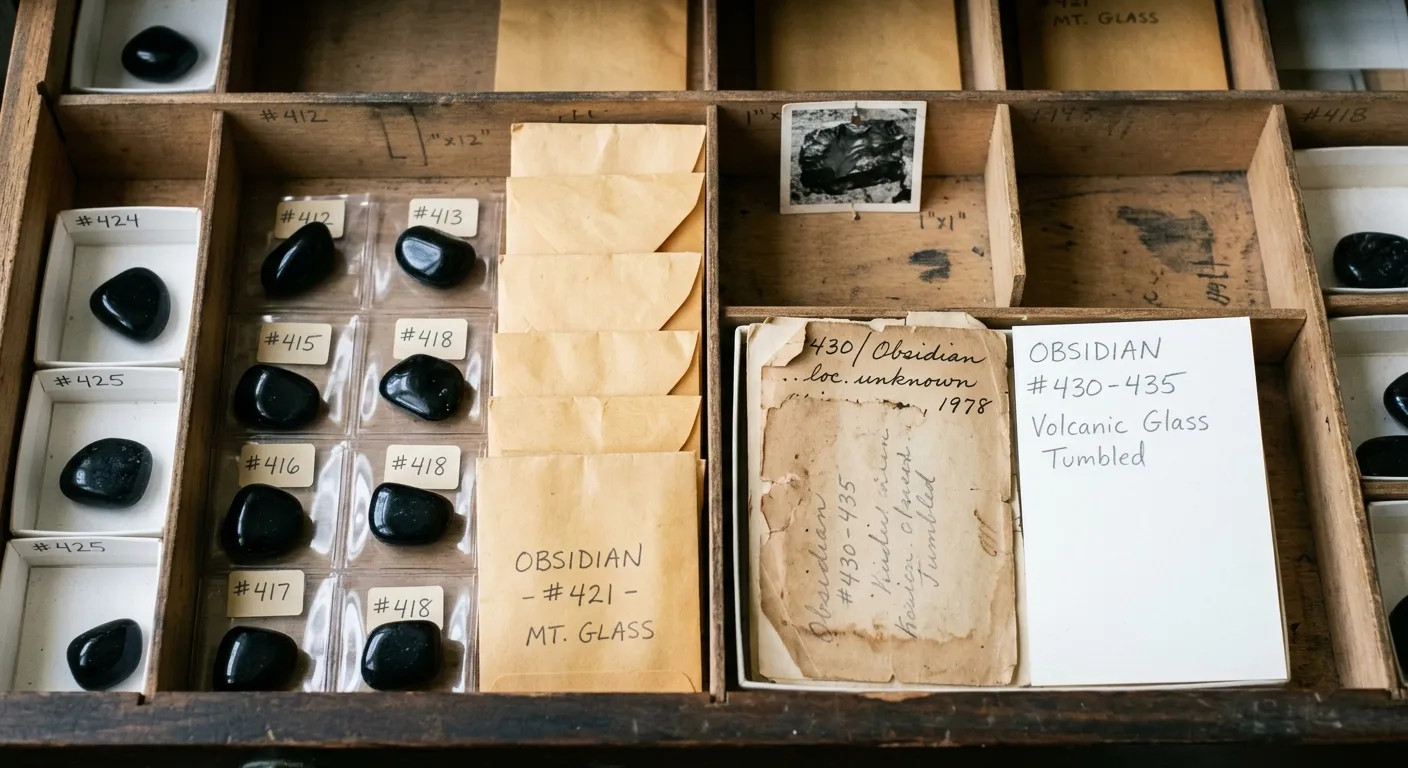
Small tumbled obsidian pieces create a practical problem: they are easy to separate from their records. Once a group of similar black stones is mixed, a label may no longer apply to any one piece with confidence.
For small stones, keep the label at the batch level unless individual identity is clear. If you buy ten tumbled stones in one packet with one seller card, label the packet or tray cell as a group:
Batch: 10 tumbled obsidian stones. Seller label: black obsidian, locality not provided. Purchased 2026.
If one stone came with its own small card, keep it in a separate bag or compartment. Do not later assign that card to another similar piece. For tiny stones, a catalog number can go on the container rather than the stone itself. A photo of the stone beside the label can also help maintain the association.
When a mixed lot contains several variety names, avoid over-sorting by guesswork. A black tumbled stone, a sheen stone, and a snowflake-patterned stone may be visually distinguishable, but their original source information can still be unknown. The label should say that clearly:
Mixed tumbled obsidian lot. Visual varieties separated by appearance; individual localities not documented. Original retail label retained.
That kind of note is not a downgrade. It is a more accurate record of what the collection actually knows.
Field-Collected Obsidian and Acquisition History
Field-collected obsidian can have strong provenance when the collector records details at the time of collection. It can also become vague quickly if the piece is stored without notes.
For a field-collected specimen, useful details include:
- Date collected
- Collector name
- General land area or site name, as appropriate
- Map reference or GPS note, if used and preserved responsibly
- Field notebook page or trip record
- Bag number that matches the field notes
- Any permission or access note relevant to the collection context
- Photos of the collecting setting, if kept with the record
Public-land and access rules vary by place and date. General rockhounding guidance is useful background, but a private label should not turn it into a legal conclusion. A label can record “collected during permitted club trip” if that is what the records say, but it should not say more than the documentation supports.
For purchased field-collected material, keep the chain visible:
Obsidian nodule. Seller stated field-collected from [recorded area]. Purchased from collector at show, 2026. No original field notebook provided. Seller tag retained.
That sentence tells a future reader the difference between a direct field record and a seller-provided story. It does not reject the statement; it keeps the level of support visible.
A Practical Confidence Scale for Obsidian Provenance
Because labels vary widely, it helps to sort provenance into working levels. This is not an official grading system. It is a collector’s way to avoid using the same tone for very different records.
Material only
You have the piece labeled or identified as obsidian, with no locality. Phrase it as “Obsidian; locality unknown.”
Seller-provided
You have a shop card, invoice, or verbal seller source, but no deeper record. Phrase it as “Seller-provided locality…” or “Sold as…”
Prior-collection record
You have an old label, catalog number, or collection name, but limited field detail. Phrase it as “Old label records…” or “From prior collection of…”
Field-documented
You have collector, date, locality, and notes associated with the specimen. Phrase it as “Collected by… on… at…”
Cross-referenced
The label matches a catalog, field notes, map reference, receipt, or collection record. Phrase it as “Documented by associated label, catalog entry, and field notes…”
Most private specimens will sit in the middle. That is normal. The goal is not to force every piece into the strongest category. The goal is to stop a weak record from being repeated as a strong one.
When the locality is unknown, do not leave the field blank if that might invite later invention. Write “locality unknown” or “no locality data.” When a locality is plausible but not documented, use “reported,” “labeled as,” or “claimed.” When the source is clear, name it: old label, seller tag, family note, prior collection card, or field notebook.
Should You Keep Original Labels with Obsidian Specimens?
Yes. Keep original labels whenever possible, even if you add a clearer modern label. Original labels can carry information that is not visible in the stone: older locality wording, collector names, former catalog numbers, acquisition routes, and the exact language used when the specimen entered a collection.
Do not overwrite an old label’s uncertainty with a cleaner story. If the original says “Apache tears, Arizona?” keep the question mark in your transcription. If it says only “obsidian,” do not add a locality unless another record supports it. If a seller card uses a variety name, keep it as seller language rather than turning it into provenance.
A simple preservation habit is enough for most collectors:
- Keep old paper labels in the same box, tray, or bag as the specimen.
- Use a second inner sleeve if the label is fragile or dirty.
- Add your own label rather than writing over the old one.
- Photograph the specimen, old label, and new label together.
- Record your catalog number on the container and in a notebook or spreadsheet.
- If a label and stone become separated, mark the association as uncertain rather than reattaching it confidently.
Obsidian specimen labels are small, but they carry the difference between a stone that is merely named and a specimen with context. A careful label should tell the next reader what the material is, what the locality record says, where the information came from, and which parts remain open.