
Volcanic glass formation
How Obsidian Forms from Lava
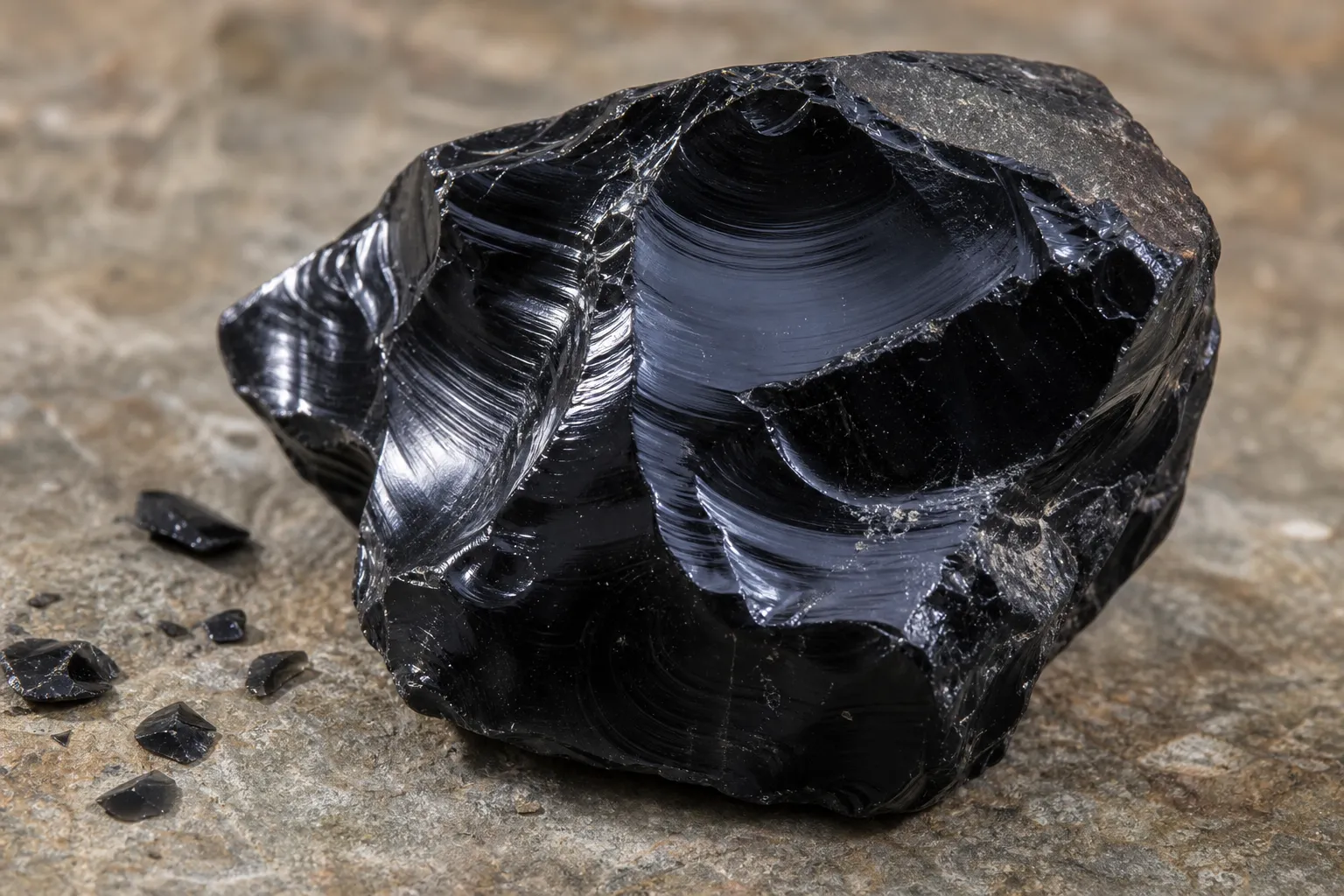
If a glossy black stone is labeled “obsidian,” its formation story is more than geology trivia. It explains why the piece may look glassy rather than grainy, why broken areas can show curved fractures, and why bands, bubbles, sheen, or snowflake-like patches may appear in some specimens.
The short answer to how obsidian forms is this: silica-rich volcanic material cools into natural volcanic glass before large, visible mineral crystals can develop. The fuller answer has a few moving parts. Composition, cooling conditions, gas behavior, and volcanic setting all influence whether a melt becomes dense obsidian, pumice-like material, crystalline rhyolite, or a mixed-texture rock.
This page is about natural volcanic formation. It is not a method for handling molten lava, cooling lava, or trying to manufacture obsidian.
upward
Start with the broader guide
Use the broader guide first if you need the full scope before this page.
From silica-rich lava to volcanic glass
Obsidian starts as molten volcanic material. In most collector-level geology, it is linked with silica-rich lava, commonly rhyolitic in composition. Silica-rich melts tend to be viscous, meaning they resist easy flow compared with many lower-silica lavas. That thick, resistant behavior helps explain why crystal growth, gas escape, and flow textures can become complicated.
A simple formation sequence looks like this:
- Silica-rich magma rises and reaches a shallow volcanic setting. Obsidian is most often discussed around lava flows, domes, flow margins, and other near-surface volcanic environments.
- The molten material cools in a way that limits visible crystal growth. Minerals need time and suitable conditions to organize into crystals. When that process is interrupted at the scale you can inspect by eye, the material may become glassy instead of visibly grainy.
- The melt solidifies as natural volcanic glass. Rather than separate mineral grains, a collector sees a smooth, vitreous texture. This is why obsidian is described as volcanic glass.
- Movement, gas loss, fracture, and later textural change can add detail. Real obsidian is not always a plain black glass. Flow bands, tiny bubbles, pale patches, sheen, and color variation can reflect what happened during cooling, deformation, gas escape, or later alteration.
For beginners, the key point is that obsidian is not simply “lava that got wet” or “any shiny black glass.” It is natural volcanic glass formed under particular volcanic conditions.
Why obsidian becomes glass instead of a visibly crystalline rock
Many igneous rocks are crystalline. Granite, for example, is visibly grainy because its minerals had time to grow underground. Some volcanic rocks cool faster at or near the surface and become fine-grained, but they still contain crystals, often too small to see clearly without magnification.
Obsidian sits at the glassy end of that texture spectrum. Its surface tells you that the melt did not grow the obvious interlocking mineral grains many collectors expect in crystalline rocks.
Cooling speed matters, but it is not a stopwatch
A common explanation says obsidian forms because lava cools “very fast.” That is a useful starting point, but it can become misleading if treated as one fixed number of seconds or one universal temperature rule.
Obsidian-bearing flows and domes can have uneven cooling histories. The top, base, edges, fractured zones, and interior of the same lava body may cool and deform differently. A piece from one zone may be dense and glassy; another may be banded, bubbly, or partly crystallized.
For a collector, the practical translation is: glassy texture means crystal growth was limited at the hand-sample scale. It does not prove that every specimen formed in exactly the same way or at the same pace.
Silica-rich composition raises the chance of glass
Composition changes the result. Silica-rich volcanic material tends to form glass more readily than many lower-silica lavas because its melt structure and viscosity can slow crystal growth and movement within the melt. That is why obsidian is commonly associated with rhyolite and related volcanic rocks.
Silica content is not something you can confirm from shine alone. It is part of the melt’s chemistry before cooling, not a surface effect caused by polish.
Gas changes the final texture
Gas can push the same general volcanic setting toward different-looking materials. If gas remains abundant and expands through the melt, the result may be frothy or pumice-like rather than dense obsidian. If bubbles collapse, escape, or stretch as the lava moves, the rock may show cavities, bands, streaks, or mixed textures.
That is why two volcanic pieces can share a broad origin story but look very different in the hand.
Where obsidian forms around a volcano
Obsidian can form where lava or shallow molten material cools into glass. Common settings include rhyolitic lava flows, lava domes, flow margins, and near-surface zones where molten material chills against cooler surroundings.
It helps to picture obsidian formation as uneven rather than instant. A thick, silica-rich volcanic mass may move slowly, crack, lose gas, fold, cool along its margins, and preserve different textures in different zones.
Above ground or underground?
Obsidian is strongly associated with surface and near-surface volcanic cooling, including flows and domes. It may also appear along shallow chilled margins. The important factor is not a simple “above ground versus underground” rule, but whether the melt cools and solidifies in a way that preserves glass.
Deep underground, slow cooling generally gives crystals more opportunity to grow. Near the surface, faster cooling can preserve glass. In real deposits, the boundary is not always neat.
Can obsidian form in water?
Water can chill lava rapidly, and volcanic glass can form when hot volcanic material meets water or another cool environment. But “lava plus water equals obsidian” is too simple. Natural volcanic glass formation still depends on chemistry, cooling history, gas behavior, and setting.
If your search began with “how to make obsidian,” a more useful collector question is: what natural volcanic conditions produced this glassy rock, and do the visible traits fit that story?
What formation explains in a specimen
Formation is useful because it connects the science to visible features.
Glassy luster
Melt solidified as volcanic glass rather than visible crystals.
Shine supports the possibility of obsidian, but does not prove natural origin by itself.
Little or no visible grain
Crystal growth was limited at normal hand-sample scale.
The piece should not look like a coarse crystalline rock.
Curved fracture
Glass commonly breaks with conchoidal, shell-like fracture.
Fresh chips and thin broken edges can be extremely sharp.
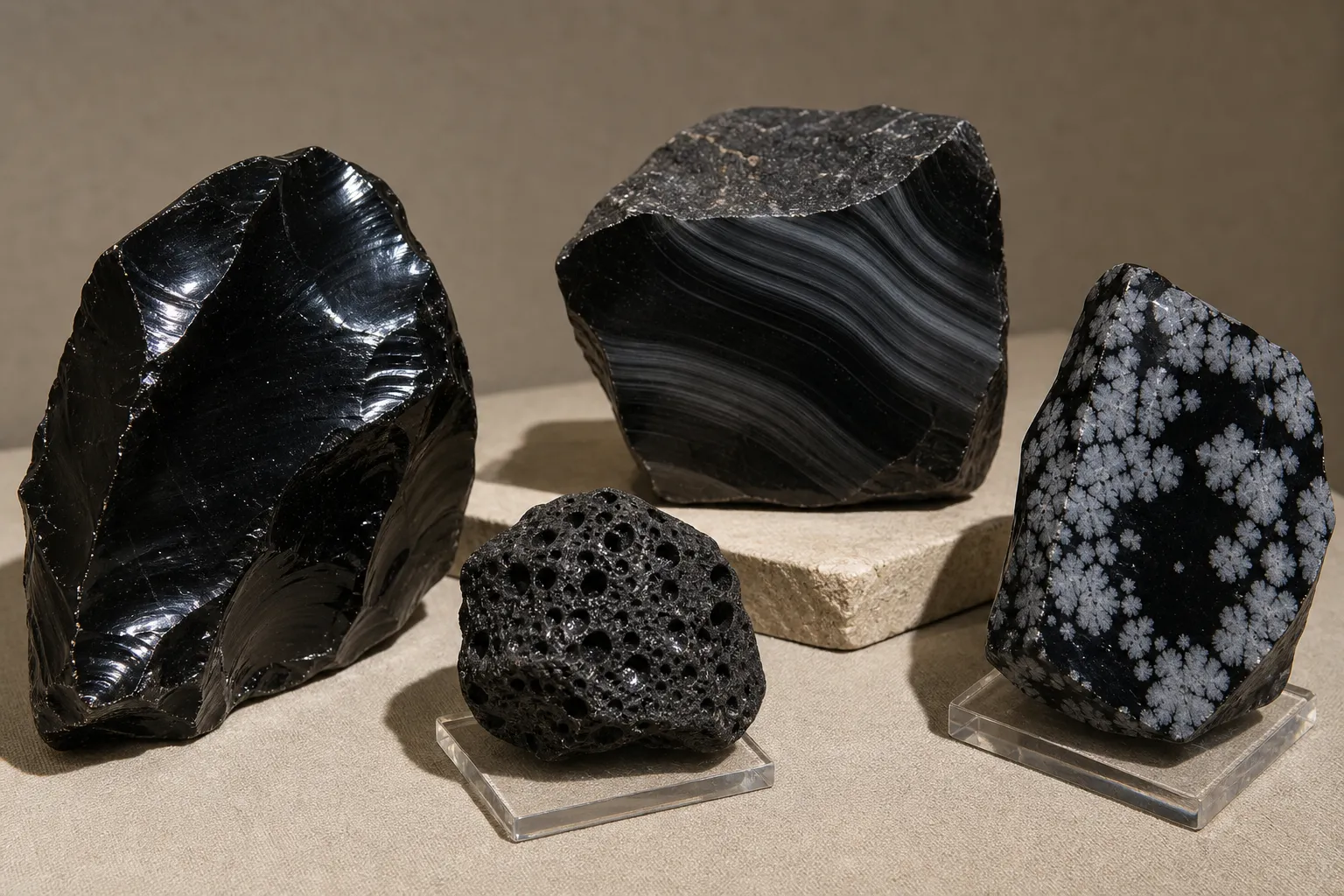
Flow bands
Viscous lava moved, stretched, folded, or cooled unevenly.
Bands may be subtle and lighting-dependent.
Bubbles or vesicles
Gas expanded, escaped, collapsed, or became stretched during movement.
Many bubbles may suggest pumice-like material or slag, depending on context.
Snowflake-like patches
Later crystallization within the glass can form pale rounded aggregates.
These patches do not mean the whole rock began as a grainy rock.
Sheen or rainbow effect
Fine internal layers, bubbles, inclusions, or textures affect reflected light.
Variety names should be checked visually, not accepted from a label alone.
Glassy does not mean perfectly featureless
Obsidian is glassy, but it may still contain tiny crystals, microlites, bubbles, inclusions, or bands. Some are too small or subtle for casual inspection. Others create familiar collector names such as snowflake obsidian, sheen obsidian, mahogany obsidian, and rainbow obsidian.
A careful description is: obsidian usually lacks the visible mineral grains of crystalline rocks, but it can still contain small internal features.
Why broken obsidian can be so sharp
The same glassy structure that gives obsidian its smooth curved fracture can also create sharp brittle edges. Conchoidal fracture means the break forms shell-like curves instead of splitting along flat mineral cleavage planes. Fresh chips, broken points, cut pieces, and thin edges should be handled carefully.
That handling note belongs in a formation guide because it follows directly from the material’s glassy nature. It does not make every piece dangerous in the same way, but broken or worked obsidian deserves more care than a rounded tumbled stone.
Why some lava becomes obsidian and some does not
Not every lava flow produces obsidian. Several variables change the outcome.
1. Composition
Silica-rich volcanic material is more likely to form obsidian than many lower-silica lavas. Basaltic lava can form volcanic glass in some situations, but the collector material commonly called obsidian is usually tied to silica-rich, often rhyolitic, volcanic settings.
2. Cooling conditions
Cooling has to limit visible crystal growth. Chilling along surfaces, margins, fractures, or contact zones can favor glassy texture. Slower cooling gives crystals more time to form. A thick lava body may preserve glassy zones next to more crystalline ones.
3. Gas content and degassing
Gas can separate dense obsidian from frothy or pumice-like material. As magma rises and pressure changes, dissolved gases may form bubbles. Those bubbles may expand, collapse, escape, or stretch during flow.
4. Movement and deformation
Obsidian-bearing lava is often viscous. As it moves, it can fold, stretch, break, weld, and develop flow bands. Those bands are not painted stripes; they can reflect differences in bubbles, tiny crystals, glass texture, or flow history.
5. Later alteration
Obsidian is glass, and glass can change over time. It may hydrate or partly crystallize after formation. Snowflake obsidian is a familiar collector example: pale rounded crystal aggregates appear within darker volcanic glass. The patches change the appearance, but they do not erase the glassy volcanic origin.
Obsidian versus crystalline rock, manufactured glass, and slag
Formation also helps with one of the most common identification limits: a shiny black surface is not enough. Natural obsidian, manufactured glass, slag, and some polished stones can all look glossy.
Obsidian versus crystalline volcanic rock
A crystalline volcanic rock may be dark and fine-grained, but it usually does not have obsidian’s continuous glassy look. Its broken surface may appear duller, stonier, or more granular. Some rhyolite can be partly glassy and partly crystalline, so texture and volcanic context both matter.
Obsidian versus manufactured glass
Manufactured glass can look very similar to obsidian, especially when black, brown, green, or translucent. Polish, color, and a seller’s label do not establish natural origin.
Useful clues may include fracture style, bubbles, flow-like texture, source information, and whether the appearance fits known natural obsidian varieties. Even then, a photo or quick glance may not settle every case.
Obsidian versus slag
Slag can be glassy and bubbly, with colors and textures that attract collectors. Some slag is sold as, or mistaken for, natural volcanic glass. Abundant rounded bubbles, unusual industrial colors, or a source story tied to smelting or dumping may point away from natural obsidian.
Still, the distinction should be made carefully. A few bubbles do not rule out obsidian, and a glossy black surface does not confirm it.
Common questions about obsidian formation
How long does obsidian take to form?
There is no single collector-safe number for all obsidian. The glassy texture forms when cooling and crystal-growth conditions prevent visible crystals from developing. Different parts of a flow or dome can cool at different rates, so exact time claims should be treated cautiously unless they are tied to a specific studied deposit.
What kind of lava forms obsidian?
Obsidian is most commonly associated with silica-rich volcanic material, especially rhyolitic lava. Composition is a major reason obsidian differs from many ordinary lava rocks. It is not the only factor, though. Cooling history, gas behavior, and emplacement setting also shape the final material.
Does obsidian form above ground?
Often, yes, in the sense that it is commonly associated with surface or near-surface volcanic settings such as lava flows and domes. But “above ground” is not the complete rule. Shallow chilled margins can also preserve glassy material, while deeper slow cooling usually favors more visible crystal growth.
Can obsidian form again after a volcano erupts?
A future eruption in a suitable volcanic system could produce new obsidian if the chemistry and cooling conditions allow glass to form. An old piece of obsidian does not grow into new obsidian after it has already solidified. Later changes may alter the glass or produce crystallized patches, but that is different from fresh formation from lava.
Is obsidian the same as glass made by people?
No. Obsidian is natural volcanic glass. Manufactured glass may share a glassy texture and similar colors, but it has a different origin. For collecting and identification, origin matters: a glassy object is not automatically natural obsidian.
A practical way to read the formation story
When examining a piece labeled obsidian, connect the formation process to what you can observe:
- Look for a glassy surface or broken face, not a coarse grainy texture.
- Check chipped areas for curved, smooth-looking fracture.
- Notice bands, bubbles, snowflake patches, sheen, or color zones, but treat variety names as visual descriptions rather than proof of origin.
- Be cautious with perfect shine alone, because polish, manufactured glass, and slag can also look glossy.
- Handle broken edges carefully, since glassy fracture can create very sharp margins.
The best collector-level answer to how obsidian forms is not a slogan about fast cooling. It is a linked set of conditions: silica-rich volcanic material, cooling that limits visible crystal growth, gas and flow behavior that shape texture, and a glassy structure that explains both the surface beauty and the brittleness of the stone.