
Collector identification
Are Apache Tears a Type of Black Obsidian
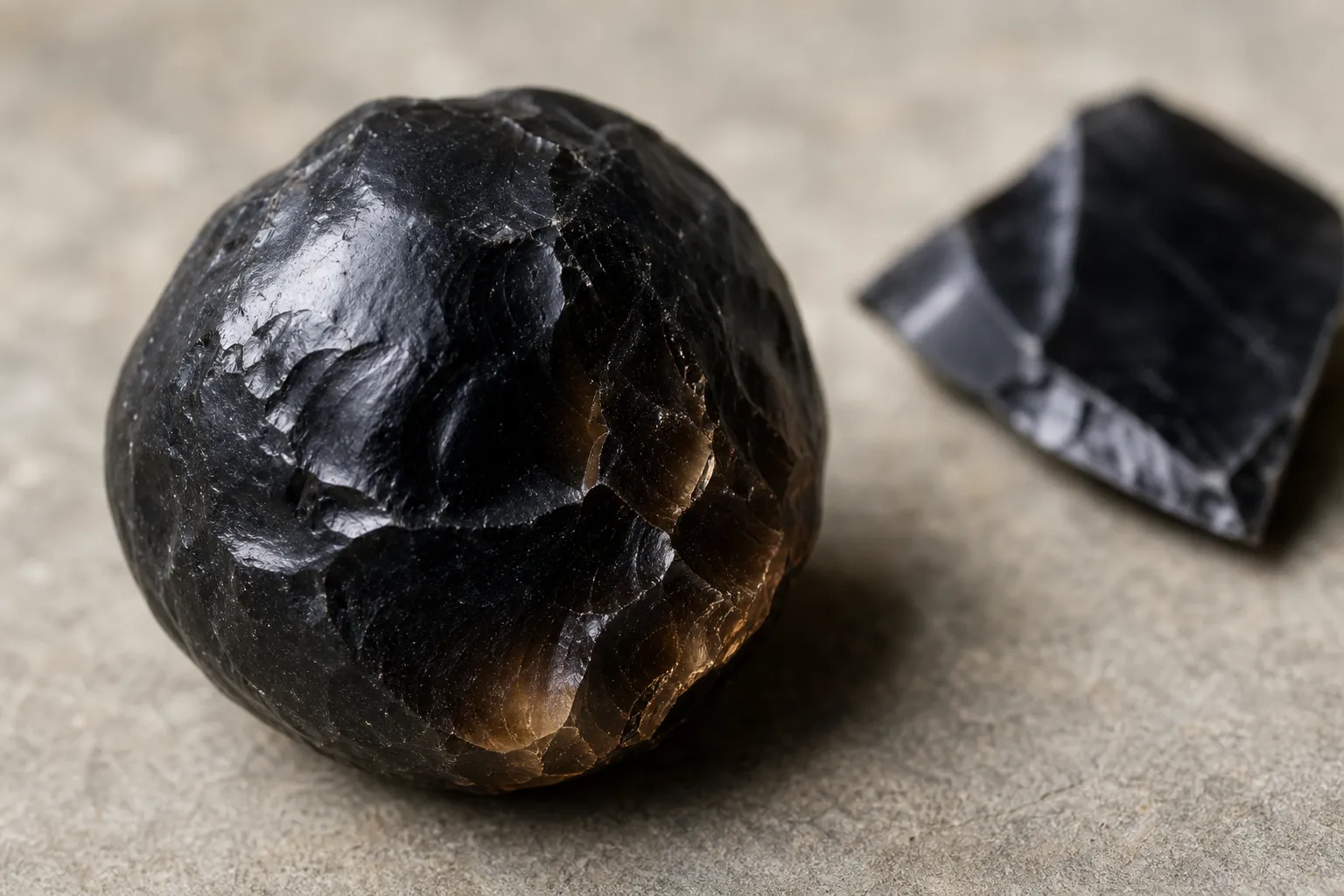
Yes. In ordinary collector language, Apache tears are usually treated as a type of black obsidian: small, rounded or nodule-like pieces that look dark in normal light and may show a smoky edge when held to strong light.
The careful answer to “are Apache tears black obsidian” is slightly narrower: the name usually points to a small black obsidian nodule, not every black glassy stone. The label still depends on the actual specimen, the lighting, the surface condition, and whether the seller or collector is using the term precisely.
upward
Read the full overview first
Use the broader guide first if you need the full scope before this page.
The Short Collector Answer
Apache tears and black obsidian overlap, but they are not perfect synonyms.
- Black obsidian is the broader material and collector category.
- Apache tear obsidian is a more specific name, usually used for small rounded nodules or pebble-like pieces.
- A black glassy stone is not automatically an Apache tear.
- A smoky edge can support the label, but it does not confirm it by itself.
This page keeps the answer practical rather than absolute. No source set was supplied here for stronger claims about formation, locality, or certified identification, so the useful approach is to treat “Apache tear” as a collector label and check whether the visible traits fit.
What Makes an Apache Tear Different From Ordinary Black Obsidian?
The difference is mainly form, not a completely separate material category.
A typical black obsidian piece might be a rough chunk, flake, slab, carved shape, bead, cabochon, or tumbled stone. An Apache tear is usually discussed as a small, compact, rounded nodule: dark in the hand, pebble-like in shape, and sometimes smoky at thinner edges.
That is why “small black obsidian nodules” is a more precise phrase than simply “black obsidian.” It describes the object type as well as the material.
Before accepting the name, look at three things:
Main distinction
Apache tear is usually a narrower collector label for a small rounded obsidian nodule. Black obsidian is the broader material category.
-
Shape
Apache tears are usually expected to be small, rounded, or nodule-like. A flat flake, blade-like piece, or large rough chunk may still be obsidian, but it may not fit the narrower Apache tear label.
-
Light behavior
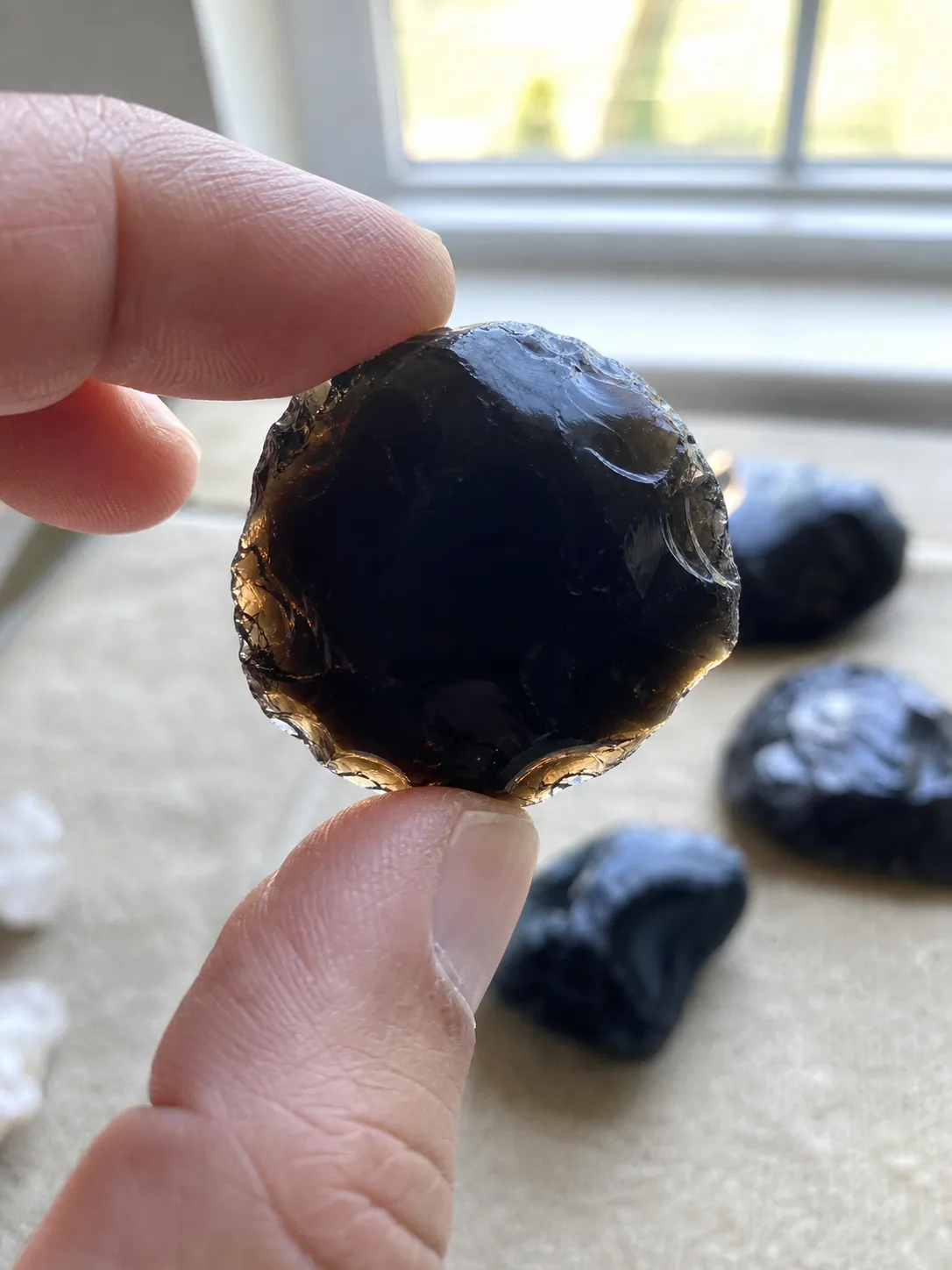
Some pieces that look black in normal light show brownish, grayish, or smoky translucence at thin edges under strong light. Thickness, polish, and camera exposure can change this effect.
-
Surface and context
Natural-looking surfaces, tumbled finishes, drilled holes, and polished shapes can all change how confidently the original nodule form can be read.
The point is not to make the name difficult. It is to keep it useful.
Apache Tears Identification: What You Can Inspect
Start with what you can actually see.
Check the form first
First, check whether the piece looks like a nodule rather than a random chip. A rounded form supports the Apache tear label better than a sharp, flat fragment does.
View it in ordinary light
Second, view it in ordinary light. Many Apache tear pieces are handled as black stones in trays, bowls, or collection boxes. If the piece reads as a different color in normal light, the label needs more explanation.
Look for edge translucence
Third, hold a thin edge near a bright light. Some black obsidian nodules look smoky or translucent at the edge because thinner areas allow more light through than the thicker center. That is why the same piece may be described as both black and smoky.
Account for alteration
Fourth, consider whether it has been polished, dyed, coated, drilled, or shaped. A worked pendant or bead may still be sold under Apache tear wording, but the original form may no longer be easy to judge.
Treat photos cautiously
Finally, be cautious with single-photo identification. A photo can suggest Apache tear obsidian, but it may not show scale, edge translucence, surface texture, or enough angles to settle the label.
Why Apache Tears Naming Gets Confusing
Apache tears confusion usually comes from loose naming.
A collector may use “Apache tear” narrowly for small rounded black obsidian nodules. A seller may use it more broadly for small black tumbled pieces. A casual listing may use the term because buyers recognize it.
Common mix-ups include:
- A small black tumbled stone being called an Apache tear even when the original nodule shape is unclear.
- Ordinary black obsidian being described with Apache tear wording because it is small and dark.
- Smoky edges being emphasized in photos even though the effect depends on thickness and lighting.
- Any dark glassy object being assumed to be obsidian because it resembles shop specimens.
Read the name as context, not as a complete identification. A useful listing or collection note should say whether the piece is a natural-looking nodule, a tumbled Apache tear, a polished or drilled piece sold under that name, or simply black obsidian in another form.
Are Smoky Edges Enough to Confirm Apache Tear Obsidian?
No. Smoky edges are helpful, but they are not enough on their own.
A smoky edge can show that a dark piece has some translucence in thin areas. That effect is one reason Apache tears stand out from pieces that look uniformly black. But “smoky edge obsidian” is still a visual description, not a full identification method.
Several things affect what you see:
- Thickness: thin edges can look lighter than the center.
- Lighting: strong backlighting may reveal color that room light hides.
- Polish: a smoother surface can make translucence easier to notice.
- Photography: exposure and contrast can exaggerate edge color online.
- Shape: rounded nodules and broken shards may transmit light differently.
Use the smoky edge as one clue alongside size, shape, surface, and seller context. If buying online, ask for photos in normal light and against light, plus a note on whether the piece is natural, tumbled, or polished.
When the Answer Changes
If someone asks, “Are Apache tears black obsidian?” the ordinary collector answer is yes: they are generally treated as Apache tear obsidian within the black obsidian family.
If the question is about one specific stone, the answer becomes conditional.
It may be reasonable to call it an Apache tear if it is a small dark obsidian nodule with a rounded form and, in some cases, a smoky-looking thin edge. It may be better to call it black obsidian if it is dark and glassy but not nodule-like. It may need a provisional label if it is known only from a seller photo, has been heavily polished, or lacks enough visible features.
For a collection card, cautious wording can be more accurate than a confident label:
- “Apache tear obsidian, seller label”
- “Small black obsidian nodule”
- “Black obsidian, Apache tear style”
- “Possible Apache tear; identification not confirmed from photo”
Those labels preserve uncertainty instead of hiding it.
A Practical Check Before You Label One
Before adding “Apache tear” to a collection note, ask:
- Does the piece appear small and nodule-like rather than flat, blade-like, or chunk-like?
- Does it look black or very dark in ordinary light?
- Do thin edges show any smoky or translucent quality under strong light?
- Is the surface natural-looking, tumbled, polished, drilled, or otherwise altered?
- Is the name coming from your own observation, a seller label, or both?
- Are you identifying the material, or recording the market name it was sold under?
If several answers are uncertain, keep the label provisional. This is especially useful for online purchases, inherited collections, and mixed bowls of small black stones without original labels.
Bottom Line
Apache tears are generally understood by collectors as a type of black obsidian, especially when the piece is a small rounded nodule rather than a larger chunk, flake, bead, or carved form.
The name is more specific than “black obsidian,” so it should not be applied only because a stone is dark. Use the visible traits first: small size, rounded nodule-like shape, black appearance in normal light, and possible smoky translucence at thin edges. Then add the naming context: whether the piece was sold, collected, or documented as Apache tear obsidian.
If those details are missing, “small black obsidian nodule” or “possible Apache tear” may be a more honest label than a firm identification.