Rock type guide
What Type of Rock Is Obsidian
Obsidian is natural volcanic glass in the igneous rock family. More specifically, the obsidian rock type is usually described as volcanic or extrusive igneous because it forms from lava that cools so quickly at or near Earth’s surface that ordinary mineral crystals do not have time to grow.
That can sound odd at first: how can something be both a rock and a glass? In geology, “glass” describes its texture and internal structure, while “igneous” describes its origin. For a collector, the cleanest version is:
Obsidian is igneous by origin, volcanic by setting, glassy by texture, and not a true mineral crystal in strict mineralogy.
upward
Start with the broader guide
Use the broader guide first if you need the full scope before this page.
The short answer for a specimen label
If you are trying to label a piece in a tray or understand a shop description, use this hierarchy:
Broad rock family
Igneous
Formation setting
Volcanic / extrusive
Texture
Glassy
Common description
Natural volcanic glass
Strict mineral status
Not a true mineral crystal
Collector wording
Often sold as an “obsidian crystal,” but that is not strict geology
So, is obsidian igneous? Yes. It belongs with igneous materials because it comes from molten rock. If the question is whether obsidian is intrusive or extrusive, the better answer is extrusive: it forms from lava in a surface or near-surface volcanic setting, not from magma cooling slowly deep underground.
Phrases such as obsidian volcanic rock, extrusive igneous obsidian, and obsidian igneous rock type all point to the same basic idea. Obsidian comes from volcanic lava, even though the finished material looks more like glass than a grainy rock.
Why obsidian is called volcanic glass
Obsidian forms when lava cools rapidly enough that atoms in the melt do not arrange into normal visible crystals. Instead, the material solidifies into a glassy, amorphous structure. “Amorphous” means it lacks the orderly repeating crystal lattice expected in a true crystal.
This rapid cooling explains the familiar obsidian glassy texture. Many igneous rocks cool slowly enough to show mineral grains. Granite, for example, is intrusive and visibly crystalline because its minerals had time to grow underground. Obsidian follows the opposite path: the melt chills quickly, crystal growth is limited, and the result is smooth volcanic glass.
Obsidian is often associated with silica-rich lava, even when the piece looks black or very dark. That matters because beginners sometimes assume every dark volcanic rock is basalt-like. Color alone is not enough. A black obsidian specimen may be glassy and silica-rich, while basalt is generally a fine-grained crystalline volcanic rock with a different texture.
Most accurate short phrase
Obsidian is natural volcanic glass formed from rapidly cooled lava.
Is obsidian a mineral or a crystal?
In strict geology, obsidian is not a true mineral and not a true crystal.
A mineral normally has a defined chemical composition and an ordered crystal structure. Obsidian does not fit that neatly. It is non-crystalline, and its composition can vary from source to source. Mineral references therefore commonly treat obsidian as a natural glass or mineraloid rather than a mineral species.
This is where shop language gets confusing. Many sellers and collectors use phrases such as “obsidian crystal,” “black obsidian crystal,” or “snowflake obsidian crystal.” Those terms are common in the crystal trade and may help people find decorative pieces, but they are not precise mineralogical descriptions.
A polished obsidian palm stone, tower, bead, or cabochon may sit beside quartz, amethyst, or other crystals in a shop display. That does not make obsidian crystalline in the geological sense. It means “crystal” is being used as a retail or collector category.
A simple distinction helps
- Quartz crystal: a true mineral with an ordered crystal structure.
- Obsidian: natural volcanic glass without a normal crystal lattice.
- Polished obsidian object: a shaped collector piece made from volcanic glass.
So if someone asks, “Is obsidian a mineral?” the careful answer is: not in the strict mineral sense, even though it is often grouped with minerals and crystals in shops.
What obsidian looks like in hand
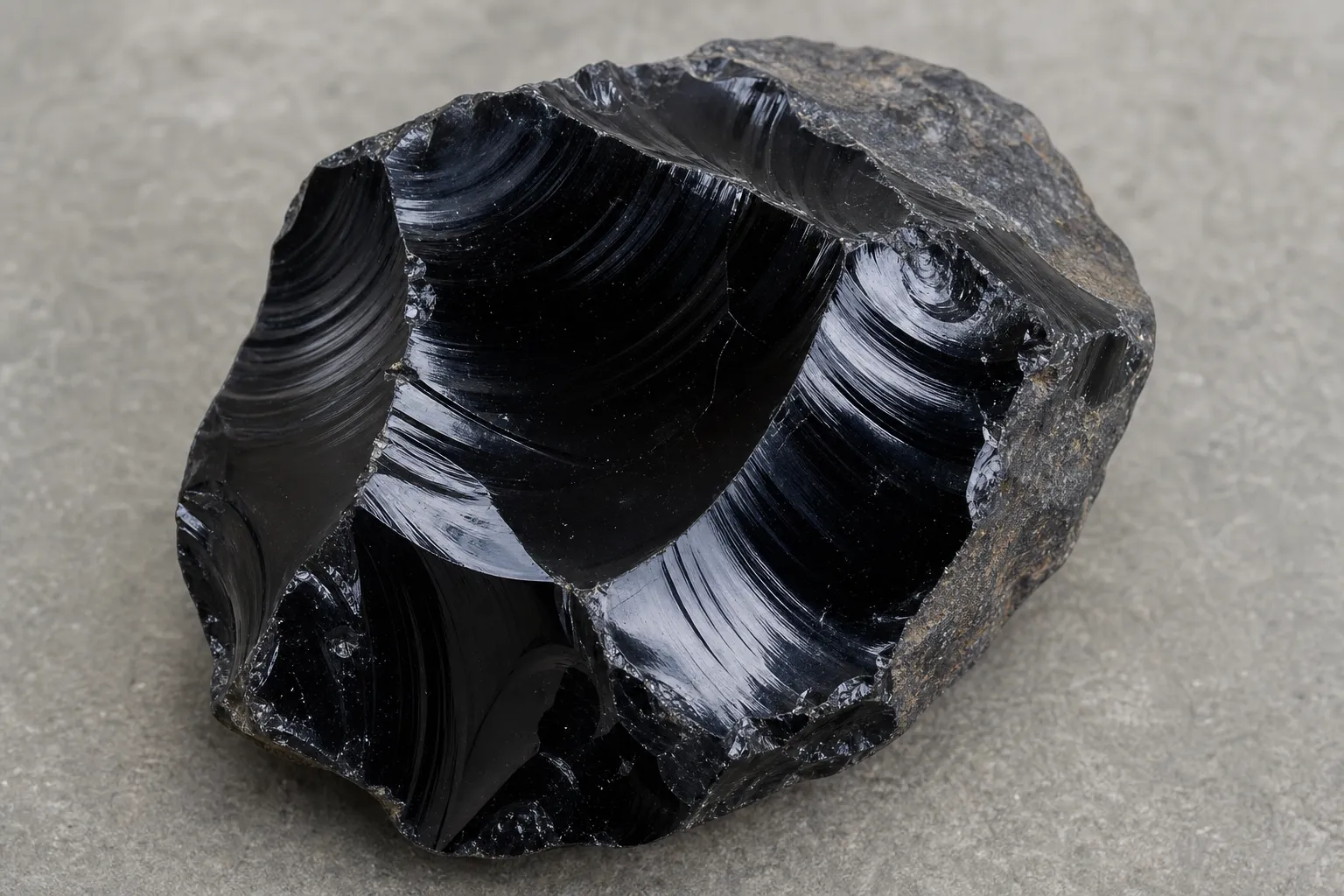
If you are connecting the rock type to what you can see, start with texture rather than color. Obsidian is commonly black or very dark, but it can also show brown, gray, greenish, reddish, banded, or iridescent effects depending on inclusions, oxidation, bubbles, thickness, polish, and lighting.
Useful visual cues include:
- Glassy shine: fresh or polished obsidian often has a vitreous, glass-like luster.
- Smooth surface: it usually lacks the visible grains seen in many crystalline rocks.
- Conchoidal fracture: broken surfaces may curve in shell-like patterns.
- Sharp broken edges: fractured obsidian can be extremely sharp because it breaks like glass.
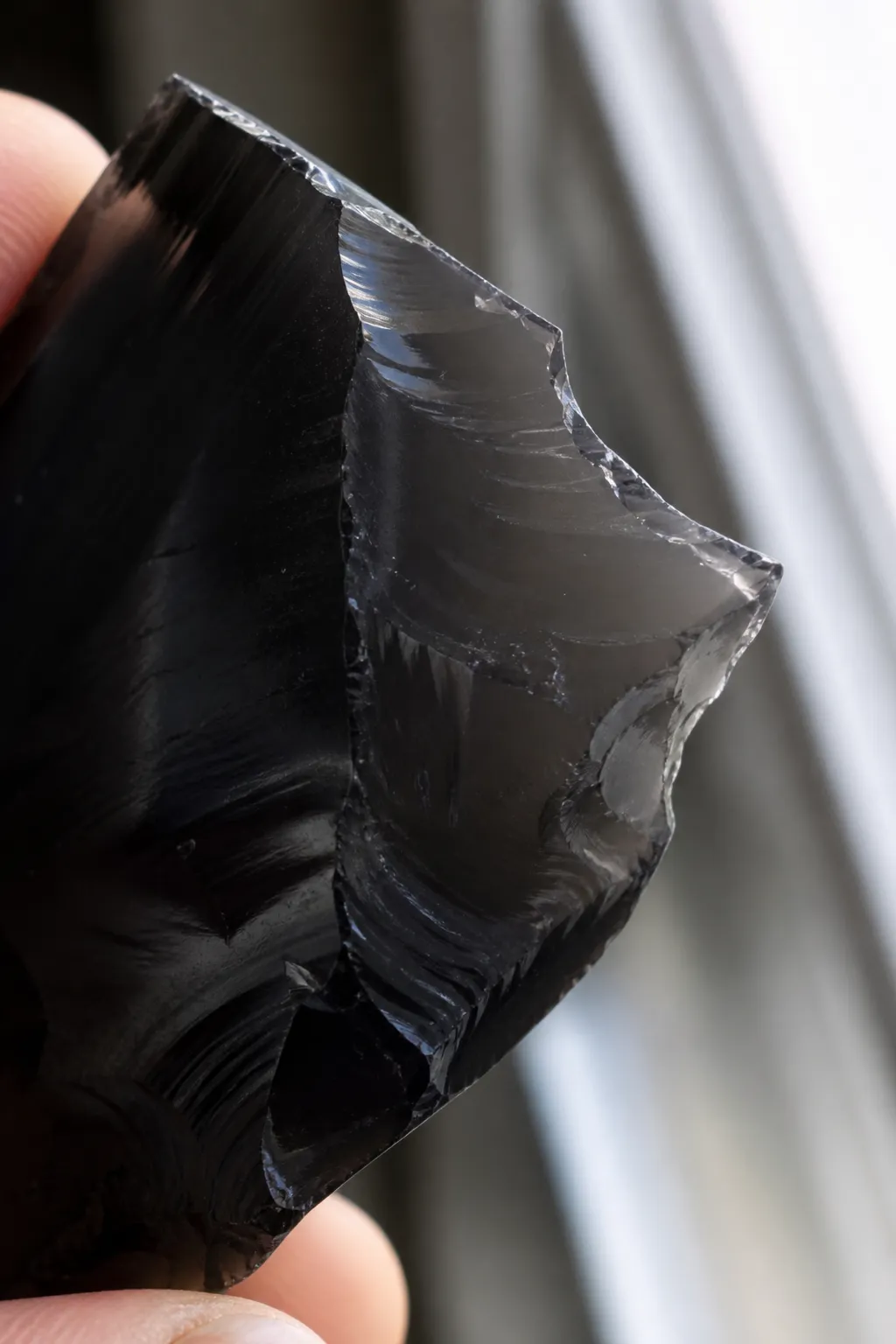
- Thin-edge translucency: some dark pieces show brownish or smoky translucence along a thin edge.
- Flow, banding, or sheen: some varieties show bands, shimmer, or color play when tilted in light.
These clues can suggest obsidian, but they should be read together. A glossy black stone in a photo is not automatically obsidian. Lighting, polish, slag glass, dyed material, and other dark rocks can mislead the eye.
The conchoidal fracture is especially useful. It is the curved, shell-like break pattern typical of glassy materials. For a collector, it is also a handling note: avoid striking or dropping pieces, and treat broken fragments as you would sharp glass.
Obsidian vs basalt, quartz crystal, and man-made glass
A few comparisons clear up the obsidian rock type without turning this into a full rock guide.
Obsidian vs basalt
Both are volcanic, but obsidian is glassy; basalt is generally fine-grained and crystalline.
Obsidian vs quartz crystal
Quartz is a true mineral crystal; obsidian is amorphous volcanic glass.
Obsidian vs man-made glass
Both can look glassy, but obsidian forms naturally from volcanic lava.
Obsidian vs “lava stone” beads
Obsidian comes from lava, but many “lava stone” beads are porous basaltic material rather than glassy obsidian.
The basalt comparison is often the most useful for beginners. Basalt and obsidian can both be dark volcanic materials, but basalt usually has a fine-grained rock texture and may show small holes or crystals. Obsidian looks glassy and may break with curved, sharp surfaces.
The quartz comparison addresses the “crystal” label. Quartz can grow as a visible crystal because its atoms are arranged in a repeating structure. Obsidian did not crystallize that way; it cooled into glass.
The man-made glass comparison explains another common mix-up. “Volcanic glass” does not mean artificial glass. It means naturally occurring glass made by volcanic processes. Some human-made glass can look similar, which is why appearance alone has limits.
Do variety names change the rock type?
No. Variety names usually do not change the basic answer. Black obsidian, snowflake obsidian, rainbow obsidian, gold sheen obsidian, and fire obsidian are still obsidian when the material is genuinely obsidian. Their names describe appearance, inclusions, internal textures, or light effects rather than separate rock families.
For example, snowflake obsidian has pale “snowflake” patterns related to internal crystallization features within the volcanic glass. Sheen and rainbow effects are tied to tiny internal structures, bubbles, or inclusions interacting with light. Those labels are useful for collectors, but they belong in the appearance category.
That means searches such as “snowflake obsidian rock type” or “black obsidian rock type” have the same core answer: the material remains volcanic glass in the igneous family. What changes is the visual variety label.
Polish and lighting can also change how a variety looks. A sheen may appear strong from one angle and weak from another. A dark piece may look opaque in the palm but translucent along a chipped thin edge. Inspecting a piece from more than one angle is usually more helpful than relying on a name alone.
Common misunderstandings
The main classification is simple. The confusion comes from the overlap between geology, collecting language, and shop wording.
The most common misunderstanding is that obsidian must be a true crystal because it is sold with crystals. In strict terms, it is not. “Obsidian crystal” is common collector language, not a precise geological statement.
Another misunderstanding is that all igneous rocks should show crystals. Many do, but obsidian is the classic beginner-friendly exception: its cooling history produced glass rather than ordinary visible mineral grains.
A third mix-up is that dark color means basalt. Obsidian is commonly black, but it is glassy and often silica-rich. Basalt is also volcanic, but it is not the same texture or typical composition.
Finally, “lava stone” is too broad to be a reliable material name. Obsidian is related to lava because it forms from lava, but the useful term is volcanic glass. Porous lava beads sold in jewelry are often closer to basaltic material, not obsidian.
Bottom line
Obsidian is an igneous volcanic material by origin and natural volcanic glass by texture.
The most precise beginner answer is:
Obsidian is an extrusive igneous volcanic glass formed when lava cools rapidly enough to limit normal crystal growth. It is not a true mineral crystal in strict geology, even though collectors and shops often group it with crystals.
For a practical check, look for glassy luster, smooth texture, conchoidal fracture, sharp broken edges, lack of ordinary visible grains, and possible translucency at thin edges. Use those clues together, and remember that photos, polish, lighting, and seller labels can all affect what you think you are seeing.