
Collector decision guide
Obsidian Buying Guide for Collectors
Buying obsidian often looks straightforward: a glossy dark stone, a variety name, a few photos, and a price. The part that matters is usually less obvious. A good purchase depends on what the listing actually shows, what the seller label can and cannot tell you, and how much uncertainty is acceptable for the price and purpose.
This obsidian buying guide is written for collectors comparing real listings. It treats photos, grade words, variety names, and symbolic descriptions as clues, not proof. The goal is to help you decide when to buy, when to ask a follow-up question, and when the listing does not give enough information.
upward
Read the full overview first
Use the broader guide first if you need the full scope before this page.
Start With What the Listing Shows
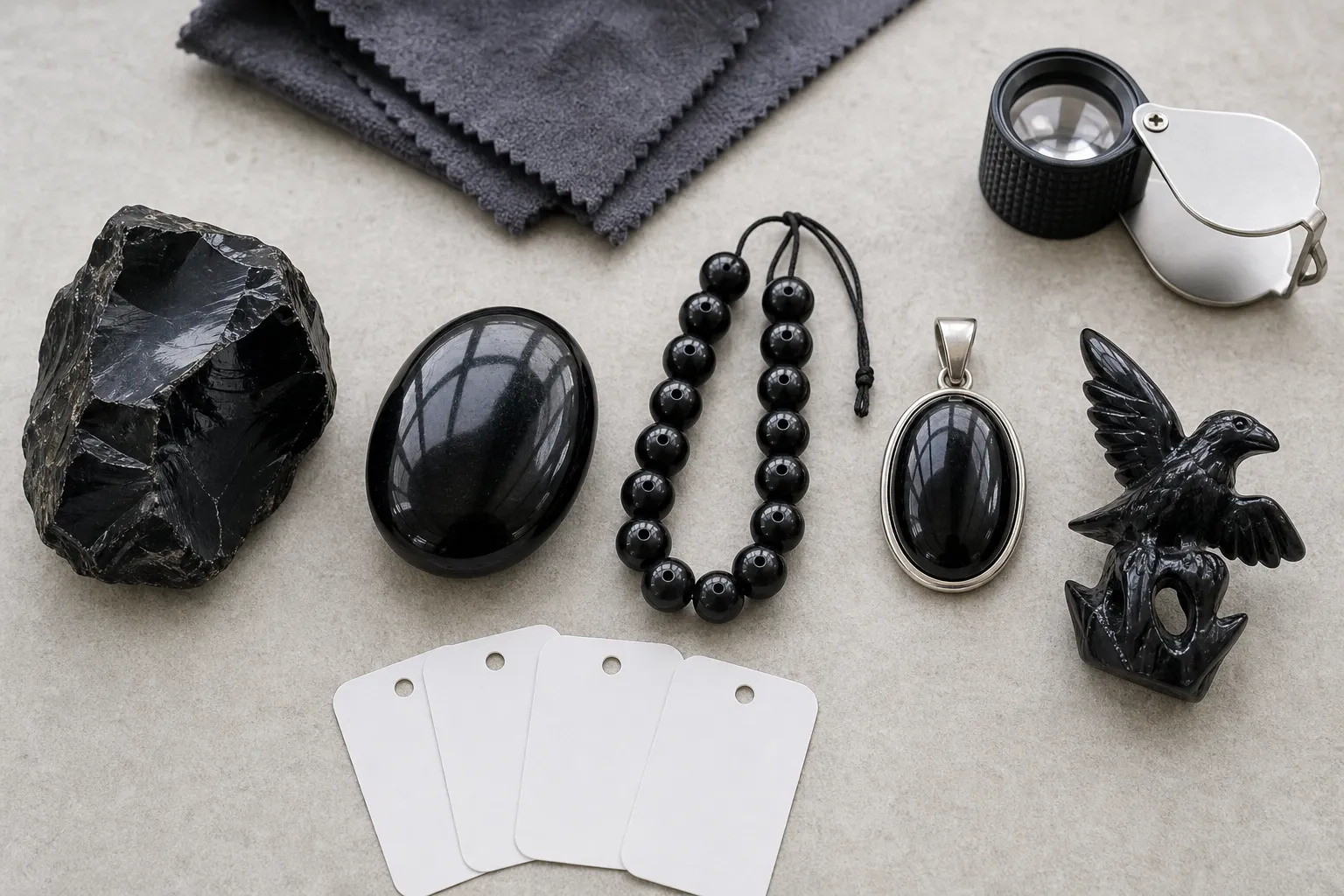
Begin with visible evidence before reacting to the most attractive name in the title. For obsidian, the useful details are usually plain: shape, color appearance, surface finish, inclusions or bands, edge condition, size, weight, lighting, and whether the piece is raw, tumbled, polished, carved, drilled, beaded, or set in jewelry.
When buying obsidian crystals online, one photo is rarely enough. A single image can hide surface marks, make a dark piece look flatter or more uniform than it is, exaggerate sheen, or make a small stone appear larger without a scale reference. The better question is not only “Does this look like obsidian?” but “What can I compare from this listing?”
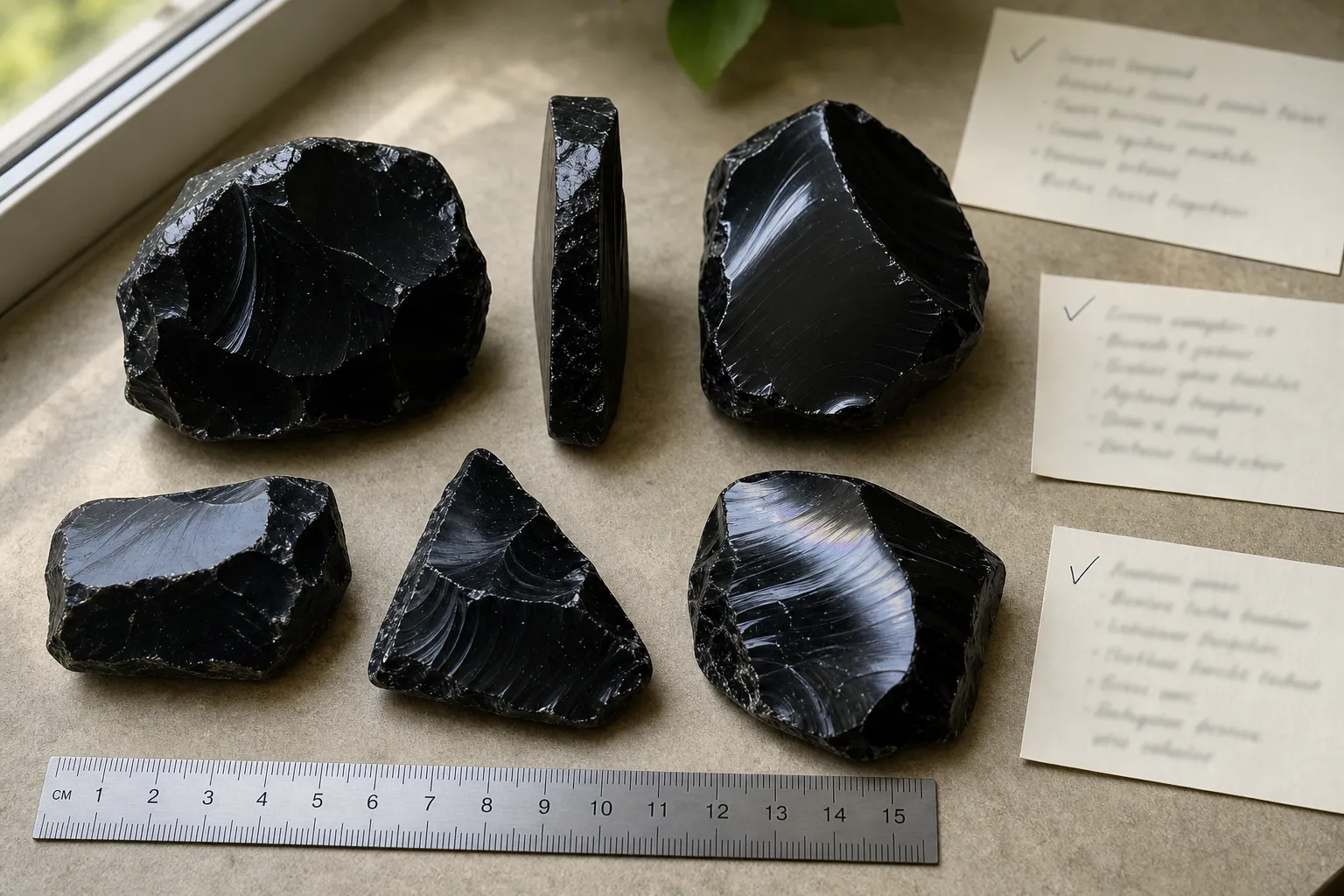
Useful listing photos show
- The front and back of the exact piece being sold.
- At least one side view, especially for slabs, palm stones, pendants, beads, and carvings.
- A scale reference, such as a ruler, hand, coin, or clearly stated dimensions.
- The surface in ordinary light, not only under dramatic glare.
- Chips, cracks, drill holes, repairs, rough edges, or thin points.
- For lots, a spread-out view instead of a piled group.
A polished glamour photo does not automatically make a piece poor. It does make the buying decision thinner. A collector choosing a display piece, matched bead strand, carving, or specific variety name needs more visual detail than someone buying an inexpensive mixed lot for sorting or comparison.
How to Read Obsidian Seller Labels Before You Buy
Obsidian seller labels can be useful, but they are not independent identification. A short product title may mix appearance, trade name, finish, size class, locality language, symbolic wording, and marketing emphasis.
Separate what each word is doing before relying on it.
“Raw obsidian”
Unpolished or rough-looking form
Size, edge condition, fractures, exact piece photos
“Polished obsidian”
Surface finish
Whether polish hides chips, cracks, or color variation
“Natural obsidian”
A material-origin claim
Whether the listing explains why that claim is made
“Glass obsidian” or similar wording
Ambiguous market language
Whether it means volcanic glass, manufactured glass, or unclear phrasing
“Rare”
Scarcity language or sales emphasis
The specific reason, source of claim, and comparison point
“AAA grade”
Seller grading language
Whether the grade is defined in measurable terms
“Collector quality”
Market positioning
Photos, condition, size, finish, and return terms
“What does AAA grade mean on obsidian listings?” is worth asking because the answer often depends on the seller. Without a stated grading system, “AAA” may point to polish, color uniformity, size, visual appeal, or simply a sales tier. Treat grade words as prompts for inspection, not as conclusions.
The same applies when an obsidian listing says “rare.” Ask what makes it rare: pattern, source claim, size, finish, form, or seller positioning. If the listing does not explain the basis, the word adds mood but little buying information.
Natural Obsidian, Glass Wording, and Authenticity Limits
Obsidian is commonly described as volcanic glass, but that does not mean every glossy dark object in an online listing can be judged confidently from photos. A dark surface, a polished finish, and a confident title are not enough for a complete material conclusion.
For collector buying, think in levels of confidence:
Low confidence
One photo, no scale, no back view, vague title, no condition or origin detail.
Moderate confidence
Multiple photos, clear dimensions, visible surfaces, plain description, seller answers basic questions.
Higher confidence
Exact piece shown, detailed angles, condition notes, consistent labeling, clear return terms, and no pressure language.
Even a strong listing is still not the same as material testing or an appraisal. If a purchase depends on high value, claimed locality, unusual variety, or a specific authenticity claim, photos alone may not be enough. The practical question is whether the price and purpose fit the remaining uncertainty.
This matters when comparing “natural obsidian” with glass-related wording. Some sellers use glass language because obsidian has a glassy nature; others use phrases that leave the material unclear. Do not let the title do all the work. Look for the exact item, the seller’s explanation, and whether they will answer direct questions.
Before buying an obsidian specimen, ask
- Is the pictured item the exact piece that will ship?
- Are there chips, cracks, glue, coating, repairs, or other condition issues not visible in the photos?
- What are the exact dimensions and weight?
- Is the finish raw, tumbled, polished, carved, drilled, or set?
- What does the seller mean by the variety name or grade term?
- Can they provide a photo in natural or neutral light?
- What is the return policy if the item does not match the listing?
A seller does not need to write a geology paper for a small collectible. But if the listing asks you to pay for a specific claim, it should give enough detail to evaluate that claim.
Raw, Polished, Beads, Pendants, and Carvings
Raw obsidian buying and polished obsidian buying are different decisions. The form changes what you can inspect, what may be hidden, and how the piece will likely be handled.
Raw pieces may show irregular surfaces, broken areas, and geological character. They can also have sharp edges, unstable fragments, fragile points, or uneven shapes that matter for storage and display. Shipping protection matters more when a rough piece has protruding or brittle-looking areas.
Polished pieces are often easier to display and handle, but polish changes the inspection problem. A glossy surface can make color and sheen look more dramatic, while small marks may disappear unless the lighting angle changes. For palm stones, spheres, towers, and freeforms, look for multiple angles, including the base, back, and edges.
Beads, pendants, and carvings add workmanship to the decision. You are not only judging the stone face; you are also judging holes, settings, symmetry, wear points, and thin details.
For beads, check
- Hole placement and whether holes look clean or chipped.
- Size consistency if the strand is meant to match.
- A full-strand photo plus close-up examples.
- Whether the finish looks even across multiple beads.
For pendants, check
- The drill hole, bail, wire wrap, or setting.
- Thickness and whether the piece looks comfortable to wear.
- Front and back views.
- Clear description of any metal components.
For carvings, check
- Thin points, protruding details, and areas likely to chip.
- Symmetry if the form depends on it.
- Visible tool marks or polish differences.
- Base stability if the carving is meant to stand.
A carving can be beautiful but better suited to display than frequent handling. A bead strand can look strong in a distance photo but show uneven drilling up close. A pendant may have an attractive front while the back reveals chips or a shallow setting. Let the form decide what evidence you need.
Size, Weight, Scale, and Online Photo Traps
Obsidian size and weight are easy to misread online. Dark glossy objects can photograph with little internal detail, and without a reference point a small piece can look substantial. Always read the dimensions rather than judging from the image alone.
Useful scale information includes:
- Length, width, and thickness for specimens, slabs, palm stones, and carvings.
- Diameter for beads, spheres, and round cabochons.
- Weight for rough chunks, lots, and larger display pieces.
- A ruler or common object when the shape is irregular.
Weight helps with mixed lots and raw pieces, but it does not tell you whether the lot will suit your collection. A heavy lot may include many small chips, uneven fragments, or pieces that do not match your goal. When evaluating a mixed obsidian lot, look for total weight, approximate count, and the range of individual piece sizes. If the photo only shows the top layer, ask whether the whole lot is pictured.
Scale also affects shipping. A small polished stone can be packed differently from a sharp-edged rough chunk or delicate carving. When buying raw obsidian, ask how brittle-looking or pointed pieces are wrapped. Movement inside a package can lead to chips or abrasion, so packing details matter when the form is fragile.
Care Considerations Before You Buy
Care starts before the item arrives. A piece that needs separate wrapping, limited handling, or careful display may still be worth buying, but it should fit how you collect.
For display collectors, the question is whether the piece can sit, stand, or be mounted without pressure on a thin edge. For jewelry buyers, it is whether the item suits the kind of wear expected. For bead buyers, look at hole wear, stringing, and whether the beads may rub against harder materials. For raw specimen buyers, think about edge contact and storage separation.
Listing words such as “durable,” “wearable,” or “easy to maintain” depend on form and use. A thick polished palm stone and a thin carved point do not carry the same handling expectations. A pendant worn often faces different conditions from a specimen kept in a tray.
Before buying, decide where the piece will live:
- In a display case with limited handling.
- In a tray with other stones.
- As jewelry or a carried object.
- In a teaching, sorting, or comparison set.
- As a raw specimen needing separate wrapping.
This prevents a common mismatch: buying a visually appealing form that does not fit your actual collection habits. A sharp-edged rough piece may be awkward in a loose tray. A delicate carving may belong in display. A bead strand may need closer inspection than a single decorative stone because every bead affects the final object.
A Practical Decision Path for Buying Obsidian
You do not need perfect certainty for every purchase. Match the evidence to the stakes. A low-cost piece for casual comparison can tolerate more uncertainty than a high-priced item sold with a specific variety, origin, or grade claim.
Use this decision path before buying:
- Name the purpose. Are you buying for identification practice, display, jewelry, variety comparison, or a gift?
- Check the form. Raw, polished, bead, pendant, carving, slab, and mixed lot each require different inspection.
- Read the title carefully. Separate material claims, variety names, finish words, grade terms, and symbolic language.
- Inspect the photos. Look for multiple angles, scale, surface detail, and whether the exact item is shown.
- Compare size and weight. Do not rely on visual impression alone.
- Ask about missing details. Focus on condition, dimensions, lighting, finish, packing, and unclear labels.
- Match price to uncertainty. If the listing depends on a claim it does not support, treat that uncertainty as part of the cost.
- Consider care and shipping. Fragile shapes, rough edges, drilled pieces, and carvings need more practical attention.
The “best” choice depends on your collecting purpose. A beginner building a comparison tray may prefer several modest pieces with clear photos over one dramatic item with vague labeling. A collector focused on polish quality will need surface close-ups. Someone choosing a pendant should inspect construction, not only the stone face. Someone buying raw material should look closely at shape, edge condition, and packing.
Common Buying Misreads
A dramatic photo does not prove quality. Strong light can make a surface look more vivid or hide uneven areas. Ask for ordinary lighting if color, sheen, or surface condition matters.
A variety name does not prove origin. Some labels are visual trade names, some are seller categories, and some imply more than the listing supports. If origin affects the price, look for the seller’s explanation.
A grade term does not replace inspection. “AAA” and similar wording only help when the seller defines the grade. Otherwise, rely on photos, measurements, and condition notes.
A mixed lot photo may not show the whole lot clearly. Check whether the exact pieces are pictured and whether the listing gives total weight, approximate count, and individual size range.
A symbolic description is not material evidence. Obsidian is often discussed through cultural, personal, or spiritual language, but that language should be treated as interpretation, not as proof of identity, quality, or outcome.
A low price does not automatically mean a bad piece, and a high price does not automatically mean a better one. The stronger question is whether the listing gives enough information for the claim being made.
When to Buy, Ask, or Pass
Buy
Buy when the listing shows the exact piece, gives clear dimensions, uses understandable labels, shows enough angles for the form, and the price feels reasonable for the remaining uncertainty.
Ask
Ask when the piece is appealing but the listing lacks one or two important details: scale, back view, neutral lighting, condition, drill hole, weight, packing method, or label meaning. A short, specific question often shows whether the seller can describe the item plainly.
Pass
Pass when the listing depends on pressure words, unclear grade claims, one dramatic image, no scale, no condition detail, or a claim that matters to the price but is not explained. Passing is not a judgment on the stone itself; it is a judgment on the information available.
For a collector, the strongest buying habit is not memorizing every seller term. It is learning to compare visible obsidian traits, recognize where labels become uncertain, and choose pieces that fit your purpose, budget, and tolerance for unanswered questions.