Collector Value Guide
What Affects Obsidian Value for Collectors
Collectors ask about obsidian value because two pieces that look similar in a photo can feel very different in hand. The useful obsidian value factors are not one magic trait or a fixed price rule. They are a mix of visible features and context: variety, sheen, pattern, condition, size, polish, workmanship, locality notes, and how well the seller’s description matches the object.
Obsidian is natural volcanic glass. Its glassy surface, curved breakage, and potentially sharp chips affect how a piece looks, handles, and displays. For collector value, the best habit is simple: separate what you can see from what is only being claimed.
upward
Start with the broader guide
Use the broader guide first if you need the full scope before this page.
Is Obsidian Valuable or Usually Affordable for Collectors?
Obsidian can be approachable for beginners, yet some pieces are more desirable because they display better, have cleaner condition, show a stronger visual effect, or carry better collection context. The available public sources support the material background of obsidian, but they do not provide enough market data to justify exact price ranges, guaranteed premiums, or investment-style conclusions.
A better question is: what kind of value is being discussed?
Display value
Inspect shine, color effect, polish, balance, and stable shape to judge whether the piece presents well in a collection.
Specimen value
Inspect natural form, visible traits, size, condition, and label quality to judge whether it works as an interesting material example.
Craft value
Inspect carving detail, symmetry, finish, and polish to judge whether workmanship adds appeal.
Context value
Inspect locality, provenance, older labels, and purchase notes to judge whether the story attached to the piece is supported.
Seller-claim value
Words such as rare, premium, or museum grade are only useful when backed by visible traits or documentation.
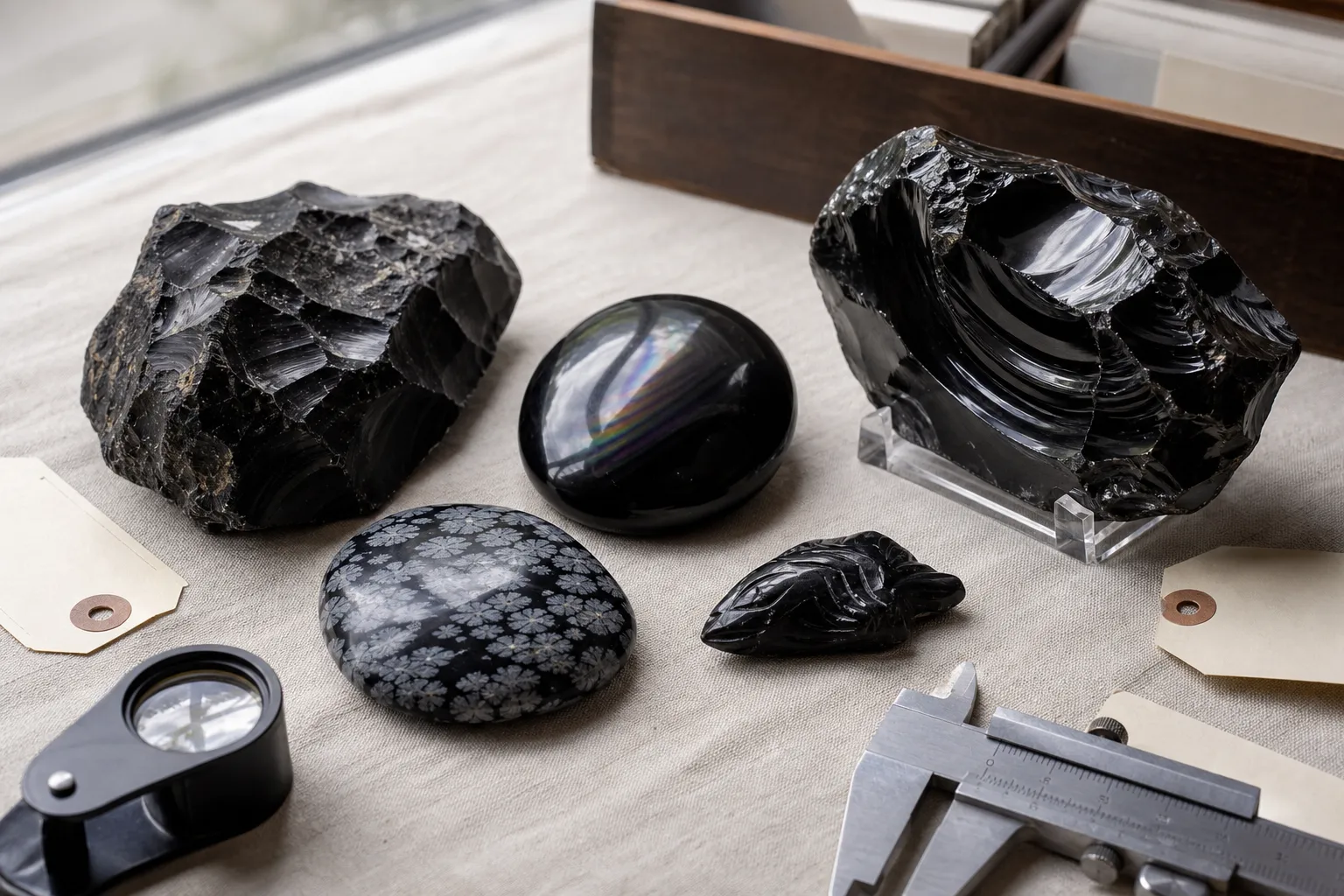
A plain black tumble, a large raw chunk, a sharp broken flake, a rainbow-sheen palm stone, and a detailed carving should not be judged by the same standard. Compare like with like: polished rainbow obsidian with other polished rainbow obsidian, snowflake obsidian with other patterned pieces, and carvings with carvings of similar size and detail.
That keeps the conversation grounded in observable features rather than broad price talk.
How Obsidian Variety Affects Collector Value
Obsidian variety value starts with the feature the eye can verify. Black obsidian, snowflake obsidian, rainbow obsidian, sheen obsidian, mahogany obsidian, and other named forms are usually described by visible color, inclusions, pattern, or reflective effects. Those names can help collectors compare pieces, but a variety label is not automatic proof of higher value.
Ask what the name is actually pointing to.
Snowflake obsidian is recognized by pale, snowflake-like patterning in dark glass. Rainbow obsidian is discussed for color bands or iridescent effects that may appear under certain lighting and polish. Sheen in obsidian refers to reflective effects, often clearer on a cut and polished surface. Mahogany obsidian is commonly described by reddish-brown and black patterning.
These labels matter when they change the way a piece can be displayed and compared. A strong visual effect, balanced pattern, or clean polish can make a specimen more appealing within its category. The name alone should not carry the whole argument.
Questions for a Variety Label
- Is the named trait visible without extreme lighting?
- Does the polish reveal the feature clearly?
- Are patterns balanced with the object’s shape?
- Does the label describe the specimen, or does it sound like broad sales language?
- Is the variety name being used as description or as an upgrade word?
Seller names often help buyers search, but they do not prove a fixed market result. Variety affects collector interest most clearly when it is tied to visible traits.
Rainbow, Sheen, and Pattern Quality
Rainbow obsidian value and sheen in obsidian are often discussed together because both depend on visibility. A color effect that appears strongly from one angle and disappears from another may still be interesting, but the collector should know how it behaves in ordinary viewing conditions.
For display pieces, the question is not only “does it have sheen?” but “how well does the sheen show?” A polished surface may reveal bands, flashes, or depth that are hard to see on a rough surface. Lighting matters too. Some pieces look dramatic under a directed light and quiet on a shelf.
That does not make the effect false. It means the comparison should be honest. A subtle piece should not be described as if it displays the same way as one with broad, easy-to-see color. Photos can also exaggerate or flatten sheen depending on angle, exposure, and background.
Snowflake obsidian pattern quality raises a different issue. The pale inclusions are part of the visual identity, but not every pattern has the same display appeal. Some collectors prefer evenly scattered “snowflakes,” bold contrast, or an unusual arrangement. Others prefer a quieter pattern. Because taste varies, pattern quality is better treated as a visual factor than a guaranteed price rule.
When Comparing Snowflake Obsidian
- Look for clear contrast between dark glass and pale patterning.
- Look for pattern distribution that suits the object’s shape.
- Look for a surface finish that does not blur the inclusions.
- Look for chips or cracks that interrupt the main display face.
- Look for a label that does not oversell ordinary patterning as exceptional.
This approach avoids two common mistakes: calling every patterned piece rare, or dismissing a subtle piece that may still be attractive to the right collector.
Raw vs Polished Obsidian Value for Collectors
Raw vs polished obsidian is not a better-or-worse comparison. Each form serves a different collector interest.
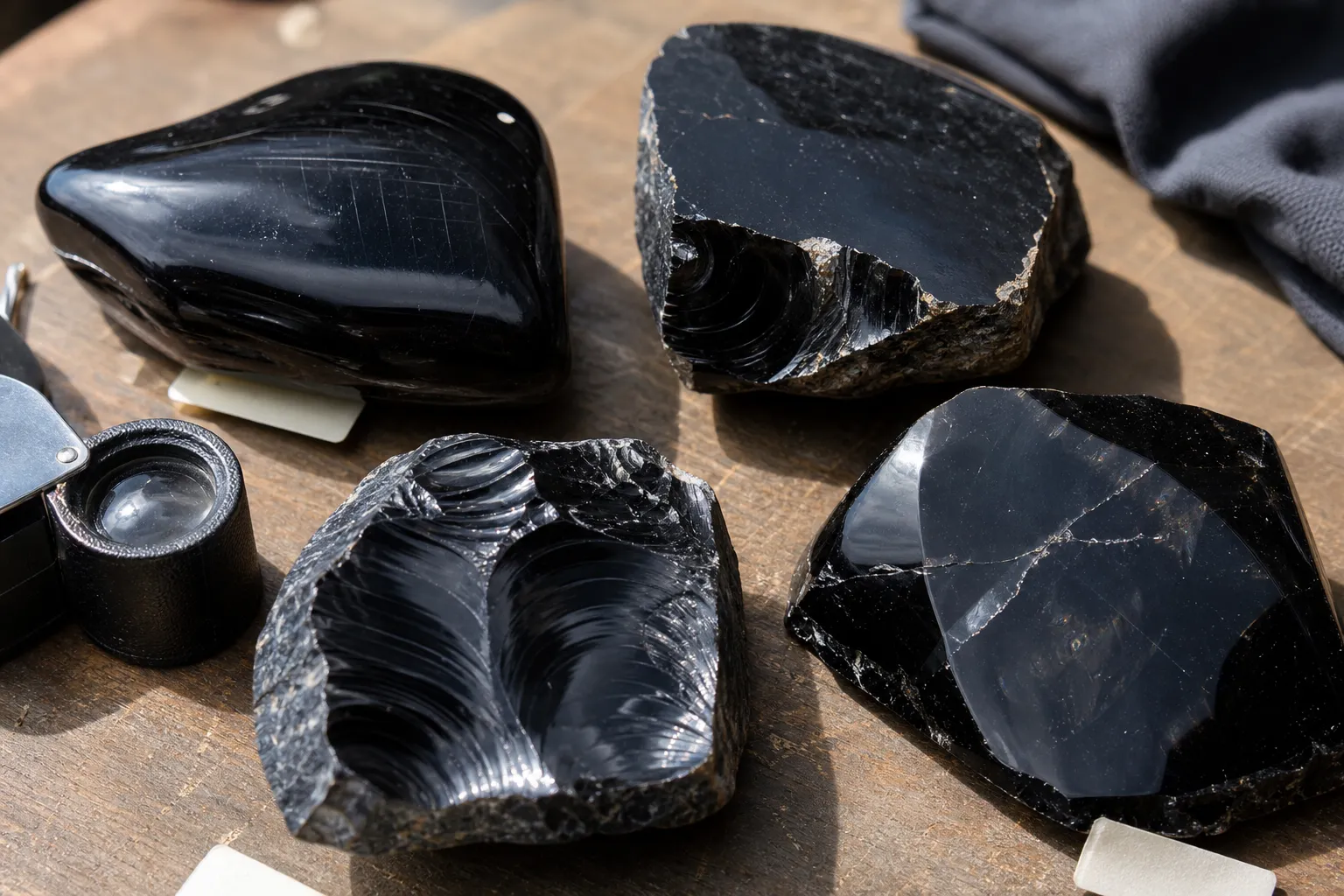
Raw obsidian can show natural fracture surfaces, flow textures, edges, and the way volcanic glass breaks. For a collector interested in material identity, a raw piece may feel closer to the geological object. It may also show conchoidal fracture: the curved, shell-like breakage associated with glassy materials. That breakage helps explain why obsidian can have sharp edges and why chips may be visually obvious.
Polished obsidian serves another purpose. Cutting and polishing can reveal sheen, color bands, inclusions, and reflective depth that might be hard to see in a rough chunk. A well-polished palm stone, sphere, cabochon, or display form may be valued for clarity of finish and visual presentation rather than natural shape.
A Raw Piece May Be More Appealing When
- The natural fracture surface is clean and interesting.
- The specimen has a stable shape for display.
- Edges are not so battered that they distract.
- Locality or collection context is documented clearly.
- The collector wants a natural material example.
A Polished Piece May Be More Appealing When
- The finish reveals sheen, color, or pattern well.
- Scratches and flat spots are minimal.
- The shape feels balanced and intentional.
- The surface displays light cleanly.
- The workmanship improves the object rather than hiding flaws.
A polished piece may cost more because of cutting, shaping, and finishing labor. A raw piece may be more collectible when it has strong natural features or reliable context. The form matters through the role it plays.
Size, Weight, and Display Presence
Obsidian size and weight affect specimen value, but not in a straight line. A larger piece may feel more substantial, show more surface area, or reveal broader patterning. It may also be harder to store, easier to chip at exposed points, and less practical for some displays.
Weight alone is a blunt measure. A heavy piece with dull presentation, many damaged edges, or an unsupported label is not automatically more desirable than a smaller piece with stronger visual character. Size becomes meaningful when it helps the specimen show what collectors care about.
For raw obsidian, size may allow a better view of fracture surfaces, color variation, or natural form. For polished obsidian, size may create a larger window for sheen, banding, or inclusions. For carvings, size may support more detail, but only when the workmanship is clean.
Display stability matters as much as size. A specimen that rolls, tips, or rests on a fragile edge may be less satisfying to show. A stable base, natural resting point, compatible stand, or balanced carved shape can make the piece easier to enjoy.
When Weighing Size as a Value Factor
- Does the larger size reveal more of the feature being collected?
- Is the piece stable enough for normal display?
- Are chips concentrated on important viewing faces?
- Does the weight create storage or handling concerns?
- Is size being used as the main selling point?
A large plain piece can still be worthwhile. It just should not distract from condition, visual quality, or documentation.
Chips, Scratches, and Cracks in Obsidian
Condition is one of the most practical obsidian price factors because it is visible, easy to misunderstand, and tied to handling. Since obsidian is glassy and can break with sharp edges, chips and fresh fractures can affect both appearance and the way a piece should be stored or touched.
Chips are not all equal. A tiny edge nick on the back of a raw specimen may matter less than a bright chip across the main polished face. A natural fracture surface may be part of a raw specimen’s appeal, while a later impact mark on a polished sphere or carving may reduce display quality.
Scratches matter most on polished obsidian. A glossy black or reflective surface can show fine marks clearly under light. On a piece collected for sheen, scratches may interfere with the surface effect. On a carved object, scratches or dull patches can make the workmanship look less careful.
Cracks need close attention. A visible crack may remain stable, or it may mark a vulnerable area that could worsen with pressure, impact, or poor storage. Public geology references explain obsidian’s glassy fracture behavior, but they do not provide a collector grading system. Describe what you see instead of assigning false certainty.
Useful Condition Language
- Small edge chip
- Fresh-looking break
- Surface scratch
- Internal-looking crack
- Dull polish area
- Bruised point or corner
- Stable natural fracture face
Specific wording is more helpful than vague labels such as “perfect” or “damaged.” It also keeps condition separate from authenticity. A chipped piece can still be natural obsidian; the chip changes how it compares, displays, and handles.
Locality, Provenance, and Label Reliability
Obsidian locality and provenance can make a specimen more interesting when the information is credible. Locality means where the material is said to come from. Provenance is broader: prior collection notes, older labels, purchase records, or other context that connects the object to a source or owner history.
Locality is useful background, but it does not automatically create a price conclusion. A label saying a piece comes from a certain region may help organize a collection, yet the claim is stronger when the chain of information is specific and consistent.
A Stronger Context Note May Include
- A specific locality rather than only a broad region.
- A date or source of acquisition.
- A previous collection label or catalog note.
- Naming that matches both appearance and known material type.
- Clear separation between observed features and claimed origin.
A weaker label may lean on dramatic wording, broad rarity claims, or a locality name without supporting detail. That does not prove the specimen is wrong, but it should limit how much weight the claim carries.
Natural obsidian vs imitation glass also belongs here because the label directly affects comparison. Obsidian is natural volcanic glass; man-made glass may be attractive, but it should not be represented as natural obsidian. Photos alone may not settle the question, especially when color, lighting, and polish are involved. If the value discussion depends on natural origin, the label and source deserve extra scrutiny.
Polish Quality, Carvings, and Workmanship
Obsidian polish quality can strongly affect display value. A clean polish can make black obsidian look deep and reflective, reveal sheen more clearly, and make inclusions or color effects easier to see. A poor polish can leave haze, uneven shine, flat spots, or sanding marks that distract from the material.
This matters for pieces sold because of rainbow, silver, gold, or other sheen effects. If the surface is not cut and polished in a way that shows the effect, the named variety may be less satisfying as a display object. The material may still be interesting, but the finished piece may not show its best feature.
Carvings add another layer. Obsidian carvings may cost more than simple specimens because carving, shaping, and polishing require labor. That does not mean every carving should be valued above every raw or simple polished piece. The workmanship has to earn the added appeal.
Look at Workmanship Details
- Clean transitions between carved areas
- Symmetry where symmetry is intended
- Smooth polish in recessed areas
- Minimal distracting tool marks
- No major chips on points, edges, or raised details
- A design that suits the material’s color and sheen
A carving can also hide or distract from material flaws. Deep black obsidian may make surface quality obvious, while patterned obsidian may make small irregularities less noticeable. Inspect the object both as obsidian and as a made piece.
Simple forms can be strong collector objects. A clean cabochon, sphere, palm stone, slab, or raw display piece may show the material better than an overworked carving. Workmanship adds value when it improves visual clarity, not merely because the piece has been shaped.
What “Rare” Means When Describing Obsidian Value
Rare obsidian labels are common in listings, but “rare” can mean several different things. It may refer to a less common visual effect, a locality claim, a limited supply from a specific source, an unusual pattern, or simply a seller’s attempt to make the piece sound more desirable.
Because the available research pool does not include strong market data, dealer pricing methods, or appraisal examples, rare should be treated as a claim that needs support. It is not enough for a listing to say a piece is rare. Ask: rare compared with what, and how is that shown?
A Careful Rare Claim Might Be Tied To
- A specific, documented locality.
- A visible feature that is unusual within that variety.
- Pattern or sheen that is clearly stronger than ordinary examples.
- Known collection history.
- Form or workmanship that is hard to find in similar pieces.
A Weak Rare Claim Usually Stands Alone
It may be paired with vague premium wording or investment-style language without showing why the object deserves that description. Symbolic meaning can matter to some owners as personal or cultural interpretation, but it should not be treated as physical proof or monetary evidence.
This is where value discussions become muddy. Geological identity, collector preference, seller language, and personal meaning can all appear in the same listing. They are not the same kind of information.
A Practical Way To Compare Two Obsidian Pieces
When two obsidian pieces are in front of you, compare them in a consistent order. That keeps the decision from being driven by one dramatic word in a label.
Start with identity. Is the piece being presented as natural obsidian, and does the description match obsidian as natural volcanic glass? If the object is brightly colored in a way that raises questions, or if terms are unclear, do not let the label do all the work.
Move to visible features. Identify the variety claim and look for the trait that supports it: snowflake patterning, sheen, color banding, mahogany-like pattern, or plain black glassy appearance. If the feature only appears under one exact photo angle, note that.
Then inspect condition. Check the main display face, edges, points, base, and polished surfaces. Chips, scratches, and cracks matter most when they interrupt the feature that makes the piece desirable.
Next, judge presentation. Does the piece sit well? Does the polish serve the material? Is the size useful for showing pattern or sheen? Does the carving, if present, improve the object?
Finally, review context. Locality, provenance, and collection notes can add interest, but vague claims should stay in the background. A well-documented modest piece may be more satisfying to own than a dramatic listing with little support.
A Simple Comparison Path
- Confirm the object is described in material terms, not only sales language.
- Match the variety name to visible traits.
- Inspect condition under ordinary light.
- Decide whether raw form, polish, size, or carving improves the specimen.
- Treat locality and rarity claims as stronger only when supported.
- Keep personal meaning separate from value conclusions.
Bottom Line: Value Comes From Supported Features, Not One Label
Obsidian specimen value is best understood through a cluster of factors: visible variety traits, pattern quality, sheen, size, condition, polish, workmanship, locality notes, and label reliability. No single word proves value by itself.
A rainbow effect may matter more when it is easy to see. Snowflake patterning may matter more when it is clear and well placed. A larger piece may matter more when it displays the material better. A carving may matter more when the workmanship is clean. Locality may matter more when the provenance is specific and credible.
The strongest collector approach is steady and visual: name what you can see, separate it from what is claimed, and be cautious where the evidence becomes thin. That does not make obsidian less interesting. It makes the comparison more useful for collectors who want pieces that are understandable, well described, and satisfying to keep.