Collector meaning
What Does Volcanic Glass Mean for Obsidian Collectors
For an obsidian collector, “volcanic glass” means obsidian is a natural glass formed from rapidly cooled volcanic material, not a true crystal with visible crystal faces. The practical volcanic glass obsidian meaning is simple: inspect it for glassy luster, smooth polish, curved fracture, flow banding, inclusions, bubbles, and sharp chipped edges, while treating variety names and seller labels as things to verify rather than automatically accept.
That is why obsidian may be sold as a stone, crystal, gem, or mineraloid. In casual collecting language those words overlap. Technically, though, obsidian is better understood as a glassy volcanic material rather than a crystalline mineral.
upward
Read the full overview first
Use the broader guide first if you need the full scope before this page.
Why “Volcanic Glass” Changes the Way You Classify Obsidian
Calling obsidian “volcanic glass” tells you two things at once: it has a volcanic origin, and it lacks the regular crystal structure found in minerals such as quartz or calcite.
Obsidian forms when volcanic melt cools quickly enough that a regular crystal structure does not fully develop. Mineral and gem references commonly describe it as natural volcanic glass, or as a glassy mineraloid rather than a mineral in the strictest sense.
For collectors, that distinction matters because it prevents a common misunderstanding. Obsidian can be displayed with crystals, carved into points, and sold in crystal shops, but it does not naturally grow as a quartz point, calcite rhomb, or other crystal form with repeated faces and terminations.
A quartz collector may study crystal faces, growth lines, terminations, and clarity. An obsidian collector reads different clues: surface luster, polish quality, fracture style, internal streaks, bubbles, color zones, and the way light moves across the piece.
Collector labels and what they usually mean
Volcanic glass
Natural glass associated with volcanic activity.
Mineraloid
A technical term for material that lacks normal mineral crystal structure.
Stone
A broad collector or retail word, not a precise classification.
Gem
A use-based word when obsidian is cut, polished, carved, or displayed.
Crystal
Common shop language, but not technically exact for obsidian structure.
So if the question is “is obsidian volcanic glass?” the answer is yes. If the question is “is obsidian a true crystal?” the careful answer is no in the strict mineralogical sense, even though many collectors still keep it in crystal collections.
What to Look For on an Obsidian Piece
Because obsidian is volcanic glass, the most useful inspection points are surface and fracture traits, not crystal habits. You do not need to damage a piece to start reading it. Use steady light, a clean surface, and several viewing angles.
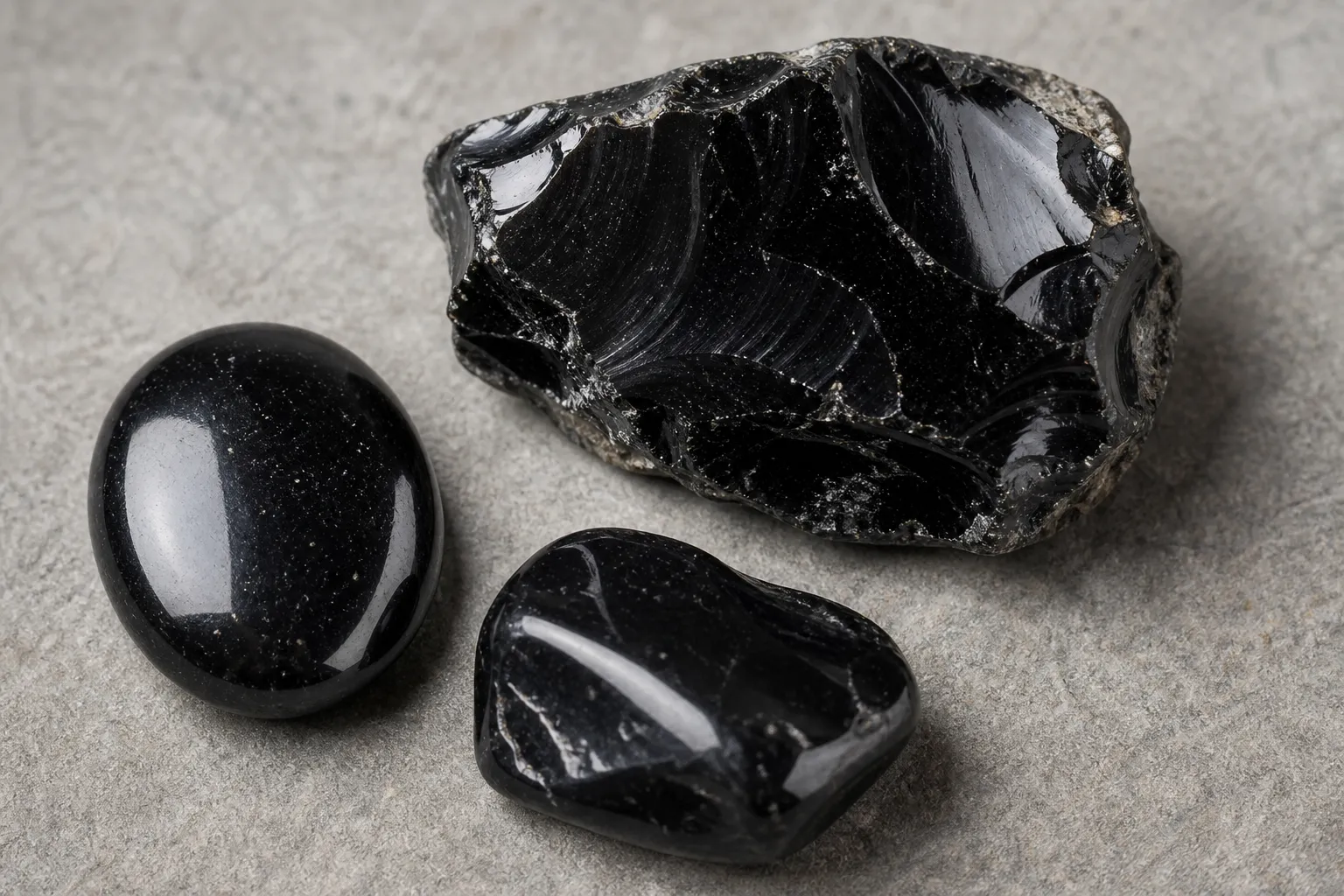
First, look at the luster. Obsidian often has a glassy, reflective surface, especially on polished faces or fresh breaks. A polished black obsidian palm stone, sphere, point, or cabochon may look deep and smooth rather than granular. Raw or chipped areas can also show glass-like shine, though weathering, dust, fingerprints, or poor polish can dull the effect.
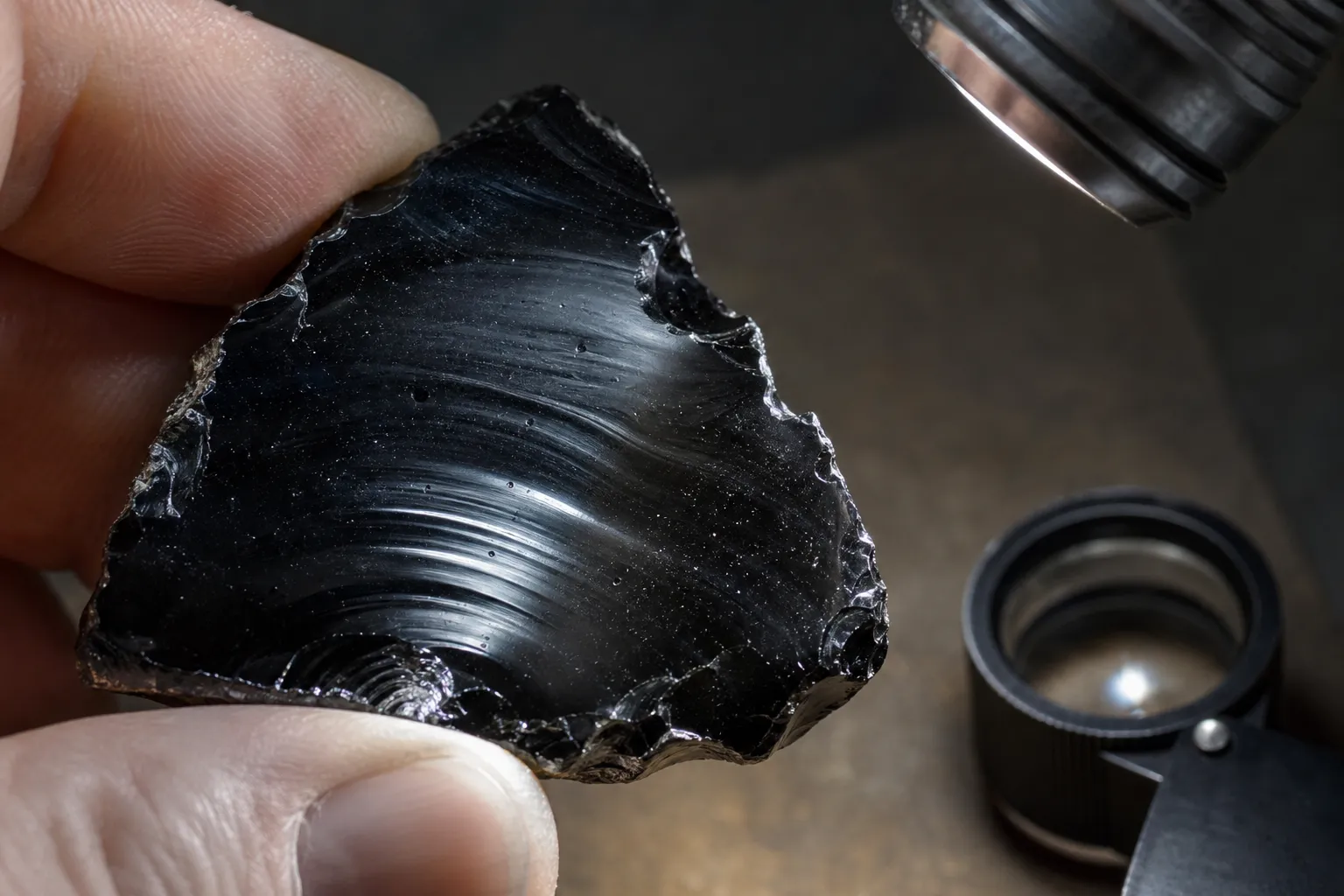
Next, check any existing chip or broken edge for conchoidal fracture. This means the break curves in shell-like arcs instead of splitting along flat crystal cleavage planes. It is one reason broken obsidian can form very sharp edges. Do not create a new break for identification; use only damage that is already present.
Flow banding is another useful clue. Some pieces show faint lines, smoky ribbons, folded-looking layers, or color zones. These can be subtle in black obsidian and more obvious in mahogany, rainbow, or other patterned pieces. Flow banding supports the idea of a volcanic glass shaped by movement and cooling, but it does not prove every variety label by itself.
Also look for small bubbles, inclusions, cloudy patches, or angle-dependent optical effects. A piece that looks plain black from one direction may reveal sheen, bands, or flashes when tilted under stronger light.
A practical inspection list
- Glassy luster: reflective, smooth, or vitreous rather than earthy or sugary.
- Smooth polish: common on cabochons, spheres, carvings, and palm stones.
- Curved fracture: visible only where a chip or break already exists.
- Sharp damaged edges: possible because obsidian fractures like glass.
- Flow banding: lines, ribbons, or layered-looking zones.
- Inclusions or bubbles: small internal features that need cautious interpretation.
- Angle-dependent sheen: flashes or bands that change with light and polish.
- Lack of crystal faces: no natural terminations or repeated crystal habit.
These traits are not a perfect authenticity checklist. They are a better way to read obsidian as volcanic glass instead of expecting it to behave like a crystalline mineral.
Why Obsidian Variety Names Can Be Helpful but Imperfect
The volcanic glass identity also explains why obsidian naming can get messy. Many variety names are collector or market names based on appearance, not one universal scientific classification system.
Black obsidian is usually named for its dominant dark, glassy look. Snowflake obsidian is recognized by pale, snowflake-like patches against a darker base. Mahogany obsidian usually refers to reddish-brown and black swirls, bands, or patches. Rainbow obsidian is named for color flashes or bands that appear only under the right light and angle. Golden sheen obsidian is named for a reflective golden-looking effect across the surface.
These names are useful when they describe what you can actually see. The trouble starts when a name implies more certainty than the piece can support. A polished carving may show only part of the original rock. A dark surface may hide banding until the light changes. A seller photo may exaggerate sheen. Locality names may be accurate, approximate, or simply repeated through a supply chain.
Three layers for collection notes
- Material identity: Does the object look consistent with natural volcanic glass obsidian?
- Visible variety label: Does the appearance support the name being used?
- Provenance or special claim: Is there reliable information beyond the look of the piece?
The first two can often be discussed from observation. The third usually needs seller records, collection history, reputable comparison material, or formal testing for high-confidence claims. A photo alone rarely settles every question.
This matters most with glossy black or glassy objects in casual listings. Industrial glass, slag glass, dyed stone, resin, plastic, painted ceramic, dyed chalcedony, and other dark polished materials can be confused with obsidian. Tektites and moldavite can also be glassy, but they are impact-related glasses, not volcanic lava glass. That difference matters if you collect by origin or formation.
More careful wording often makes better records: “sold as black obsidian,” “appears consistent with obsidian,” “labeled rainbow obsidian,” or “needs stronger provenance.”
Handling and Care for Natural Volcanic Glass Obsidian
“Volcanic glass” also affects how you handle and care for obsidian. The main concern is not ordinary display of a polished piece. It is chipping, sharp broken edges, and dust-producing modification.
For normal collecting, treat obsidian as a glassy material that can chip. Store polished pieces so they do not knock against harder stones or metal stands. A soft pouch, lined tray, divided box, or stable shelf is usually better than letting loose pieces rub together. Points, blades, raw chunks, and thin edges deserve extra care because small chips can be sharp.
Cleaning should stay simple. For most polished obsidian, use a soft cloth and water. If needed, add mild soap and rinse well. Avoid harsh abrasives that can dull the polish, and avoid heat shock or rough scraping. If a piece has metal settings, glue, labels, delicate carving, or mixed materials, clean for the most fragile part.
Cutting, grinding, drilling, sanding, or heavy polishing is different from ordinary cleaning. Obsidian is silica-rich volcanic glass, and dust-producing lapidary work should be done with proper equipment, ventilation, wet methods where appropriate, and suitable protection. That does not make a polished display stone a problem on a shelf; it just means modification should not be treated as casual home cleaning.
Also avoid destructive identification tests. Scratching, breaking, heating, burning, or cutting a collectible piece can damage it and still may not give a reliable answer. Observation, comparison, seller records, and cautious labeling are better first steps.
What “Volcanic Glass” Does and Does Not Mean Symbolically
Obsidian’s symbolic meaning often grows from its physical character: dark glassy surface, volcanic origin, reflective polish, and sharp fracture. In modern collector and crystal language, obsidian is often associated with reflection, grounding, protection symbolism, shadow work, sharp insight, or volcanic intensity.
Those associations are cultural and personal interpretations. They can be meaningful when a piece is chosen for display, meditation, journaling, or as a reminder of a personal theme. But they should not be confused with the physical meaning of volcanic glass. The material facts are about formation, structure, luster, fracture, and care. Symbolic meaning belongs to tradition, personal practice, or market language.
“Black obsidian, natural volcanic glass; polished palm stone; glassy luster; personal association with reflection.”
That keeps the physical description separate from the interpretation. You can observe luster, fracture, polish, banding, and sharp edges. You can compare a piece with known examples. You can ask for provenance. Personal meaning is different: it belongs to the collector, not to a guaranteed property of the material.
A Quick Collector Check
Use “volcanic glass” as a practical filter when recording or evaluating a piece:
- If it has glassy luster, no crystal faces, possible flow texture, and curved fracture on existing chips, it may fit obsidian better than a crystalline mineral.
- If the variety name depends on color flashes, inspect it under different light and angles before accepting the label.
- If the seller calls it a “crystal,” understand that as common market language unless the material is also described as obsidian, volcanic glass, or a mineraloid.
- If there are origin, rarity, or special variety claims, look for provenance rather than relying on appearance alone.
- If the piece is broken, thin, or raw, handle edges with care.
- If modification would create dust, treat it as lapidary work, not ordinary cleaning.
- If symbolic meaning matters to you, record it separately from physical identification.
In short, “volcanic glass” tells an obsidian collector how to classify the material, how to inspect it, why names can be imperfect, and how to handle it with the right kind of caution. It makes obsidian no less interesting than a true crystal; it simply asks to be understood on its own glassy, volcanic terms.