
Collector pattern guide
Snowflake Obsidian and Patterned Inclusions
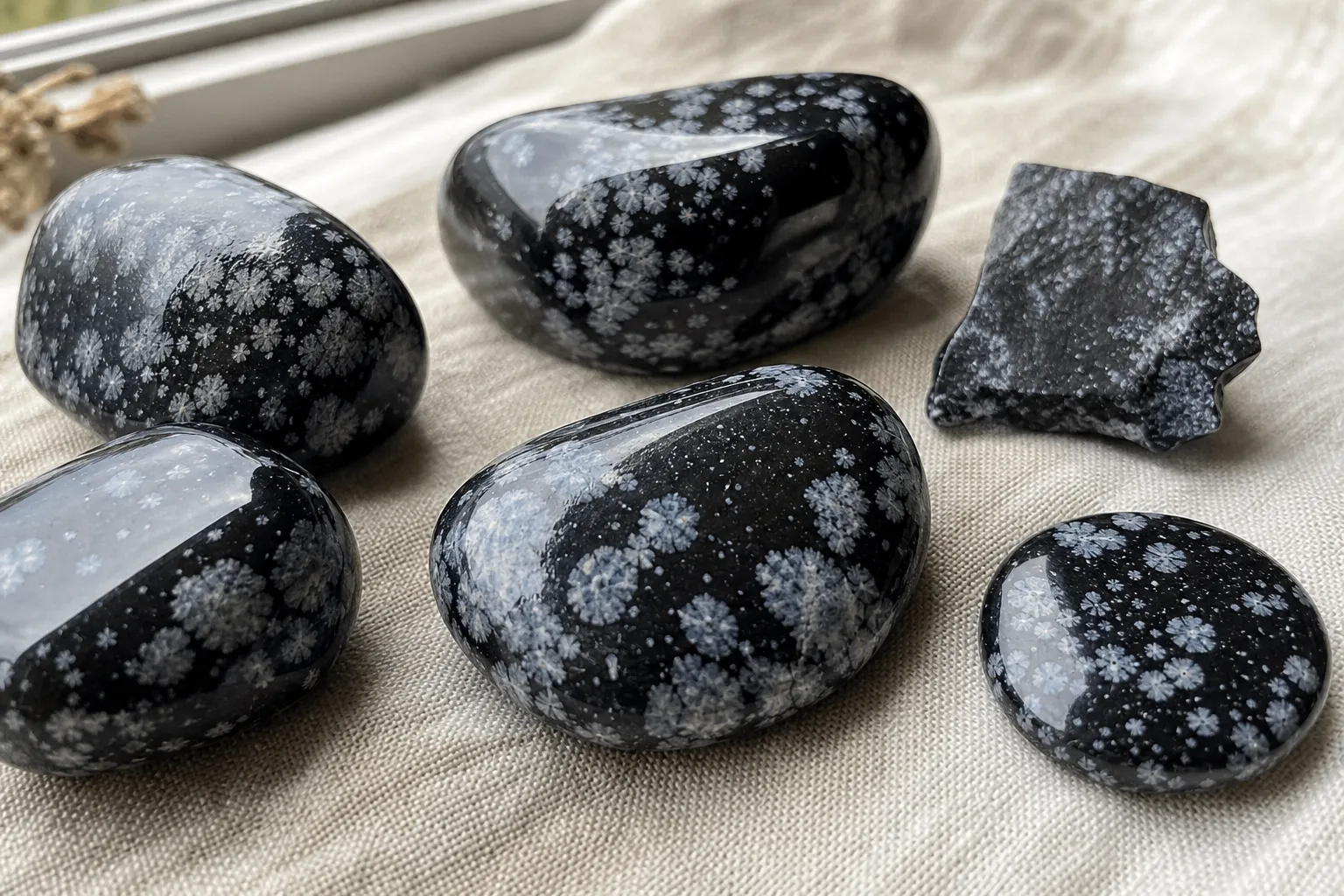
Snowflake obsidian patterns are the reason a dark piece of obsidian stops looking plain: pale dots, soft blooms, gray-white clusters, scattered specks, or cloudy patches break up the black glassy base. For a collector, the better question is not only “Is this snowflake obsidian?” but “What can I actually see, and how much weight should I give the label?”
The answer can shift with lighting, polish, photo quality, pattern density, and seller wording. This guide keeps the focus on what can be checked at the collection table: how the white spots in obsidian appear, why similar pieces vary so much, and where a confident variety name should become a careful description.
upward
Start with the broader guide
Use the broader guide first if you need the full scope before this page.
What Is Snowflake Obsidian as a Variety?
Snowflake obsidian is commonly used for dark obsidian with pale, spot-like or flower-like markings. The name is visual. Many pieces do not show crisp six-pointed flakes; they may show rounded patches, gray smudges, small dots, soft rosettes, or clustered blooms.
The base material is generally described as obsidian, a volcanic glass rather than a crystal in the strict mineral sense. The pale areas are often discussed as inclusions or internal growth features within that glassy body. Many collector and mineral descriptions connect the markings with cristobalite inclusions, but that term should be handled carefully here: a buyer usually cannot confirm the exact mineral identity by sight alone.
A useful working description
- A dark, glassy obsidian body.
- Pale white to gray-white spots, patches, or blooms.
- Markings that appear embedded rather than painted on.
- Variation from sparse speckling to dense cloudy coverage.
- A variety name that may depend on seller convention, polish, and inspection quality.
That does not mean every black stone with light specks should be accepted as snowflake obsidian. Dirt in pits, surface scratches, matrix fragments, artificial decoration, and unrelated dark stones can all create pale contrast. The name is useful only when it follows the visible material.
What Are the White Spots in Snowflake Obsidian?
The white spots in obsidian are the feature most readers notice first. They may look like tiny flowers, pale dots, round blooms, soft islands, or small cloudy patches against a black background. In common descriptions of snowflake obsidian, these pale areas are often linked to cristobalite inclusions. For ordinary collecting, it is better to treat “cristobalite” as a commonly used explanation, not as something proven by appearance alone.
For practical identification, pattern behavior matters more than the exact mineral term.
A hand lens can help. Look for whether the pale areas seem to sit within the material, continue around curves, and vary naturally from spot to spot. Surface-applied marks tend to look flatter and more uniform. Residue often gathers in cracks, drilled holes, or rough pits rather than forming a repeated pattern through the stone.
The strongest visual clue is not one white mark. It is the relationship between the marks and the body: repeated pale inclusions distributed through a dark, glassy stone.
Why Snowflake Obsidian Patterns Look Different from Piece to Piece
Pattern density
Sparse pieces may read as black obsidian with occasional white spots. Dense pieces may look mottled or cloudy. A collector who wants strong display contrast may prefer larger, clearer blooms; someone who likes quieter material may prefer a subtler pattern.
Spot shape
Round dots, soft flowers, star-like forms, cloudy patches, and small granular specks may all appear in seller descriptions. “Snowflake” is a metaphor, not a requirement that every inclusion look like a perfect flake.
Contrast and base color
A deep black body makes white patches stand out. A smoky, charcoal, or less glossy surface can make similar markings look softer. Some pieces look dramatic in direct light and muted in indoor shade.
Cut orientation
A cabochon, bead, palm stone, or slab may expose different parts of the material. A cut through a dense patch can look heavily patterned; a cut through a quieter zone can look almost plain. One photo of one side may not tell the whole story.
Polish changes visibility. A strong polish can deepen the dark base and sharpen contrast. A rough or matte surface may scatter light, making pale areas look chalkier or less defined. Polished snowflake obsidian patterns are often easier to read, but polish can also highlight scratches, pits, glare, or residue.
Lighting affects judgment. Direct light can create reflection that hides subtle inclusions. Soft side lighting may reveal cloudy zones better. When comparing pieces, view them under the same lighting before deciding that one has better pattern quality.
Does Snowflake Obsidian Have to Be Black and White?
Snowflake obsidian is often imagined as black stone with bright white spots, but many pieces are less stark. Examples may appear black and gray, charcoal and cream, smoky and pale gray, or dark brownish-black with softened markings. A piece does not have to look like a high-contrast print to fit the general snowflake obsidian idea.
Color words can be slippery. “White” may describe clean pale inclusions, gray cloudy areas, or cream-colored marks. “Black” may mean deep black, dark charcoal, or simply a dark body color in ordinary room lighting. Online photos add another layer because exposure, background, and editing can shift both the base and the markings.
Describe what you see before deciding how strongly to use the name
- “Dark glassy base with clear white spots.”
- “Charcoal base with gray-white cloudy patches.”
- “Mostly black with a few pale inclusions.”
- “Dense gray mottling rather than separate snowflake forms.”
- “Dark stone with surface specks that need closer inspection.”
This wording is more useful than forcing every piece into a strict black-and-white expectation. It also helps separate snowflake obsidian from plain black obsidian with incidental specks. A few random light marks are not the same as a repeated inclusion pattern.
Snowflake Obsidian vs Plain Black Obsidian with Specks
The most common mix-up is between snowflake obsidian and black obsidian that happens to show pale flecks, scratches, dust, chips, or leftover polishing material. The difference is not always obvious from a single photo, but the pattern gives clues.
Snowflake obsidian should show a repeated visual relationship between the dark body and the pale markings. The spots usually feel like part of the stone’s internal character, not random debris on top. Plain black obsidian with specks may have isolated pale marks on edges, inside pits, along scratches, or near damaged areas.
This is a collector’s screening method, not a formal identification test. If a piece is expensive, unusually described, or sold with a very strong claim, ordinary visual inspection may not be enough. For casual collecting, repeated embedded-looking inclusions are a reasonable starting point.
Raw vs Polished Snowflake Obsidian
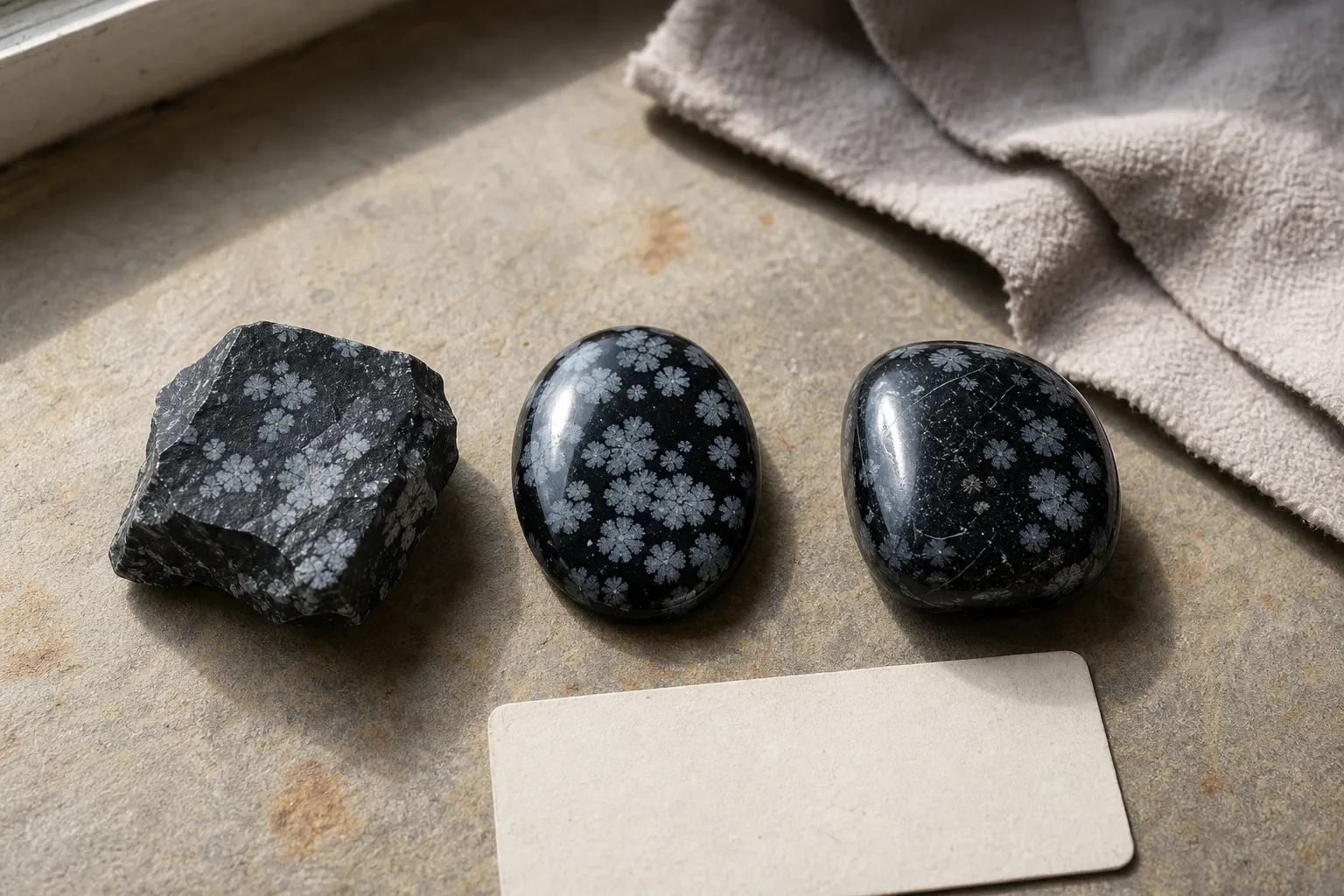
Raw and polished snowflake obsidian can look like different materials even when they belong to the same general pattern family. A rough surface may make the stone look duller, grayer, or more granular. A polished surface can bring out the glassy body and make pale inclusions look cleaner.
Raw pieces may show broken edges, uneven texture, and cloudy surfaces that make pattern boundaries harder to read. Pale areas can appear chalky or dusty, especially in crevices. That does not automatically make the pattern false, but it means surface condition becomes part of the judgment.
Polished pieces, including beads, cabochons, palm stones, and carvings, often show contrast more clearly. The dark base may look deeper, and the pale spots may look more defined. Polish can also introduce its own distractions: glare in photos, visible scratches, white residue in drill holes, or softened detail on rounded surfaces.
When comparing raw and polished pieces, ask
- Is the pattern visible across more than one surface?
- Are pale areas part of the stone or collected in cracks?
- Does the finish look glassy, matte, scratched, or cloudy?
- Are the markings irregular in size and spacing, or unusually uniform?
- Would the piece still read as patterned under softer light?
Care is tied to finish. Obsidian can have sharp broken edges, especially in raw form, so handle rough pieces with attention. Polished pieces are easier to wipe and store, but they can still chip if knocked against harder objects. Use gentle cleaning, avoid harsh abrasion, and store pieces so polished faces do not rub against other stones.
Lines, Bands, and Cloudy Patches
Not every snowflake obsidian piece is covered in neat round spots. Some show lines, bands, cloudy patches, smeared-looking zones, or irregular clusters. The question is whether those features still support a snowflake-style description or point toward another material, another variety name, or loose seller wording.
Cloudy patches can fit the snowflake look when they appear as pale, soft-edged areas within a dark obsidian body. Larger blooms may look more like flowers than flakes. This is where names such as “flower obsidian” may appear in the market. It is best to treat that as a seller or collector naming style that may overlap visually with snowflake descriptions, not as a fixed category in every listing.
Lines and bands need more caution. Some obsidian varieties are described by sheen, flow lines, banding, or color zones rather than pale snowflake-like inclusions. A stone with strong stripes but few pale spots may be better described by its visible banding. A stone with both scattered pale spots and faint flow-like lines can be described more clearly as “snowflake-style inclusions with subtle banding.”
Cloudy gray coverage is another gray area. Some pieces look more mottled than spotted. If the pale material is dense, the piece may lose the distinct snowflake look and appear smoky or marbled. That does not make it uninteresting; it simply changes how precise the label feels.
Follow the dominant feature. If the eye sees dots and blooms first, snowflake obsidian may be a natural description. If the eye sees bands, streaks, or broad clouds first, mention those features directly.
Naming Limits and Seller Labels
Seller labels are useful starting points, not final proof. “Snowflake obsidian,” “flower obsidian,” “black obsidian with white inclusions,” “gray snowflake,” and similar names may be used differently across shops. Some labels emphasize pattern, some emphasize color, and some are written for search visibility rather than careful classification.
A label is more convincing when photos show
- The pattern on more than one side.
- A clear view without heavy glare.
- Close-ups of the pale areas.
- The surface finish, including chips or pits.
- Scale, so dot size and pattern density make sense.
A label is less convincing when evidence is thin
The only evidence may be a dark photo, a single dramatic angle, a vague name, or wording that asks you to accept identity without visible support. For online listings, ask for additional photos in neutral lighting if the pattern is the main reason you are buying the piece.
Naming is also separate from value. A piece with dramatic contrast may appeal to some collectors, but this page should not be used to rank rarity, appraisal, or price. Snowflake obsidian is commonly encountered in the collector market, but that does not create a precise value scale. For practical collecting, choose based on visible pattern quality, condition, size, finish, and how clearly the seller shows uncertainty.
What to Look For When Choosing Snowflake Obsidian
Start with the object, not the sales language. Place the piece under ordinary light and rotate it slowly. You are looking for pattern continuity, surface condition, and whether the stone still reads as snowflake obsidian without idealized photography.
Inspect the base first. It should appear dark and glassy enough to fit obsidian in ordinary collector language. Matte surfaces, weathered rough, or heavy scratches can make this harder to judge, so do not rely on shine alone.
Then inspect the pale inclusions. Look for variation in shape and size. Natural-looking snowflake obsidian white spots are often irregular: some small, some larger, some soft-edged, some clustered. Perfect uniformity is a reason to slow down and inspect more closely.
Check the finish. Chips on edges, dull patches, residue in holes, and scratches across the polish all affect how the pattern appears. They may not ruin a piece, but they should be part of the buying decision.
For beads or carvings, rotate the piece. A pattern visible only on one face may still be real, but a full view gives better confidence. For slabs and palm stones, inspect the edges as well as the broad face. Pale areas that appear to continue into the material are more persuasive than marks that sit only on the top.
Match the piece to your reason for collecting. If you want a display specimen, contrast and pattern balance may matter most. If you want a study piece, variation, raw edges, or mixed features may be more interesting. If you want jewelry, polish quality, drill holes, comfort, and chipping tendency matter as much as the most dramatic pattern.
Symbolic Language Without Overreading the Stone
Snowflake obsidian often appears in shops and collector conversations with symbolic or personal-meaning language. Those meanings can be part of how people choose, gift, or describe a stone, but they should not be treated as physical evidence or guaranteed outcomes. On a practical identification page, symbolism belongs after the visible features.
A careful way to handle symbolic language is to say that some people associate the dark-and-light pattern with balance, contrast, reflection, or grounding themes. That is a cultural or personal interpretation of the appearance, not an identification method. The white spots do not become more authentic because a description sounds meaningful, and a quieter-looking piece does not become less valid because it lacks dramatic wording.
For collecting, the better order is simple
- 1. Identify visible traits.
- 2. Note naming uncertainty.
- 3. Consider condition and use.
- 4. Treat symbolic language as optional interpretation.
That order keeps the stone itself at the center.
A Practical Decision Path for Patterned Pieces
Start with the pattern
If the pale areas are repeated, irregular, and appear embedded in a dark glassy body, snowflake obsidian is a reasonable working label. If the pale marks are only in scratches, pits, or drilled areas, keep the label uncertain.
Move to the finish
If the piece is polished, check for glare, scratches, chips, and residue. If it is raw, check whether rough texture is hiding or exaggerating the pale areas.
Check the pattern type
Dots and blooms support the snowflake description more strongly than long bands or isolated streaks. Cloudy patches can still belong in the conversation, but describe them plainly.
Consider the seller language
A modest label that matches the photos is more useful than an exaggerated name with poor visual support. If the piece is being sold at a premium, ask what evidence supports the description.
A good collector conclusion sounds measured: “likely snowflake obsidian based on visible pale inclusions.” That is often more useful than pretending a photo or label can settle every question.
FAQ
Can snowflake obsidian have gray spots instead of white ones?
Yes. In ordinary collector description, many pieces look gray-white rather than bright white. Lighting, polish, surface condition, and the darkness of the base can all make the pale areas appear softer or grayer.
Are cristobalite inclusions visible without testing?
The pale markings are often described as cristobalite inclusions, but visual inspection alone should be treated cautiously. A collector can observe the pattern; confirming the exact mineral identity is a different level of claim.
Is flower obsidian the same as snowflake obsidian?
The terms can overlap in market language when pale inclusions look more like blooms than flakes. Because naming is not always standardized, compare the visible pattern rather than relying only on the name.
Can I identify snowflake obsidian from one online photo?
Sometimes you can make a reasonable guess, but one photo is not enough for certainty. Multiple angles, neutral lighting, close-ups, and clear surface views make the label easier to judge.