
Formation guide
How Do Snowflake Patterns Form in Obsidian
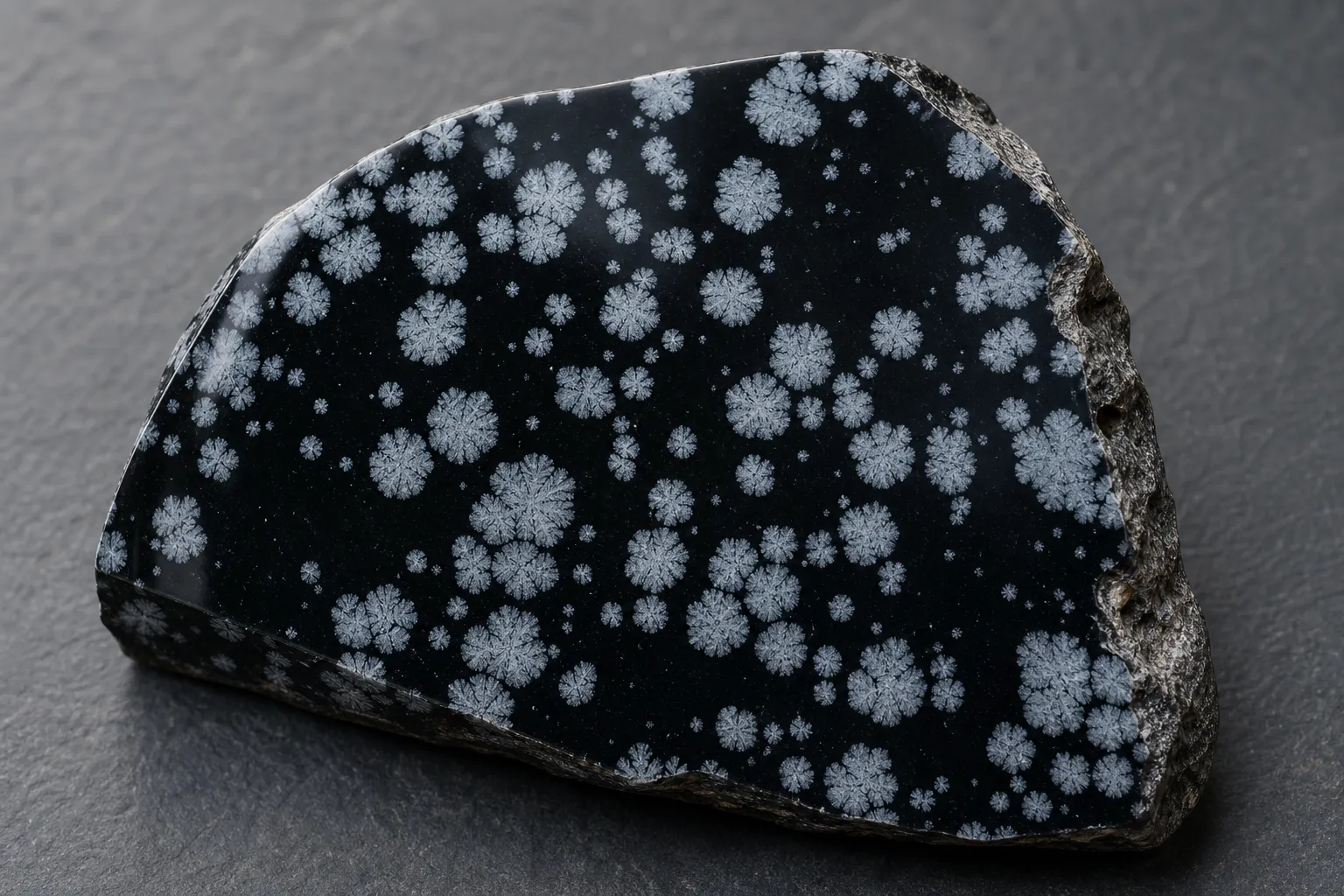
Snowflake patterns in obsidian form when dark volcanic glass develops pale crystalline clusters inside it. In collector terms, how snowflake obsidian forms is a two-part story: silica-rich lava cools quickly enough to become glassy obsidian, and then selected areas of that glass partially crystallize. The white or gray “snowflakes” are commonly described as cristobalite-rich clusters set against the dark glassy matrix.
They are not snow, paint, fossils, bubbles, or a surface print. They are internal crystalline patches in a stone that remains mostly volcanic glass.
upward
Start with the broader guide
Use the broader guide first if you need the full scope before this page.
The visible clue: dark glass with pale clustered spots
A typical piece of snowflake obsidian shows strong contrast. The background is usually black, charcoal, or very dark brown. Within that darker body are pale gray, off-white, or cream-colored marks that may look like tiny stars, flowers, rounded bursts, or snowflakes.
That appearance is why the name works. The stone does not form from ice or weather-related frost; the name is visual.
How the pattern can vary
- Some pieces have small, tight gray dots.
- Some show larger pale bursts with a star-like shape.
- Some are densely patterned.
- Others have only a few scattered patches.
- Polished surfaces often show the contrast more clearly than rough or weathered surfaces.
The useful identification cue is not simply “white spots.” It is white or gray crystalline-looking patches within a dark glassy obsidian body. Lighting, polish, camera exposure, and seller labels can all change how obvious that pattern appears, especially in online photos.
The formation process in two stages
Snowflake obsidian formation is easier to understand if you separate the dark glass from the pale patches.
Stage 1
Obsidian forms as volcanic glass
Obsidian is natural volcanic glass. It forms when silica-rich molten rock cools so quickly that its atoms do not arrange into the larger crystal structures seen in many other rocks and minerals. That is why obsidian is described as glassy rather than as a normal fully crystalline mineral.
In a collector piece, the dark background records that glassy character. If the same material had cooled or changed under different conditions, more extensive crystallization could have occurred, and the result might not have the clean glassy look associated with obsidian.
Stage 2
Selected zones crystallize inside the glass
The pale “snowflakes” appear where parts of the glassy obsidian crystallize locally. This does not usually happen evenly through the whole stone. Instead, crystal growth begins at scattered points or favorable zones, then spreads outward into rounded, star-like, or radiating clusters.
The material most often associated with those pale clusters is cristobalite, a form of silica. Quartz is also a silica mineral, but the more careful wording for snowflake obsidian is cristobalite or cristobalite-rich clusters, not ordinary quartz spots.
That is the key distinction: snowflake obsidian is dark volcanic glass with localized crystalline patches, not black stone with white decoration added later.
Why the patches look like snowflakes
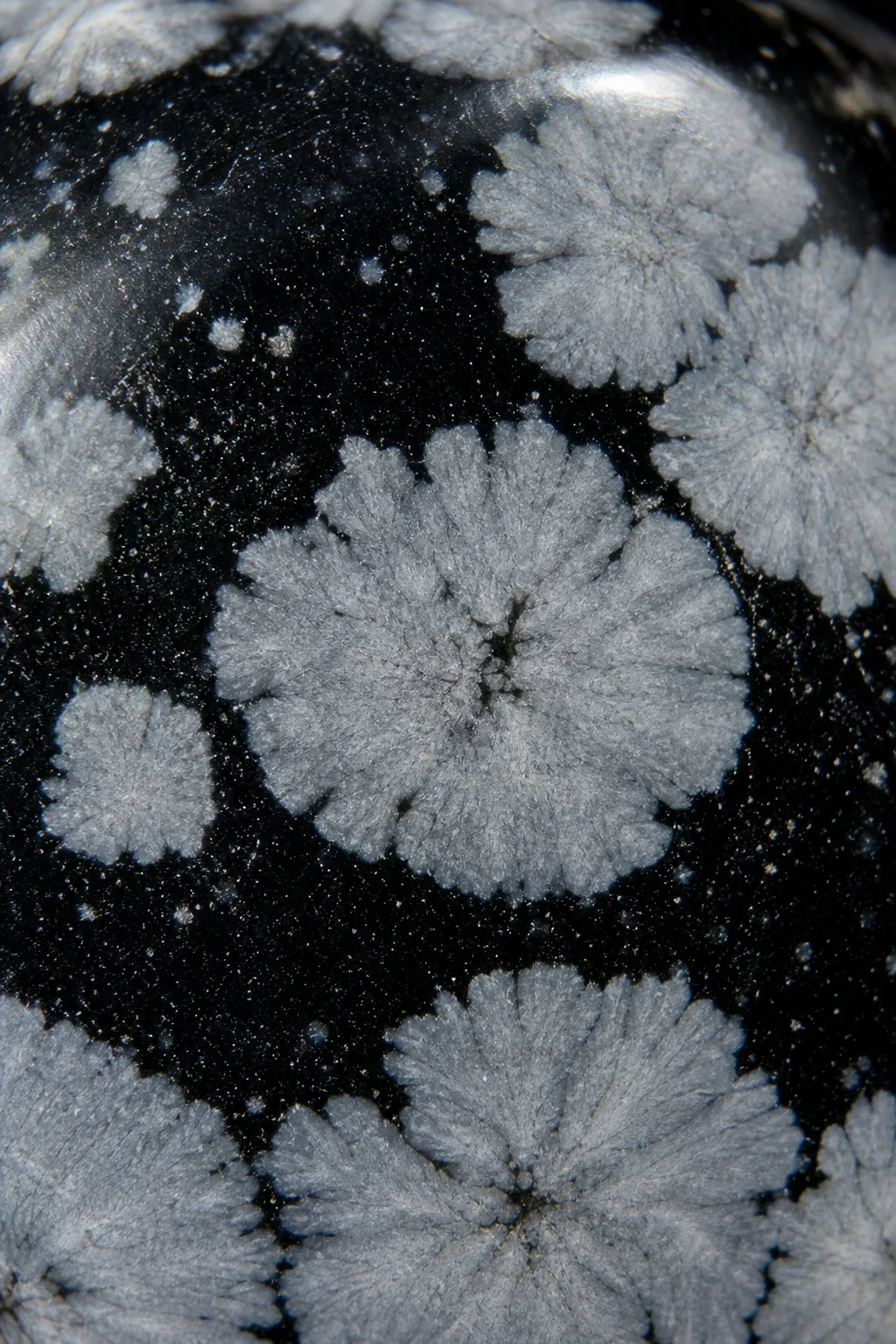
The snowflake look comes from the way pale crystals cluster and grow. In geology and collector descriptions, these patches may be called radial clusters or spherulites.
A spherulite is a rounded aggregate of crystals that grow outward from a center. When that three-dimensional growth is cut or polished across, it can look like a circle, flower, star, or snowflake-like mark.
Why no two pieces look exactly alike
- Where crystal growth began.
- How many starting points were present.
- How the glass cooled and changed after formation.
- Local chemistry within the volcanic glass.
- How the stone was cut, polished, or oriented.
The available geology supports the broad mechanism: volcanic glass plus localized crystallization, commonly involving cristobalite. It does not support a precise rule that every visible patch formed at one exact temperature, speed, or moment. For collectors, the steadier explanation is that the pale spots are local crystallized zones within an otherwise glassy obsidian body.
What the white or gray spots are not
Snowflake obsidian attracts a lot of casual explanations. A few are useful shorthand, but others can mislead identification.
Not frost or trapped snow
The name describes appearance, not origin.
Not fossils
Obsidian forms from volcanic material, and the pattern is a crystallization texture rather than a preserved organism.
Not simply bubbles
Obsidian can contain vesicles or other textures in some settings, but the classic snowflake patches are better understood as pale crystalline clusters, not empty holes.
Not a painted natural pattern
Polishing can sharpen the contrast, but it does not create the geological pattern. The pale areas should look integrated into the material rather than sitting on top like applied speckling.
They also do not mean the whole stone is crystalline. Obsidian is glassy overall, while snowflake obsidian contains localized crystalline areas. That mixed character is exactly what creates the pattern.
Why not all obsidian has snowflakes
Most obsidian does not show obvious snowflake patches. That does not make it less real as obsidian. It only means that this visible crystallization texture is absent, too fine to see, not exposed on the surface, or not part of that particular material.
Snowflake patterns require more than “lava cooled.” The base obsidian needs rapid cooling to become glassy, while the pale patches require partial crystallization in selected areas. If the glass remains visually uniform, you may see plain black obsidian. If other textures are present, you may see banding, sheen, or another variety name. If crystallization becomes too extensive, the material may move away from the glassy look collectors expect from obsidian.
That is why “obsidian with gray spots” is only a starting clue. The pattern should make sense as pale internal clusters in a dark glassy matrix, not as loose surface powder, artificial-looking speckling, or a different stone with a similar color scheme.
Can you identify snowflake obsidian from a photo?
A clear photo can show whether a piece resembles snowflake obsidian: dark glass plus pale snowflake-like patches. It is especially helpful when the surface is polished and evenly lit.
A photo still has limits. It may not show whether the pale areas are internal or only on the surface. It can hide chips, coatings, dyed areas, or texture changes. It can also exaggerate contrast, making gray patches look bright white or making subtle markings disappear.
Practical collector wording
- “This looks consistent with snowflake obsidian” is reasonable.
- “The pale clusters resemble cristobalite snowflakes” is reasonable when the visual pattern fits.
- “This photo proves the specimen’s origin and natural formation” goes too far.
If the piece is in hand, look for a glassy luster, a dark matrix, and pale clusters that appear to pass through or sit within the material rather than resting as a fragile surface layer.
A short handling note tied to the glassy structure
Snowflake obsidian is still obsidian, so it behaves like glassy volcanic material. It can chip or break, and broken obsidian may form sharp curved edges through conchoidal fracture. That shell-like break is part of the same glassy character that gives obsidian its smooth, reflective look.
For ordinary collecting, simple care is enough: avoid dropping it, do not store it where it will knock hard against other stones, and handle broken or thin-edged pieces carefully. The snowflake patches do not make the stone harder or less prone to chipping.
Formation and meaning are separate questions
Some shops and crystal traditions associate snowflake obsidian with ideas such as grounding, balance, or personal reflection. Those are cultural or personal interpretations. They do not explain how the snowflake patterns physically form.
The physical answer is geological: dark volcanic glass forms first, then localized crystallization creates pale cristobalite-rich clusters. A person may attach meaning to the appearance, but that meaning is separate from the stone’s formation.
The collector takeaway
Snowflake obsidian gets its pattern from partial crystallization inside volcanic glass. The dark background is obsidian’s glassy matrix, formed from rapidly cooled silica-rich lava. The pale white or gray “snowflakes” are localized crystalline clusters, often described as cristobalite-rich radial patches or spherulites.
When you look at a piece, start with what you can see: dark glass, pale internal clusters, variable size and spacing, and a pattern that appears integrated rather than painted on. That keeps the explanation grounded: snowflake obsidian is obsidian whose glassy body contains scattered zones where crystals had room to grow.