
Online Buying Guide
How to Buy Obsidian Crystals Online Without Relying on One Photo
If you want to buy obsidian crystals online, one attractive product image should not carry the whole decision. A single photo can hide the back, blur the edges, flatten the scale, exaggerate reflections, or make a polished piece look more even than it is. A stronger listing shows the exact item from several angles, describes visible condition clearly, and gives you enough seller information to judge whether the piece matches your expectations.
Photos can help you compare visible traits: shape, polish, chips, sheen, pattern, scale, and edge condition. They cannot settle every question about origin, variety name, value, or material history. If a listing shows only one staged image and the seller gives vague answers, ask for more photos or keep looking.
upward
Read the full overview first
Use the broader guide first if you need the full scope before this page.
What Multiple Photos Should Show
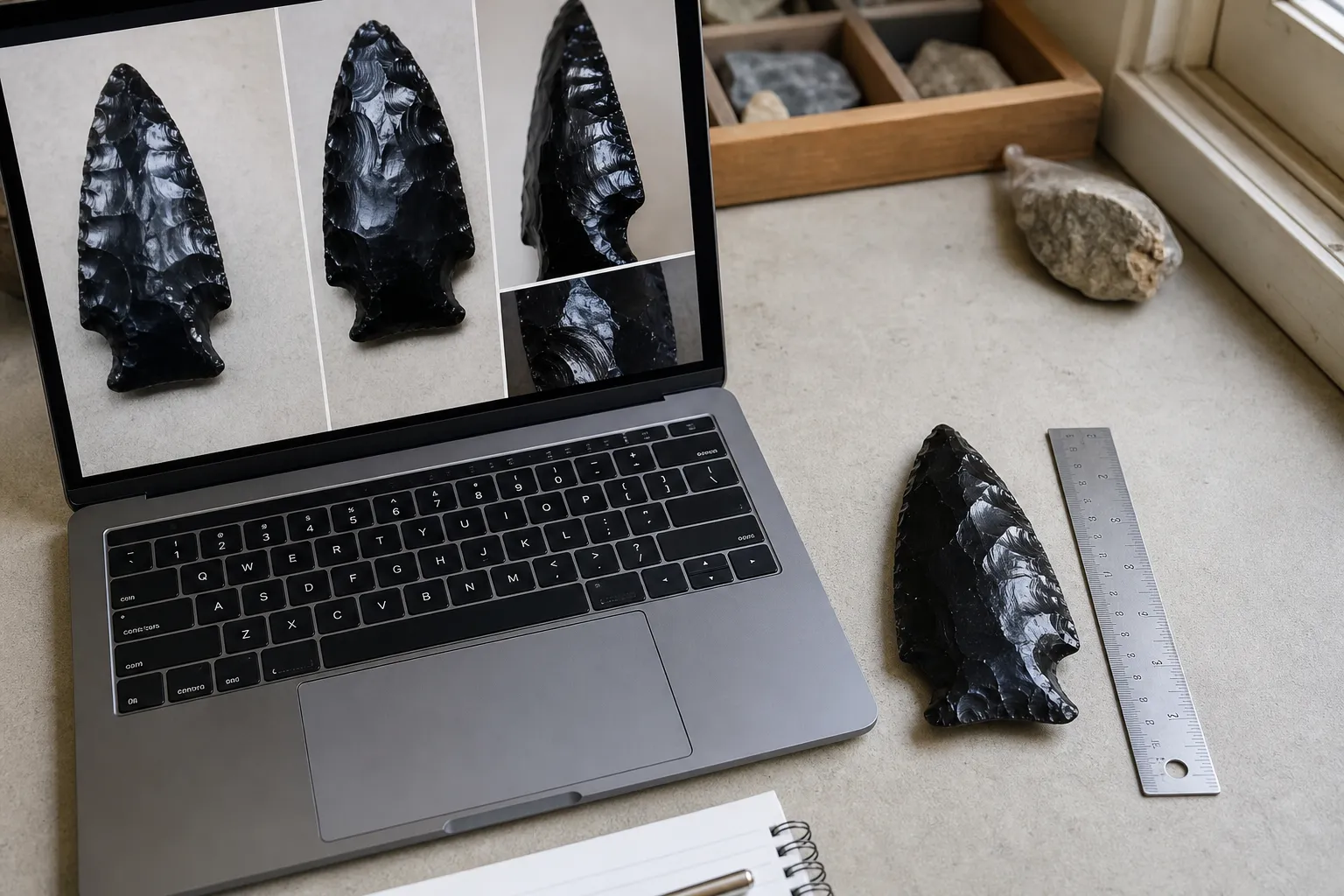
Obsidian is reflective volcanic glass, so it can change noticeably from one angle to another. A front-facing image may show a deep black surface, while a side or back view may reveal chips, uneven polish, glue residue on a base, a drilled hole, or a shape that was not obvious from the main picture.
For a small collector purchase, a useful photo set usually includes:
- A straight front view of the exact item
- A back view, not only the display side
- A side view showing thickness, edge shape, and profile
- A close-up of polish, chips, surface marks, or sheen
- A scale photo with a ruler, coin, hand, or listed measurement
- A second lighting angle if the listing depends on sheen, banding, or color effect
The phrase “exact item” matters. Stock photos may show a general product type, but they are weak for choosing a specific piece. If a listing says the item will be “similar,” the photo should not be read as a promise that every snowflake pattern, sheen patch, surface mark, or shape will match what arrives.
A seller does not need studio photography. Clear ordinary pictures can be more useful than dramatic images if they show the piece honestly. Be slower with listings that use heavy contrast, dark backgrounds, bright glare, or only one flattering angle, especially when the price depends on polish quality, unusual sheen, color effect, or a named variety.
How to Read Obsidian Listing Photos
Photo-reading is not the same as identification. It is a way to decide whether the listing gives enough visible information to continue. Obsidian listing photos can support a cautious “this matches the description well enough to consider” judgment, but they should not be treated as final proof.
Start with scale
Polished stones, towers, palm stones, tumbles, and raw-looking chunks can look much larger when photographed close up. Measurements in the description should match the visual impression. If the seller gives only weight, ask for dimensions. A ruler or listed length is clearer than a hand alone.
Look at the edges
Obsidian edges can be sharp, rounded by tumbling, chipped during handling, or softened by polishing. On a tower or point, check the base corners, tip, and side ridges. On a palm stone or freeform, look along the rim where small chips may catch light. On a raw or partly worked piece, ask whether any edges need careful handling.
Study the surface
Reflections can reveal polish quality, but glare can also hide marks. A clean reflection line may suggest a smoother polished area, while broken or wavy reflections can make uneven surfaces easier to notice. That does not automatically make the piece undesirable; some collectors like natural texture, pits, or irregular shapes. The question is whether the listing shows those traits clearly enough.
Check lighting when the listing depends on effect
If the listing features sheen, color flash, or pattern, lighting matters even more. A sheen patch may look dramatic in one image and subtle in another. A seller who shows the same piece under indirect light, angled light, and a neutral background gives you a more realistic view than a seller who shows only the strongest flash shot.
Seller Transparency Matters More Than Perfect Photography
A careful online obsidian seller does not have to make every piece look flawless. Useful seller disclosures tell you whether the photos show the exact item, whether the stone is polished or rough, whether there are chips or fractures, and whether color or sheen may vary with lighting.
Look for details such as:
- Exact dimensions and weight
- Whether the listing is for the pictured item or a similar one
- Notes about chips, pits, repaired areas, drilled holes, or unstable bases
- Whether a stand, cord, chain, or display prop is included
- Whether the piece has sharp edges or fragile points
- Return policy details before purchase
The return policy is not just administrative fine print. It affects how much uncertainty you can reasonably accept. A listing with limited photos and a clear return process is different from a listing with limited photos and no practical return path.
Seller communication also matters. If you ask for a side view, scale image, or edge close-up and receive a clear answer, that is more useful than a reply that simply repeats the title. If the seller will not provide more photos for a one-of-a-kind item, you can still buy, but you are accepting more uncertainty.
Be careful with broad variety labels that are not supported by visible features. Terms such as “rainbow,” “gold sheen,” “silver sheen,” or “snowflake” should be backed by photos that actually show the named trait. A product name can be a seller category, not a promise that the effect will appear strongly from every angle.
When One Photo Is Especially Weak
One image is weakest when the listing asks you to trust a trait that changes with angle, lighting, or surface finish. This includes sheen obsidian, very dark polished pieces, carved shapes with hidden backs, and items sold in mixed lots.
Black polished stones
One front photo may make the surface look smooth and uninterrupted. A side photo may show uneven thickness. A back photo may show pits or flat saw marks. A close-up may show small scratches. These details do not automatically make the piece poor, but they matter if you are comparing listings or paying for a particular finish.
Snowflake obsidian
Pattern distribution matters. One side may have clear gray or pale patches, while the other side may be mostly black. If the listing only shows the best side, you cannot know whether the pattern wraps around the piece or appears mainly in one display area.
Sheen varieties
A single bright flash photo can overstate what you will usually see. Ask for another image in softer light or from a slightly different angle. The goal is not perfection; it is to see whether the visual effect is part of the stone’s normal appearance or mainly the result of one lighting setup.
Towers, points, spheres, and carvings
Inspect bases and edges. A tower can photograph beautifully from the front while leaning or showing chips near the base. A sphere can hide flat spots if it is shown only in a stand. A carving can look balanced from one angle and asymmetrical from another. Item-specific photos reduce these surprises.
A Practical Photo Check Before You Buy
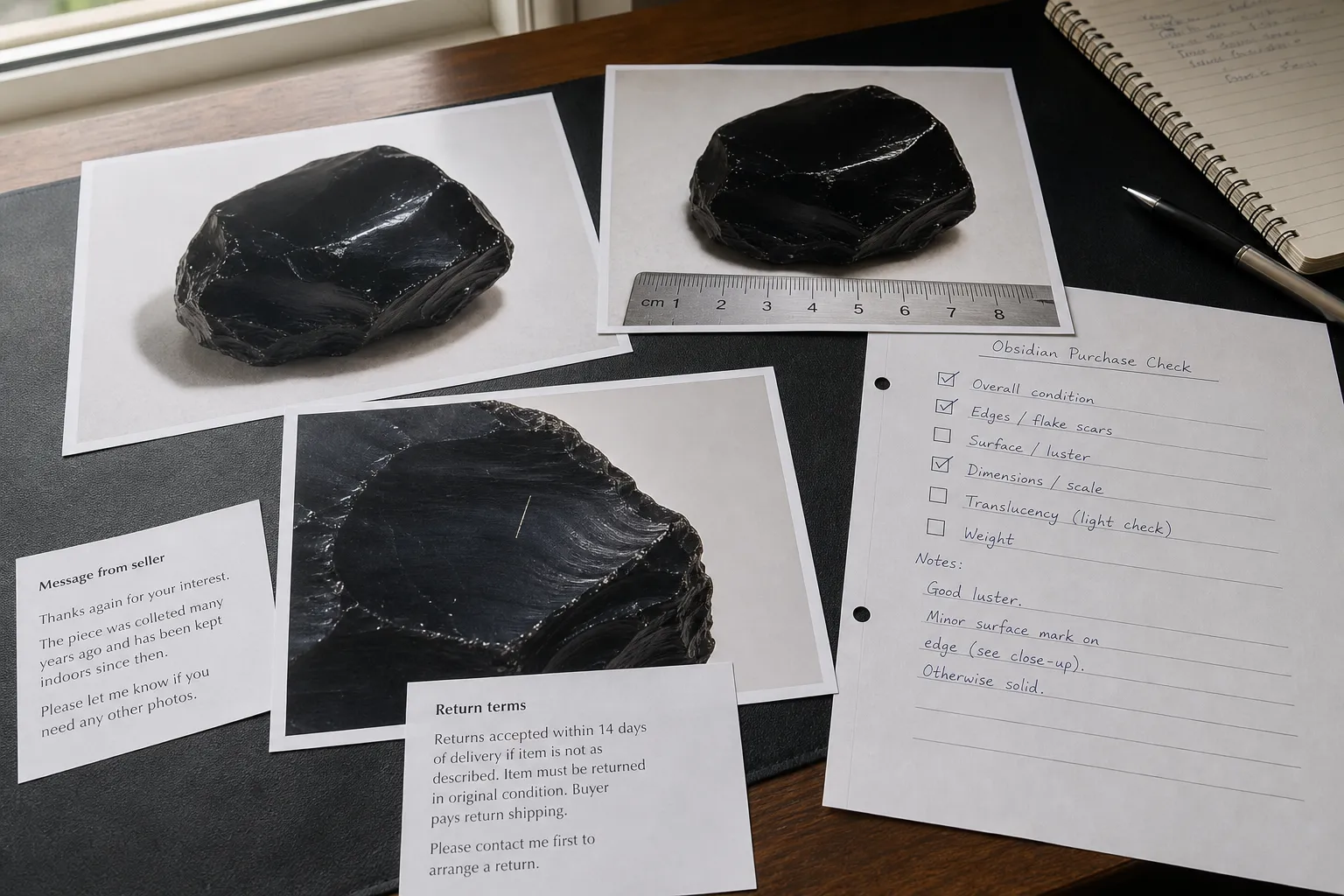
Before buying obsidian crystals from an online listing, make two passes. The first pass tells you whether you like the piece. The second tells you whether the listing gives enough information to trust your expectations.
Ask:
- Are the photos of the exact item, not only a representative example?
- Do they show front, back, side, and close-up views?
- Is there a clear sense of size through measurements or a scale image?
- Does the lighting show surface detail, not only dramatic shine?
- Are chips, scratches, pits, uneven edges, or base issues disclosed?
- Does the description match what the photos show?
- Is the return policy visible before purchase?
- Does the seller answer reasonable condition questions clearly?
If several answers are missing, the stone is not automatically bad. The issue is that you are being asked to decide with too little information. That may be acceptable for a low-cost casual purchase, but it is not ideal for a collector piece, named variety, or item where finish and display angle matter.
A useful rule is to separate “I like this image” from “I understand this object.”
Online listings often make the first feeling easy. The second requires scale, angles, surface detail, and seller clarity.
What Photos Cannot Tell You
Even a strong photo set has limits. Photos cannot confirm every statement about source location, exact material history, fair market value, or how the object will look in your room under different light. They also cannot turn symbolic or personal meanings into verified effects. For an obsidian buyer, photos are best used for visible traits: color impression, polish, shape, chips, edges, pattern, sheen, and listing consistency.
This matters because some listings imply more certainty than the images can support. A photo may look consistent with a type of obsidian, but that is not the same as a formal identification. A polished surface may look clean, but small marks can appear under different light. A seller may use a familiar variety name, but the strength of that label depends on what is visible and disclosed.
The cautious buying point is simple: move forward only when the photos, written description, seller communication, and return terms tell the same story. If one part is weak, adjust your expectations or ask for more information.
The Better Decision
Buying obsidian online does not require suspicion toward every seller or perfection from every listing. It requires enough visual coverage to understand what you are choosing. One photo can introduce a piece; it should not make the whole decision.
Look for multiple angles, realistic lighting, scale, surface detail, edge condition, and item-specific disclosure. Treat attractive photos as a starting point, not a final answer. When a listing gives you a clear view of the object and a clear path if it does not match the description, you can make a calmer choice. When it does not, the practical collector move is to pause, ask, or keep looking.