Obsidian identification notes
How to Read Sheen on Obsidian Without Overstating the Label
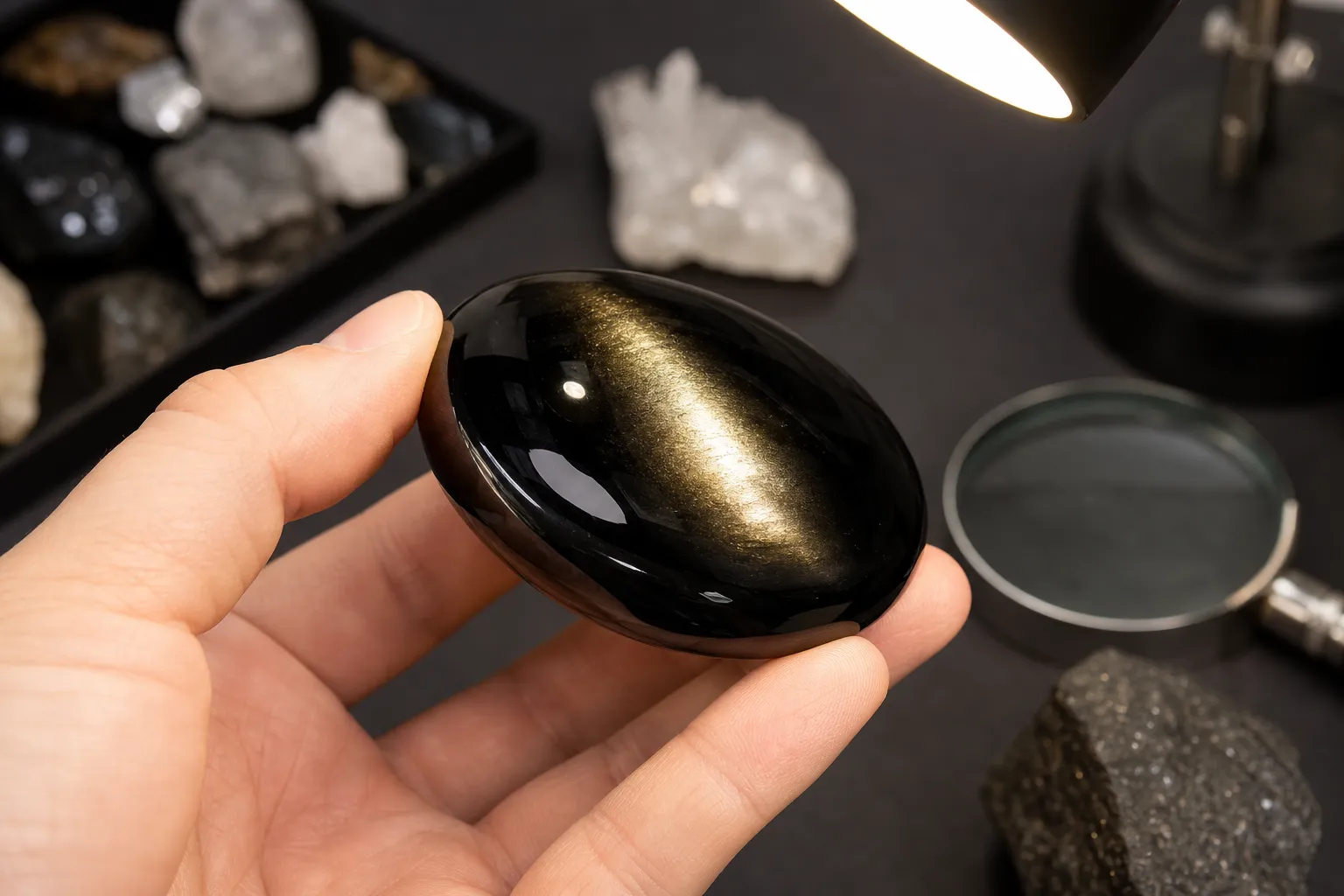
Obsidian sheen is best read as a visible, angle-dependent flash—not as a complete identification, origin, value, or authenticity answer. If a polished piece flashes gold, silver, rainbow-like, fire-like, or metallic color when you turn it under steady light, describe what you can actually see: “appears to show gold sheen,” “has a silvery internal flash,” or “shows rainbow-like color under angled light.”
That wording matters. Sheen labels are usually collector or seller descriptions based on appearance. They can help you talk about a piece clearly, but they should not be stretched into claims about exact source, rarity, composition, price, or personal effects.
upward
Read the full overview first
Use the broader guide first if you need the full scope before this page.
How to inspect obsidian sheen
Start with the stone in your hand, not the sales name. Sheen is easiest to judge on a smooth polished surface: a palm stone, bead, cabochon, pendant, ring stone, sphere, carving, or display piece. Rough or poorly polished areas may hide the effect.
Use one steady light source. A desk lamp, window, or bright overhead light can work. Avoid making a final call from one dramatic product photo, because sheen can look stronger at the best possible angle.
A simple inspection sequence:
- Check the base look first. Is the piece mainly black, dark gray, smoky, or slightly translucent at thin edges? Obsidian is volcanic glass, so a glassy look is expected, but appearance alone has limits.
- Find the reflection. Move the stone until light catches it. Notice whether you are seeing ordinary surface shine or a colored flash that seems to sit within the stone.
- Rotate slowly. Angle-dependent sheen usually appears, fades, or changes as you turn the piece. A constant white reflection may just be polish catching the light.
- Name the dominant flash. Warm yellow, bronze, or golden color may be described as gold sheen. Cool gray, white, or silvery flash may be described as silver sheen. Multiple shifting colors may fit rainbow-like or fire-like wording.
- Notice the coverage. Is the flash broad, narrow, patchy, fan-shaped, banded, or scattered? Coverage often tells a collector more than a dramatic variety name.
- Compare the label with the stone. A piece sold as gold sheen obsidian may show only a small warm flash. A piece sold as silver sheen may show gray, white, or mixed metallic reflection.
This process gives you a disciplined way to describe the obsidian reflective effect without leaning too hard on a market label.
Surface gloss vs internal flash
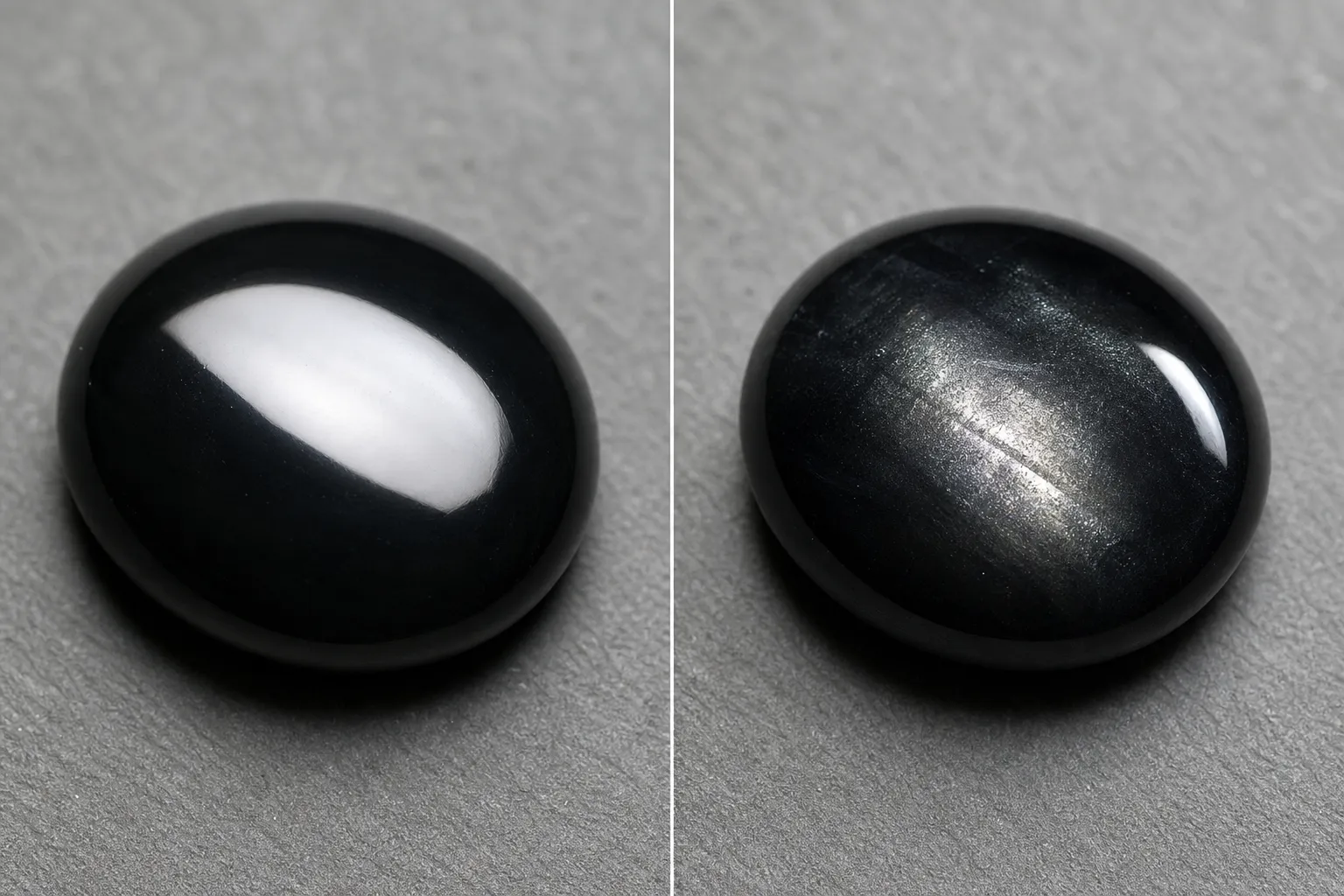
The most common mistake is confusing a polished surface reflection with an internal-looking sheen. Obsidian can take a high polish, and glossy black volcanic glass can reflect a lamp, window, phone, or your hand. That shine may be bright and attractive, but it is not the same observation as angle dependent obsidian sheen.
A surface reflection usually behaves like a mirror highlight. It follows the light source, appears on the outer curve or flat face, and may look white, rectangular, or shaped like the lamp or window.
An internal flash is the effect collectors usually mean when they talk about sheen obsidian. It may appear as a metallic glow, a moving band, a soft field of color, or layered color that only shows from certain directions. Public explanations often connect these effects with light interacting with microscopic features in volcanic glass, such as tiny bubbles, inclusions, layers, or other fine structures. From a casual look, though, you should not assign one exact cause to every specimen.
Lighting also changes the impression. Research on shiny material perception shows that illumination, highlight structure, and viewing angle can affect how glossy or metallic a surface appears. In collector terms: the same stone may look more metallic under a lamp, flatter in diffuse daylight, and more colorful in a carefully angled photo.
Common sheen labels and careful wording
Sheen labels are useful when they stay tied to what is visible. They become weak when they are treated as proof of things the eye cannot confirm.
| Label you may see | What to look for | Cautious wording |
|---|---|---|
| Gold sheen obsidian | Warm metallic flash, yellow-gold to bronze glow, usually angle dependent | “Appears to show gold sheen under angled light.” |
| Silver sheen obsidian | Cool gray, white, or silvery metallic flash | “Shows a silver-toned sheen when rotated.” |
| Gold vs silver sheen obsidian | Compare the flash color, not just the body color | “The flash reads warmer/cooler in this lighting.” |
| Rainbow obsidian sheen | More than one color, sometimes in subtle bands or zones | “Shows rainbow-like color play at certain angles.” |
| Fire obsidian sheen | Stronger iridescent or fire-like color play; label use varies | “Has fire-like iridescence, with the label used cautiously.” |
| Metallic sheen obsidian | Metal-like flash within dark volcanic glass | “Displays a metallic-looking internal flash.” |
“Gold sheen obsidian” does not necessarily mean the piece contains gold. “Silver sheen obsidian” does not necessarily mean it contains silver. These are appearance labels for the color of the flash, not chemical analysis. The same caution applies to “rainbow” and “fire” names: they point to visible color under light, but public usage is not always consistent.
If a piece shows both warm and cool reflections, do not force one name. Try: “dark polished obsidian with mixed gold and silver-toned sheen,” or “sold as silver sheen, though the flash looks warmer in some light.” That kind of note is more useful than a confident label the stone does not clearly support.
What a sheen label cannot tell you
Sheen is visible information. It can help describe a polished obsidian piece, but it cannot carry claims that require records, testing, or market expertise.
A sheen label does not reliably establish:
- Geological source or origin. Obsidian sourcing work often uses analytical methods such as XRF, Raman spectroscopy, ICP-MS, INAA, EPMA, or related approaches. A collector does not need those methods for a display note, but flash color alone is not a source record.
- Exact composition. Sheen may involve light interacting with fine internal features, but a casual visual check is not enough to assign one universal structure or ingredient to all gold, silver, rainbow, or fire-like pieces.
- Authenticity from a photo. A photo can hide sheen, exaggerate it, or show only the most flattering angle. Lighting, polish, contrast, camera settings, and editing all affect the impression.
- Rarity or price. A bright flash can make a piece desirable, but value also depends on size, polish, cutting, damage, demand, seller context, and documentation.
- Symbolic or wellness-related effects. Some shops attach personal-practice or meaning language to sheen obsidian. Treat those as beliefs, traditions, or personal associations—not as established outcomes.
This does not make the label useless. It puts the label in the right place: “gold sheen,” “silver sheen,” “rainbow-like sheen,” and similar terms work best as careful descriptions of what the stone shows under stated viewing conditions.
Better wording for collection notes or listings
If you keep collection records, sell a duplicate piece, or want a clear label for a display tray, describe the observation in layers: material, form, visible flash, and viewing condition.
Examples:
- “Polished dark obsidian palm stone with gold-toned internal sheen visible under angled light.”
- “Round obsidian bead showing a cool silver flash when rotated; surface also has strong gloss.”
- “Cabochon sold as rainbow obsidian; visible bands appear blue-green and purple from one direction.”
- “Pendant stone with subtle metallic sheen, not enough from this view to separate gold vs silver confidently.”
- “Dark volcanic glass piece labeled fire obsidian; shows iridescent color play, but origin and composition are not established from appearance alone.”
This is especially helpful for online photos. Instead of writing “rare authentic gold sheen obsidian from a specific source” without support, write what the image can carry: “gold-toned sheen visible in the listing images.” It is less dramatic, but more accurate.
For jewelry, inspect more than one bead or face. A bracelet may include beads with uneven flash. A ring stone may show sheen only from one angle because of how it was cut. A pendant may look bright in a shop light and subdued in daylight. Those differences do not automatically make the piece mislabeled; they show why the viewing condition belongs in the description.
Handling while checking sheen
Obsidian is glassy and brittle. A polished piece may feel smooth, but a chipped or broken edge can be sharp. When you rotate a stone under light, hold it over a soft cloth or tray so a slip does not send it onto a hard floor. Do not run your finger along a damaged edge.
For routine inspection, a dry microfiber cloth or gentle wipe is usually enough to remove fingerprints that interfere with seeing the flash. Store polished sheen pieces away from rough contact with harder stones or metal objects that can scuff the surface. The goal is simple: preserve the polish that lets the reflective effect show.
Quick decision path
Use this when you are unsure how to name the flash:
- If the piece only reflects the lamp or window on the surface, call it glossy polished obsidian, not necessarily sheen obsidian.
- If a colored or metallic-looking flash appears and disappears as you rotate it, describe it as angle-dependent sheen.
- If the flash is mostly warm yellow, bronze, or golden, use gold sheen cautiously.
- If it is mostly cool gray, white, or silvery, use silver sheen cautiously.
- If it shows multiple shifting colors or bands, use rainbow-like sheen or fire-like iridescence, depending on the look and seller context.
- If you cannot separate the colors confidently, write mixed metallic sheen or subtle internal flash instead of forcing a variety name.
The most accurate label is often not the boldest one. For obsidian sheen, good collecting language stays close to the visible flash, the light angle, and the limits of what a polished stone can show.