
Formation guide
How Does Lava Turn Into Obsidian
Lava turns into obsidian when suitable volcanic melt solidifies as glass instead of growing visible crystals. In most collector-level examples, that means silica-rich lava—often rhyolitic or felsic—cools and stiffens before its atoms and ions can arrange into a regular crystal structure. The result is natural volcanic glass.
That is the short answer to how does lava turn into obsidian, but one detail matters: “rapid cooling” is not the whole recipe. Composition, viscosity, gas content, and cooling history all affect whether lava becomes dense obsidian, bubbly volcanic glass, crystalline rhyolite, basalt, or another volcanic rock.
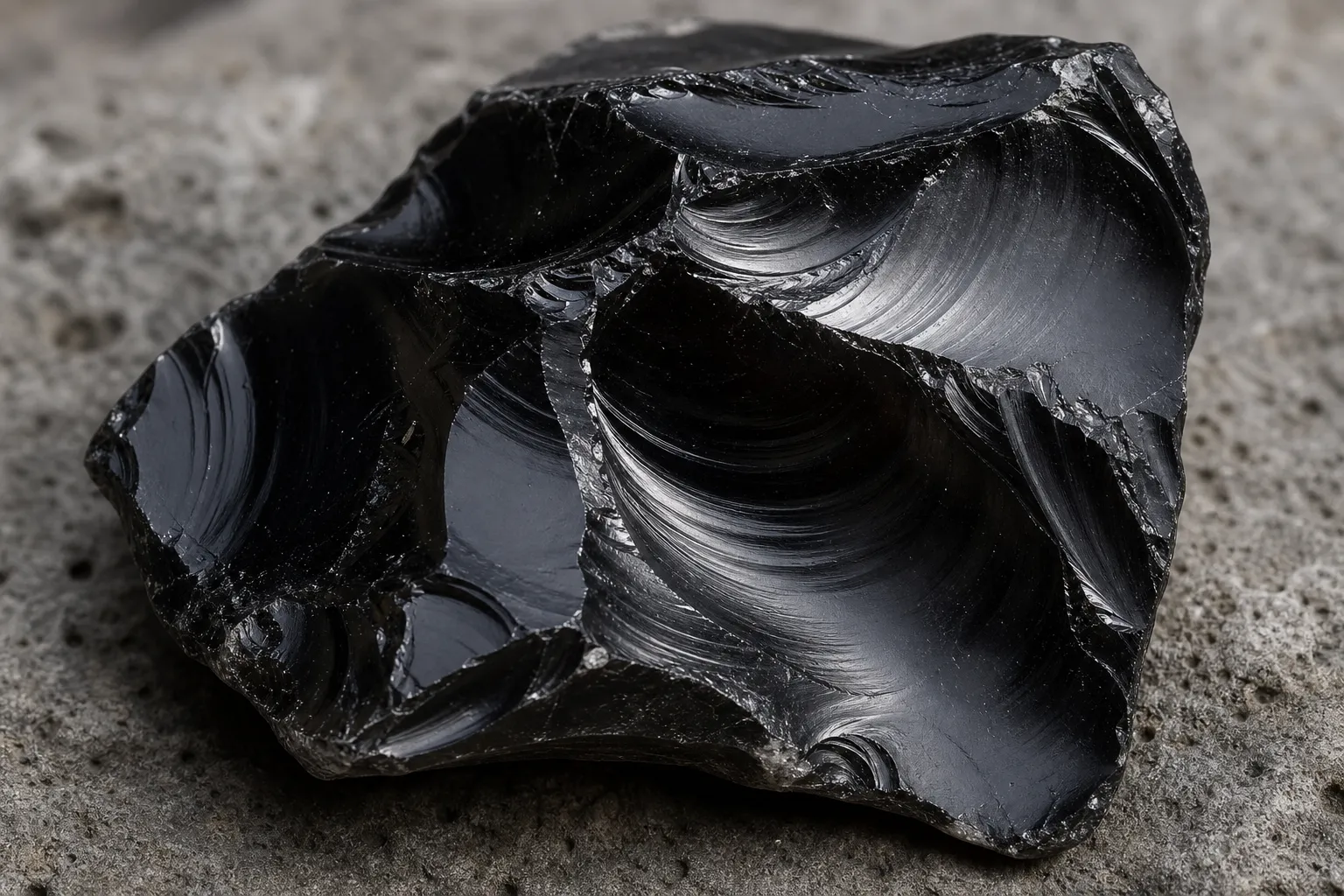
For collectors, this formation story shows up in visible traits: a glassy surface, little to no grainy texture, sharp broken edges, and curved conchoidal fracture.
upward
Read the full overview first
Use the broader guide first if you need the full scope before this page.
The basic process: lava cooling into glass
Obsidian begins as molten volcanic material. When that melt reaches the surface as lava and loses heat, it can solidify in two broad ways:
- As crystalline rock: its chemical components have enough time and mobility to organize into mineral crystals.
- As volcanic glass: the melt becomes rigid before a regular crystal structure develops.
Obsidian is the second outcome. It is often grouped with “crystals” in shops and collections, but in a strict mineralogical sense it is not a crystal. It is a natural, silica-rich volcanic glass.
A simple comparison is window glass. Glass is solid, but it does not show mineral grains the way granite does. Obsidian is not manufactured glass and does not share one fixed industrial recipe, but the broad idea is similar: the material hardens without forming large, orderly crystals.
That is why a fresh break in obsidian can look smooth, glossy, and shell-like rather than sandy, sugary, or speckled with obvious mineral grains.
Why silica-rich lava is more likely to form obsidian
Obsidian is most commonly linked with silica-rich lava. This matters because silica-rich melts tend to be thick and sluggish compared with many low-silica basaltic lavas.
In collector language, a thick melt gives crystal growth fewer chances. The ingredients that would build crystals cannot move around as freely, and if the melt is also losing heat, the opportunity for visible crystals can close quickly. The lava then solidifies as glass.
Several conditions work together:
Silica-rich composition
Common in rhyolitic or felsic volcanic systems, where obsidian is more likely to occur.
High viscosity
A thick melt limits internal movement, making crystal organization harder.
Cooling history
Heat loss can limit crystal growth, but “instant cooling” is an oversimplification.
Gas content
Gas-rich material may become bubbly or pumice-like instead of dense obsidian.
Time for crystals to grow
Less time and less mobility favor a glassy result.
This is why not every lava flow leaves obsidian behind. Basaltic lava commonly forms basalt or other volcanic textures rather than the dense black volcanic glass most collectors picture. Volcanic glass can occur in more than one setting, but familiar obsidian is strongly associated with silica-rich volcanic systems.
Why obsidian has no visible crystals
When people ask why obsidian has no crystals, they usually mean: why does it look like glass instead of a normal rock?
The answer is that its main body did not allow crystals to grow large enough to see. In crystalline rocks, minerals form as a melt cools and chemical components arrange into repeating patterns. In obsidian, cooling history, composition, and viscosity prevent that larger crystal structure from developing.
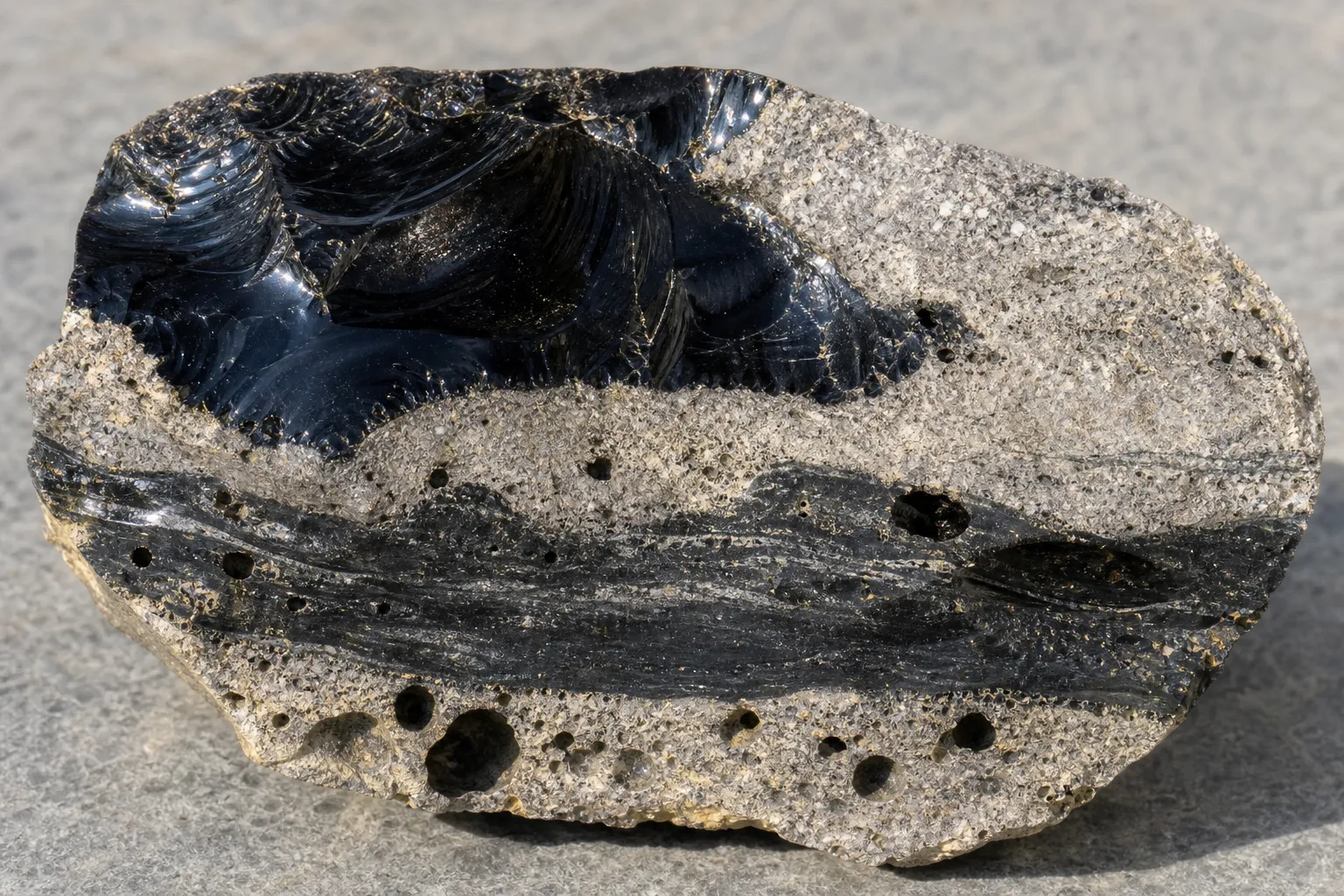
That does not mean every piece is perfectly featureless. Some obsidian contains tiny inclusions, bubbles, flow bands, or later growths within the glass. Snowflake obsidian, for example, has pale snowflake-like patches formed by crystalline growth in the glassy material. Rainbow, sheen, mahogany, and other variety names also depend on visible features such as inclusions, bubbles, iron staining, or internal structures that affect light.
The main distinction remains simple: obsidian is glassy, not grainy.
Look for these formation-linked clues:
- Glassy luster: a reflective, vitreous surface on fresh breaks or polished areas.
- Non-grainy texture: it should not look like a cluster of sand-sized crystals.
- Conchoidal fracture: curved, shell-like break patterns, similar to broken glass.
- Sharp broken edges: fractured obsidian can be extremely keen, so handle broken pieces carefully.
- Flow banding in some pieces: subtle lines or ribbons may reflect movement in the lava before it fully solidified.
These clues help explain the material, but they do not identify every black shiny stone on their own. Slag glass, dyed glass, polished basalt, and other dark materials can confuse beginners.
Does water make obsidian?
Water can cool lava, but water is not the ingredient that makes obsidian.
This misunderstanding is common because game rules and short demonstrations often simplify the process. In real geology, lava can lose heat to air, nearby rock, ice, water, or other cooler surroundings. Contact with water may chill lava quickly in some natural settings, but the final material still depends on the melt itself.
If the lava does not have the right composition and cooling behavior, fast chilling alone will not automatically produce dense collector-grade obsidian.
It is also not a collector method. Real lava-water interaction can involve extreme heat, steam, unstable crust, fragments, and volcanic gases. The useful takeaway is geological, not practical: cooling can help prevent crystal growth, but water is neither required for every obsidian occurrence nor sufficient by itself.
A cleaner way to say it:
Obsidian forms when suitable lava becomes glass before visible crystals can grow. Water may be one cooling environment, but it is not a universal recipe.
How long does obsidian take to form?
There is no single stopwatch answer. Obsidian forms as lava cools through the range where it becomes rigid, but different parts of a flow or dome can cool at different rates.
The outer surface of a lava body may lose heat faster than its interior. Margins can become glassy while deeper parts stay hot longer. Some obsidian-bearing flows preserve more complicated cooling histories than the phrase “cooled instantly” suggests.
For a beginner collector, the practical version is:
- Obsidian can form when cooling is fast enough, relative to the melt’s composition and viscosity, to limit visible crystal growth.
- It does not have to happen instantly throughout an entire lava flow.
- One volcanic body may include glassy zones, more crystalline zones, bubbly areas, or banded textures.
So a piece of obsidian usually tells a more specific story than “lava touched water.” It may have formed along a chilled edge, within a silica-rich lava dome, or in another volcanic setting where glass formation was favored.
What formation tells you when inspecting a piece
The formation story gives you useful clues, but it should not become an absolute shortcut. A black, shiny stone is not automatically obsidian.
When inspecting a possible obsidian piece:
- Check the surface in good light. Obsidian often shows a glass-like reflection, especially on fresh or polished areas.
- Look for grain. It usually lacks the sandy or granular texture of many crystalline rocks.
- Inspect broken edges carefully. Obsidian commonly breaks with curved conchoidal fracture and can be very sharp.
- Notice internal features. Flow bands, bubbles, sheen, snowflake-like patches, or brown mahogany coloring can appear in different varieties.
- Treat variety names cautiously. Labels often depend on appearance, lighting, polish, and seller wording.
The absence of visible crystals is one important clue, but reliable identification usually combines texture, luster, fracture, weight in hand, source context, and sometimes local geology or seller documentation.
The clean answer
Lava becomes obsidian when suitable volcanic melt—usually silica-rich and relatively viscous—cools and stiffens before visible crystals can grow. That process creates volcanic glass rather than a grainy crystalline rock.
Rapid cooling matters, but it is only part of the answer. Composition, viscosity, gas content, and cooling history all help decide whether the result is dense obsidian, pumice-like glass, crystalline rhyolite, basalt, or another volcanic material.
For collectors, the science points back to what you can see: obsidian looks glassy because it is volcanic glass, lacks a grainy crystal texture because larger crystal growth was inhibited, and breaks with sharp curved fractures because glassy materials fracture differently from many crystalline rocks.