
Collector Basics
How to Start an Obsidian Collection
Starting an obsidian collection is not a race to own every name you see in a listing. It is a way to train your eye: color, surface, polish, edge condition, translucency, sheen, and the gap between a seller’s label and what the piece actually shows.
If you are looking up how to start an obsidian collection, begin with a practical question: which few pieces will help you compare visible differences without filling a tray with duplicates? A strong beginner collection is usually small, labeled, and easy to explain in your own words.
The source packet available for this page did not include strong public references for geology, lapidary handling, or collector practice. For that reason, this guide keeps its claims modest. It focuses on visible traits, careful handling, record keeping, and the limits of market names, photos, and symbolic language.
upward
Start with the broader guide
Use the broader guide first if you need the full scope before this page.
What Should Be in a Beginner Obsidian Collection
A useful beginner obsidian collection has a purpose. It might be for visual comparison, display, tactile study, variety learning, or personal meaning. Whatever the reason, the first group should give you clear comparison points instead of five stones that look the same under normal light.
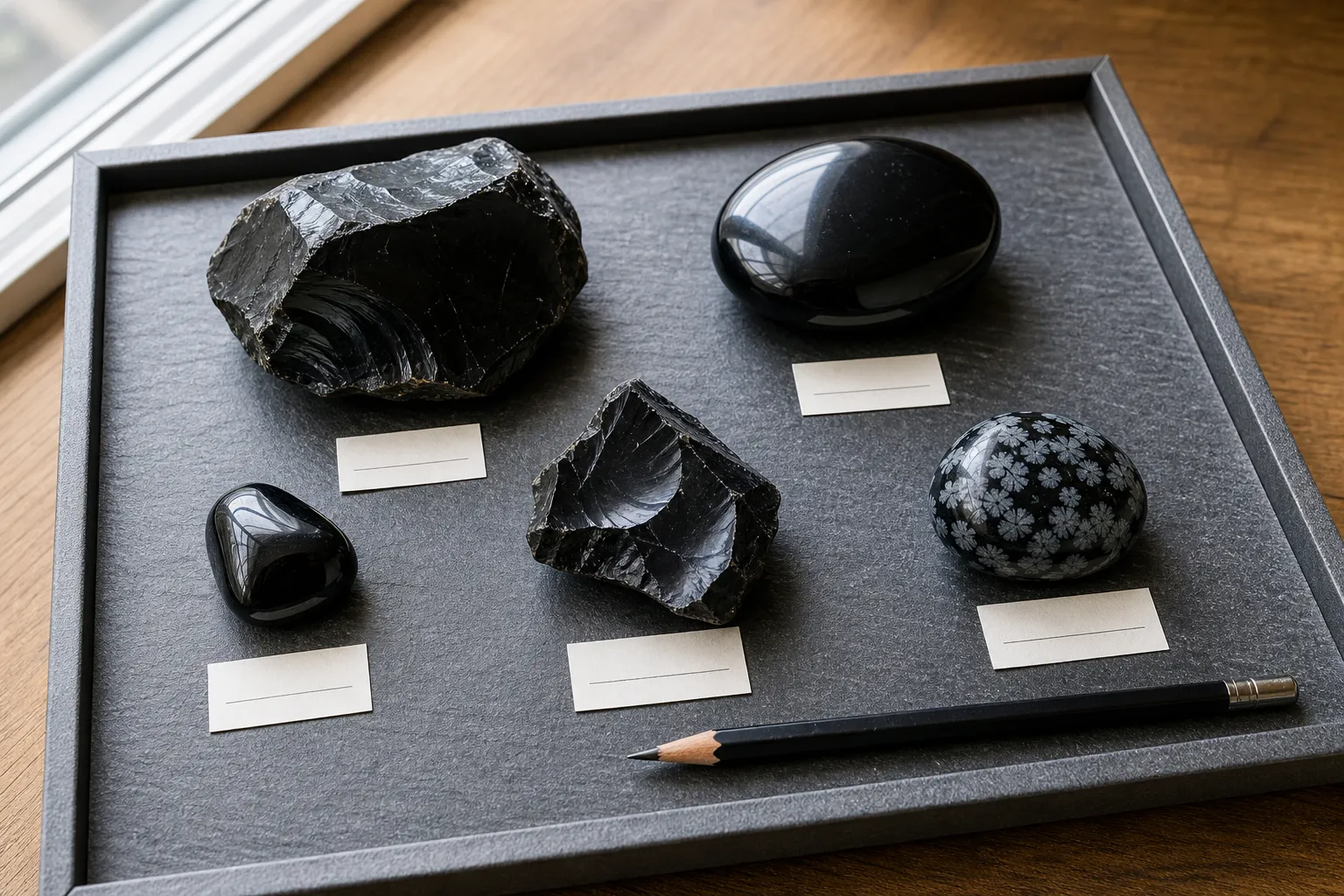
A sensible starter group might include:
- One plain dark piece for a baseline.
- One polished piece, such as a palm stone, cabochon, or small freeform.
- One rough or minimally worked piece, if you can handle and store it carefully.
- One visibly different variety or trade-labeled type, chosen for what you can actually see.
- One small tumbled stone if you want an affordable, low-space starting point.
- A label card or notebook entry for each piece.
This is a structure, not a mandatory shopping list. Three pieces with different finishes, edge conditions, or light responses can teach more than a larger group bought only because the names sound attractive.
A beginner obsidian collection becomes hard to use when every piece is added for a label rather than a visible reason. Before buying another stone, ask what it will help you compare.
How to Choose Your First Obsidian Specimen
Your first obsidian specimen should be easy to inspect, easy to store, and simple to describe without repeating the seller’s wording. Avoid making your first purchase depend entirely on a dramatic name, edited photo, rarity language, or a promised result that cannot be checked by looking at the object.
Before buying or keeping a piece, ask:
What can I see without special equipment?
Beginner collecting should build observation first.
Is it rough, polished, tumbled, carved, mounted, or broken?
Finish affects both appearance and handling.
Does it show color, sheen, banding, speckles, or inclusions?
Visible traits help you avoid buying near-duplicates.
Is the name descriptive or mostly a market label?
Some obsidian variety names are used inconsistently.
Can I label and store it without confusion?
Records make a small collection more useful over time.
A good first piece does not need to be rare. A modest specimen with clear features is often more useful than an expensive one whose identity depends on trust alone. Choose something you can compare under ordinary light and describe in plain terms.
If you are buying online, treat photos as partial information. Lighting, wet surfaces, strong contrast, dark backgrounds, and editing can change how sheen, color, and transparency appear. A photo can help you decide what to ask next; it should not settle the identification by itself.
Raw or Polished Obsidian: Which Should You Collect First?
Polished pieces
Polished obsidian is often easier for beginners to display and compare. Smooth surfaces can make reflection, color impression, and visual patterning easier to notice. Polished pieces also sit neatly in trays, shelves, or divided boxes, which helps if your goal is a small obsidian display collection.
Raw or broken pieces
Raw or broken pieces can show texture, edge behavior, and less-shaped forms that polish may hide. They also call for more attention during handling, especially if points, chips, or thin edges are present. “Raw” should not be treated as automatically more authentic, older, or more valuable. It simply describes a different state of finish.
Tumbled stones
Tumbled stones are a practical middle ground. They are small, easy to compare side by side, and useful for learning basic differences in color and surface. The tradeoff is that tumbling rounds edges and may remove or soften features you would study on a rough specimen.
Raw and polished obsidian teach different things. Neither is automatically the better starting point. A balanced first set could be one polished piece, one tumbled piece, and one rough or less-shaped piece. That simple contrast shows how finish changes the way obsidian presents itself.
How Many Pieces Do You Need to Start?
You do not need many pieces to begin. Three to seven well-chosen specimens can teach more than twenty loosely labeled purchases.
Start with three if you want a focused comparison:
- One simple dark specimen.
- One piece with a different finish.
- One piece with a visible pattern, sheen, speckling, or seller-applied variety name to examine cautiously.
Start with five to seven if you want a small display:
- One baseline piece.
- One polished form.
- One tumbled stone.
- One rough or minimally worked piece.
- One visually distinct variety.
- One piece chosen for size or display shape.
- One “question mark” piece kept for learning uncertainty.
That last category is useful. A collection does not have to pretend every label is settled. A specimen can be marked as “sold as,” “appears to show,” or “needs comparison” instead of being forced into a confident name.
The early collecting problem is rarely owning too few pieces. It is buying too many similar ones before you know what differences you are trying to observe.
Obsidian Collection Ideas for Beginners
Good obsidian collection ideas are built around comparison, not accumulation. A theme gives your tray a shape and helps you pause before buying another piece with a new name but no new information.
Finish-based collection
A finish-based collection might include a rough piece, a tumbled stone, a polished palm stone, a carved item, and a cabochon or small display form. The point is to see how cutting, shaping, and polishing change the appearance of a dark glassy material.
Visible-trait collection
A visible-trait collection starts with what the eye can describe: stronger reflection, softer luster, possible banding, speckled appearance, translucency at a thin edge, or a more uniform dark surface. In this kind of collection, the label matters less than the feature you can compare.
Variety-based collection
A variety-based collection needs the most caution. Obsidian variety names may depend on appearance, seller convention, polish, lighting, or local trade usage. If you collect by variety, pair each name with an observation note. Instead of writing only the trade name, add something like “golden reflection under angled light” or “dark body with small pale speckles.”
Compact display collection
A compact display collection can be arranged by size, finish, or contrast. Use a shallow tray, divided box, small shelf, or labeled cards. Leave enough space between pieces so they do not rub against one another. Give fragile points, uncertain edges, or mounted pieces their own compartments.
A learning collection can include one deliberate duplicate if it teaches a specific comparison. Two dark polished pieces might help you compare shape, reflectivity, or lighting response. More than that, duplicates should earn their place.
What to Look For When Adding a New Piece
Every new piece should answer a question your collection does not already answer. Before adding it, compare it with what you own.
Look first at visible obsidian traits:
- Color impression in normal light.
- Reflection or sheen when tilted.
- Surface finish and polish level.
- Shape, edge condition, and thickness.
- Pattern, speckles, banding, or visible inclusions.
- Difference between the piece in hand and the seller photo.
- Whether the label describes a visible feature or mostly a marketing idea.
Then decide what the piece adds. A larger version of a stone you already own may make sense for display. A second similar tumble may add little unless it shows a new feature. A dramatic name is not enough if the object itself does not show the trait being implied.
Seller naming uncertainty is part of collecting obsidian. Some names are broad visual categories, some are trade labels, and some mix appearance with symbolic or aesthetic language. You do not need to reject every seller name, but you should avoid treating the name as proof by itself.
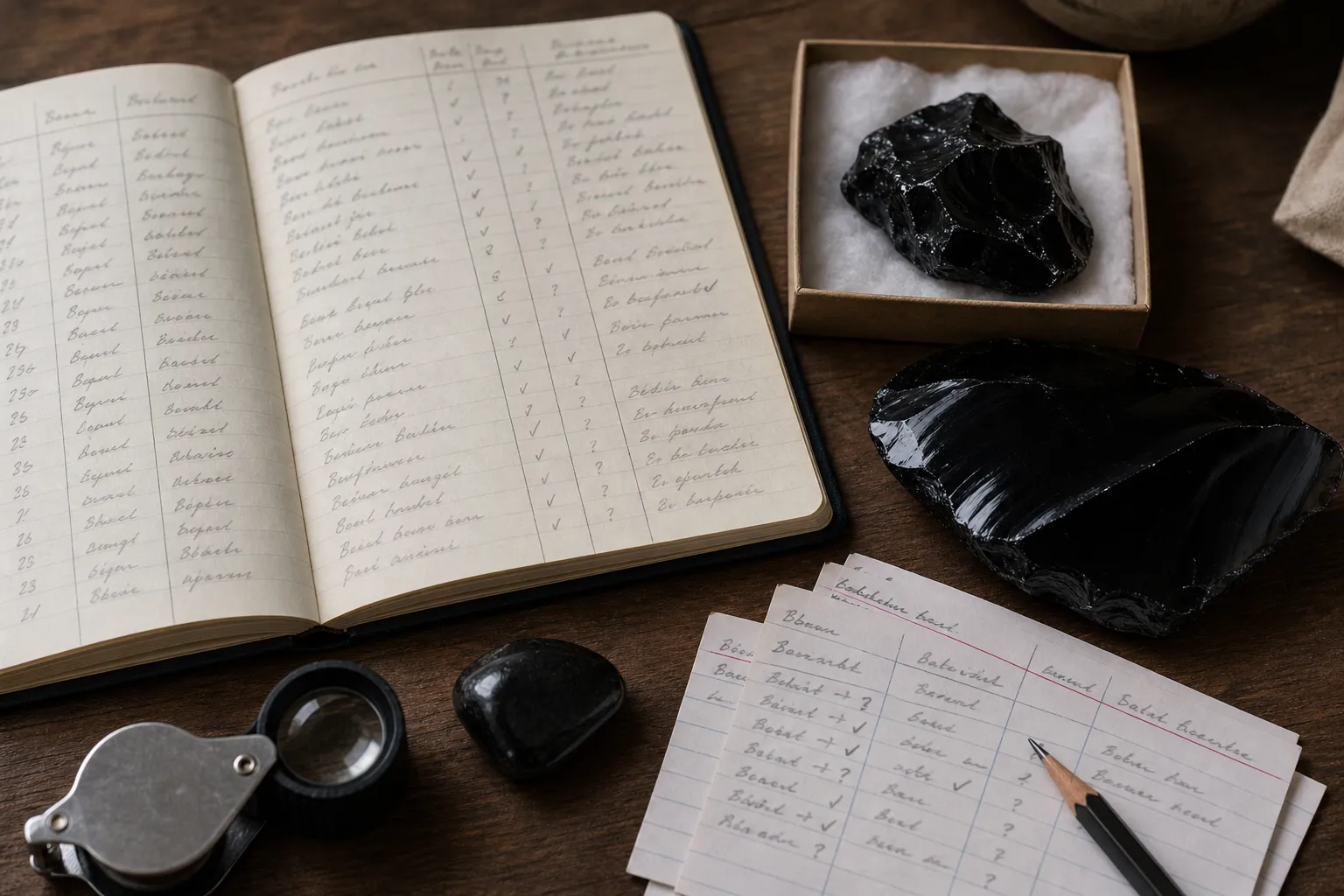
A practical label format is:
- Purchased or received as:
- Visible description:
- Format:
- Size:
- Source or seller note:
- Confidence:
- Questions to revisit:
This keeps the collection honest. It also helps months later, when you no longer remember why you added a piece.
How to Avoid Duplicate Pieces
Duplicate pieces are not always a mistake. They become a problem when they take up space without improving comparison. The easiest rule is to make each new piece meet at least one condition.
Add it if:
- It shows a visible trait you do not already have.
- It represents a different format, such as rough, tumbled, polished, or carved.
- It improves your display because of shape, size, or condition.
- It replaces a poorly labeled or damaged piece.
- It supports a specific comparison you want to study.
- It has a clear personal or symbolic reason, recorded as interpretation rather than fact.
If a piece only has a new name but looks the same as one you already own, pause. Ask what the object adds beyond the label.
A simple photo record helps. Photograph your collection under consistent light with a plain background and minimal editing. The goal is not formal identification; it is remembering what you already have before buying another similar-looking piece.
A “maybe” list also works well. When a piece catches your attention, write down why. If the reason is only that the name sounds different, wait. If the reason is that it shows a feature you cannot yet compare, it may deserve a place.
Handling, Cleaning, and Storage Basics
Obsidian pieces can have polished surfaces, chips, points, thin edges, or fragile mounts. Handle them as collectible objects, not tools.
Use two hands with larger pieces. Avoid gripping sharp-looking edges or points. If a piece appears freshly broken, chipped, or unusually thin, give it extra care and store it separately. Do not test an edge on skin or use a specimen for cutting, scraping, or pressure work.
For cleaning, start conservatively. Dusting with a soft cloth is a lower-commitment first step than soaking, scrubbing, or using household chemicals. If a piece has metal fittings, glued parts, dyed components, unknown coatings, or mixed materials, cleaning becomes less straightforward. In those cases, avoid aggressive methods until you know more about that object.
For storage, separation matters. Small boxes, padded compartments, soft wraps, or labeled trays can keep pieces from knocking together. Display shelves should be stable and arranged so heavier pieces cannot roll into smaller ones. If children, pets, or frequent visitors can reach the display, enclosed storage is the better choice.
Labeling belongs with care. A collection without records becomes harder to understand over time. A short note can preserve what the seller called the piece, what you observed, when you obtained it, and what remains uncertain.
Symbolic Meanings and Market Language
Many people meet obsidian through symbolic, spiritual, or personal meaning language. That language can explain why someone values a piece, but it should not be used as evidence of material identity, physical effect, value, or certainty.
Keep symbolic notes separate from observable description. “Black polished piece with mirror-like surface” describes the object. “Chosen for grounding symbolism” or “associated in some traditions with protection imagery” records personal or cultural context.
This separation is especially important for beginners because market language often blends appearance, mood, tradition, rarity language, and sales appeal. A meaningful object can still be poorly documented. A dramatic listing can still leave basic identification questions unanswered.
Beginner Obsidian Collection Checklist
Use this checklist before buying, labeling, or displaying a new piece:
- Can I describe what I see without relying only on the seller name?
- Does this piece add a new visible trait, format, or comparison point?
- Do I know whether it is rough, polished, tumbled, carved, mounted, or broken?
- Have I checked whether it duplicates something I already own?
- Can I store it so it will not scrape, chip, or roll into other pieces?
- Have I recorded the original label separately from my own observations?
- Am I treating symbolic meaning as personal or cultural context?
- Is anything about the piece still uncertain?
A beginner collection becomes stronger when uncertainty is documented instead of hidden. “Sold as rainbow obsidian; color effect not confirmed in my lighting” is more useful than a confident label you cannot support. “Dark polished tumble; no source information” is still a valid record if it helps you compare finish and shape.
A Practical Starting Path
If you want a simple route, begin with five pieces.
First, choose one plain dark piece as your baseline. Second, add one polished piece that is easy to handle and display. Third, include one tumbled stone to compare rounded finish and small-scale collecting. Fourth, add one rough or less-shaped piece if you can store it without damage. Fifth, choose one visually distinct specimen, but record the seller name as provisional unless the visible traits are clear.
Then stop and study the group. Look at it in consistent light. Write labels. Compare surfaces. Notice which pieces you return to. Your next purchase should respond to a gap you can name.
That is the most useful way to start an obsidian collection: start small, choose pieces that teach visible differences, separate observation from market language, and keep careful notes. A collection does not need to be large to be serious. It needs to be understandable.