
Collector identification note
Is Green Obsidian Natural or a Misleading Trade Label
“Natural green obsidian” is a claim, not something to accept from color alone. Obsidian is natural volcanic glass, and volcanic glass can vary in appearance, but a green shop title does not prove that a piece formed in a volcanic setting rather than in a glassworks.
For collectors, the better question is not simply “is green obsidian real or fake?” It is: what connects this green glassy object to natural obsidian, a known locality, or reliable identification? Without that link, “green obsidian” is best treated as a seller label.
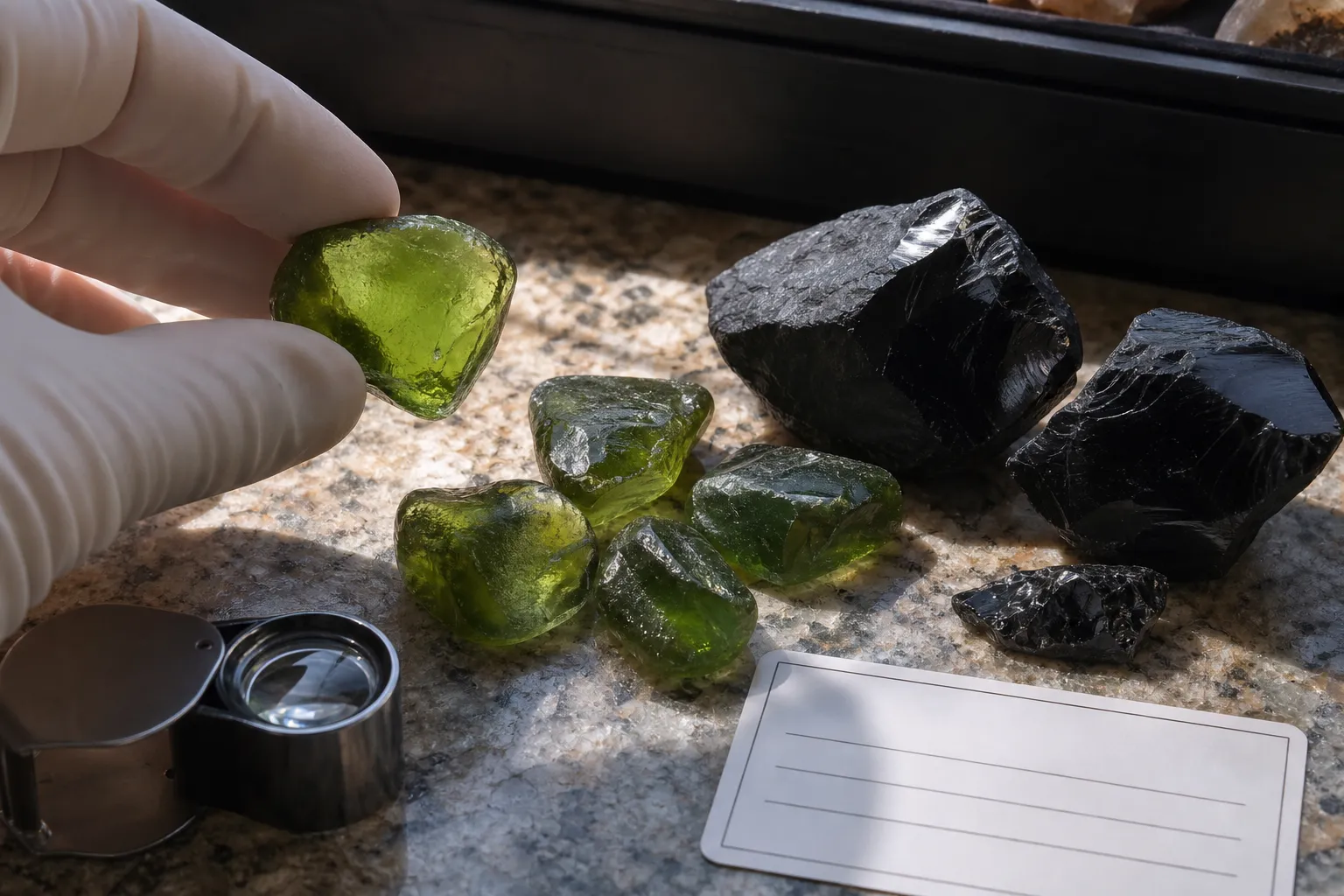
upward
Start with the broader guide
Use the broader guide first if you need the full scope before this page.
What “Natural Green Obsidian” Can Mean
Obsidian is usually defined as volcanic glass formed when lava cools rapidly. That gives the word a real material boundary: it is not just any shiny, dark, translucent, or polished glass.
In listings, though, “green obsidian” can be used in several ways:
When evidence is missing, “green volcanic glass” or “green glassy material” is often more careful than “natural green obsidian.” Those phrases describe what can be observed without confirming origin.
A seller’s claim becomes stronger when it includes locality information, collection context, reputable documentation, or testing. It becomes weaker when it relies only on color, polish, rarity language, or symbolic descriptions.
Natural Obsidian Versus Manufactured Glass
The confusing part is that obsidian is glass. It is natural glass, not quartz, jade, fluorite, or a typical mineral specimen with visible crystal structure. Manufactured glass and natural obsidian can both look smooth, glossy, translucent at thin edges, and highly polished.
The difference is origin. Natural obsidian forms in volcanic environments. Manufactured glass is made by people. A green piece can be glassy and attractive without being natural obsidian.
That is why no single visual cue settles green obsidian authenticity. A glossy surface does not prove natural origin. Green color does not prove rarity. A tumbled shape does not prove volcanic formation. Even a curved broken edge only shows glass-like fracture behavior; it does not identify the source.
A more useful check separates three questions
- Is the object glassy material?
- Is there evidence that the glass is natural volcanic glass?
- Is there evidence that the green color and locality support the name being used?
A listing may answer the first question clearly while leaving the second and third unresolved.
What to Inspect Before Trusting the Name
You cannot fully identify every piece at home, but you can avoid taking a weak label at face value.
Read the seller’s wording
Is “green obsidian” just the product name, or does the listing explain where the material came from? Color, size, and broad symbolic language do not add much material evidence. Locality, collection context, and restrained wording are more useful.
Look for signs of decorative glass
Uniform color, repeated shapes, bubbles, seams, or a molded look may point toward manufactured glass. These signs do not settle the question by themselves, but they are reasons to ask for better support.
Check edges and transparency carefully
Thin edges of obsidian and other glassy materials may transmit light differently from thicker areas. Polish, background color, lighting, and camera exposure can make a piece look greener, darker, brighter, or more translucent than it appears in hand.
Use fracture clues with limits
Obsidian is associated with conchoidal fracture, a curved shell-like break seen in glassy materials. This explains why broken obsidian or similar glass can have sharp edges. It does not prove that a green object is natural obsidian, because other glassy materials can break in similar ways.
Match the evidence to the value
If the item is inexpensive and decorative, uncertainty may not matter much. If the price or collecting value depends on it being natural obsidian, the label needs stronger support.
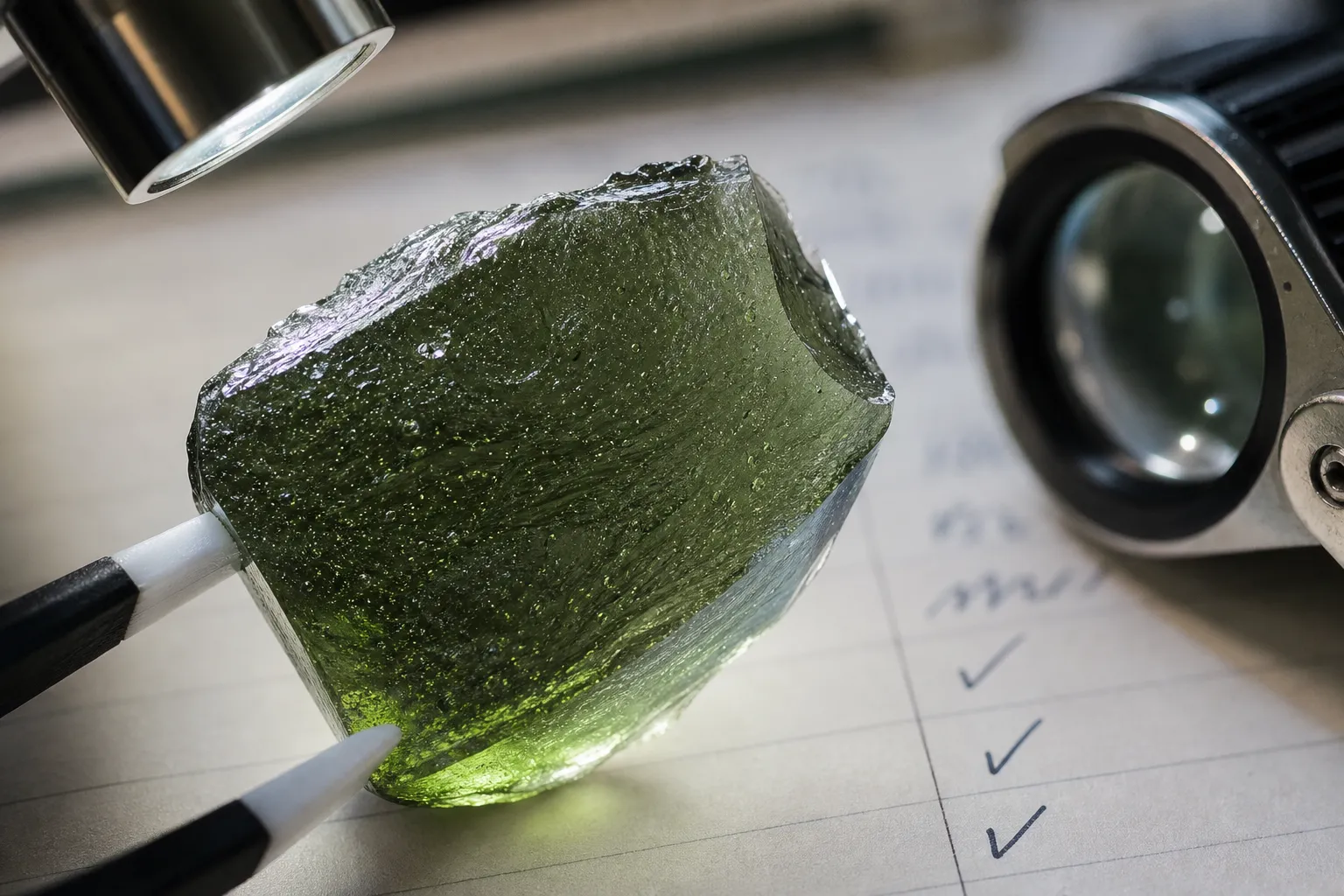
When the Label Becomes Questionable
The label becomes a problem when the sales language sounds more certain than the evidence. That does not mean every green item sold as obsidian is automatically wrong. It means the claim needs support.
Be cautious when a listing:
- Uses “natural green obsidian” as the main proof instead of explaining origin.
- Shows only polished shapes with no rough material context.
- Gives no locality, collection history, or testing information.
- Treats green color itself as proof of authenticity.
- Uses broad rarity language without explaining what is rare or where it comes from.
- Relies on dramatic photos that do not show edges, surface details, or scale clearly.
Photos can help you notice bubbles, seams, chips, polish quality, or suspicious uniformity, but they cannot confirm origin on their own. Lighting, editing, angle, and background can all change the apparent color.
If you are considering a purchase, the most useful question is: “What evidence supports this being natural volcanic glass rather than manufactured green glass?” A strong answer adds context. A weak answer usually repeats the product name.
A Practical Decision Path
If the item is labeled only by color
Treat the name as unverified. It may be a trade label or decorative name.
If the seller gives locality context
Read it closely. A locality claim is more useful than a color claim, but it should be specific and plausible.
If the item is expensive or sold as rare
Ask for stronger support, such as documentation, clearer provenance, or appropriate material testing when the value justifies it.
If the piece is broken or chipped
Handle it like glass. Obsidian and similar glassy materials can leave sharp edges where they break.
If the evidence remains thin
Use careful wording in your own notes, such as “green glass sold as obsidian,” “green glassy material,” or “labeled green obsidian by seller.”
That kind of wording may feel less exciting, but it keeps a collection honest and leaves room to update the identification later.
Bottom Line
Green obsidian should not be accepted or rejected in one move. Obsidian is volcanic glass, and color variation can be discussed carefully, but a green appearance and a seller title do not prove natural origin.
The collector-level answer is simple: “natural green obsidian” needs evidence. It is more credible when tied to provenance, locality, or reliable material identification. It is weak when it appears only as a polished retail name. If the distinction matters for price, collecting value, or accurate labeling, do not rely on photos or color alone; ask what supports the name.