Collector color guide
Mahogany Obsidian and Red Brown Color Varieties
A red-brown piece of obsidian is not always easy to name from a listing photo. One seller may call it mahogany obsidian, another may write red brown obsidian, and a third may describe the same warm look as iron colored obsidian. For a collector, the better first question is not “what is the most impressive name?” but “what can I actually see?”
Mahogany obsidian is best handled as a visual collector label: dark volcanic-glass material with red, brown, rust, gray-brown, or black areas that can change in strength with polish, lighting, surface texture, and viewing angle. Because the available source set does not establish a formal naming standard for these labels, this page treats them as practical collecting language rather than certified classifications.
upward
Read the full overview first
Use the broader guide first if you need the full scope before this page.
What Is Mahogany Obsidian as a Red Brown Variety?
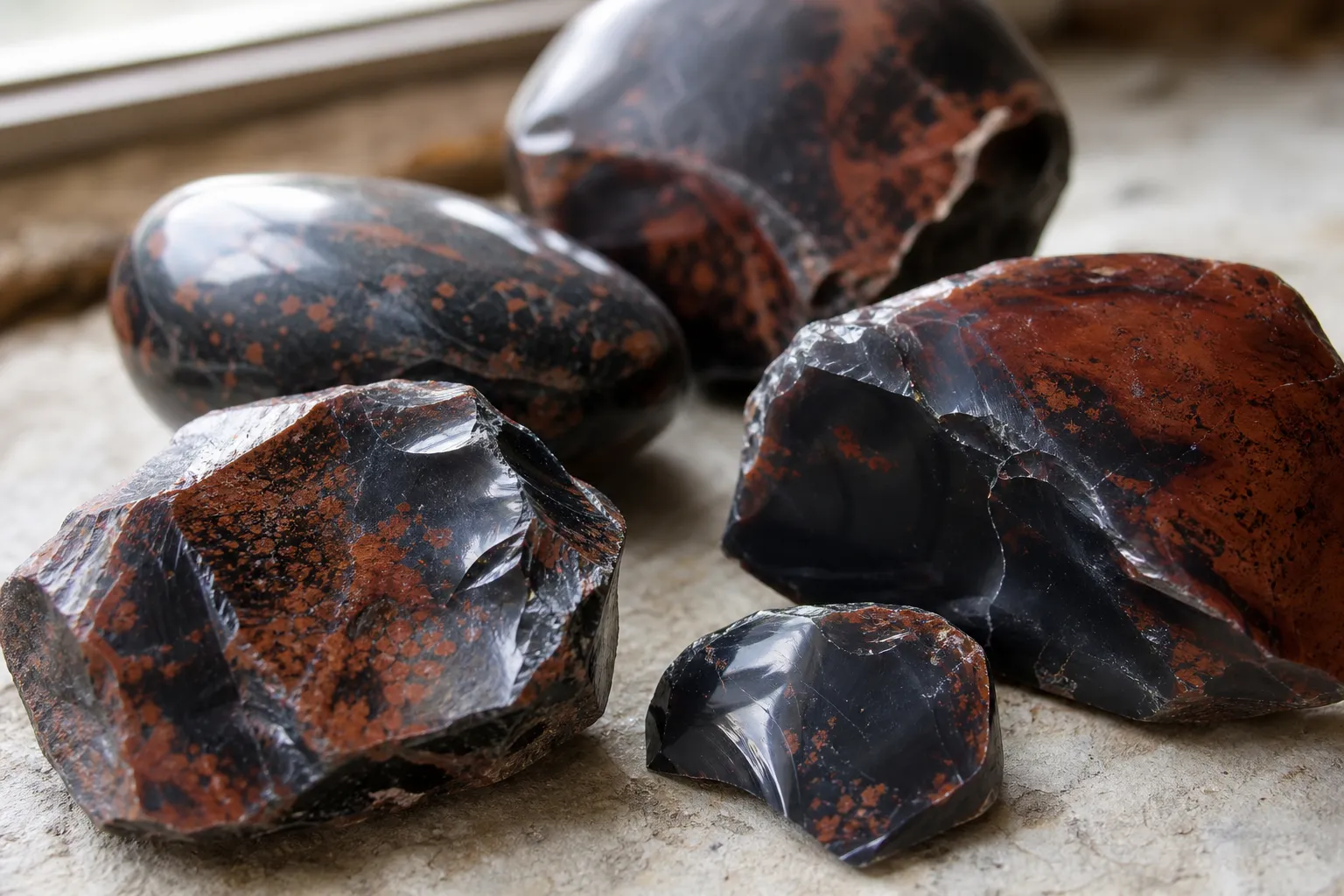
Mahogany obsidian is commonly used for obsidian with a warm red-brown presence. The color may appear as broad patches, cloudy mottling, streaks, soft bands, or irregular areas set against darker black or gray-black portions.
That separates it from a plain black obsidian label in everyday collecting language. Black obsidian usually points to an overall dark look. Mahogany obsidian draws attention to reddish brown contrast. The word “mahogany” is a color comparison, not a promise that every piece will match polished wood or show the same shade from edge to edge.
The most useful reading is visual first. The piece may appear red brown, reddish black, rusty brown, gray brown, or mottled. The label can help you compare pieces, but it should not carry more certainty than the visible pattern supports.
Why Mahogany Obsidian Looks Red Brown Instead of Plain Black
This draft does not have strong enough source support to present a detailed chemical explanation for mahogany obsidian color as settled fact. For identification, the stronger point is simpler: the name is attached to visible contrast, not to what a seller says the color must mean.
A piece may show warm red, brown, rust, or reddish gray areas that interrupt the darker glassy body. Those areas can be bold and easy to see, or so subdued that the stone looks almost black in poor light.
Variables that change the impression
- Lighting can make red-brown areas look richer, flatter, warmer, or more gray.
- Polish can increase contrast by changing how dark and warm areas reflect light.
- Surface texture can make a raw piece appear duller than a polished one.
- Photography can exaggerate red tones or hide them, especially under warm bulbs.
- Background color can make brown patches look more orange, more black, or less distinct.
That is why one online photo is a weak basis for a firm identification. A stone may look like mahogany obsidian in one image and like a dark brown-black pebble in another. In hand, you can rotate it, compare ordinary light with brighter light, and check whether the red-brown color belongs to a broader pattern rather than a single photographic effect.
Mahogany Obsidian Color Range: Red, Brown, Rust, and Black
Mahogany obsidian color works better as a range than as one target shade. A beginner may expect a dramatic red-and-black contrast, but many pieces are quieter. Some look rusty brown and black. Others lean red brown, chocolate brown, gray brown, or dark reddish black.
That range matters because it affects both naming and expectations. A piece does not need bright red patches to fit the collector idea of mahogany obsidian. At the same time, a piece that is only vaguely brown in one photo should not be named with too much confidence.
Does Mahogany Obsidian Always Have Black Patches?
Not in the clean, dramatic way buyers often imagine. Some pieces show obvious black patches against red-brown areas. Others look more blended, with dark streaks, smoky zones, or mottled transitions instead of clear borders. A polished palm stone might show a strong black island in a reddish field, while a rough chip might show muted brown-gray surfaces until a fresher or smoother face is visible.
For this kind of branch-level identification, the question is not only “are there black patches?” A better question is: “is there a visible relationship between warm red-brown areas and darker obsidian-like areas?” If yes, the mahogany label may be reasonable collector shorthand. If the answer is unclear, a softer description such as red-brown obsidian-like material may be more honest until the piece is inspected more closely.
Mahogany Obsidian with Bands, Streaks, or Mottled Patches
Pattern terms are most useful when they stay close to what the eye sees.
- Patches suggest irregular zones of red-brown and black, often with soft or uneven borders.
- Bands suggest longer color areas running across the piece in a more directional way.
- Streaks suggest narrower lines or drawn-out color movement.
- Mottling suggests speckled, cloudy, or broken color mixing without a clean pattern.
This wording reduces overclaiming. Instead of forcing a rigid sub-type, a collector can write “polished mahogany obsidian with red-brown mottling and black patches” or “raw mahogany obsidian fragment with dull rust-brown streaking.” Those notes are more useful than a confident label with no visible description behind it.
Red Brown Obsidian vs Mahogany Obsidian: Are They the Same?
Red brown obsidian and mahogany obsidian can overlap in everyday use, but they do not always do the same job. “Mahogany obsidian” functions like a variety name in collector language. “Red brown obsidian” can be a looser color description. A seller, collector, or beginner might use red brown obsidian when the color is clear but the variety label feels less certain.
The distinction becomes easier if you ask what the label is doing.
If the label is naming a familiar variety, “mahogany obsidian” is the more specific phrase. If the label is only reporting appearance, “red brown obsidian” may be more cautious. If the label says “iron colored obsidian,” it may be trying to explain a rusty or reddish look, but without stronger support it should still be read as appearance language rather than confirmed analysis.
“It has red-brown and black patches. What should I call it?”
Mahogany obsidian may be reasonable if the pattern is clear.
“It is brownish, but the pattern is hard to see.”
Red brown obsidian is a more cautious description.
“The seller says iron colored. Does that confirm the cause?”
Treat it as appearance language unless stronger support is provided.
“Can I prove the identity from a photo?”
A firm conclusion should not rest on a photo alone.
A broad label is not automatically wrong. It just needs to match the level of support available. Clear visual pattern supports a stronger collector name. Ambiguous color calls for a softer description.
Raw vs Polished Mahogany Obsidian: How the Red Brown Color Changes
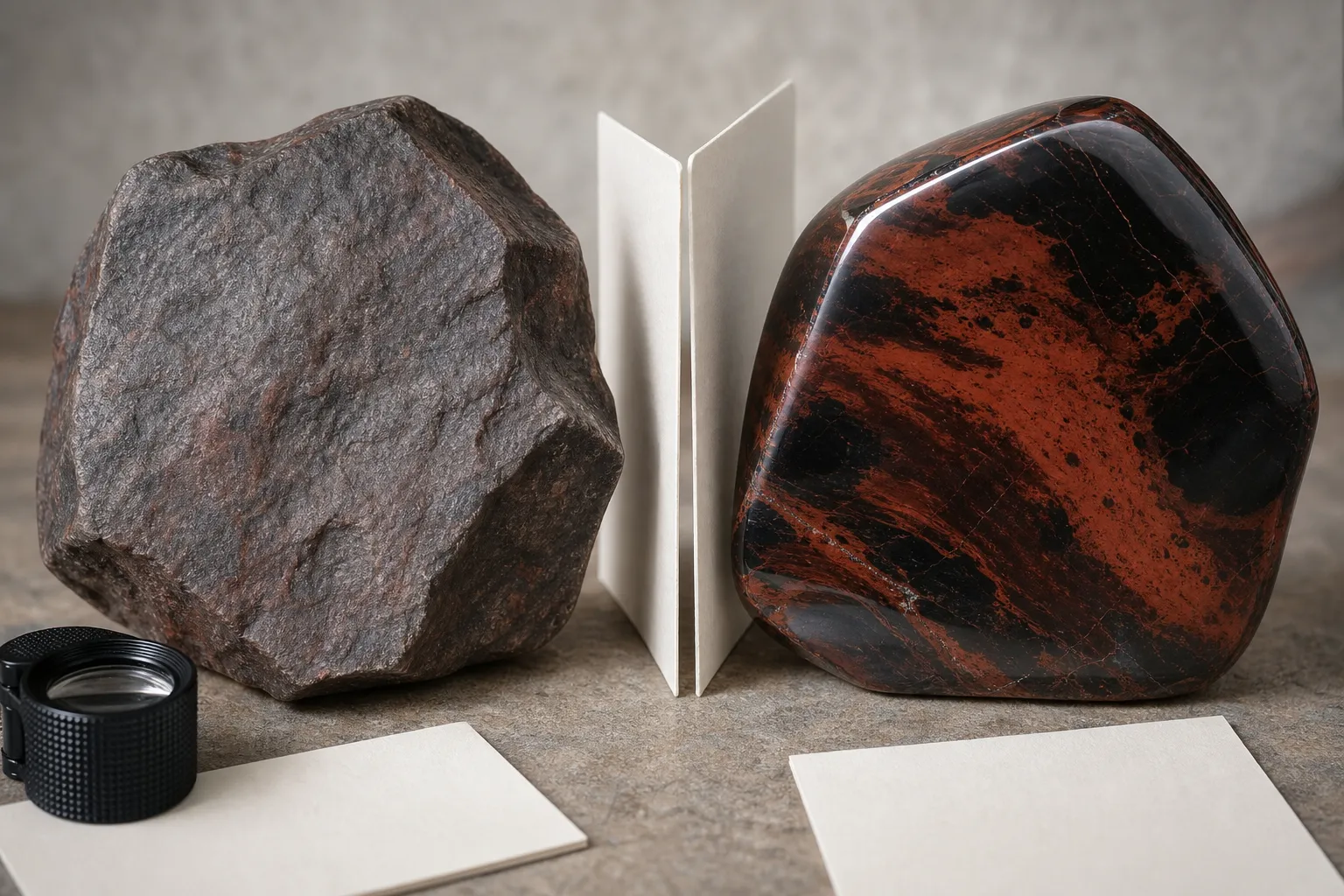
The same piece can read differently before and after polishing. This page should not make unsupported lapidary claims about every specimen, but surface condition plainly affects what a viewer can see.
Raw mahogany obsidian may look dull, dusty, chalky, gray brown, or uneven at the surface. Edges and broken faces may show more contrast than weathered or abraded areas. A rough piece can also hide its pattern because the surface scatters light and interrupts reflection.
Polished mahogany obsidian is often easier for beginners to read. A smoother surface can make color boundaries and dark glassy areas more visible. Red-brown zones may look richer, black areas may seem deeper, and bands or patches may be easier to follow. Even then, polished stones can look more dramatic in photos than they do under ordinary room light.
A simple inspection workflow
- Start in neutral daylight or bright, even indoor light.
- Rotate the stone instead of judging one face.
- Check whether the red-brown color continues across more than one visible area.
- Compare shiny faces, dull faces, and chipped or broken edges if present.
- Describe the pattern before deciding how strong the label should be.
A beginner identification workflow should not rely on one cue. Color matters, but so do pattern, contrast, finish, and the limits of the view.
What “Iron Colored Obsidian” Means on a Label
“Iron colored obsidian” needs careful reading. In ordinary language, “iron colored” may mean rusty red, reddish brown, dark brown, or earthy orange-brown. It may be used to explain why a piece resembles mahogany obsidian or why the surface looks warmer than plain black.
What it should not do is settle questions that require stronger evidence. A color phrase alone does not confirm origin, composition, treatment, age, value, or authenticity. It also does not prove that two pieces with similar rusty coloring belong to the same named variety.
Use the phrase as a prompt to inspect the stone
- Is the color truly red-brown, or could it be a warm photo cast?
- Does the color appear within the pattern, or only on the surface?
- Are the darker areas glassy, dull, gray, or black?
- Is the seller using “iron colored” as a description or as a stronger claim?
- Would “red brown obsidian” be a more neutral label until the piece is seen in hand?
The label may point toward a real visible trait, but it cannot do all the identification work.
Is Mahogany Obsidian Rare or Common?
The available material does not support a firm rarity statement. Without stronger sourcing, it would be overconfident to call mahogany obsidian rare, common, abundant, or scarce in a general way.
A more careful statement is that mahogany obsidian is a recognizable collector name, but a familiar label is not the same as a measured supply category. Rarity also depends on the exact question. Are you asking about rough material, polished pieces, large display specimens, strong red-black contrast, a particular locality, or a certain pattern quality? Each version could have a different answer, and color alone does not settle it.
For buying or cataloging, focus on the visible piece
- Is the red-brown pattern clear or faint?
- Are the black areas strong, smoky, or minimal?
- Is the surface finished well enough to read the color?
- Is the shape useful for your collection purpose?
- Does the label stay close to what the object shows?
If a listing leans heavily on scarcity, origin, or high-value language, treat that as a reason to ask for more information rather than a reason to accept the claim.
What to Look For When Choosing Mahogany Obsidian
Choosing mahogany obsidian is mostly an exercise in matching the label to the object. A beginner does not need a complex tool kit, but they do need to separate visible traits from assumptions.
Start with the color relationship. A strong piece usually gives you readable contrast between warm red-brown areas and darker zones. The pattern does not have to be symmetrical or dramatic, but it should be visible enough that the name is doing useful work.
Then look at the surface. A polished piece should let you see whether the color appears as patches, streaks, bands, or mottling. A raw piece may require more patience because dull surfaces can hide detail. Do not expect a rough fragment to show the same clarity as a polished cabochon, palm stone, or bead.
Next, check the label language. A careful label might say mahogany obsidian, red-brown pattern, polished, or raw. A more uncertain label might say red brown obsidian or iron colored obsidian. Neither is automatically bad, but the stronger the claim, the more visible support you should expect.
A practical collector checklist
- The red-brown color is visible under normal lighting.
- The darker areas are not only shadows from the photo.
- The pattern can be described clearly: patches, bands, streaks, or mottling.
- The seller label does not claim more than the image or object shows.
- The piece fits your purpose: study sample, display piece, bead, carving, or comparison specimen.
- Meaning, rarity, locality, and value statements are considered separately from the color name.
This keeps the decision grounded. You are not trying to solve every geological or market question from one stone. You are deciding whether the visible traits fit the name well enough for your collection.
Can Mahogany Obsidian Look Dull, Matte, or Gray Brown?
Yes. Mahogany obsidian may look dull, matte, or gray brown when the surface is rough, weathered-looking, poorly lit, or photographed without enough contrast. That does not automatically rule out the label, but it does make the label harder to judge.
A dull surface can flatten warm color. A gray-brown face might still belong to a red-brown variety, or it might be too ambiguous to name from that view. A matte-looking area can make black zones appear softer and less glassy. In photos, the same piece may look like mahogany obsidian, a brown-black stone, or an unclear dark material depending on the shot.
When the color is subdued, use cautious wording. “Possible mahogany obsidian,” “red-brown obsidian label,” or “brown and black obsidian-like piece” may be more accurate than forcing certainty. If you are cataloging your own collection, add notes about lighting and finish so the label does not become more confident over time than the original observation justified.
Mahogany Obsidian Meaning: Symbolic Interpretations and Limits
Mahogany obsidian meaning is often discussed in symbolic or personal terms in crystal culture, but that material should stay separate from identification. A meaning does not verify a stone name, and a stone name does not verify a personal result.
Within a careful collector frame, symbolic language can be treated as interpretation. People may associate red-brown and black stones with grounding, steadiness, earthiness, strength, or protection themes in a cultural or personal sense. Those associations belong to belief, display choices, meditation practice, storytelling, or personal reflection. They should not be presented as tested effects or used in place of higher-stakes support.
If meaning matters to your collection, record it as a separate note
- Visual label: polished mahogany obsidian with red-brown patches and black areas.
- Pattern note: mottled, strong contrast on one side, softer brown on the back.
- Personal meaning note: chosen for grounded or earthy symbolism.
- Unconfirmed claims: origin, rarity, exact cause of color, and value not established from appearance alone.
That separation protects both sides of the interest. The collector label stays tied to what can be observed. The symbolic layer remains available for personal use without being treated as proof.
A Practical Way to Judge the Label
For most readers, the best final question is not “which label is perfect?” but “which label is honest for what I can see?”
Use “mahogany obsidian” when the stone shows a clear red-brown, rust, or brown relationship with darker obsidian-like areas, especially when patches, bands, streaks, or mottling are visible. Use “red brown obsidian” when the color is the main observation but the variety name feels less certain. Treat “iron colored obsidian” as a descriptive or seller-used phrase unless additional support is available.
Plain collector notes are usually strongest
- Red-brown and black mottled polish.
- Rust-brown bands with dark glassy areas.
- Dull raw surface; possible mahogany obsidian, needs better light.
- Seller labeled iron colored obsidian; appearance is reddish brown, cause not confirmed.
That wording may feel less dramatic than a confident sales label, but it is more useful over time. It preserves what you saw, leaves room for uncertainty, and helps you compare pieces without turning color into a promise about origin, rarity, value, or meaning.