Material comparison guide
Obsidian Compared with Glass, Onyx, and Other Black Stones
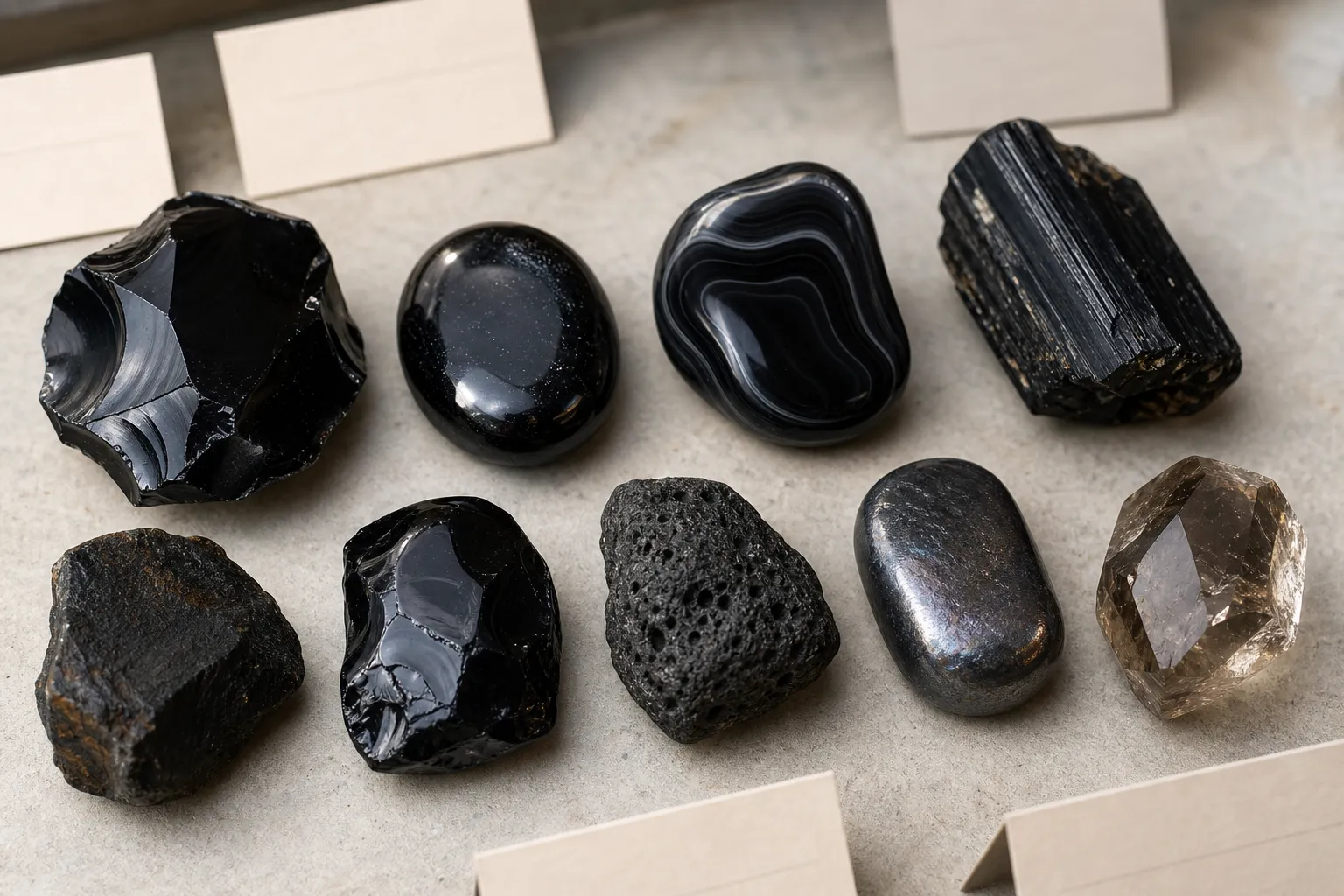
A polished black piece can be hard to name from appearance alone. It may be obsidian, manufactured glass, onyx, black tourmaline, black agate, jet, basalt, hematite, smoky quartz, tektite, or another dark material sold under a simple shop label.
The phrase obsidian vs glass causes confusion because obsidian is not the opposite of glass. Obsidian is natural volcanic glass, formed when lava cools so quickly that visible crystals do not develop. Most buyer questions are really about natural volcanic glass vs man-made glass, slag glass, molded glass, dyed stones, or other glossy black materials.
The useful comparison is not one “test.” Look at origin, material family, polish, luster, edges, bubbles, inclusions, banding, sheen, fracture surfaces, and seller wording together. Each clue can raise or lower confidence; none certifies a specimen from a photo or a single quick check.
upward
Start with the broader guide
Use the broader guide first if you need the full scope before this page.
The first correction: obsidian is natural volcanic glass
Geology references commonly describe obsidian as natural volcanic glass. It forms from rapidly cooled lava, which gives it a glassy character rather than the visible crystal structure you might see in quartz, tourmaline, or many other minerals.
For a collector, the better question is usually not “Is this obsidian or glass?” but:
- Is it natural volcanic glass, such as obsidian?
- Is it manufactured glass, such as molded, colored, bottle, decorative, or slag glass?
- Is it another black stone that only looks glassy after polishing?
- Is the label a precise material name, a loose retail name, or a symbolic crystal-market term?
Obsidian can look like black glass because, materially, it is glass in the natural volcanic sense. A glossy surface does not separate it from ordinary glass, onyx, black agate, polished tourmaline, or other black stones.
What you can reasonably inspect
A beginner collector can check several visible features without damaging the piece:
Surface luster
Obsidian often has a smooth, glassy shine, especially on polished or freshly broken surfaces.
Edge translucency
Thin edges of some obsidian pieces may show smoky, brown, gray, or greenish light under a strong lamp. This is a clue, not proof.
Fracture surfaces
Obsidian is known for curved, shell-like breaks. Manufactured glass can also break this way, so fracture shape alone does not settle the question.
Inclusions and flow features
Snowflake-like inclusions, mahogany coloring, sheen, banding, and internal variation can support an obsidian label when they fit the variety, but manufactured glass can also show bubbles, swirls, and color effects.
Molded regularity
A seam-like line, repeated pattern, unusually uniform shape, or many identical pieces may suggest a manufactured item.
Seller wording
“Black obsidian,” “green obsidian,” “slag glass,” “volcanic glass,” “black onyx,” and “dyed stone” are not equally precise labels.
The habit that matters most: treat each feature as part of a comparison, not as a final verdict.
Obsidian vs glass: natural volcanic glass and man-made glass
In practical collecting, obsidian vs glass usually means obsidian versus black manufactured glass. Both can be glossy, dark, sharp when chipped, and capable of curved fracture surfaces. That overlap is why simple at-home claims are often too confident.
Origin
Obsidian: natural volcanic material from rapidly cooled lava.
Manufactured glass or slag glass: made by people through glass production, remelting, molding, coloring, or industrial processes.
Material structure
Obsidian: glassy and non-crystalline in ordinary collector language.
Manufactured glass or slag glass: glassy and non-crystalline.
Common confusion
Obsidian: black polished pieces, tumbled stones, vivid “obsidian” colors.
Manufactured glass or slag glass: black glass, bottle glass, slag glass, molded beads, decorative pieces.
Edge translucency
Obsidian: some pieces may show smoky, brown, gray, or greenish light at thin edges.
Manufactured glass or slag glass: many glasses are also translucent at edges, depending on color and thickness.
Bubbles
Obsidian: internal features may occur, but bubble interpretation is not simple.
Manufactured glass or slag glass: regular bubbles, clusters, or molded-looking bubbles can be a warning sign.
Fracture
Obsidian: curved, sharp, glass-like breaks are common.
Manufactured glass or slag glass: can also break with curved, sharp, glass-like surfaces.
Confidence from photos
Obsidian: limited.
Manufactured glass or slag glass: limited.
Does a glassy shine mean a black stone is obsidian?
No. A glassy shine only says the surface is smooth and reflective. Polished onyx, black agate, hematite, jet, glass, tourmaline, basaltic glass, and smoky quartz can all look glossy in certain forms. Shine is one reason black stones are confused with obsidian; it is not a deciding mark.
Is the obsidian bubble test reliable?
The so-called obsidian bubble test is better treated as a warning sign than a proof. Regular, round, repeated, or obvious bubbles may make a piece worth questioning, especially if it is sold as a perfect black or brightly colored “obsidian” bead. But bubbles alone do not create a clean answer. Natural glass and manufactured glass can both contain internal features, and photos can exaggerate or hide them.
A better approach is to combine bubble observations with edge color, fracture, shape regularity, seller details, and whether the piece matches known obsidian varieties. If the answer matters for resale, collection records, or provenance, visual checks are not enough.
What about bright green, blue, red, or very transparent “obsidian”?
Brightly colored or highly transparent pieces sold as obsidian deserve extra skepticism, especially in jewelry and tumbled-stone listings. Some retail names use “obsidian” loosely for colored glass-like items. That does not mean every unusual color can be dismissed from a photo, but vivid color plus perfect uniformity plus vague sourcing is a reason to ask harder questions.
The phrase green obsidian vs glass appears often because green glass has sometimes been sold in ways that confuse buyers. A cautious collector should ask whether the seller means a natural volcanic glass variety, a trade name, slag glass, or decorative manufactured glass.
Why scratch tests are a poor shortcut
Scratch testing can damage a valued piece, and it may not separate obsidian from common glass-like materials cleanly. Hardness ranges can overlap enough that a casual scratch test may leave you with a marked specimen and no secure answer. The same caution applies to “temperature feel” checks and other quick tricks repeated in market conversations. They can be suggestive at best and misleading at worst.
Obsidian vs onyx: volcanic glass and chalcedony are different material families
The obsidian vs onyx comparison is different from obsidian vs manufactured glass. Onyx is not glass. In gem and mineral terminology, onyx belongs with chalcedony, a quartz-family material. Obsidian is natural volcanic glass. Both can be polished black and sold in beads, cabochons, carvings, and display pieces, but they come from different material families.
Material family
Obsidian: natural volcanic glass; often described as a mineraloid rather than a crystalline mineral.
Onyx: chalcedony, within quartz-family terminology.
Common look
Obsidian: glassy black, smoky-edged, sometimes with sheen, snowflake, mahogany, or banded effects.
Onyx: polished black, sometimes banded; may appear waxy or dense depending on finish.
Structure
Obsidian: glassy, lacking visible crystal structure in normal hand samples.
Onyx: microcrystalline quartz-family material.
Common market issue
Obsidian: confused with black glass, slag glass, or dyed items.
Onyx: “black onyx” may involve natural, treated, dyed, or trade-name complications.
Visual certainty
Obsidian: limited from photos alone.
Onyx: limited from photos alone.
Onyx enters the confusion because polished black onyx can be very smooth and dark. If a seller uses “onyx” simply as a style word for a black stone, the label may not answer the material question. Look for clearer descriptions such as chalcedony, dyed black onyx, natural onyx, black agate, or related terms. Even then, a label is not independent confirmation.
Obsidian vs black agate
Black agate and onyx are often discussed near each other because both are chalcedony-related terms in the collector market. The practical distinction from obsidian is the same: chalcedony-family material versus volcanic glass.
Banding can help when it is visible, but cutting, polishing, dyeing, and jewelry settings may hide it. A black agate piece may show layers or a slightly different polish character, while obsidian may look more glass-like at chipped edges. Banding alone does not prove agate, and glassiness alone does not prove obsidian.
Other black stones most often confused with obsidian
A useful black stone comparison does not need to turn every material into a full mineral guide. The point is to know which visible traits should make you slow down.
Obsidian vs black tourmaline
Black tourmaline is a crystalline mineral, not volcanic glass. In rough hand samples, it often shows lengthwise striations, column-like forms, or crystal faces. Obsidian usually looks glassier and may show smooth curved fractures rather than crystal surfaces.
Polished black tourmaline beads or carvings are harder to judge because polishing removes many rough-sample clues. If the piece is set in jewelry or photographed under bright light, the distinction may depend heavily on seller documentation unless visible crystal textures remain.
Obsidian vs jet
Jet is an organic material associated with fossilized wood, not volcanic glass. It can be black and glossy when polished, so it sometimes appears in the same visual category as obsidian. Jet is often discussed in antique jewelry contexts, while obsidian is usually tied to volcanic origin and crystal-collector settings.
Weight, warmth to touch, and surface feel are sometimes mentioned in informal comparisons, but those impressions are not secure identification tools on their own. For older jewelry, editorial review may matter more than casual comparison.
Obsidian vs hematite: shine, weight, and streak
Hematite can polish to a strong metallic or mirror-like shine. Compared with obsidian, it often feels heavier in hand and has a different type of luster: more metallic than glassy.
Streak is sometimes used in mineral identification, but streak testing can mark the specimen or the testing surface and is not ideal for valued pieces. For a collector, the simple visual warning is this: if the black material looks metallic rather than glassy, hematite or another metallic-looking mineral should be considered before calling it obsidian.
Obsidian vs basalt
Basalt and obsidian can both be volcanic and dark, but they are not the same texture. Basalt is a volcanic rock that is usually more crystalline or fine-grained in appearance, often duller, grainier, or stonier than obsidian. Obsidian is glassy volcanic material.
A black volcanic-looking stone with a matte, grainy, vesicular, or rock-like surface may be basalt rather than obsidian. A glossy black piece with sharp curved fractures may lean toward obsidian or glass, but appearance alone still has limits.
Obsidian vs smoky quartz
Smoky quartz is crystalline quartz. It may be transparent to translucent brown, gray, or nearly black. Obsidian can also show smoky or brownish translucency at thin edges, which creates confusion. The difference is material family: quartz crystal versus volcanic glass.
In clear hand samples, smoky quartz may show crystal shape, internal clarity, or quartz-like fracture patterns. In polished beads, those clues can be reduced. If a dark transparent bead is labeled “obsidian,” ask whether it is truly volcanic glass or a quartz-family stone.
Obsidian vs tektite
Tektites are natural glassy materials, but they are generally understood as impact-related natural glasses rather than volcanic glass. This makes obsidian vs tektite a comparison between two natural glassy materials, not glass versus mineral.
Some tektites are dark, glassy, pitted, or irregular. Obsidian is tied to volcanic lava cooling. In rough pieces, surface texture and origin information may be more useful than shine alone. If a seller cannot explain whether the piece is volcanic obsidian, tektite, moldavite-like material, or decorative glass, treat the label as incomplete.
Seller labels, dyed stones, and “real obsidian” claims
The market often uses simple phrases such as “real obsidian,” “black obsidian,” “colored obsidian,” “volcanic glass,” “slag glass,” and “natural stone.” These words do not all carry the same level of precision.
Separate three things:
- Material identity: What is the object physically made of?
- Trade name: What name is commonly used in shops?
- Symbolic or decorative label: What name is used because buyers recognize it?
For black obsidian vs dyed stones, color alone is not enough. A uniformly black polished stone could be natural obsidian, dyed chalcedony, black glass, or another material. Dye may be difficult to detect visually, especially in polished beads. A seller’s confidence helps only when it is supported by clear sourcing, consistent terminology, and appropriate testing when the claim matters.
Known obsidian variety names can help, but they are not magic words
Some common obsidian names are tied to visible features:
- Snowflake obsidian: black obsidian with pale, snowflake-like inclusions.
- Mahogany obsidian: dark obsidian with reddish-brown areas often associated with iron-related coloration.
- Rainbow obsidian: dark obsidian that may show colored sheen under the right lighting and angle.
- Gold sheen or silver sheen obsidian: dark obsidian with reflective sheen effects.
- Apache Tears: small rounded obsidian nodules in common collector language.
These names can guide inspection, but they do not replace material confirmation. Lighting, polish, photo editing, and seller wording can all affect what a buyer thinks they are seeing.
Photos can show clues, not certify a specimen
Photos can reveal edge translucency, strong color uniformity, bubbles, seams, fracture surfaces, and polish style. They can also hide the very features that matter. A dark glossy stone photographed against a black background may reveal almost nothing. A bright backlit photo may make ordinary glass look dramatic.
If the item is inexpensive and decorative, a cautious visual judgment may be enough for your own collection notes. If the piece is expensive, part of a formal collection, or sold with a specific origin claim, the answer should move beyond photos and home tests. Laboratory or gemological methods can examine chemistry and structure in ways casual inspection cannot.
A practical comparison path for black stones
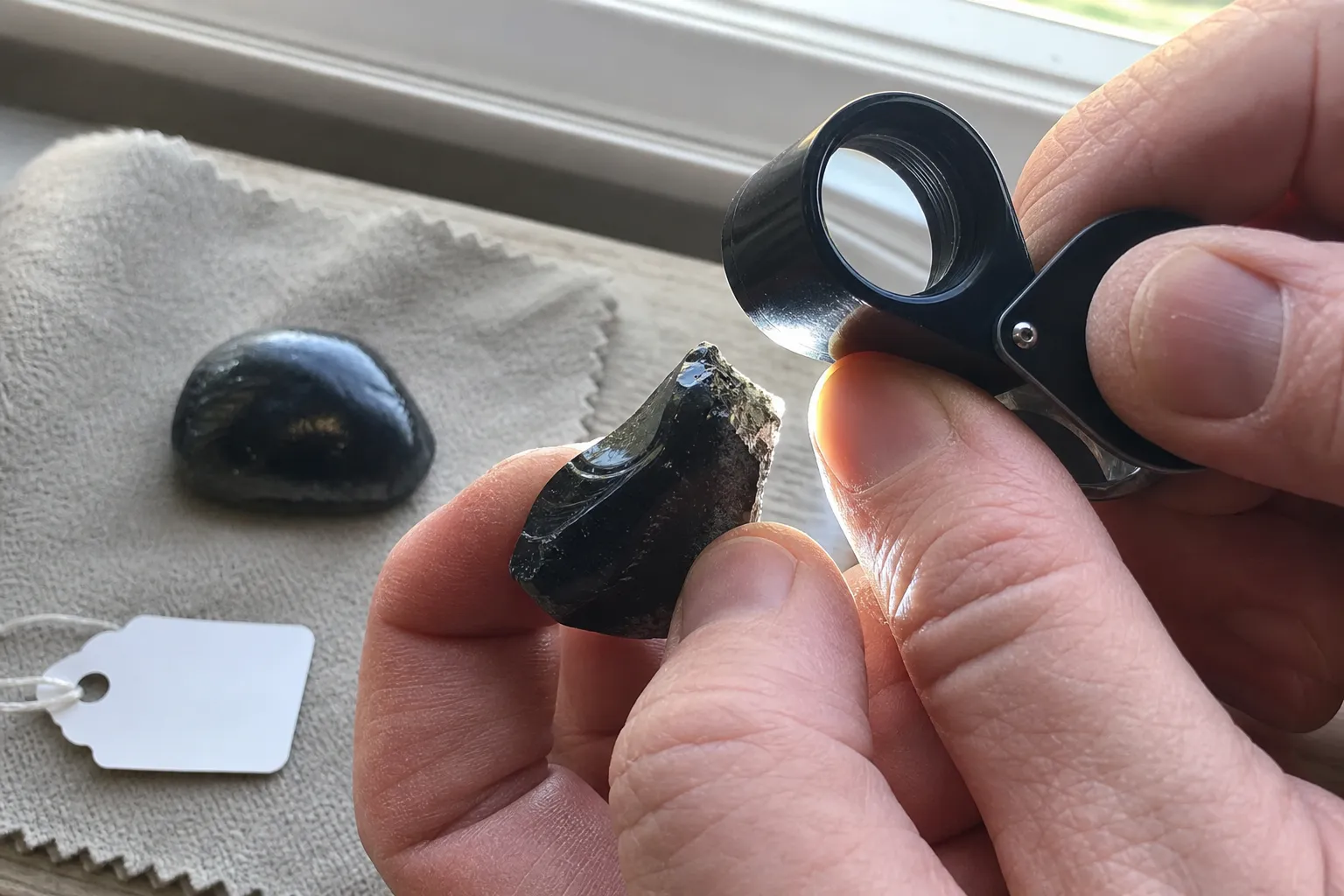
When you are holding a black glossy piece, use a slow comparison path rather than a single test.
1. Start with the seller’s exact words
Write down the label exactly: “black obsidian,” “volcanic glass,” “onyx,” “black agate,” “tourmaline,” “slag glass,” “green obsidian,” or something else. Loose labels are common. A vague name is not automatically false, but it should lower your confidence.
2. Ask whether the claimed material family makes sense
- Obsidian: natural volcanic glass.
- Manufactured glass: made glass, molded glass, slag glass, decorative glass.
- Onyx or black agate: chalcedony or quartz-family material.
- Black tourmaline: crystalline mineral.
- Jet: organic material.
- Hematite: metallic-looking iron oxide mineral.
- Basalt: volcanic rock, usually stonier or finer-grained.
- Tektite: natural impact-related glassy material.
This step often clears up more confusion than shine does.
3. Inspect edges and chipped areas
Thin edges may reveal translucency. Fresh chips may show curved glass-like fractures. Handle carefully: obsidian and manufactured glass can both have sharp edges, and both can cut skin. Do not break a piece just to inspect it.
4. Look for internal features, not just surface polish
Check for bubbles, bands, swirls, inclusions, sheen, snowflake-like patterns, or suspicious regularity. These are comparison clues. Manufactured glass can be swirled or bubbly; natural obsidian can vary; polished stones can hide their internal structure.
5. Avoid destructive shortcuts
Do not scratch, chip, heat, or grind a valued specimen to answer a casual question. Destructive tests can reduce value and still fail to produce a secure identification.
6. Escalate only when the decision matters
For display pieces, personal collecting, or casual sorting, a careful clue-based label may be reasonable: “likely obsidian,” “possibly black glass,” “sold as onyx,” or “black stone, uncertain.” For higher-stakes buying, selling, provenance, or collection records, seek qualified gemological or laboratory confirmation.
Handling and care cautions for obsidian and glass-like stones
Obsidian and manufactured glass can break into sharp edges. Even polished pieces may have small chips along points, drill holes, or carved details. Store them so they do not strike harder objects, and wrap sharp rough pieces separately from softer polished stones.
Cleaning should stay simple: gentle wiping, mild water when appropriate, and careful drying are usually more sensible than harsh chemicals or aggressive scrubbing. If a piece is set in jewelry, has dye, coating, metal findings, or unknown treatment, clean more conservatively.
Cutting, grinding, sanding, or polishing is a different situation from casual handling. Dust-generating work on stone or glass-like materials should not be treated as casual home experimentation. It calls for proper equipment, dust controls, and experienced instruction. That caution is about workshop processes, not ordinary ownership of a polished stone.
Where symbolic language fits
Some collectors and crystal sellers describe obsidian with symbolic meanings such as protection, grounding, shadow work, or personal reflection. Those phrases belong to crystal-market and personal-meaning language, not material identification. They cannot tell you whether a black bead is volcanic glass, onyx, dyed agate, or manufactured glass.
If symbolic meaning matters to you, keep it separate from the physical comparison. First decide what the object most likely is. Then, if you use symbolic language, treat it as personal or cultural interpretation rather than material evidence.
The collector’s bottom line
The strongest starting point is simple: obsidian is natural volcanic glass, so obsidian vs glass really means natural volcanic glass compared with manufactured glass or other glossy black materials. Onyx is different again because it belongs to chalcedony and quartz-family terminology, not volcanic glass.
Black tourmaline, jet, hematite, basalt, black agate, smoky quartz, and tektite each bring their own reasons for confusion. A reliable comparison uses several clues at once: origin, material family, edge translucency, fracture, bubbles, inclusions, banding, sheen, polish, weight impression, luster type, and seller wording.
The more a label depends on one quick test or one dramatic photo, the less confidence it deserves. For a beginner collector, the most honest labels are often measured ones: likely obsidian, possible glass, sold as onyx, dyed or treated uncertain, or black stone needing confirmation.