
Why Obsidian Breaks with Sharp Curved Edges
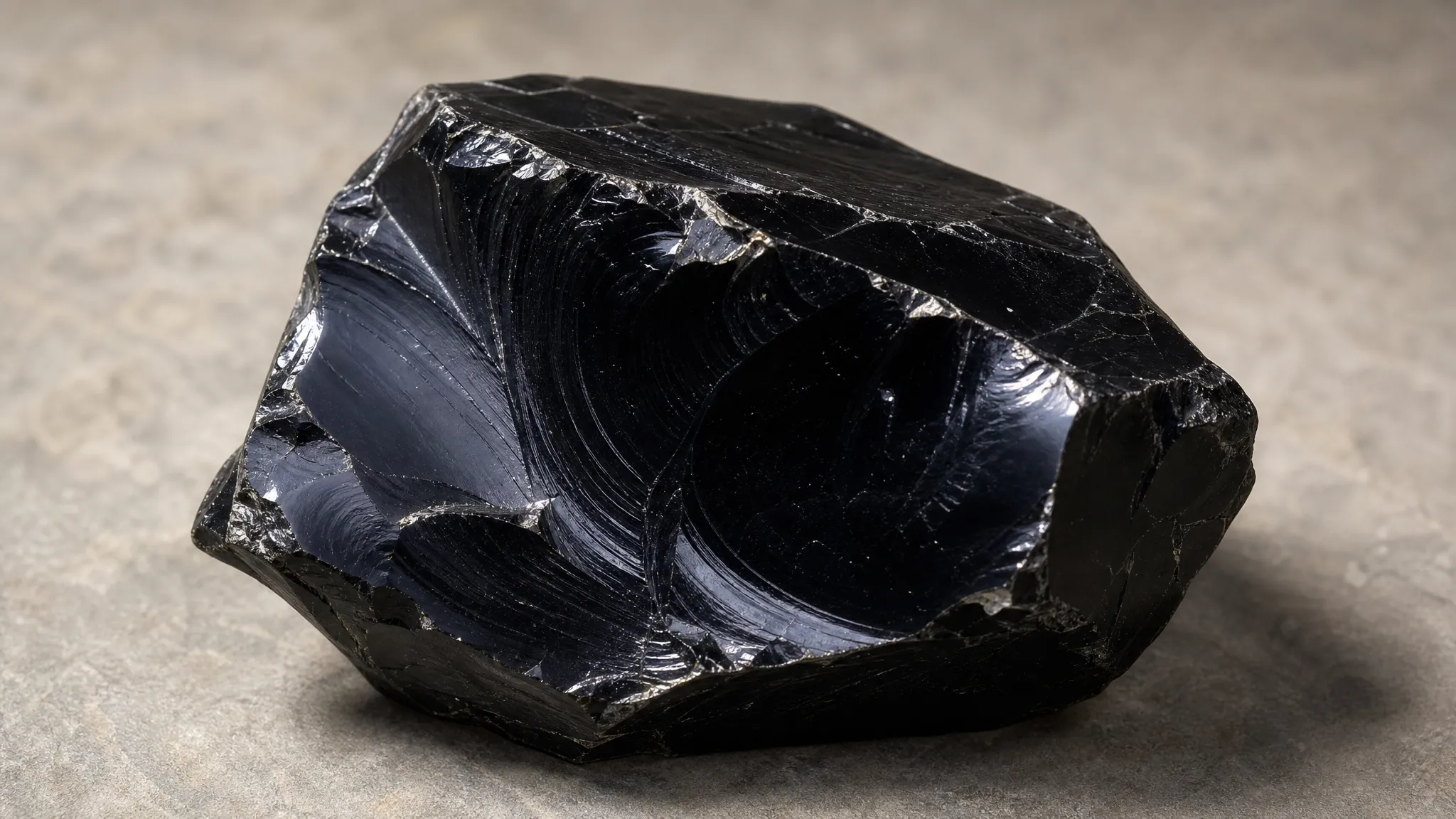
A chipped obsidian piece can look oddly smooth for something that broke: glossy curved faces, ripple-like marks, small flake scars, and edges that feel closer to broken glass than to an ordinary stone. That look comes from obsidian conchoidal fracture. Obsidian is volcanic glass, so it does not have the regular internal cleavage planes found in many crystalline minerals. When it breaks, the crack can move through the glassy body in curved, shell-like paths.
That explains why broken obsidian often shows smooth arcs instead of flat mineral cleavage, and why thin fractured margins can become very sharp. It is a strong collector clue, but not a standalone proof that a piece is natural obsidian.
upward
Start with the broader guide
Use the broader guide first if you need the full scope before this page.
What conchoidal fracture means in obsidian
Conchoidal fracture is a curved, shell-like break pattern. In obsidian, it commonly appears as:
- glossy curved break surfaces;
- crescent or shell-like fracture faces;
- ripple marks or semi-circular waves spreading from a point of force;
- flake scars where small chips detached;
- thin, sharp, glass-like edges along fresh breaks.
Geology references describe obsidian as volcanic glass. It forms when silica-rich lava cools so quickly that atoms do not arrange into large, regular crystals. That non-crystalline structure matters because a crack has fewer internal planes directing where it must go.
For a collector, the visible result is enough to recognize the pattern. If a dark, glassy volcanic-looking piece has a smooth curved fracture face with a bright fresh gloss, it is showing the kind of break people mean when they ask whether obsidian has conchoidal fracture.
The caution is scope. Conchoidal fracture is not unique to obsidian. Manufactured glass and some very fine-grained natural materials can also break in curved, shell-like ways. The feature supports a glassy-material reading; it does not settle origin by itself.
Why obsidian breaks in curves instead of layers
Many people expect a stone to split along layers, grains, or flat planes. Some minerals and rocks do. Obsidian usually does not, because its structure is different.
A simple sequence explains the break:
- Lava cools rapidly. Obsidian forms from volcanic material that cools quickly.
- A glassy structure develops. The material becomes amorphous rather than neatly crystalline.
- No regular cleavage planes guide the break. Cleavage depends on repeated internal crystal structure.
- Force moves through the glassy mass. When struck, dropped, or stressed, the crack can curve through the material.
- The surface records the crack path. The result is a smooth, shell-like fracture face, often with ripple marks or flake scars.
This is the key difference between obsidian fracture vs cleavage. Cleavage is controlled by crystal structure. Fracture describes how a material breaks when it does not split along regular planes. Obsidian lacks true mineral cleavage because it is glassy and amorphous, not a crystalline mineral with orderly planes of weakness.
So the reason obsidian lacks cleavage is not that it is unusually tough or soft. It simply does not have the internal crystal pattern needed for cleavage. It can still chip, crack, or snap; it just does so by fracture rather than by clean mineral cleavage.
What ripple marks and glossy broken faces reveal
A fresh obsidian break often tells more than an old, weathered surface. The useful clues come from a cluster of signs, not from one feature alone.
Ripple marks on obsidian can look like frozen motion. They may appear as curved waves spreading away from where force entered the piece. In a collector setting, read them as signs of brittle glassy fracture, not as a full reconstruction of exactly what happened.
Fresh breaks and weathered breaks can look very different. A fresh obsidian break may be darker, glossier, and cleaner than the outer surface. A weathered break may look duller, abraded, dusty, grayish, or less sharply defined. Natural tumbling, soil contact, handling, and small impacts can soften the contrast over time.
This matters for broken obsidian edge identification. A newly chipped tumbled stone may reveal a bright sharp crescent that was hidden before the chip. On an older field piece, the conchoidal shape may still be present, but the shine and edge sharpness may be reduced.
Why broken obsidian edges can be so sharp
Obsidian sharp edges come from the way a curved fracture can taper. When a chip breaks away, the remaining margin may narrow to a very fine glass-like edge. That same broad material behavior helps explain why obsidian was historically useful for flakes and cutting edges, though archaeology is only background context here.
Two details matter:
- The break surface can be smooth. A smooth fracture face may meet another surface at a narrow angle.
- The edge can be thin. The thinner the remaining margin, the more blade-like it may feel.
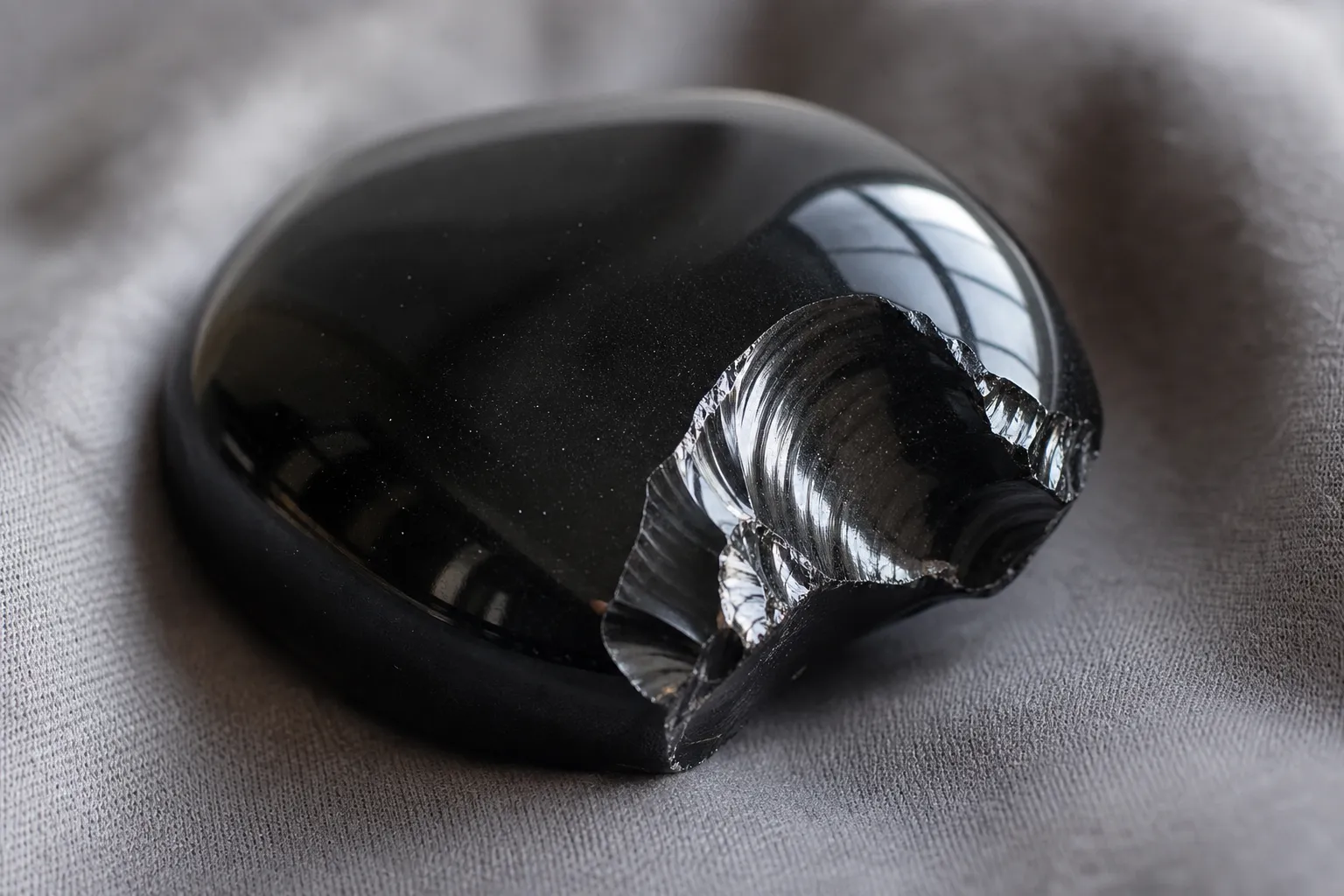
Not every obsidian edge is sharp, and a polished specimen is not automatically harmless. A rounded palm stone may feel smooth across most of its surface, but a chip along an edge, point, drilled hole, or broken base can expose a narrow glassy margin. Polished obsidian can still have sharp edges if it has been chipped, cracked, or incompletely rounded.
Avoid testing a fresh edge with a finger. Treat a sharp obsidian chip like a small piece of broken glass: handle it from stable, rounded areas when possible, keep it from loose contact with other specimens, and store it so the exposed edge does not press into skin, cloth, or neighboring stones. General broken-glass guidance supports this kind of caution, but the practical point is simple: a broken glassy edge deserves careful handling.
Why obsidian chips instead of crumbling
When obsidian is knocked, it often chips rather than crumbles because it is a brittle glassy material. A brittle break can release a distinct flake, leaving a scar with a curved face. That differs from a granular rock that may shed grains or crumble along weak, sandy, or weathered zones.
A chip is more likely to stand out where the piece has:
- a thin edge;
- a point or corner;
- an existing crack;
- a polished surface that makes the fresh break obvious;
- loose storage where pieces knock against each other;
- a shape that concentrates force in one small area.
A small fall can create a bright crescent on a tumbled stone, a sharp nick on a pendant, or a flake scar on a rough specimen. The exact result depends on the angle of impact, the shape of the piece, existing flaws, and how force moves through the glassy material.
One collector distinction helps: “hard” and “resistant to chipping” are not the same thing. A material may resist some surface scratching yet still break in a brittle way if struck at an edge or point. For this page, the more useful observation is visible rather than numerical: obsidian can chip on impact, and those chips often show curved, glossy fracture surfaces.
Does a sharp curved edge prove the stone is obsidian?
No. A sharp curved edge can support the idea that a material is glassy or very fine-grained, but it does not prove the specimen is natural obsidian.
This is a common identification trap. A black glossy piece with conchoidal fracture may look convincing, but other materials can also show similar break patterns, including manufactured glass and some fine-grained natural materials. Color and shop names add another layer of confusion.
In gemstone and crystal markets, names such as snowflake obsidian, rainbow obsidian, sheen obsidian, mahogany obsidian, Apache tears, blue obsidian, green obsidian, or cherry obsidian may appear. Some refer to recognized obsidian varieties or ordinary market forms; some bright-colored material sold under obsidian-like labels may be manufactured glass or only vaguely disclosed. Treat color names as labels that need context, not as proof of natural origin.
For a more grounded reading, combine several observations:
- Is the material glassy rather than grainy?
- Does the broken surface show conchoidal curves?
- Are fresh breaks glossy while older surfaces are duller?
- Are there natural-looking inclusions, flow features, or variety traits consistent with the label?
- Is the source clear about whether the piece is natural obsidian, treated material, or manufactured glass?
Even then, visual inspection has limits. A photo, a sharp edge, or a single fracture mark cannot provide a final determination. For ordinary collecting, the goal is a cautious, well-described observation rather than overstated certainty.
Conchoidal fracture vs cleavage in obsidian
Because “fracture” and “cleavage” are often used loosely in shops and casual guides, it helps to separate them.
Cleavage is breakage along regular internal planes in a crystalline mineral. The break tends to repeat in predictable directions because the crystal structure guides it.
Conchoidal fracture is a curved, shell-like break. It is common in glassy materials and some fine-grained materials where no visible cleavage planes control the break.
Obsidian belongs on the fracture side of that comparison. It is volcanic glass, not a crystalline mineral with neat cleavage planes. That is why a broken obsidian face may curve like a shell instead of splitting into flat sheets or blocks.
This distinction also explains why obsidian does not break along layers. Layering is a separate visual idea from cleavage. Obsidian may show flow bands, sheen effects, inclusions, or surface patterns depending on variety, but those visible features do not create the kind of regular mineral cleavage that would make it split like mica or calcite.
How to handle obsidian with broken edges
A broken obsidian piece does not need drama, but it does deserve care. Treat fresh sharp edges as glass-like.
Practical handling choices:
- Do not run your fingertip along a fresh fracture to test sharpness.
- Pick up a broken piece from thicker, rounded, or stable areas.
- Wrap or separate sharp chips before placing them in a collection tray.
- Avoid storing broken obsidian loose against polished stones, soft display materials, or pieces with delicate points.
- If a polished item chips, inspect the damaged area before wearing, carrying, or displaying it.
- Keep small sharp fragments away from places where they may be handled casually.
Cleaning should stay conservative. If you are only removing dust from a stable specimen, gentle wiping or mild cleaning is usually more appropriate than aggressive methods. Detailed lapidary work, ultrasonic cleaning choices, and repair decisions belong in a separate care discussion.
For display, the main concern is contact. A fresh chip can scratch, snag, or cut. A padded compartment, small box, or separated tray space is often enough for a collector who wants to prevent accidental contact. If the piece is jewelry or a handled object, a damaged edge may need professional assessment before further use, especially if the setting, drill hole, or point has been compromised.
What a broken edge can and cannot tell you
A broken obsidian edge can tell you quite a lot about material behavior. It can show that the piece is glassy, brittle, and capable of conchoidal fracture. It can reveal a fresh interior surface that may be glossier than the outside. It can explain why a tumbled stone suddenly has a sharp nick after a drop.
It cannot tell you everything.
A broken edge alone cannot prove natural origin, source locality, variety name, age, treatment status, or market value. It also cannot verify symbolic or metaphysical ideas sometimes attached to obsidian in crystal shops. Those meanings may be part of personal practice, cultural interpretation, or market language, but they are separate from the physical fracture behavior.
For a collector, the most useful reading is modest and visual:
- Curved glossy break: likely conchoidal fracture.
- Thin sharp margin: handle like broken glass.
- Ripple marks or flake scars: signs of brittle fracture and chip removal.
- Dull older surface: possible weathering or abrasion after the break.
- Bright color with an obsidian label: ask for clearer disclosure rather than relying on the name.
The reason obsidian breaks with sharp curved edges is simple in outline but rich in visible detail: rapid volcanic cooling creates glass; glass lacks cleavage planes; force travels through it in curved fracture paths; and those paths can leave glossy shell-like surfaces with very fine edges. Once you know that sequence, a chip is no longer just damage. It becomes a readable feature—useful for understanding the piece, but still only one part of careful identification and handling.