
Observable field guide
Obsidian Properties You Can Actually Observe
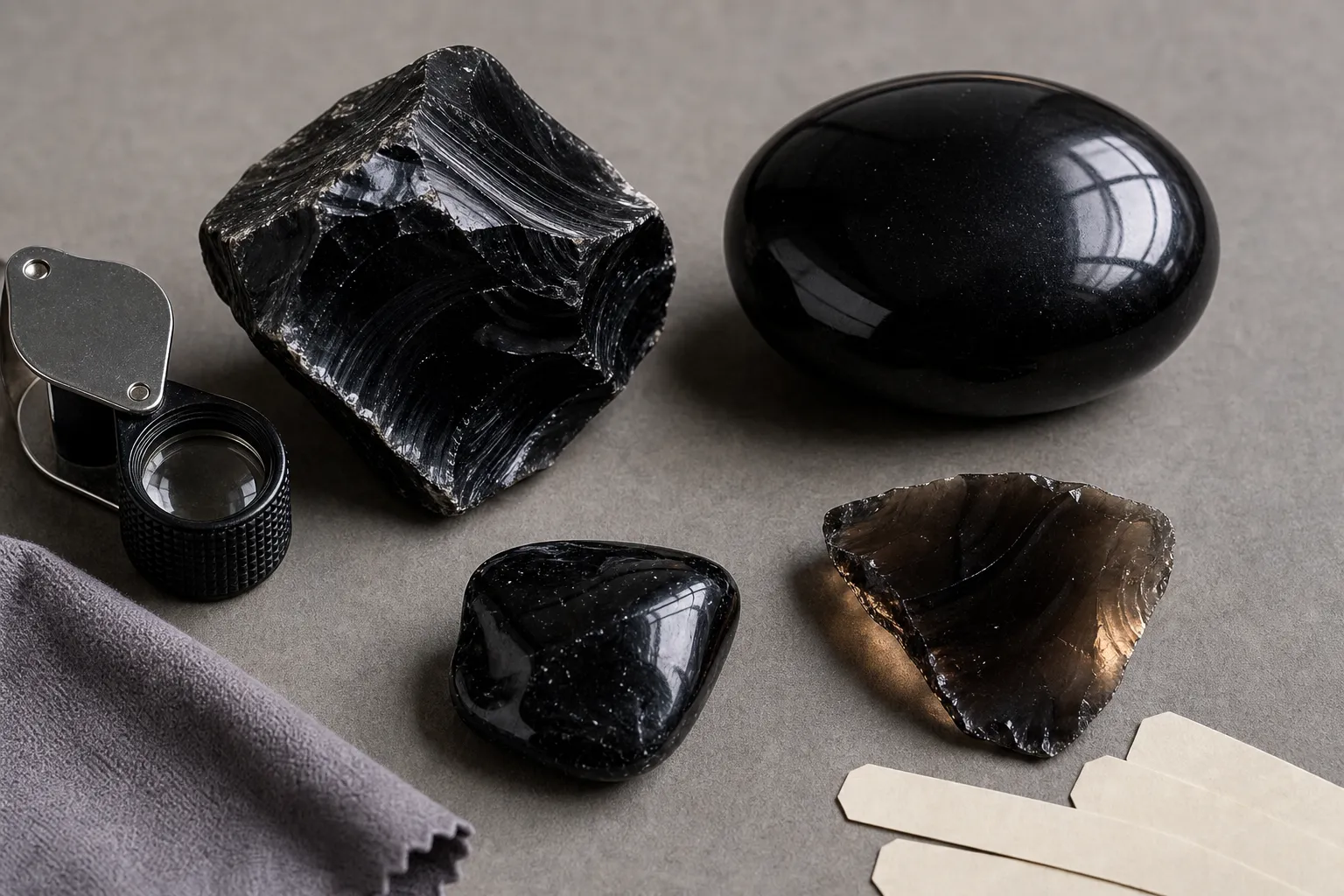
If you are holding a dark polished stone, a raw chip, or a small tumbled piece, the most useful questions are practical: what can you see, what changes under light, and what should you handle carefully? The observable obsidian properties are glassy luster, thin-edge translucency, smooth texture, curved fracture, sharp broken edges, color, sheen, bubbles, and inclusions.
Obsidian is natural volcanic glass. That glassy origin explains why it can look simple at first—often black and shiny—yet change noticeably with lighting, thickness, polish, viewing angle, and surface wear. This page stays with hand-sample observation, not lab sourcing, ancient artifacts, or note-taking software.
upward
Start with the broader guide
Use the broader guide first if you need the full scope before this page.
Start With the Glass: Luster, Texture, and Fresh Surfaces
The first property to check is the surface. Obsidian usually has a vitreous luster, meaning a glass-like shine. In collector language, obsidian luster looks closer to bottle glass than to wax, chalk, wood, or ordinary rough stone.
On a polished piece, that shine may be obvious: a smooth black surface with clear reflections. On a raw piece, it may show best on a fresh break or a small curved fracture face. Dust, weathering, scratches, fingerprints, coatings, or a weak polish can all make real obsidian look duller than expected.
Glassy luster
Reflective, glass-like shine on polished or fresh surfaces.
Can be confused by: dust, surface wear, coatings, or poor polish.
Smooth texture
Slick, fine surface, especially when polished.
Can be confused by: tumbled stones, resin coatings, or manufactured glass.
Dull exterior
Less shine than expected.
Can be confused by: weathered rind, abrasion, matte finish, or residue.
Fresh fracture shine
New breaks may look brighter than old outer surfaces.
Handle carefully: fresh chips can be sharp.
A polished palm stone, a beach-worn pebble, and a freshly broken flake can all show the same glassy material differently. Surface history changes what you see.
The geology behind this is straightforward enough for collector use: obsidian forms when silica-rich lava cools quickly and large crystals do not have time to grow. That is why it is described as glassy or amorphous rather than as a typical crystal with a repeating internal structure. In mineral references, obsidian is commonly treated as volcanic glass or a mineraloid rather than a conventional mineral.
Is Obsidian Transparent, Translucent, or Opaque?
Most thick black pieces look opaque when viewed straight on. But obsidian translucency often appears at a thin edge, in a small chip, or under strong backlighting. For most collector pieces, “translucent at thin edges” is more accurate than “transparent.”
A thick black cabochon may look completely dark. Hold a thin edge near a bright light, though, and you may see brown, gray, smoky, greenish, or amber light passing through. This is why black obsidian can show brown or gray edges in light without automatically being fake or a different stone. Thickness, light strength, and light color all affect the view.
Simple viewing sequence
- Look at the main body color in normal light. Many pieces appear black, brownish black, gray-black, or smoky.
- Check a thin edge against light. Look for a subtle glow, not clear window-like transparency.
- Rotate the piece. Some edges brighten only at certain angles.
- Compare polished and unpolished areas. Polish can deepen color and make the surface look more uniform.
- Do not force an identification from translucency alone. Natural obsidian, manufactured glass, and other dark materials can all show some edge glow.
Obsidian can also appear in colors besides black. Geology and mineral references describe black-to-gray material most commonly, with brown, reddish, greenish, tan, or other tones in some samples. For collecting, the important point is not to assume that black is the only valid color—or that every colored piece has a precise variety name. Color can be influenced by composition, tiny inclusions, bubbles, flow structure, thickness, and polish.
Fracture, Sharp Edges, and Why Shape Matters
One of the strongest visible clues is obsidian conchoidal fracture. “Conchoidal” means curved and shell-like, similar to broken glass. Instead of splitting along flat mineral cleavage planes, obsidian can break into smooth curved surfaces with ripples, arcs, or crescent-shaped contours.
This fracture behavior comes from its glassy structure. It is also why broken obsidian can form very sharp edges. The historical use of obsidian edges is interesting, but for a collector the practical point is simpler: raw flakes, chips, and fresh breaks should be handled like glass fragments.
Fracture cues to look for
- Curved, scoop-like break surfaces.
- Ripple marks or arc patterns on broken faces.
- Thin edges tapering to a sharp line.
- Bright glassy shine on fresh breaks.
- Irregular chips where an edge has been knocked or abraded.
Do not test sharpness with your fingers. A piece does not need to be large to cut skin, and a polished stone can still have a chipped edge. Store raw flakes or broken fragments so the edges are not loose in a bag, rubbing against softer stones, or hidden where someone may reach without seeing them.
Fracture also explains why some obsidian looks dull instead of glossy. Older exterior surfaces may be weathered, abraded, or coated with a natural rind. A fresh internal break may look much glossier than the outside. That contrast can fit volcanic glass, although it is not enough by itself to prove identity.
Hardness and density are useful background, but they are not ideal home tests. Reference tables often place obsidian around the middle of the Mohs scale, commonly near 5–6, with specific gravity in the low-to-mid 2 range. Scratch testing can damage a specimen, and “feels heavy” is subjective unless you are comparing known materials of similar size and shape. In everyday handling, obsidian usually feels like a dense glassy stone—not unusually light like pumice and not as heavy as many metallic minerals.
Color, Sheen, Bubbles, and Inclusions
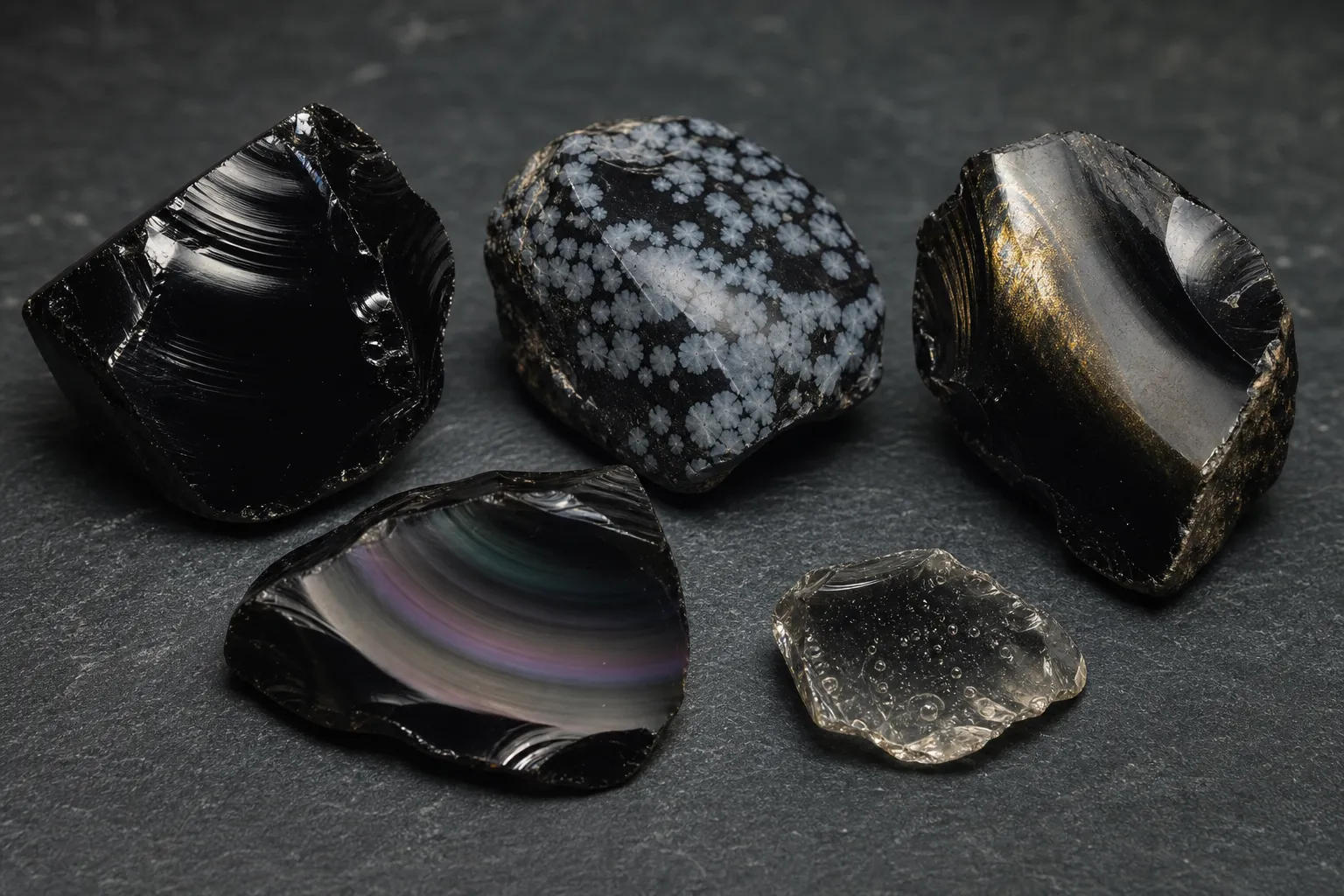
Once you have checked luster, translucency, and fracture, look at the internal features: bubbles, specks, flow lines, inclusions, and sheen. This is where variety names become useful, but also where overconfident labeling becomes easy.
Black obsidian
Black obsidian is the most familiar market name. It usually means dark volcanic glass with a glossy appearance. In thin areas, it may show smoky brown, gray, or other subtle edge colors. The label is mainly appearance-based in collector use; it does not prove a single source, composition, or symbolic meaning.
Snowflake obsidian
Snowflake obsidian is recognized by pale, snowflake-like spots or clusters in a darker glassy base. These white or gray patterns are commonly described as spherulitic inclusions; mineral references often connect the pattern with cristobalite. For hand-sample identification, the useful clue is visual contrast: repeated pale “snowflakes” inside dark volcanic glass.
The pattern can range from tiny specks to larger rounded clusters. Heavy patterning may make the surface look less uniformly glassy, especially if the piece is matte or poorly polished.
Golden sheen obsidian
Golden sheen obsidian shows a gold-like reflective effect when light hits the stone at certain angles. The available geology and materials discussion links sheen effects to features such as aligned gas bubbles or flow-related structures, but an individual specimen cannot be fully explained from a casual look alone.
For collectors, viewing method matters most. A golden sheen may not cover the whole stone evenly. Rotate the piece under a single light source. If the color flashes only at certain angles, you are seeing an optical sheen, not a solid yellow body color.
Rainbow obsidian
Rainbow obsidian is especially angle-dependent. It may look nearly black until tilted under direct light, then show bands or arcs of green, purple, gold, blue, or other colors. The phrase “rainbow obsidian angles” matters because the color is often not visible from every direction.
A photo can exaggerate or hide this effect. Strong lighting, wet-looking polish, black backgrounds, and camera contrast can all change what appears online. Treat a rainbow label as a viewing description until the piece has been seen under several lighting angles.
Fire obsidian
Fire obsidian is a market name associated with vivid internal color effects. Some research discusses nanoscale inclusions and interference-related mechanisms in fire-like effects, but that is a specialist topic. At collector level, it is better to say that the label depends on visible optical effect, lighting, polish, and seller naming rather than presenting a simple at-home proof.
Bubbles and tiny specks
Bubbles can be part of volcanic glass formation, especially where gas was trapped or flow textures developed. Tiny specks may be mineral inclusions, spherulites, bubbles, surface pits, or polishing artifacts. Their meaning depends on size, distribution, shape, and whether they sit inside the glass or on the surface.
Useful observations for bubbles and specks
- Round or elongated bubbles may follow flow direction.
- Aligned features can contribute to sheen or banding.
- White specks in snowflake obsidian are part of that variety’s visual identity.
- Random surface pits may come from wear or polishing rather than internal structure.
- Very uniform material with too-perfect bubbles may raise the question of manufactured glass, but bubbles alone do not settle the question.
What Changes the Identification
Most obsidian confusion comes from treating one feature as final proof. In practice, lighting, polish, thickness, angle, and naming all change the observation.
Lighting
View obsidian under more than one light condition. Diffuse daylight shows body color and surface texture. A small direct light can reveal sheen, rainbow effects, edge translucency, and internal features. Backlighting helps with thin edges.
Seller photos are only a starting point. Photos can deepen black surfaces, hide scratches, intensify sheen, or flatten translucent edges.
Polish
Polish can make obsidian look darker, smoother, and more reflective. A high polish may emphasize glassy luster and sheen. A matte finish, weathered surface, or abraded exterior can make the same material look dull.
So a dull obsidian surface does not automatically rule out obsidian. It asks a better follow-up question: is the dullness from weathering, surface wear, a matte finish, residue, or a different material?
Thickness
A thick piece can look opaque while a thin chip glows at the edge. Check obsidian translucency on the thinnest available area. Do not break a specimen to create a test edge; use existing edges, chips, or natural thin points.
Angle
Sheen varieties depend on the angle between light, surface, and eye. Golden sheen, rainbow, and fire-like effects may appear only when those line up. A piece that looks plain from one direction may flash from another. The reverse is also true: a photo that catches the strongest angle may not show how the piece looks most of the time.
Seller naming
Market names help readers organize what they own and search for: black obsidian, snowflake obsidian, golden sheen obsidian, rainbow obsidian, Apache tears, fire obsidian. But those names are not a complete scientific classification. Some describe appearance, some describe shape, some come from tradition, and some reflect retail habit.
Apache tears, for example, is commonly used for small rounded obsidian nodules rather than for a separate chemical category visible from color alone. Snowflake describes inclusions. Golden sheen and rainbow describe optical effects. These labels can be useful collection language, but they should not be treated as automatic proof of source, composition, or value.
Can You Identify Obsidian From Photos Alone?
Photos can support a first impression, but they cannot settle every obsidian identification question. A good image may show glassy luster, dark color, conchoidal fracture, sheen, bubbles, or snowflake inclusions. It may also hide edge translucency, coatings, weight, chips, and subtle surface texture.
A stronger photo-based check includes
- Normal light and direct light views.
- A thin edge against light.
- Close-ups of fractures or chips.
- Surface views from several angles.
- Scale reference.
- Both polished and rough areas, if present.
Even then, the result is usually “consistent with obsidian” rather than a final determination. Natural obsidian can resemble manufactured glass, slag-like material, dark glassy rocks, or heavily polished stones. When value, source, or authenticity matters, visual inspection has limits. A hand sample still needs context: where it came from, how it was sold, whether it has been altered, and which features are actually visible.
For most collectors, the best next step is not a dramatic test. It is a careful comparison:
- Does it show glass-like luster on polished or fresh surfaces?
- Does a thin edge show smoky translucency under light?
- Are any breaks curved and shell-like?
- Are chipped edges sharp like glass?
- Are bubbles, specks, or sheen features internal rather than just surface marks?
- Does the variety name match visible features, or only the seller label?
If several answers line up, the piece may be consistent with obsidian. If the observations conflict, keep the label provisional.
A Practical Observation Map for Collectors
Use this as a branch-level map before moving into a focused variety or care guide.
Glossy black surface
Likely observation category: obsidian luster / polish.
Better question: Is the shine glass-like on more than one surface?
Brown or gray edge glow
Likely observation category: thin-edge translucency.
Better question: Is the glow only visible where the piece is thin?
Curved broken surface
Likely observation category: conchoidal fracture.
Better question: Are the breaks shell-like rather than grainy?
Very sharp chip
Likely observation category: glassy fracture behavior.
Better question: Does the piece need more careful storage?
White snow-like spots
Likely observation category: snowflake inclusions.
Better question: Are the pale spots internal and repeated?
Gold flash
Likely observation category: sheen effect.
Better question: Does it appear only when rotated under light?
Rainbow bands
Likely observation category: angle-dependent optical effect.
Better question: Can the color be seen from multiple angles, or only one?
Tiny bubbles
Likely observation category: volcanic glass texture or another glassy material.
Better question: Are they aligned, internal, random, or surface pits?
Dull exterior, glossy chip
Likely observation category: weathering or surface difference.
Better question: Is the fresh interior more glass-like than the outside?
Obsidian properties are most useful when read together. A single black color, one shiny surface, or one dramatic photo is not enough. The stronger observation pattern is glassy luster plus thin-edge translucency, smooth texture, conchoidal fracture, and sharp broken edges, with variety names added only when visible features support them.
Meaning-oriented language may appear in shops, collections, or personal practice, but it belongs outside physical identification. A listing’s symbolic description does not make the stone easier to verify. For practical collecting, return to the features in front of you: glass, edge, fracture, light, surface, and label.