Material classification
Can Obsidian Be Both a Rock and Glass
Yes. Obsidian can be both a rock and glass, as long as the two words are not being used in the same way. The simplest answer to “can obsidian be both rock and glass” is this: obsidian is natural volcanic glass by structure and volcanic, or igneous, by origin.
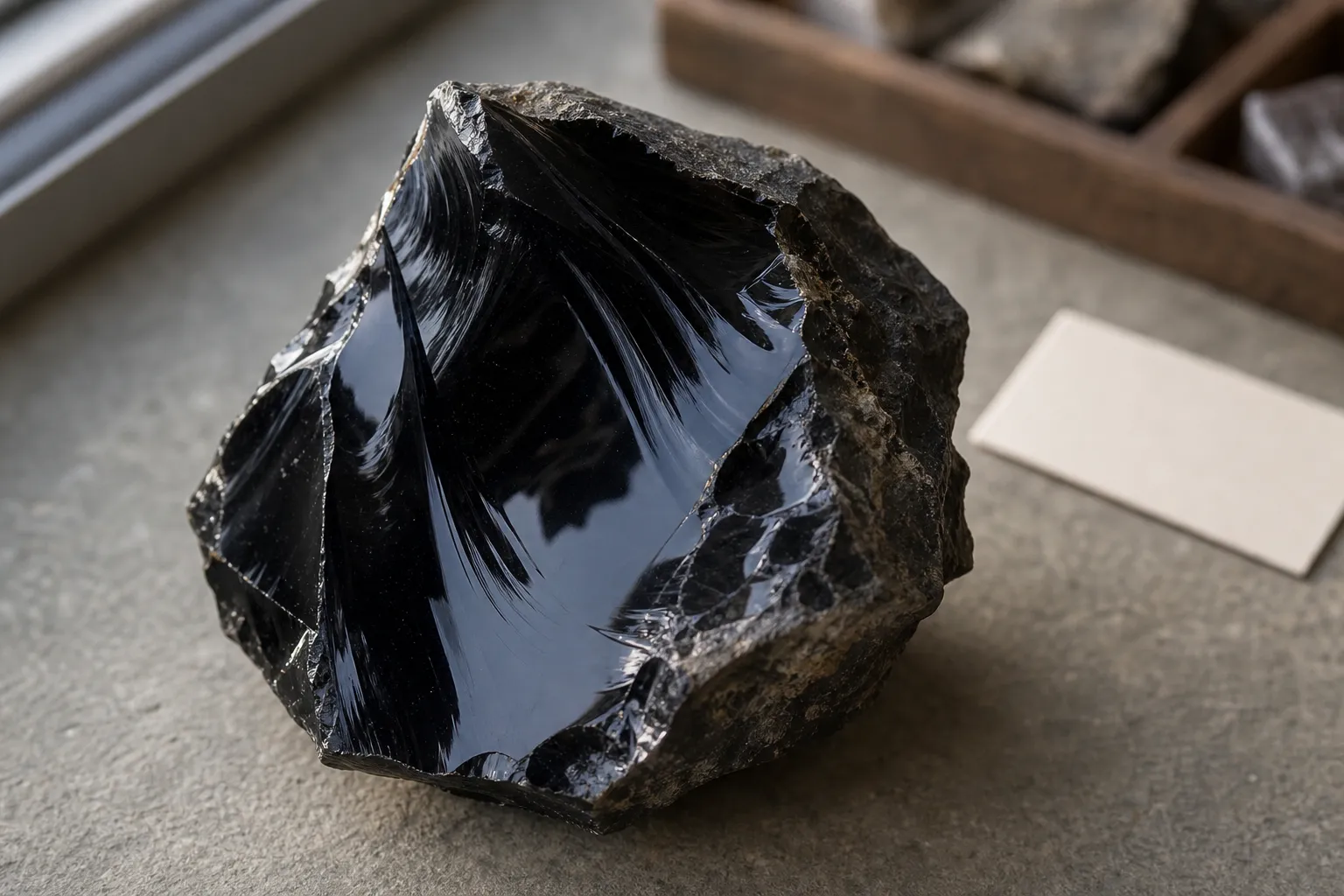
That is why the same piece can sit in an igneous-rock display case and still look, polish, and break like glass. A useful collector phrase is:
Obsidian is glassy inside, volcanic in origin, and not a mineral in the strict sense.
upward
Read the full overview first
Use the broader guide first if you need the full scope before this page.
Glass describes structure; rock describes origin
The confusion usually comes from treating “glass” and “rock” as competing labels. For obsidian, they describe different things.
When someone says obsidian is glass, they usually mean it has a mostly non-crystalline internal structure. Its atoms are not arranged into the repeating crystal pattern expected in minerals such as quartz or feldspar. Geology sources often describe obsidian as volcanic glass for this reason.
When someone says obsidian is a rock, they are usually placing it in its formation setting. Obsidian forms from volcanic melt that cools so quickly that large mineral crystals do not have time to grow. In field guides, museums, and collector labels, it is commonly grouped with volcanic or igneous materials.
So, is obsidian glass? Yes, if you mean natural volcanic glass.
Is obsidian a rock? Yes, in common geology and collector use, if you mean a volcanic material formed from molten rock.
The only caution is that in a very strict definition of rock as an aggregate of mineral crystals, obsidian is an unusual case rather than a normal crystalline rock.
Why obsidian is glassy
Obsidian forms when silica-rich lava or magma cools rapidly. The fast cooling prevents sizable crystals from forming, so the material solidifies as a glassy mass instead of a visibly granular rock.
That difference is easy to see when you compare obsidian with granite. Granite cools slowly enough for intergrown crystals to become visible. Obsidian cools quickly enough that the surface and fracture look much more like glass.
For collectors, the glassy structure shows up in several practical ways:
- Glassy luster: Fresh or polished obsidian often has a smooth, reflective surface.
- Few visible mineral grains: Most pieces do not show the speckled crystal texture seen in granite.
- Conchoidal fracture: Broken obsidian often forms curved, shell-like fracture surfaces.
- Sharp fresh breaks: Newly broken edges can be extremely sharp and should be handled carefully.
- Mirror-like polish: Polished black obsidian can reflect light like a dark mirror.
This does not mean obsidian is the same as manufactured window glass or bottle glass. It means nature made a glassy material through volcanic cooling.
Why obsidian is still called volcanic or igneous
Obsidian is not manufactured glass. It forms in volcanic settings from molten rock material. That origin is why it is commonly discussed with igneous rocks, even though its internal structure is glassy rather than visibly crystalline.
A simple comparison helps:
- Granite: igneous origin, visible crystalline structure.
- Basalt: igneous origin, usually fine-grained crystalline structure.
- Obsidian: volcanic or igneous origin, mostly glassy non-crystalline structure.
So the phrase obsidian rock and glass is not automatically wrong. It becomes misleading only if it suggests that obsidian is an ordinary crystalline rock inside, or that “glass” must always mean human-made glass.
For a collection label, the clearest short wording is often:
Obsidian — natural volcanic glass, formed from rapidly cooled lava or magma.
That phrase answers both sides of the obsidian classification question without forcing a false choice.
Why obsidian is not a mineral
Obsidian is often sold with crystals, carved into decorative stones, and described casually as a crystal. In strict geology, though, obsidian is not usually classified as a mineral.
A mineral needs an ordered crystalline structure. Obsidian does not meet that requirement because its structure is mostly glassy rather than arranged in a repeating crystal lattice.
That does not make obsidian fake, lesser, or uncollectible. A black obsidian palm stone, a snowflake obsidian tower, and a rough obsidian nodule can all be natural collector pieces without being minerals in the technical sense.
Useful wording:
“Obsidian volcanic glass”
Precise.
“Obsidian stone”
Fine in casual collector language.
“Obsidian crystal”
Common shop language, but not strict geology.
“Obsidian mineral”
Usually the least accurate option.
If you are labeling a tray, “natural volcanic glass” is clearer than “mineral.”
Visible traits that support the glass label
You do not need a lab to understand why obsidian is called glassy. Several visible traits point in that direction, though none of them alone is a complete identification test.
Glassy luster
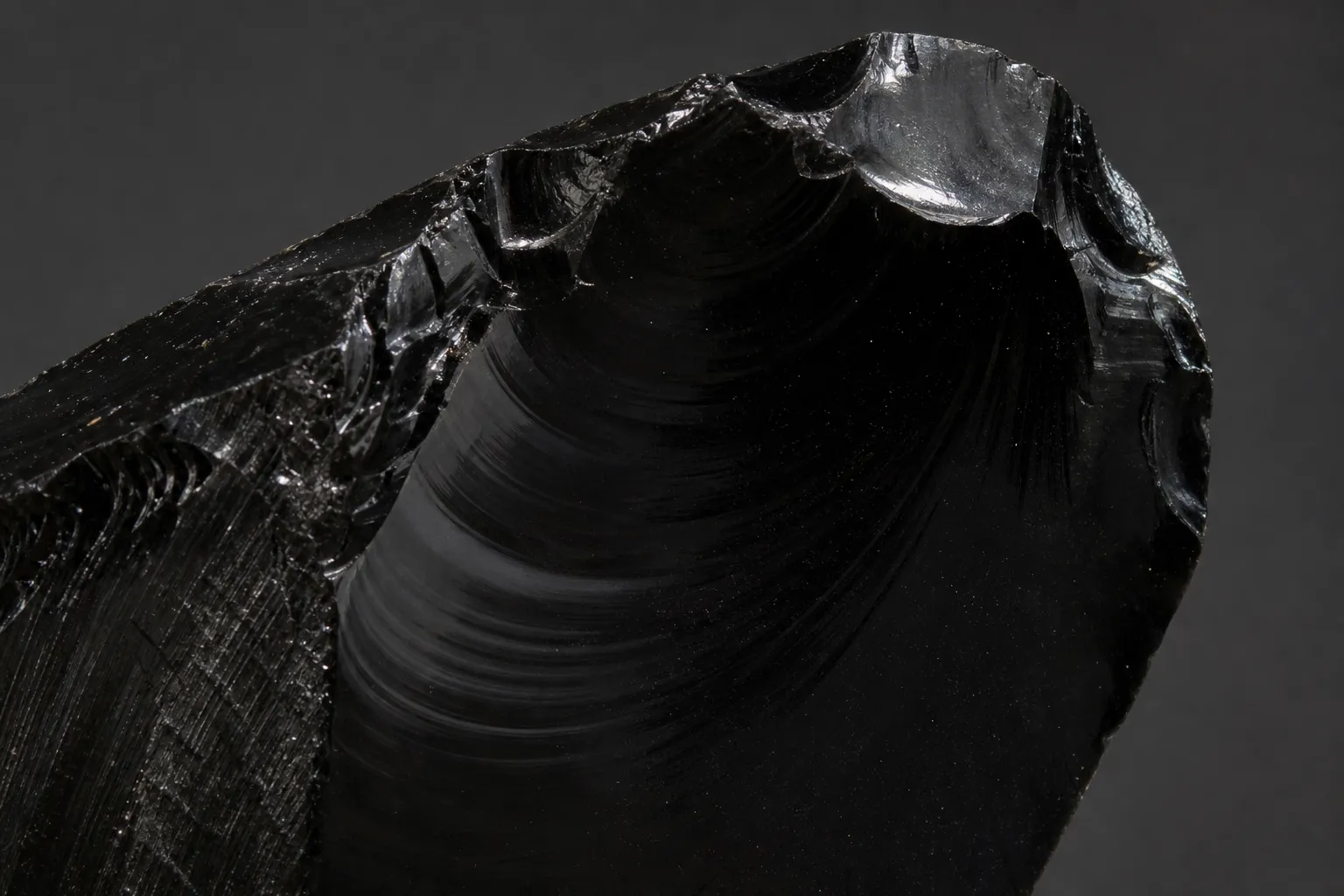
Many obsidian pieces have a bright, smooth surface. Black obsidian can look almost liquid under direct light, and polished pieces may appear mirror-like.
Luster is helpful, but it is not proof by itself. Other dark materials can also look shiny.
Conchoidal fracture
Obsidian often breaks with conchoidal fracture, meaning the broken surface forms smooth, curved shapes similar to broken glass. This happens because the fracture passes through a fairly uniform glassy mass instead of weaving around visible mineral grains.
This is also the reason fresh chips and flakes deserve careful handling. Rounded or polished pieces are usually easier to handle, but broken points, thin edges, and loose flakes can still be sharp.
Lack of large visible crystals
Granite usually shows visible grains of quartz, feldspar, mica, or other minerals. Obsidian usually does not show that kind of interlocking crystal texture.
It may show flow bands, bubbles, streaks, sheen, or color zones, but the main body is still glassy rather than visibly granular.
Sheen, bands, and variety names
Collector names such as rainbow obsidian, gold sheen obsidian, silver sheen obsidian, mahogany obsidian, and midnight lace obsidian usually describe visible effects: color, sheen, streaking, flow layers, inclusions, tiny crystals, iron-rich areas, or gas-related textures.
Those names can be useful in a collection, but they are not separate mineral species. They are visual or market labels applied to varieties of obsidian.
Snowflake obsidian shows the boundary clearly
Snowflake obsidian is a good example because it shows a glassy base with visible pale patches.
Those pale “snowflakes” are commonly explained as crystalline growths formed through devitrification, a process where glassy material begins to change toward a more crystalline texture.
That does not mean snowflake obsidian stops being obsidian in ordinary collector language. It means the piece contains a volcanic glass base with visible crystalline patches. In other words, obsidian is best described as mostly non-crystalline, not as perfectly crystal-free in every specimen at every scale.
Common wording that causes confusion
“Obsidian is just glass.”
Too simple. It is natural volcanic glass, not factory-made glass. Its volcanic origin matters.
“Obsidian is just a rock.”
Also too simple. It is not a typical visibly crystalline rock. Its glassy structure matters.
“Obsidian is a mineral.”
Usually not correct in strict geology, because obsidian lacks an ordered crystalline structure.
“Volcanic glass rock.”
Acceptable as collector shorthand if you understand it as volcanic by origin and glassy by structure.
“Gemstone” or “crystal.”
Common in jewelry and shop settings, but these are market or collector words rather than precise geological classification.
Symbolic names such as “protection stone.”
Some traditions and sellers describe obsidian with symbolic meanings. That language belongs to belief, personal meaning, or marketing context; it does not determine the material’s physical classification.
What this means for labeling and handling
For a collector, the rock-versus-glass answer is not just vocabulary. It affects how you describe and handle the piece.
A clear collection label might read:
Black obsidian — natural volcanic glass; igneous origin; glassy luster; conchoidal fracture.
Snowflake obsidian — natural volcanic glass with pale crystalline patches from devitrification.
Gold sheen obsidian — natural volcanic glass with reflective visual effect; variety name based on appearance.
Handling also follows from the glassy structure. Obsidian can resist scratching moderately well, often listed around 5 to 5.5 on the Mohs scale, but hardness is not the same as toughness. It can chip or fracture, especially at thin edges and points.
For display pieces:
- Keep broken flakes away from casual handling;
- Avoid knocking polished points or thin edges against harder objects;
- Store sharp rough pieces so they do not scrape softer stones;
- Do not assume a shiny polish means the piece cannot chip.
Historical uses of obsidian as a cutting material are part of its broader story, but they should be treated as historical context, not as a modern use recommendation. For collectors, the practical takeaway is simple: admire the fracture, and handle fresh breaks with care.
The answer in one sentence
Obsidian can accurately be called both rock and glass when the terms are used carefully: it is natural volcanic glass by structure, volcanic or igneous by origin, and not a mineral in the strict crystalline sense.
If you remember only one distinction, make it this one: “glass” tells you how obsidian is built inside; “rock” tells you where it belongs in its volcanic origin story.