
Material identification
Obsidian vs Glass: How to Tell Volcanic Glass from Man-Made Glass
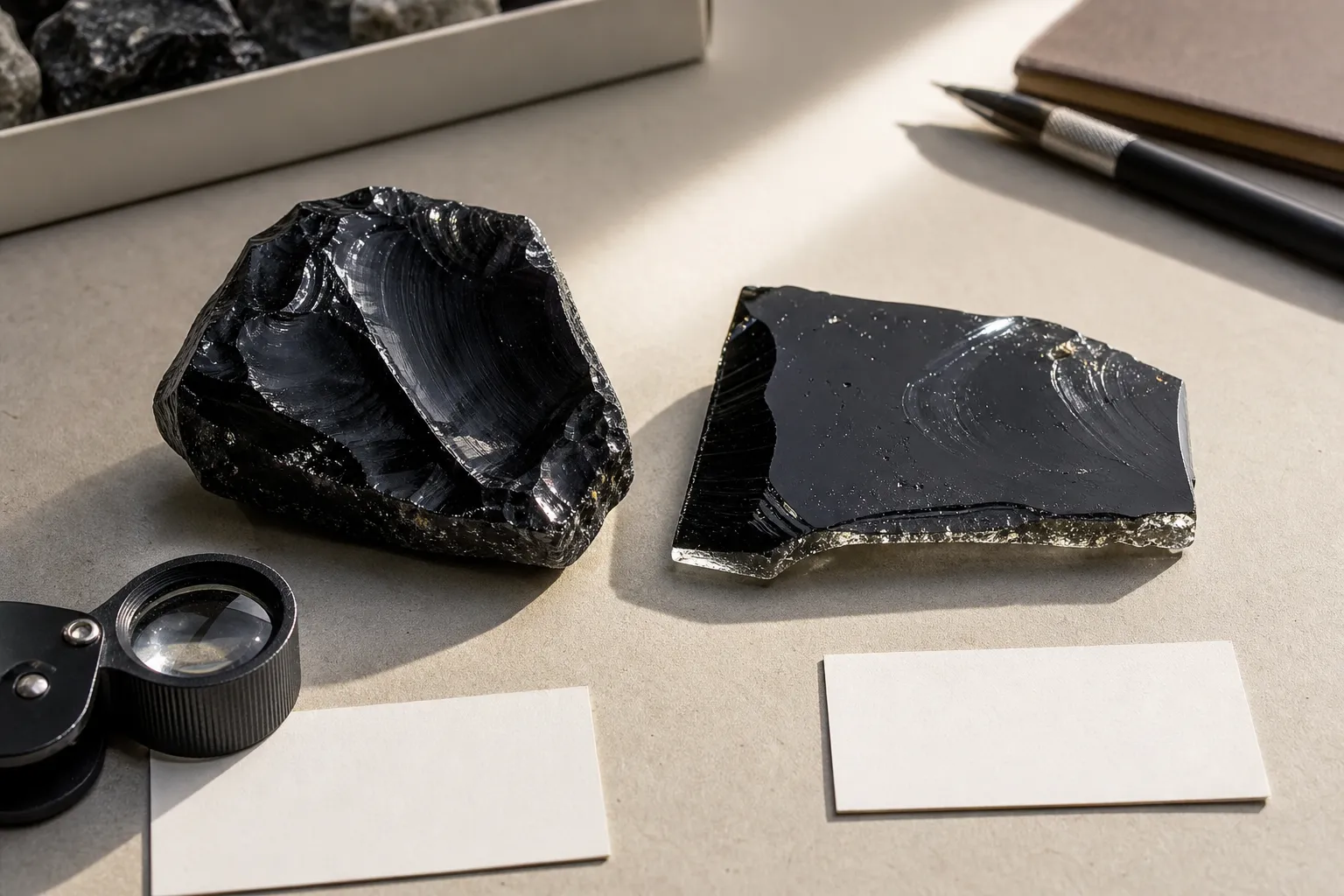
Obsidian is natural volcanic glass. Man-made glass is produced by people. In a listing photo or in your hand, though, the two can look very close: both can be glossy, black or brownish, translucent at thin edges, and capable of curved, shell-like fracture.
For obsidian vs glass, do not trust one quick test. Use a stack of clues: where the piece supposedly came from, how light passes through thin edges, whether patterns continue into the material, how bubbles look, whether the color is plausible, and whether the seller is making unusually strong claims. At home, the best answer is often “likely obsidian,” “questionable,” or “needs review,” not “proved.”
upward
Start with the broader guide
Use the broader guide first if you need the full scope before this page.
The real difference is origin, not shine
Obsidian forms when suitable lava cools so quickly that large crystals do not develop. It is glassy and mostly non-crystalline, but it is natural volcanic material. Manufactured glass can be black, glossy, sharp, colored, bubbly, molded, or patterned, but its origin is human production.
So “glass” is not the opposite of obsidian. Obsidian is a natural glass. The practical question is narrower: does this glossy piece show enough natural volcanic-glass context and texture to be reasonably called obsidian, or does it look more like bottle glass, slag glass, decorative glass, or another manufactured material?
Clue
Obsidian
Man-made glass
Origin
Natural volcanic material
Human-made material
Structure
Glassy, mostly non-crystalline
Glassy, non-crystalline
Common appearance
Black, gray, brown, reddish-brown, patterned, sometimes sheen-bearing
Black, clear, colored, opaque, bubbly, molded, slag-like, or decorative
Fracture
Often conchoidal, with curved shell-like breaks
Can also break conchoidally
Home identification
Usually a probability judgment
Usually a probability judgment
A practical inspection sequence
Use these checks together. One clue can mislead; several clues pointing the same way are more useful.
1. Start with context and the exact claim
A loose tumbled stone labeled “black obsidian” is common and may be genuine, but a label is not evidence by itself. Be more cautious with listings that say “rare bright blue obsidian,” “green obsidian,” “ancient blade,” “museum grade,” or anything unusually dramatic without source information.
For a found piece, setting matters. Obsidian is associated with volcanic regions. A glossy black fragment found near old bottles, construction fill, furnace material, or industrial debris may be manufactured glass or slag rather than natural obsidian.
2. Check thin edges in strong light
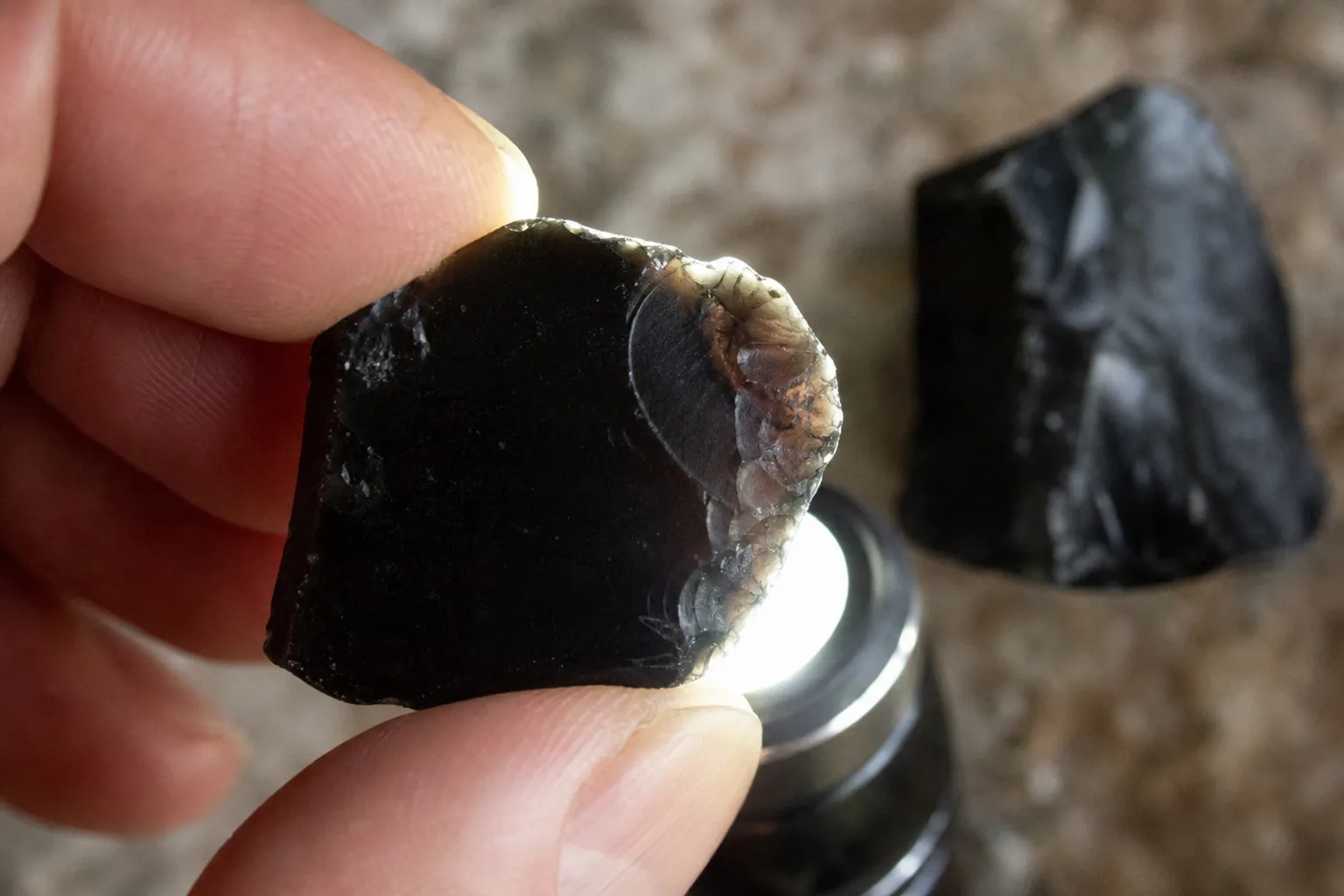
Many black obsidian pieces look opaque through the middle but show some translucency at thin edges. The glow may look smoky, brownish, grayish, or dark greenish depending on the piece and the light.
This is a useful observation, not a final answer. Manufactured black glass can also transmit light at thin edges. The light test mainly helps you see whether the material behaves like glass and whether the color seems internal rather than painted or coated.
For beads, cabochons, and pendants, inspect drill holes, chips, and edges instead of only the polished face. Surface treatments often show themselves where the finish is interrupted.
3. Use magnification for internal texture
A loupe or phone macro lens can help if you keep the result in proportion.
Features that may support obsidian
- Subtle internal variation instead of perfectly flat color.
- Wispy or flow-like banding.
- Small inclusions or tiny crystalline areas in some varieties.
- Natural-looking transitions between darker and lighter zones.
- Sheen that appears from within the polished material rather than sitting on the surface.
Features that raise questions
- Very uniform bottle-like color across the whole object.
- Large, round, decorative-looking bubbles.
- Swirls that resemble slag glass more than volcanic flow banding.
- Patterns that sit on the surface only.
- Identical pattern repetition across many beads or pendants.
Bubbles are often misunderstood. Natural volcanic glass can contain bubble-related textures, and manufactured glass can contain bubbles too. Obvious rounded bubbles in a polished “black obsidian” item can be a warning sign, but the presence or absence of bubbles is not a stand-alone obsidian bubble test.
Patterned varieties: what should look embedded
Variety names can be helpful, but they are also used loosely in the market. Look at whether the pattern belongs inside the material.
Snowflake obsidian is recognized by pale gray to white “snowflake” spots. These are associated with spherulitic textures, where small crystalline aggregates develop in the glass. On a convincing piece, the snowflake-like areas should look embedded, not printed or painted on top.
Mahogany obsidian usually shows reddish-brown and black patterning. The brown areas tend to be irregular and integrated. Flat painted-looking stripes or repeated markings across many beads should make you pause.
Rainbow obsidian, gold sheen obsidian, and silver sheen obsidian depend strongly on polish, lighting, and viewing angle. A flash that appears only from certain directions is not automatically suspicious. The better question is whether the effect looks internal and subtle, or more like a coating, foil, glitter, or surface treatment.
Be careful with vivid blue and green “obsidian”
Greenish or bluish natural volcanic glass can exist in muted, dark, edge-dependent ways. That is different from a bright transparent blue or emerald-green object that looks like modern glassware.
Color alone is not enough to reject a piece, but vivid color should raise the standard of proof. Ask for source information, compare with reliable examples, and be cautious if the color claim is doing most of the selling. For unusually colored or high-priced pieces, home inspection is only a first screen.
Tests that are weaker than people think
Conchoidal fracture
Obsidian is known for curved, shell-like fracture, but many manufactured glasses break the same way. This shows glassy behavior; it does not prove volcanic origin.
Scratch testing
Do not casually scratch a specimen you care about. It can damage polish, produce confusing marks, and still may not separate obsidian from ordinary glass.
Temperature feel
“Feels colder” is not reliable. Size, polish, room temperature, and what the piece was resting on can all change the impression.
Weight in the hand
Weight can make you suspicious, but it is not diagnostic by itself. Shape, thickness, carving style, and hidden voids all affect how heavy a piece feels.
Photo-only identification
Photos can show color, surface condition, and obvious bubbles or coatings, but they often hide edge translucency, internal texture, and angle-dependent sheen. A photo may support “possibly obsidian” or “questionable,” not a firm material call.
Seller wording
Terms such as “natural,” “authentic,” “rare,” or symbolic marketplace language do not identify the material. Observable features and source context matter more than the story attached to the listing.
When it is likely, questionable, or worth review
More plausibly obsidian
A piece is more plausibly obsidian when several clues line up: credible volcanic-source context, natural black to gray or brown color, subtle thin-edge translucency, embedded variation or banding, variety features that continue into the material, and no obvious signs of molding, coating, or decorative glass production.
Questionable
A piece is questionable when the warning signs stack up: vivid transparent color, perfectly uniform black glass with no source context, large decorative bubbles, slag-like swirls, repeated bead patterns, surface-only effects, or a rare-color claim without documentation.
Worth review
A piece deserves professional review when the answer affects price, collection records, legal status, or historical claims. That includes costly purchases, unusual colors, antique labels, archaeological claims, worked blades, and artifacts. Professional mineralogical or gemological review may use more controlled observation and, in research settings, non-destructive analytical tools. For a collector, the point is simple: some pieces cannot be settled by a home light test.
Do not break, cut, or grind a piece for identification
Breaking a specimen to inspect the fracture is a poor test. Fresh obsidian and broken glass can both make extremely sharp edges, and the break still may not answer the origin question.
Cutting, drilling, grinding, sanding, or polishing also moves beyond ordinary identification. Dust-generating lapidary work can create inhalable mineral dust, so it should not be treated as a casual home test. For obsidian vs regular glass, start with non-destructive inspection and get help if the answer matters.
Bottom line
In an obsidian vs glass comparison, the deciding difference is natural volcanic origin, not gloss, black color, sharpness, or a curved break. You can often spot suspicious man-made black glass by combining context, edge light, magnification, pattern integration, color realism, and bubble appearance. No single home clue proves natural obsidian.
For an ordinary low-cost stone, layered inspection may be enough for a practical collector decision. For an expensive, unusually colored, historically claimed, or heavily marketed piece, treat home identification as a first screen and ask for a qualified material review before relying on the label.