
Handling decision
Raw Obsidian vs Polished Obsidian: Which Is Safer to Handle
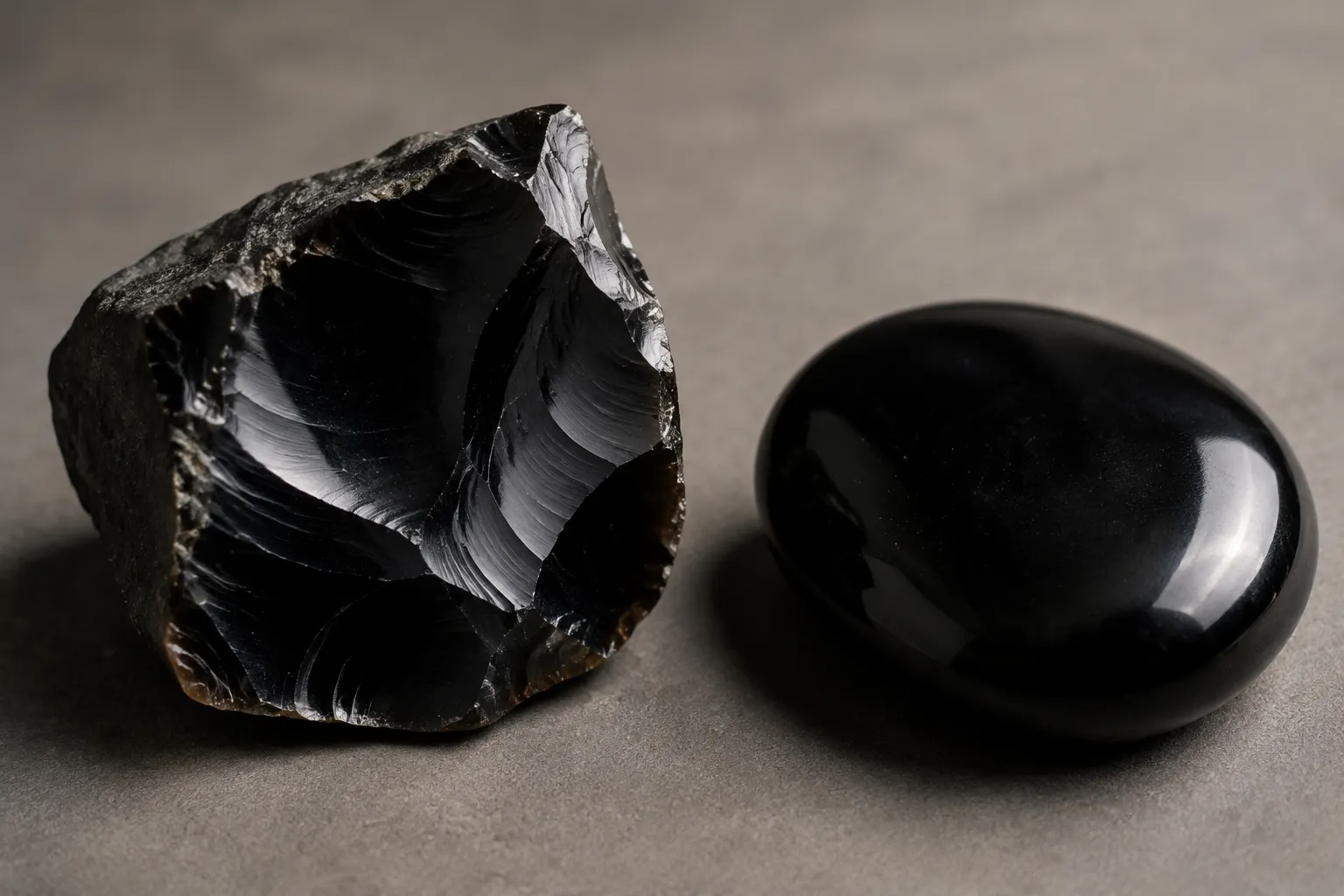
A fresh glassy fracture edge matters more than the word on the tag. For ordinary collecting, polished obsidian is usually safer to handle than raw obsidian when it is rounded, smooth, intact, and well finished. Raw obsidian often needs more caution because it is volcanic glass; fresh fractures, flakes, thin edges, points, and broken corners can be sharp.
That is the practical answer to raw vs polished obsidian safety, but it is not absolute. A dull, weathered raw chunk may be easier to handle than a chipped polished pendant, a pointed carving, or a polished flake with a blade-like rim. Inspect the actual piece before picking it up, cleaning it, carrying it, or storing it with other stones.
upward
Read the full overview first
Use the broader guide first if you need the full scope before this page.
Raw vs polished obsidian safety at a glance
Obsidian is described in geology and gemology references as natural volcanic glass. It can break with curved, shell-like surfaces called conchoidal fracture, and those breaks may leave thin edges that catch skin, cloth, cord, or nearby stones.
Polishing can smooth and round a surface. It does not change obsidian into a different material, and a finished piece can still chip or crack.
Raw obsidian chunk
Usually lower concern: edges are dull, broad, weathered, and not flaky.
Higher concern: fresh fractures, splinters, flakes, points, or thin glassy edges.
Collector decision: lift by broad dull areas; move slowly.
Raw obsidian flake
Usually lower concern: it is thick, blunt, and stable.
Higher concern: it is thin, curved, blade-like, or newly broken.
Collector decision: do not handle casually with bare hands.
Polished palm stone
Usually lower concern: it is rounded, smooth, intact, and chip-free.
Higher concern: it has a cracked rim or broken corner.
Collector decision: usually easier for display and handling.
Polished bead or pendant
Usually lower concern: hole edges are smooth and unchipped.
Higher concern: drilled holes show cracks, chips, or rough inner rims.
Collector decision: check before wearing or stringing.
Polished point or tower
Usually lower concern: faces and base are smooth; tip is not needle-like.
Higher concern: tip, edges, or base corners feel sharp.
Collector decision: treat as decorative, not pocket-friendly.
Polished slab or cabochon
Usually lower concern: edges are rounded by the finish.
Higher concern: the rim is thin, exposed, or chipped.
Collector decision: store separately if the edge catches.
The label “raw” is a reason to inspect. The label “polished” is not a promise that every edge is comfortable.
Why raw obsidian can be sharp
Raw obsidian safety starts with its break pattern. When this volcanic glass fractures, it can form curved surfaces, thin lips, and fresh glossy edges. Museum and geology materials often connect this property with obsidian’s historical use in cutting tools, but a collector’s question is simpler: does this piece have an exposed glass-like edge?
Look for these visible cues on rough obsidian:
- Fresh glossy fractures that look darker, cleaner, or more mirror-like than the weathered surface.
- Thin flakes along the side of the specimen.
- Points or hooked corners where fracture planes meet.
- Splintery chips that lift away from the main piece.
- Blade-like edges that are thin from one angle and hard to see from another.
- Broken corners on recently dropped or shipped pieces.
A raw chunk with naturally rounded, worn edges may be reasonable to pick up with care. A newly broken flake is different. The safer choice depends on the edge, not the category name.
If you are handling rough obsidian for the first time, treat it more like a glass object than a river pebble. Lift it from a stable surface, avoid sliding fingers along edges, and turn it under side light so fracture lines show.
Why polished obsidian is often easier to handle
Polished obsidian is usually easier for casual handling because tumbling, cabbing, carving, and related lapidary finishing can smooth the surface and round exposed edges. Palm stones, beads, cabochons, and well-finished display pieces are typically made to feel smooth in the hand.
The useful word is usually. Polished obsidian edges still need a quick check.
A polished surface can hide a handling problem if the piece has:
- a chipped rim;
- a cracked drilled hole;
- a sharp point on a tower or carving;
- a thin slab edge;
- a broken bead;
- a corner that catches on cloth or skin;
- a fresh glassy chip from recent impact.
A polished point is not the same as a rounded palm stone. A pendant with a small chip near the cord hole is not the same as an intact cabochon. A polished flake can look finished and still have a thin edge.
So if the question is, “Is polished obsidian safe to handle?” the better collector answer is: it is usually more comfortable when rounded and undamaged, but it still needs an edge check.
How to inspect raw obsidian before handling it
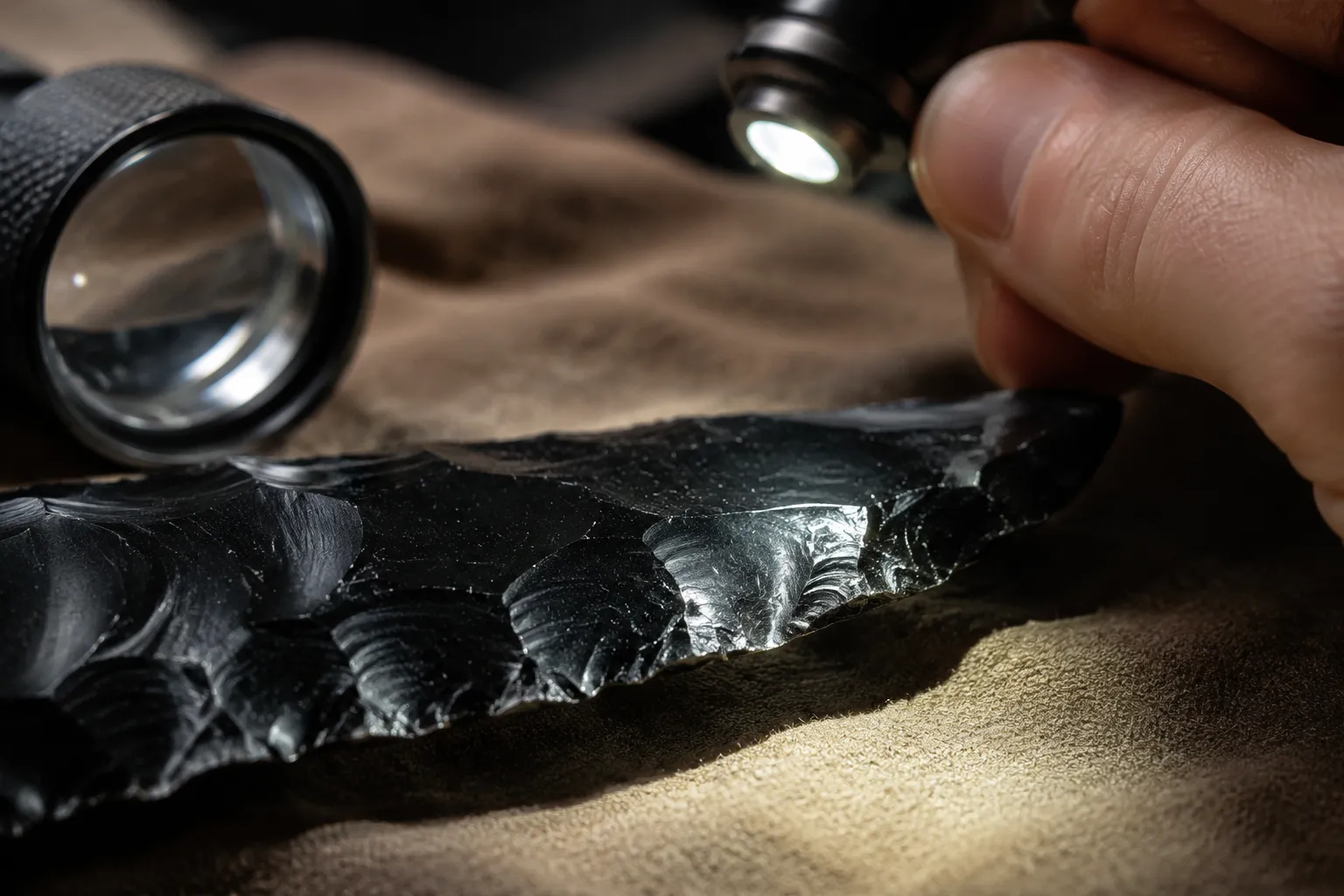
Set the specimen on a stable surface before turning it. Good light helps; sharp glassy edges are often easier to see when light skims across the surface rather than shines straight down.
Use this quick check:
- 1. Look before touching. Notice points, flakes, cracks, and broken corners.
- 2. Find the broadest dull area. That is the first place to grip if you need to move it.
- 3. Do not test sharpness with your fingertip. A visual inspection is enough to decide whether extra care is needed.
- 4. Watch the underside. Raw chunks can have hidden edges where they rest on a table.
- 5. Check for loose chips. Small splinters may sit beside the specimen after shipping or display movement.
- 6. Use a cloth wrap or gloves for jagged pieces. This is sensible for fresh-looking fractures, thin flakes, or awkward shapes.
For cleaning rough obsidian, keep the task simple. Remove loose dust gently. Do not chip, grind, cut, or reshape the piece just to make it feel better in the hand; those are lapidary tasks, not ordinary collector cleaning.
A raw specimen that feels awkward to pick up should be stored or displayed so it does not need frequent handling.
How to inspect polished obsidian edges
Polished pieces invite casual handling, so damage matters. A small chip on a polished pendant or bead can be more relevant than a large dull area on a raw chunk.
Before carrying, wearing, or placing polished obsidian in a shared tray, inspect these areas:
- Rims and corners: Do they feel rounded, or do they catch on fabric?
- Tips: Is the point decorative but blunt, or sharp enough to snag?
- Drilled holes: Are there tiny chips around the opening?
- Slab edges: Are they thick and rounded, or thin and glass-like?
- Bases of carvings or towers: Are the bottom corners smoothed?
- Recent impact marks: Does a fresh chip expose a shiny fracture edge?
A chipped polished obsidian piece should be treated more like a damaged glass object than a finished stone. You do not need to be alarmed, but you may want to stop carrying it loose in a pocket, pouch it separately, or move it to display only.
For jewelry, a chipped hole can also damage cord or wire over time. If the edge scrapes the stringing material, do not keep wearing it as if nothing changed.
Storage choices for sharper pieces
Obsidian storage safety is mostly about preventing two problems: hands brushing hidden edges, and sharp specimens scraping other stones. Raw flakes, jagged chunks, and chipped polished pieces should not be tossed into a mixed bowl with tumbled stones.
Better options include:
- a small padded box;
- a folded tissue wrap around the sharp side;
- a divided tray;
- a single-piece pouch;
- a display stand that keeps the sharp edge visible but not exposed to casual touching.
If a piece has one sharp side and one dull side, store it with the sharp side facing inward or down, as long as that does not put pressure on a fragile edge. Remove loose chips from trays; tiny fragments are easy to miss.
If other people may handle the collection, place jagged raw specimens away from casual reach. A glossy black surface can look inviting before someone notices the fracture edge.
Common misunderstandings
“Raw obsidian is always dangerous”
Not always. A raw piece with broad, dull, weathered surfaces may be manageable with ordinary care. The concern rises when you see fresh fractures, thin flakes, splinters, points, or broken corners. “Raw” is a clue to inspect, not a final verdict.
“Polished obsidian is automatically fine to carry”
A rounded, intact palm stone is very different from a polished point or a chipped pendant. Polish improves surface feel, but it does not remove every edge concern. Inspect polished obsidian before pocket carry, jewelry use, or storage with softer stones.
“Sharpness proves the piece is real obsidian”
Safety and identification are separate questions. Natural obsidian can fracture sharply, but manufactured glass and slag-like material can also have sharp glassy edges. A cut-risk check cannot prove origin, variety name, or value.
“Online sharpness claims tell me how to handle my specimen”
Extreme comparisons, knives, and blade demonstrations are not the best guide for a collector tray. The useful question is narrower: does this particular piece have a fresh, thin, exposed edge? If yes, handle and store it with caution.
When to use extra caution
Use extra caution when the piece is newly broken, recently shipped, dropped, or sold as a rough flake. Shipping can expose small chips that were not obvious in listing photos. A polished item can also arrive with a damaged corner or drilled-hole fracture.
Be more careful when:
- the piece is thin enough to snap under pressure;
- the edge looks glassy and fresh;
- the point is narrow;
- the specimen sheds tiny chips;
- cracks run toward an edge;
- you cannot see the underside clearly.
If you are unsure, do not slide your hand under it. Tip the container gently, use a cloth, or lift the piece by a broad dull section. The point is not to treat every specimen as frightening; it is to let the fracture edge guide the handling choice.
The practical verdict
Between raw and polished obsidian, the polished piece is usually safer to handle when it is rounded, smooth, intact, and undamaged. Raw obsidian is generally the more cautious choice because fresh fractures, flakes, thin edges, points, and chips can be sharp.
But the real decision is made at the surface. Inspect raw obsidian for fresh glassy breaks. Inspect polished obsidian for chips, sharp corners, damaged holes, and pointed forms. Store jagged pieces separately, and do not rely on the seller’s label to do the safety check for you.