
Collector identification note
What Is Conchoidal Fracture in Obsidian
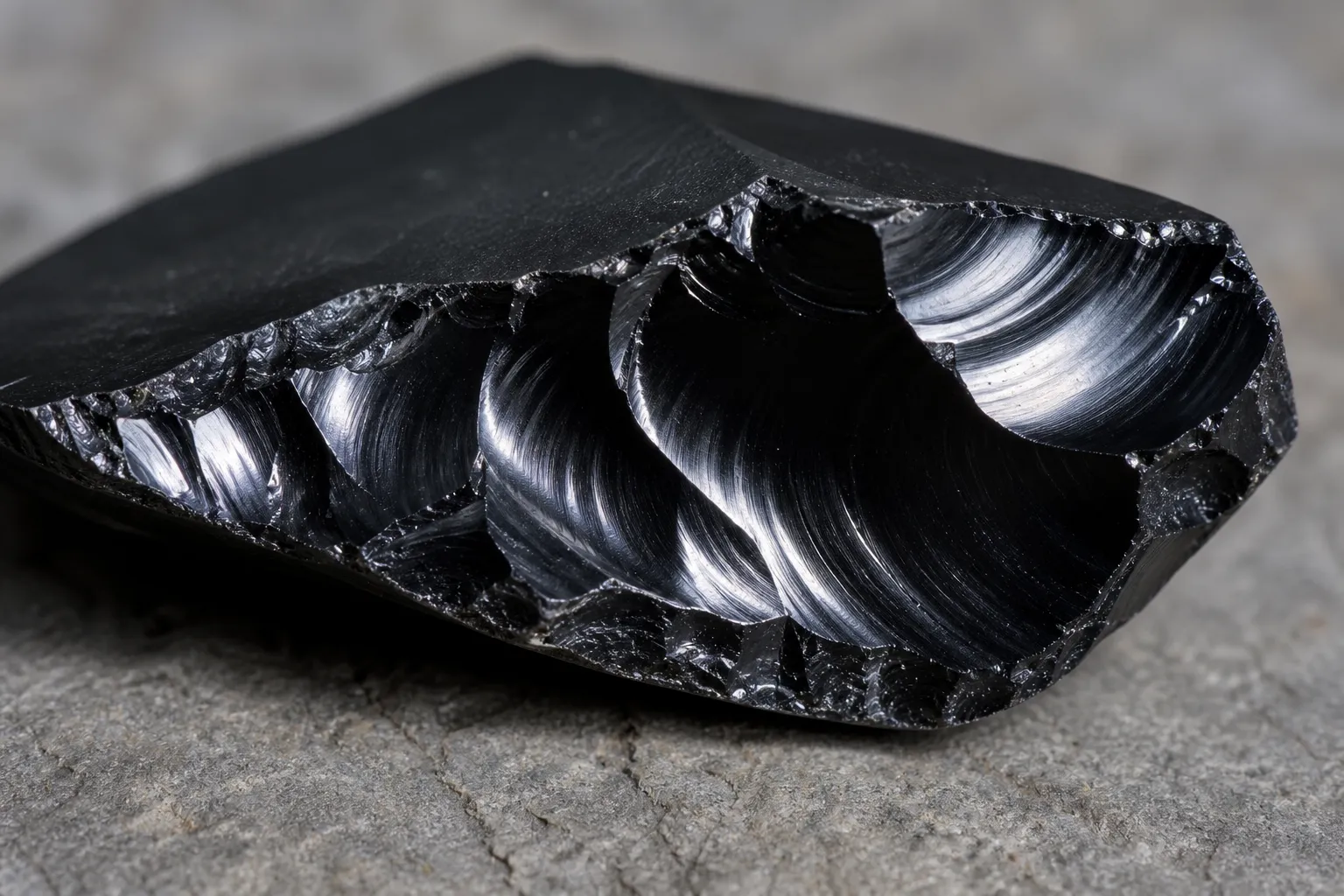
Obsidian conchoidal fracture is the curved, shell-like break pattern obsidian often shows when it chips, snaps, or flakes. Instead of splitting into repeated flat planes like some crystalline minerals, fresh broken obsidian may show smooth curved surfaces, rippling ridges, shallow bowl-like hollows, or raised rounded areas that resemble lines on a shell.
For a collector, this is a useful visual clue. It explains why a chipped corner can look glassy and why a broken edge may be sharper than it first appears. It is not, by itself, proof that a piece is obsidian, because manufactured glass and several natural materials can break in similar curved patterns.
upward
Read the full overview first
Use the broader guide first if you need the full scope before this page.
What conchoidal fracture looks like on obsidian
On a fresh chip or break, conchoidal fracture is usually easiest to recognize by shape, not by color. Look for a surface that curves smoothly rather than stepping along a flat crystal face.
Common visible signs include:
- Shell-like ripples spreading across the break surface.
- Concentric ridges or curved lines, sometimes compared with mussel-shell growth lines.
- Concave hollows where a small flake has broken away.
- Rounded raised areas on the matching broken surface.
- Glassy luster on fresh breaks, especially before weathering or abrasion dulls the surface.
- Sharp-looking intersections where two curved fracture surfaces meet.
The pattern can be subtle. A small tumble-polished stone may show no obvious fracture marks unless it has a chip, broken corner, or unpolished patch. A freshly broken obsidian fragment is more likely to show smooth curved break marks because the surface has not yet been rounded by polishing, handling, soil abrasion, or weathering.
The word “conchoidal” refers to a shell-like curve. In collector language, the key idea is simple: the break is curved and glassy-looking, not flat and repeated along internal planes.
Why volcanic glass breaks this way
Obsidian is natural volcanic glass. It forms when silica-rich lava cools quickly enough that large mineral crystals do not grow throughout the material. Because of that glassy structure, obsidian does not behave like a mineral with strong, regular crystal planes.
Many crystalline minerals have cleavage, meaning they tend to split along certain flat internal directions. Obsidian generally lacks that regular crystal structure, so when force moves through it, the break can spread in smooth curved surfaces instead. That is the basic reason for the familiar volcanic glass fracture pattern.
Real pieces are not always textbook examples. Bubbles, tiny crystals, flow bands, inclusions, older cracks, grinding, polishing, and weathered surfaces can interrupt the break and make it look uneven. The clearest examples usually appear on clean, fresh fractures in relatively uniform glassy material.
| Feature | What you may see | What it suggests |
|---|---|---|
| Conchoidal fracture | Curved, shell-like, smooth break surface | Break traveled through glassy or very fine-grained material |
| Cleavage | Repeated flat faces in predictable directions | Material split along internal crystal planes |
| Rough irregular break | Jagged, grainy, or uneven surface | Texture, inclusions, weathering, or mixed material may be affecting the break |
For obsidian collectors, the distinction matters because “fracture” describes how the material breaks. It does not describe the variety name, polish, color, source, or meaning attached to a stone.
How to check a chip or broken edge
If you are looking at a suspected obsidian piece, conchoidal fracture can be part of your visual check, but it should stay in its proper place: a clue, not a final identification.
Start with the broken area, if one exists. Use bright side lighting rather than looking only straight down at the surface. Curved ridges and shallow shell-like depressions are often easier to see when light glances across the break. Rotate the piece slowly; a surface that looks plain from one angle may show curved ripple lines from another.
Then compare the fracture mark with the rest of the object:
- Surface texture: Does the broken area look glassy rather than granular?
- Curve continuity: Are the curves smooth and continuous, or are they interrupted by grains or rough crystals?
- Freshness: Is the feature on a fresh chip, or on an older worn surface?
- Polish: Has the piece been polished, which may have removed or softened the fracture pattern?
- Other visible traits: Are there other obsidian-like traits, such as vitreous luster and a natural glass appearance?
This kind of inspection is most useful on rough pieces, chips, and broken fragments. It is less useful on cabochons, beads, spheres, palm stones, or heavily tumbled pieces because polishing can erase the visible fracture surface. A polished object can still be obsidian even if you cannot see conchoidal marks.
The reverse is also true: a shell-like fracture does not make every dark glassy piece obsidian. Manufactured glass can show conchoidal fracture. So can quartz, chalcedony, agate, flint, chert, jasper, opal, and other brittle or very fine-grained materials. Use the fracture pattern as one observation among several.
Conchoidal fracture versus cleavage
A common misunderstanding is to treat any shiny break as the same kind of break. For collectors, the cleaner distinction is between fracture and cleavage.
Cleavage is controlled by crystal structure. If a mineral has good cleavage, it tends to split along particular flat directions. The broken surfaces may look planar, repeated, and orderly.
Conchoidal fracture is different. It is not a split along a neat crystal plane. It is a curved break surface, often described as shell-like, that develops when force moves through glassy or very fine-grained brittle material. In obsidian, that curved pattern fits its identity as volcanic glass rather than a crystal with obvious cleavage.
This is also why broken obsidian can produce very thin edges. The curved fracture surfaces may meet in a narrow line. That sharpness helps explain why obsidian was historically valued for cutting tools and ornaments, but for a modern collector the practical takeaway is simpler: chipped obsidian should be handled with care.
Why some pieces do not show a neat shell pattern
Not every obsidian break looks clean and rounded. Several conditions can change what you see.
Freshness of the break
Fresh broken obsidian is more likely to show smooth curved fracture surfaces. Older breaks may be dulled by abrasion, dust, handling, or weathering.
Polish
Polished obsidian may hide fracture marks completely. A tumble-polished stone may only reveal them at a damaged corner or accidental chip.
Inclusions and internal texture
Some obsidian contains tiny crystals, flow lines, bubbles, or other features. These can interrupt the break and make the fracture less smooth.
Impact direction
A small knock at a corner may create a shallow crescent-shaped chip, while a stronger break may expose a larger curved surface. The mark depends on how force entered the piece.
Pre-existing cracks
If the stone already had internal stress or older fractures, a new break may follow those weaknesses instead of making a clean shell-like surface.
These exceptions are normal. The phrase “obsidian has conchoidal fracture” describes a characteristic behavior of volcanic glass, not a promise that every chip will look identical.
Handling broken obsidian
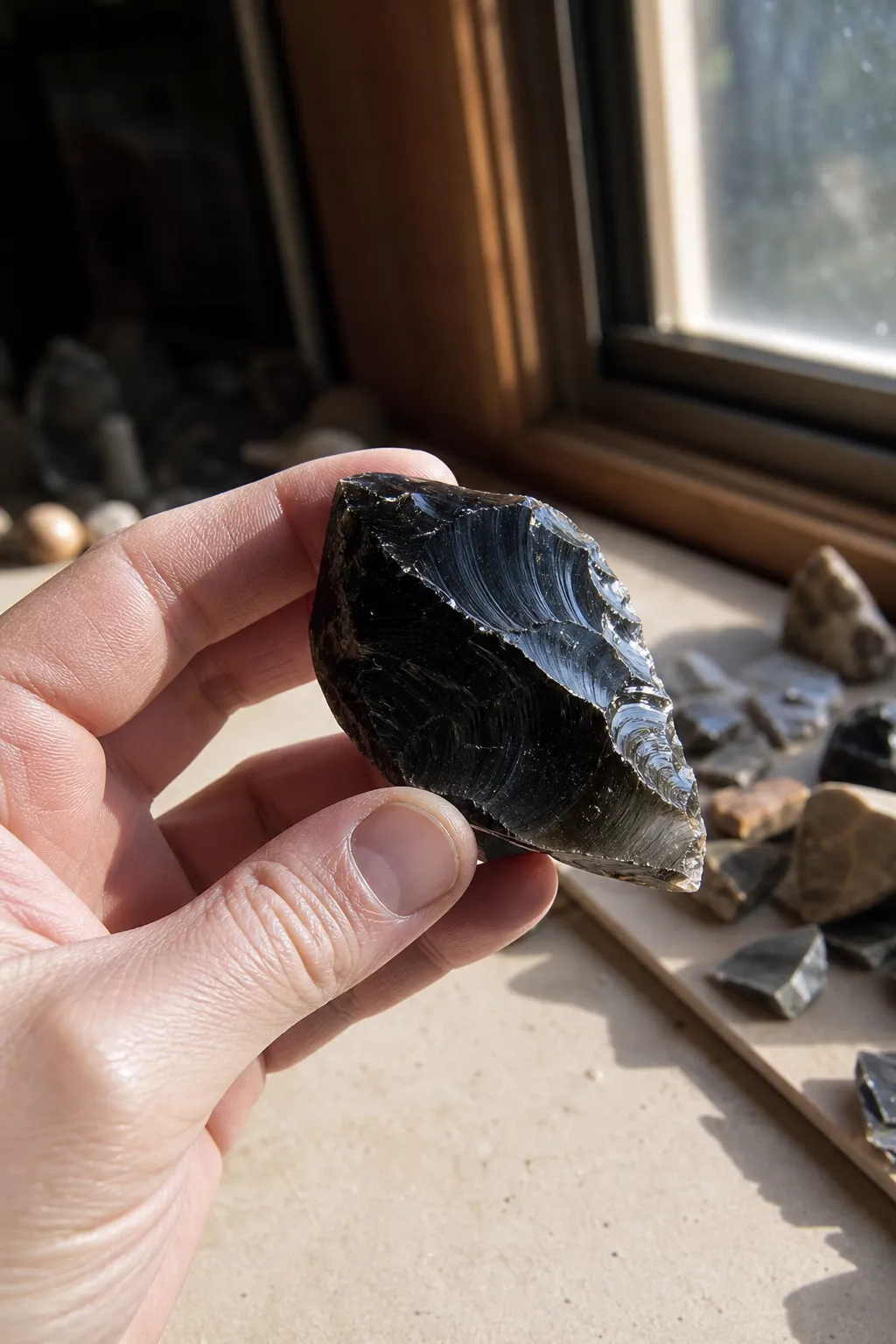
Conchoidal fracture is not just a naming detail. It affects how broken obsidian feels and behaves in a collection.
Fresh chips can leave thin, sharp edges. Avoid sliding your fingers along a broken surface to “test” it. If you need to inspect a chip, hold the piece by a stable polished or unbroken area and use light to view the fracture instead of touch. When cleaning a broken piece, avoid pressing cloth or skin into fresh edges, because a sharp corner can catch unexpectedly.
For storage, keep chipped or broken pieces from rubbing against softer stones, polished surfaces, or bare skin. A small bag, wrapped compartment, or separate tray space is often enough for ordinary collector storage. The point is not to treat every obsidian piece as hazardous; it is to recognize that a broken glassy edge can be sharper than it looks.
If a piece is actively flaking, shedding tiny chips, or has a very thin broken point, display it in a way that reduces frequent handling. A broken edge does not need to be touched to be identified.
What conchoidal fracture does not prove
The strongest boundary is worth stating plainly: conchoidal fracture is not an authenticity test for obsidian.
It can support an identification when it appears alongside other obsidian-like traits, but it cannot rule out lookalikes on its own. Manufactured glass may show the same general fracture style. Several minerals and rock materials used by collectors can also break with curved shell-like surfaces. Even within obsidian, polish, weathering, and internal texture can hide or distort the pattern.
Conchoidal fracture also has no special meaning beyond the physical break pattern in this context. It does not describe a variety, quality grade, source location, or symbolic effect. It simply names the way brittle glassy material often breaks.
Practical collector answer: if your obsidian chip has smooth curved break marks, shell-like ridges, and a glassy fresh surface, you are seeing the feature people mean by conchoidal fracture. Use it as one helpful observation, handle the broken edge carefully, and combine it with other visible clues before making an identification.