
Beginner Collection
What Should Be in a Beginner Obsidian Collection
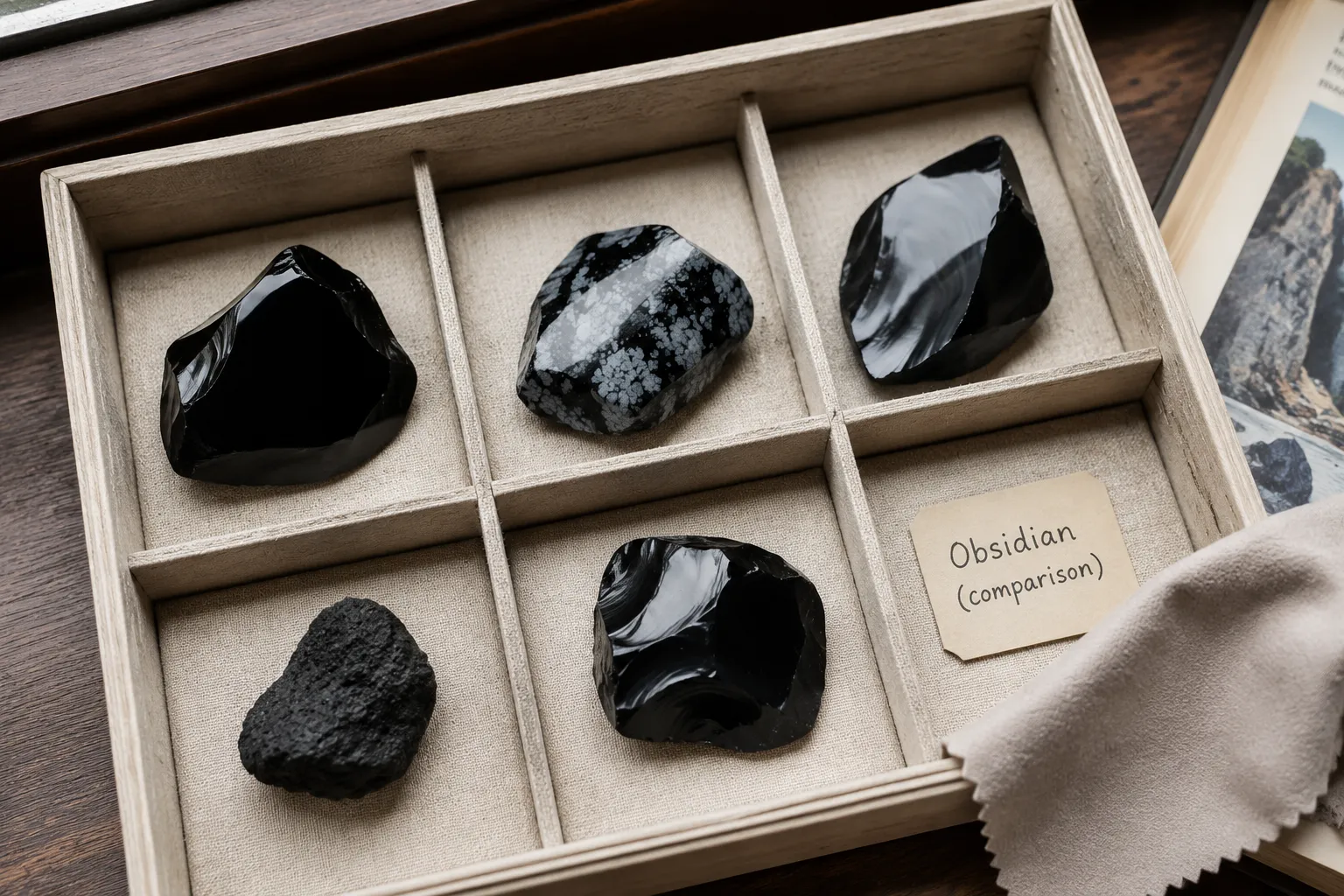
A beginner obsidian collection should start with pieces that train your eye, not a crowded tray of dramatic names. A practical first set usually includes one plain black polished piece, one patterned or included piece, one sheen or banded piece if you can inspect it in angled light, and one rough or partly rough specimen only if its edges fit your handling and storage setup.
Add a simple way to keep them separated and labeled. That is part of the collection too.
This gives you the basics: glassy luster, edge condition, color or pattern, polish, naming uncertainty, and care habits. Start with visible traits before chasing rare labels.
upward
Read the full overview first
Use the broader guide first if you need the full scope before this page.
The Starter Set: Five Useful Pieces
A starter obsidian collection works best when every piece has a job. The goal is not to own every variety name early. The goal is to learn what you can see, compare, store, and describe without treating a label as proof.
Plain black polished obsidian
What it teaches: glassy luster, surface inspection, and everyday handling.
Check before adding it: chips, cracks, and sharp corners around the edges.
Patterned obsidian
What it teaches: how pale marks, mottling, or inclusions affect naming.
Check before adding it: whether the pattern is visible without relying on a seller photo.
Sheen or banded piece
What it teaches: how light angle changes the surface.
Check before adding it: whether the flash or banding appears under more than one light source.
Small rough or partly rough specimen
What it teaches: fracture edge and natural-looking texture.
Check before adding it: loose flakes, sharp edges, and whether it can be stored apart.
Labeled comparison piece
What it teaches: how seller names compare with your own notes.
Check before adding it: keep the label, but record what you personally observe.
The plain black piece is the anchor. It gives you a clean baseline for glassy luster, polish quality, reflection, fingerprints, and small chips. If you only buy highly patterned pieces, you may not learn what ordinary obsidian looks like before names and lighting complicate the view.
A patterned piece adds contrast. Some beginner obsidian pieces are sold with names based on pale spots, flow-like bands, sheen, or mixed color. Those names can help organize a tray, but the visible pattern matters more than the label. Write down what you see: black base, gray marks, gold-like reflection, rainbow-like flash, brown areas, cloudy patches, or uneven polish.
A sheen or banded specimen belongs in a beginner set only if you can inspect it calmly. Some surfaces look quiet in flat light and active when tilted. Others look dramatic in a listing image and subtler in hand. Treat sheen as an observation, not a promise.
The rough or partly rough piece is optional. It can teach fracture edge and surface texture, but glassy edges deserve care. If the collection will be handled often, carried in a pocket, or shared with children, rounded polished pieces are usually the easier first choice.
Choose by Visible Traits, Not Just Variety Names
The strongest beginner obsidian checklist is visual. Ask what the piece shows you before asking whether the name sounds impressive.
Start with these observable traits
- Glassy luster: Does the surface reflect light like glass, or is it dulled by wear, dust, coating, or roughness?
- Color base: Is it mostly black, brownish, gray, greenish, or mixed in appearance?
- Pattern: Are there spots, streaks, bands, cloudy areas, or sharp color changes?
- Sheen: Does a reflection appear only when the piece is tilted?
- Edge condition: Are the edges rounded, chipped, sharp, flaked, or uneven?
- Polish: Is the surface smooth, scratched, waxy-looking, or uneven?
- Label support: Does the name match something you can actually see?
This keeps a beginner obsidian collection practical. A tray with one plain piece, one mottled or spotted piece, and one reflective piece teaches more than six pieces that all look similar but carry different shop names.
Naming obsidian pieces is tricky because collector names can mix visual description, seller convention, and local habit. A name may be useful without being fully verifiable from a photo or short listing. If a label mentions sheen, look for it in angled light. If it points to a pattern, check whether the pattern is obvious, faint, or only visible under strong lighting.
Do not build the first tray around claims that require lab work, exact origin, rarity, or value judgment. A beginner can make good decisions from surface, edge, polish, pattern, and storage needs. That is enough for a starter set.
What Can Change the Right Answer
The right starter pieces depend on how the collection will be used. A display tray, a study set, a pocket collection, and a personal-symbolic set do not need the same balance.
For visual learning
Choose contrast. One plain black polished piece, one patterned piece, one sheen or banded piece, and one rough-edge example can show a useful range without becoming cluttered. Keep labels beside the pieces, but let visible traits lead the notes.
For frequent handling
Prioritize rounded, polished forms. Smooth palm stones, small tumbled pieces, or well-finished shapes are easier to inspect repeatedly than rough chips. Still check for tiny edge chips; polished does not mean every corner is comfortable.
For display
Think about separation. Obsidian surfaces can show scratches, dust, and fingerprints. Pieces that rub together may collect small marks or lose surface clarity. A lined box, divided tray, soft pouch system, or individual wrapping can be more useful than another specimen.
For personal meaning
Keep that layer separate from identification. Some people treat black obsidian, rainbow-like sheen, or patterned pieces as personally meaningful. That can be part of how a collector organizes a tray, but it should not be written as a guaranteed effect. The physical collection still begins with what the surface, edge, and label can support.
If the collection is for buying practice, choose modest comparison pieces rather than expensive claims. A first set should train inspection habits, not depend on proving a dramatic market story.
Handling and Storage Belong in the Collection Too
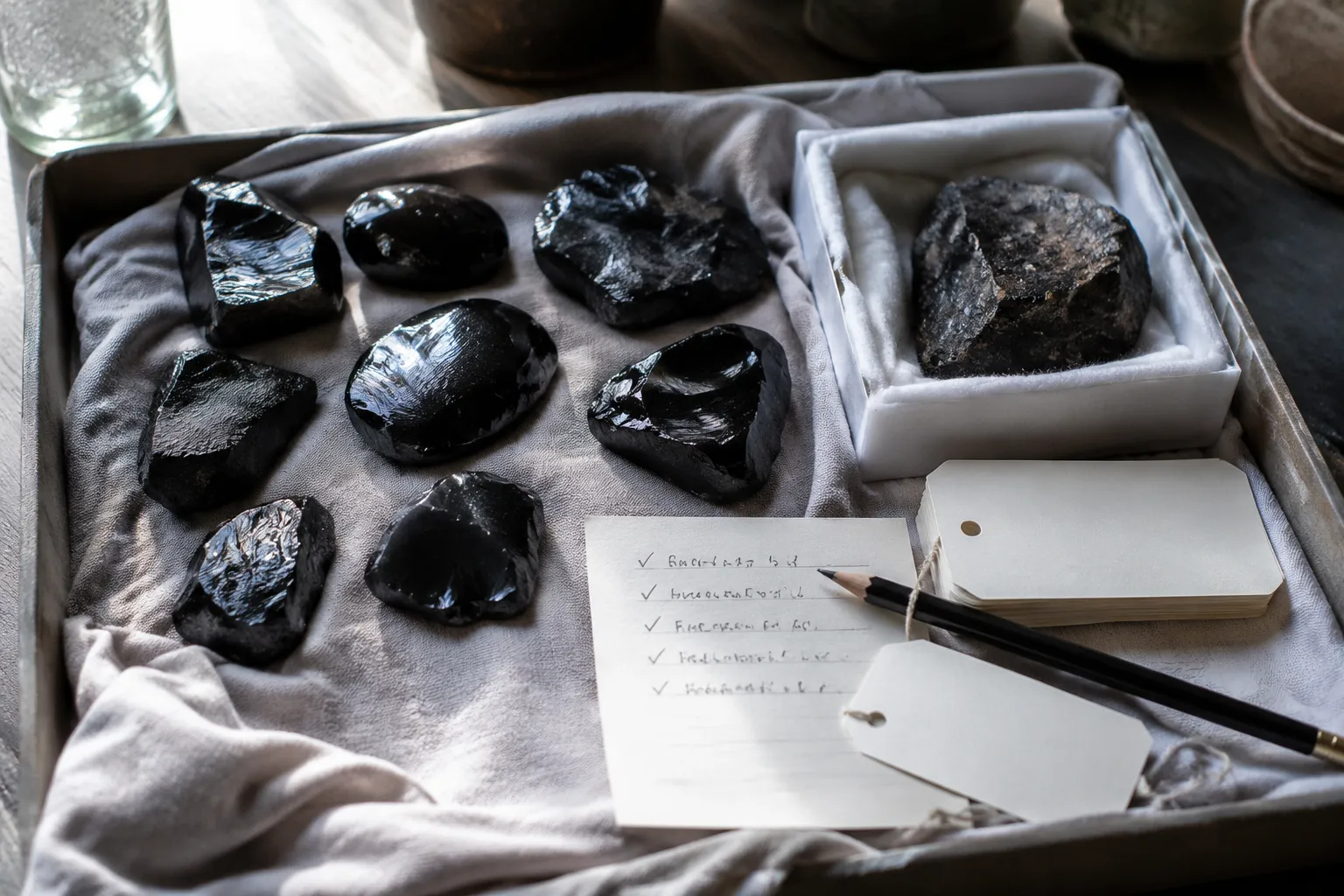
Obsidian handling choices are part of the collection, not an afterthought. Because the material is glassy, edges and chips need attention. The practical question is simple: can you pick up, clean, label, and store the piece without damaging it or catching yourself on a sharp edge?
For a beginner collection, include a small care setup:
- A soft cloth for fingerprints and dust
- A divided tray, padded box, or individual pouches
- Paper labels or a simple notebook for names and observations
- A place to keep rough pieces away from polished surfaces
- A habit of checking broken, freshly chipped, or sharp pieces before handling
Keep the routine simple. Most beginners need a consistent place, clean hands, gentle wiping, and separation between pieces. If a specimen has a sharp fracture edge, do not toss it into a bowl with polished stones. If it has a high-gloss face, store it where grit and harder surfaces are less likely to scrape across it.
The label system matters. A good beginner label can be plain:
- Name as received
- Date acquired
- Visible traits
- Edge condition
- Any uncertainty about the name
For example: “Black polished obsidian; smooth face, one small chip near edge; label not independently checked.” That kind of note is more useful than a dramatic name with no observation attached.
As the tray grows, pieces can become separated from seller cards or memory. Your own notes help you compare what was claimed, what you saw, and what still needs checking.
Common Confusion in Beginner Obsidian Collections
Treating variety names as proof
A name can guide attention, but it does not remove the need to inspect. Lighting, polish, angle, photography, and seller wording can all affect how a piece appears. If a name depends on flash or sheen, turn the stone slowly. If a name depends on spots or bands, look for the pattern without relying only on the listing image.
Buying too many similar black pieces
Plain black obsidian is useful, but six nearly identical polished stones do not teach much unless you are comparing shape, polish, size, or edge quality. A practical collection grows by contrast: one baseline piece, one pattern, one sheen, one roughness example, one careful label.
Mixing symbolic language with material identification
A collector may personally value a piece for reflection, shielding imagery, grounding language, or other traditions. Put that in a meaning note, not in the identification field. Write “personal meaning” separately from “visible traits.”
Settling authenticity, locality, or value from casual inspection
This page is not an appraisal route. Without stronger documentation, keep those questions open and avoid paying more because a label sounds certain. The more precise the claim, the more support it should need.
A Simple Beginner Obsidian Checklist
Use this checklist before adding a new piece:
- Can I describe what I see without using the seller’s label?
- Does this piece add a new visible trait to my collection?
- Are the edges comfortable enough for how I plan to handle it?
- Can I store it without rubbing it against other pieces?
- Does the label make a claim I cannot verify from appearance alone?
- Am I buying it for study, display, personal meaning, or only because the name sounds rare?
- Have I recorded uncertainty instead of turning it into certainty?
A good starter obsidian collection does not need to be large. It needs enough range to teach the eye and enough restraint to keep names, care, and meaning in their proper places.
If you are starting from zero, choose three pieces first: one plain black polished piece, one visibly patterned piece, and one piece that changes under angled light or shows a different surface character. Add a rough or partly rough specimen later if you have a storage plan and are comfortable inspecting edges carefully.
That is the practical answer. Build the tray around glassy luster, visible pattern, edge condition, polish, and honest labels. Meanings can stay personal; names can stay provisional; the collection should remain something you can inspect, handle, and explain without overstating what the pieces prove.