
Formation guide
How Do Gas Bubbles Affect Obsidian Formation
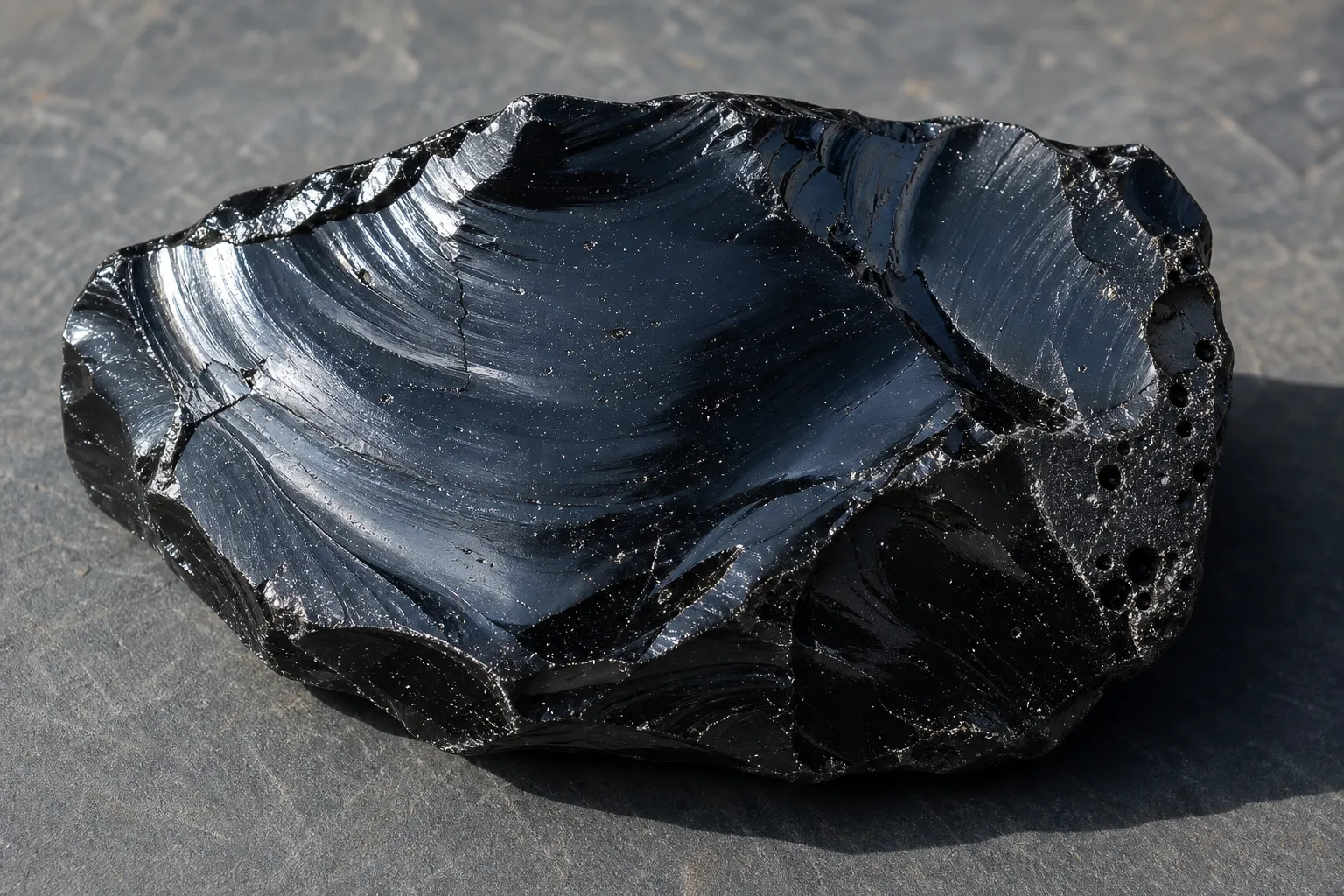
Gas bubbles affect obsidian formation by shaping whether the final volcanic glass looks dense, slightly pitted, cavity-marked, or frothy. In plain terms, gas bubbles in obsidian formation start when dissolved volatiles in magma, especially water, come out of solution as pressure and temperature change. If those bubbles are still present when the melt stiffens into glass, they are preserved as vesicles: pinholes, small cavities, or bubble trails. If gas escapes, or if bubbles shrink as water vapor dissolves back into the cooling melt, the final obsidian can look compact and glassy with very few visible openings.
That is why typical dense obsidian looks much less bubbly than pumice-like volcanic glass.
upward
Read the full overview first
Use the broader guide first if you need the full scope before this page.
Start With the Texture You Can See
For a collector, the useful starting point is the surface, edge, and broken or polished face of the piece.
You may notice:
- Dense black, brown, greenish, or smoky glass with few obvious openings.
- Tiny pinholes scattered across a polished or fractured surface.
- Small round or stretched cavities that look like frozen bubbles.
- Lines of small voids that follow flow bands or stretched textures.
- A frothy, lightweight texture with many holes, closer to pumice-like volcanic glass than dense obsidian.
In volcanic material, preserved gas-bubble spaces are called vesicles. The bubble existed in the molten stage; the vesicle is the space left behind after the material hardened.
A few bubbles do not automatically rule out obsidian. Dense obsidian can contain sparse vesicles, tiny pits, or occasional cavities. But a very light, hole-rich, sponge-like piece may sit closer to pumice or another highly vesicular volcanic glass than to dense obsidian.
From Dissolved Gas to Locked-In Vesicle
Obsidian is natural volcanic glass, commonly associated with silica-rich magma such as rhyolitic melt. It becomes glassy because the melt solidifies without growing large mineral crystals. But “it cooled quickly” is not enough to explain why obsidian is usually not full of holes.
A better sequence is:
-
1. Volatiles are dissolved in magma.
Silicic magma can hold dissolved volatile components, especially water, under high pressure.
-
2. Bubbles form as conditions change.
As magma rises and pressure drops, some dissolved volatiles come out of the melt. This is called exsolution, and it creates gas bubbles inside the molten material.
-
3. Some gas escapes.
Growing bubbles may connect with one another, link to fractures, or move through open pathways. That gas loss is part of degassing.
-
4. Some bubbles can shrink.
Bubbles do not only grow. Experimental and modeling work on obsidian-like melts shows that, under some cooling conditions, water vapor in bubbles can dissolve back into the surrounding melt. This process is often described as bubble resorption.
-
5. The glass transition freezes the texture.
As the melt becomes rigid glass, the remaining bubble shapes are preserved. After this point, those openings remain as vesicles in the solid obsidian.
This explains the central puzzle: obsidian can have a gas-rich history without ending up frothy. Much of the gas may have escaped, and some bubbles may have shrunk, before the glass hardened.
Why Dense Obsidian Usually Has Few Visible Vesicles
Vesicularity means how much of a rock or glass is occupied by vesicles. Pumice has high vesicularity. Dense obsidian has low vesicularity.
That low bubble content can seem odd if you know that gas plays a major role in volcanic systems. The main reasons are simple:
- Gas can leave before the melt hardens.
- Bubbles can collapse, shrink, or be reduced before the glass transition.
- The final specimen only shows what was preserved, not every stage the melt passed through.
So the absence of obvious bubbles does not mean gas was never present. It means gas did not remain as abundant visible vesicles in the final glass.
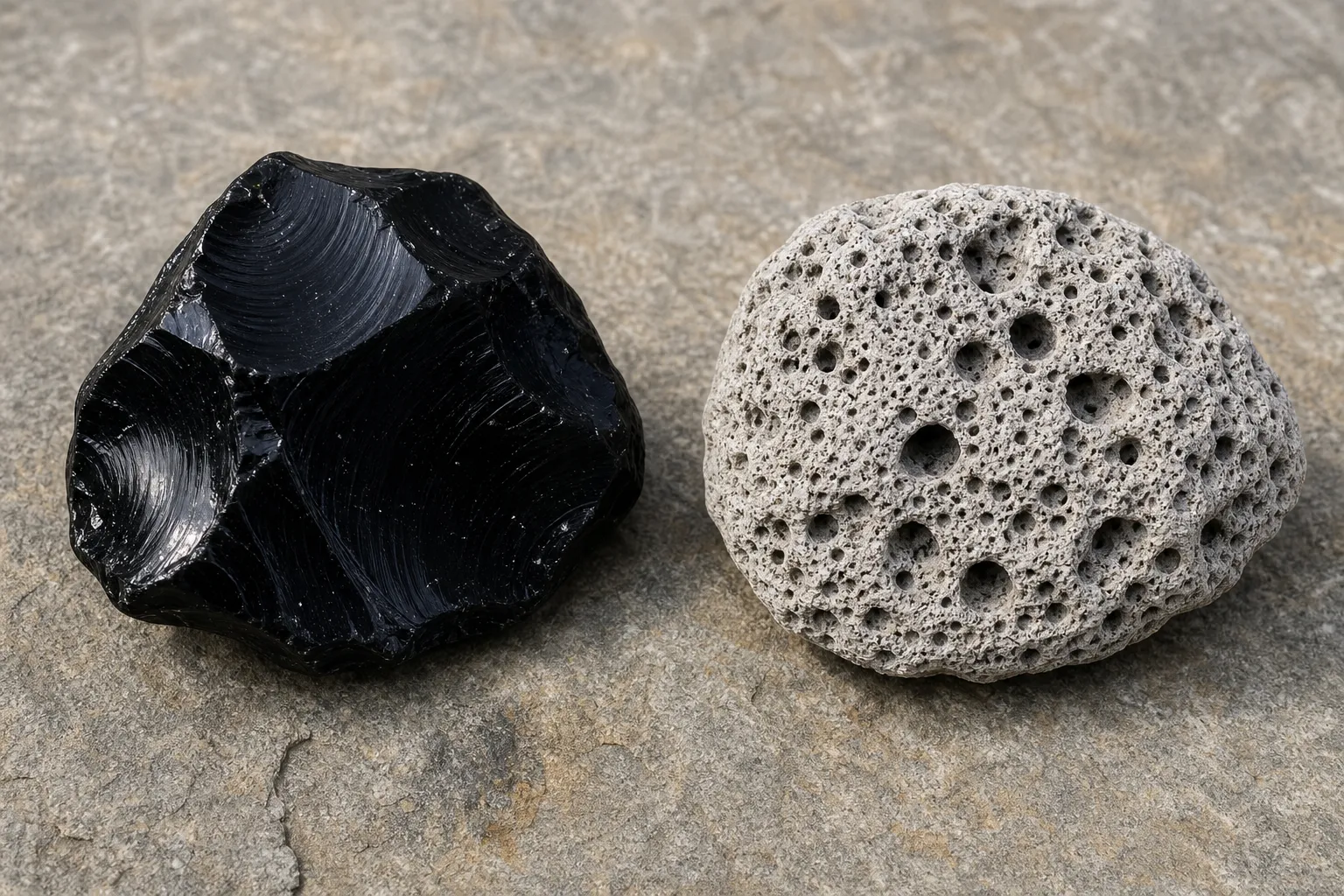
Pumice Versus Obsidian: Same Bubble Problem, Different Result
Pumice and obsidian are often compared because both can come from gas-bearing volcanic melts. The difference is the final texture.
Dense obsidian
- Visible bubble content: Low or sparse.
- Surface impression: Smooth, compact, glassy.
- Bubble outcome: Much gas escaped or bubbles shrank before hardening.
- Collector use: Bubbles are one clue, not a full identification test.
Pumice-like volcanic glass
- Visible bubble content: High and frothy.
- Surface impression: Holey, lightweight, sponge-like.
- Bubble outcome: Many bubbles remained trapped.
- Collector use: Frothy texture may point away from dense obsidian.
This does not mean pumice and obsidian are unrelated. It means they preserve different outcomes of bubble growth, gas escape, cooling, and hardening.
What Pinholes, Cavities, and Bubble Trails May Mean
Small openings in obsidian are usually discussed as preserved vesicles, but visual inspection has limits.
Tiny pinholes may be small vesicles exposed at the surface. On polished pieces, they can stand out because polishing catches the edges of the openings.
Larger cavities may be preserved gas spaces, though not every cavity can be explained confidently from appearance alone.
Bubble trails may reflect stretching, flow, or alignment while the melt was still moving. They can follow flow bands or appear as strings of small voids.
Dense and frothy zones in the same piece can happen when gas content, flow, cooling, and degassing were uneven.
For collecting purposes, bubbles help describe a specimen more accurately. They do not, by themselves, establish origin, variety name, or authenticity.
Common Misunderstandings About Obsidian Bubbles
“Bubbles mean it is fake”
Not necessarily. Natural volcanic glass can contain vesicles. Sparse pinholes, small cavities, and bubble trails can fit natural obsidian textures.
A manufactured glassy object may also contain bubbles, so the question is broader than “bubbles or no bubbles.” Look at abundance, distribution, fracture, luster, texture, weight, and context.
“No bubbles means it must be obsidian”
Also not enough. Dense obsidian often has few visible vesicles, but the lack of bubbles is not a complete identification method. Lighting, polish, dirt, and photo quality can hide small openings.
“Obsidian is just lava plus water”
Water can matter, especially as a dissolved volatile and as vapor inside bubbles. But obsidian formation is not simply lava touching water. The final texture depends on melt composition, cooling, limited crystal growth, degassing, bubble behavior, and the glass transition.
“Bubble obsidian” is a standard variety name
Seller language varies. A label such as “bubble obsidian” may describe a bubbly look, a gem-market habit, or a specific specimen appearance. It is clearer to describe the visible texture: “dense obsidian with sparse pinholes,” “black glass with round vesicles,” or “frothy volcanic glass with many vesicles.”
Where the Explanation Is Strong, and Where It Stops
Volcanology research supports the main mechanism: bubbles can form from dissolved volatiles, gas can escape, and some bubbles in obsidian-like melts can shrink during cooling through resorption. This helps explain why dense obsidian may preserve far fewer vesicles than existed earlier in the melt’s history.
That does not make bubble resorption a hand-specimen test. You cannot look at a few pinholes in one polished stone and reconstruct its exact cooling path. A fuller interpretation may require vesicle abundance, shape, flow texture, dissolved volatile data, fractures, and geological setting.
The practical version is enough for most collectors: bubbles show that gas was part of the formation story, while dense glass shows that much of that gas did not remain as open, visible vesicles.
The Short Collector Answer
Gas bubbles affect obsidian formation by forming from dissolved volatiles, especially water, as magma changes pressure and temperature. If bubbles are trapped when the melt becomes glass, they become vesicles such as pinholes, cavities, or bubble trails. If gas escapes or bubbles resorb before the glass transition, the obsidian can become dense and low in visible vesicles.
That is why dense obsidian usually looks smooth and glassy rather than frothy, while pumice-like volcanic glass preserves many more bubbles. Bubbles are useful formation clues, but they are not a stand-alone identification test.