Formation guide
What Role Does Silica Play in Obsidian Formation
Silica plays a central role in obsidian formation because silica-rich volcanic melt tends to be very viscous. In plain collector terms, that means the molten material resists easy flow, and its ingredients have less freedom to arrange themselves into visible mineral crystals. When that kind of melt cools under the right conditions, it can solidify as natural volcanic glass instead of a grainy igneous rock.
That is the short answer to silica in obsidian formation: silica helps create the glass-forming behavior, but it is not the whole recipe. Cooling history, water and gas content, eruption setting, and the time available for crystal growth all affect whether the result becomes obsidian, pumice, crystalline rhyolite, or another volcanic material.
Core takeaway
Silica helps make many obsidian-forming melts viscous, but obsidian forms only when composition, cooling, and volcanic conditions line up in a way that limits visible crystal growth.
upward
Start with the broader guide
Use the broader guide first if you need the full scope before this page.
Why silica helps obsidian become glass
Obsidian is commonly described as natural volcanic glass. It is often linked with silica-rich, rhyolitic volcanic material rather than runny, lower-silica basaltic lava.
The key idea is viscosity. A low-viscosity liquid flows easily. A high-viscosity melt resists flow. Silica-rich volcanic melt is often more viscous because of the way silica helps build the melt’s internal structure. For a beginner, the important point is the visible result: the melt can cool before atoms and ions have enough mobility to form large, orderly crystals.
Crystals need both time and movement to grow. If the melt cools while its components are still poorly organized, it can “freeze” into an amorphous glass. Amorphous means it does not have the repeating internal structure that defines a true crystal. This is why obsidian can look smooth, shiny, and glasslike rather than speckled with visible grains.
Silica contributes in two connected ways
- It helps make many obsidian-forming melts viscous.
- That viscosity can slow crystal growth, especially when cooling locks the material into glass.
This is the basis of many rhyolitic glass formations: silica-rich volcanic melt cools in a way that preserves a glassy structure instead of a visibly crystalline one.
High silica does not automatically mean obsidian
A common misunderstanding is that “high silica” always produces obsidian. It does not.
A silica-rich melt may become glassy if cooling and eruption conditions limit crystal growth. The same broad kind of volcanic material can also cool into more crystalline rhyolite if crystals have enough time and suitable conditions to form.
Silica-rich composition
Often encourages high viscosity and glass-forming behavior.
Cooling history
Faster or uneven cooling can preserve glass before large crystals develop.
Crystal-growth conditions
Crystals need time, mobility, and suitable starting points to become visible grains.
Water and gas content
Dissolved water and gases can affect viscosity, bubbles, degassing, and eruption style.
Eruption setting
Lava flows, domes, flow margins, and fragments can cool and degas differently.
Later alteration
Volcanic glass can change over time through hydration or devitrification.
So the answer is not “silica plus cold air.” Silica and melt viscosity are major parts of the story, but obsidian forms when composition, cooling, and volcanic conditions line up.
Yellowstone’s Obsidian Cliff is a useful public example: its obsidian is tied to rhyolitic volcanic activity, showing that obsidian is a natural volcanic glass formed in a specific geologic setting, not a craft glass or artificial product.
Why obsidian looks glassy instead of grainy
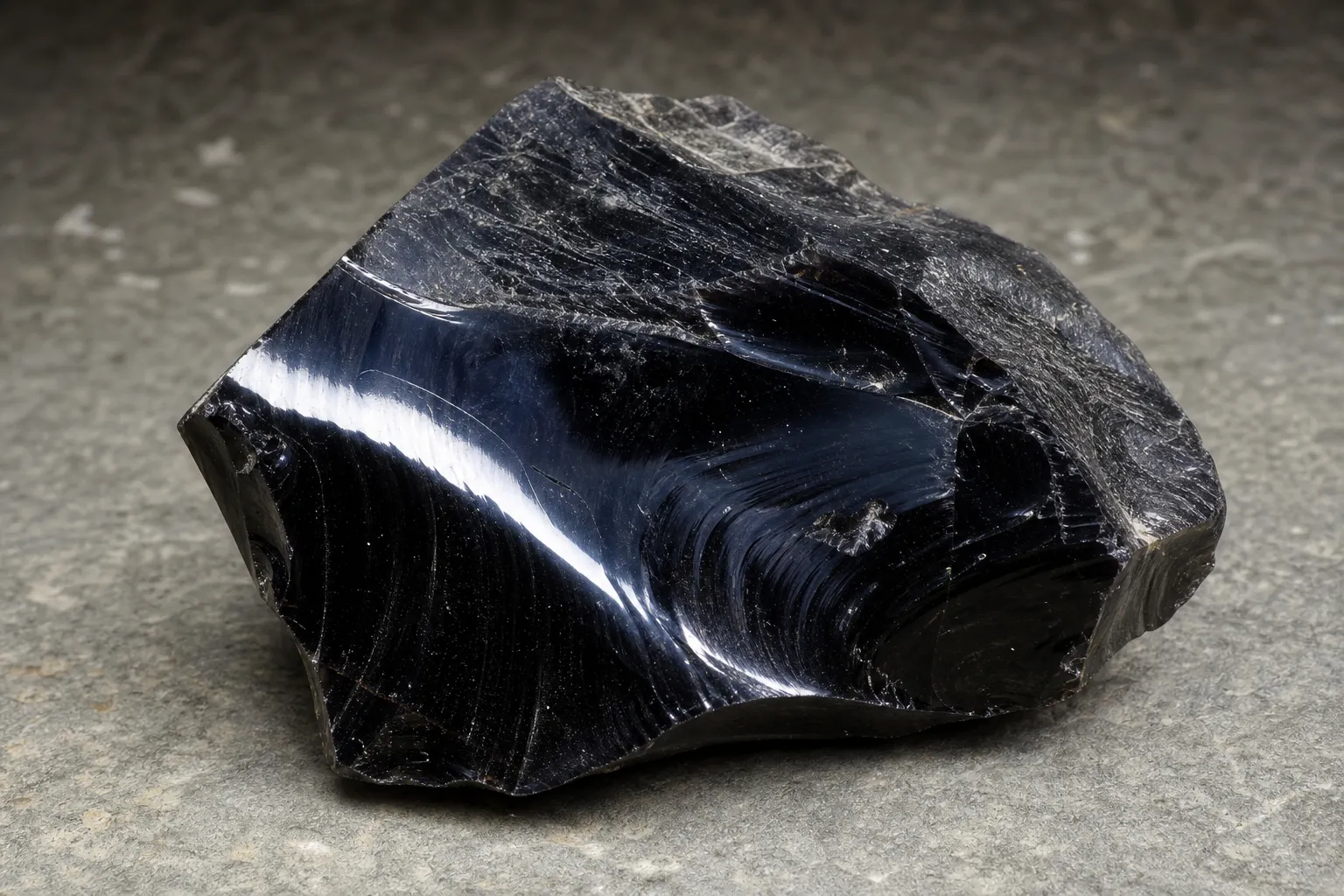
For someone holding a polished tumble, a raw chip, or a carved piece, the silica story matters because it explains what you can actually see.
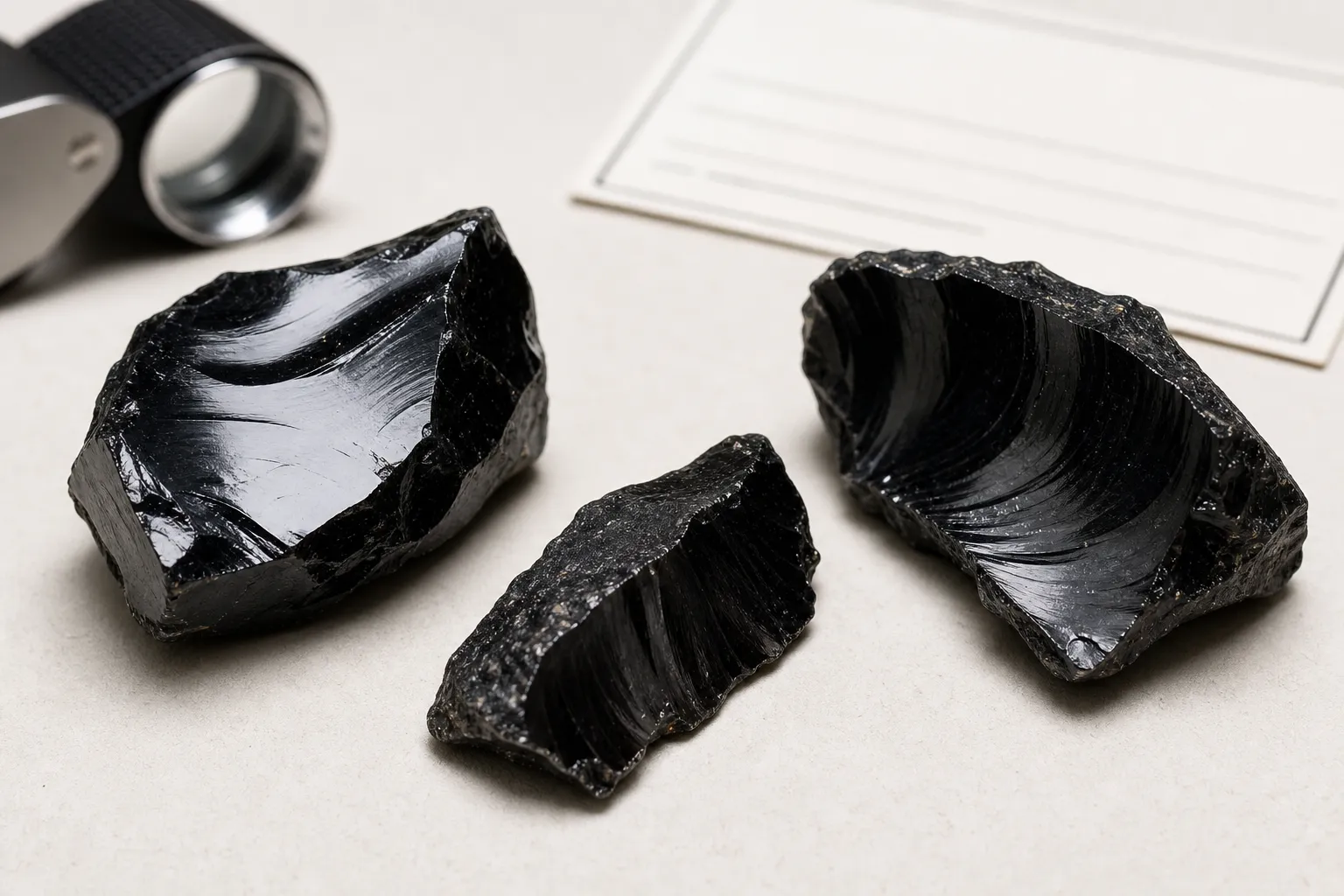
Most collector pieces of obsidian show some of these traits:
Glassy luster
Polished or freshly broken surfaces can reflect light like dark glass.
Few or no visible grains
Obsidian usually lacks the obvious mineral grain pattern seen in many crystalline rocks.
Sharp broken edges
Because it is glassy and brittle, broken obsidian can form keen edges.
Curved fracture surfaces
Many pieces show conchoidal-looking breaks, the shell-like fracture common in glassy materials.
Flow, bubbles, color, or sheen
Bands, inclusions, tiny bubbles, and light effects can change appearance, but they should not be reduced to one universal cause.
These traits do not prove every seller label on their own, but they explain why obsidian feels different from a typical grainy rock. In a crystalline igneous rock, visible grains are mineral crystals that had time to grow. In obsidian, the melt cooled in a way that preserved glass before large crystals became obvious to the eye.
This also explains why obsidian is often described as lacking crystals in the collector sense. Specialist work can discuss microscopic features, tiny crystals, devitrification, and other fine-scale details. For hand-specimen identification, though, obsidian is mainly recognized as glassy volcanic material without the visible grain pattern expected in many crystalline rocks.
“Obsidian crystal” is collector language, not strict geology
Many shops and collectors call obsidian a “crystal.” In everyday crystal-collecting language, that usually means a polished stone, carving, sphere, palm stone, or display piece.
In strict mineralogical terms, obsidian is not a crystal species. It is volcanic glass, and glass is amorphous rather than crystalline. It is also not a single mineral species in the way quartz, feldspar, or pyrite are.
A practical distinction
- In the collector market, “obsidian crystal” usually means an obsidian piece.
- In geology, obsidian is natural volcanic glass.
- Its silica-rich composition helps explain why it became glassy rather than visibly crystalline.
This matters when comparing labels such as black obsidian, snowflake obsidian, mahogany obsidian, rainbow obsidian, or gold sheen obsidian. Those names usually point to appearance, pattern, or light effect. They do not change the basic material category: obsidian is volcanic glass, not a true mineral crystal species.
What silica does not explain by itself
Silica helps explain obsidian’s glassy nature, but it should not be used as a shortcut for every feature.
It does not give obsidian one guaranteed color. Many pieces are black or very dark, but obsidian can also appear brown, reddish, gray, greenish, banded, silvery, golden, or rainbow-like. Color and sheen can involve composition, inclusions, bubbles, flow structures, and the way light interacts with the material.
It does not provide one universal formation temperature. Obsidian forms in volcanic settings, and technical studies discuss glass transition, water content, cooling, and emplacement history. A beginner article should not invent a single temperature or cooling-rate threshold for all obsidian.
It does not make pressure the main collector-level answer. Pressure can matter in volcanic systems, especially because gases and water behave differently as magma rises and erupts. But for this question, the clearer explanation is silica-rich melt, viscosity, cooling, and limited crystal growth.
It also does not mean ordinary handling is a silica-dust issue. Intact obsidian on a shelf, in a tray, or as a polished stone is different from cutting, grinding, drilling, sanding, or polishing it. Dust-producing lapidary work calls for appropriate dust control and protective precautions. Separately, broken obsidian can be sharp, so raw edges deserve careful handling.
A simple way to read an obsidian piece
If you are looking at a specimen and wondering what silica had to do with it, start with the visible clues:
- Look for glassy luster. A shiny, glasslike surface fits the volcanic glass explanation, especially on polished or freshly broken areas.
- Check for visible grains. Obsidian usually does not show the obvious grain pattern of many crystalline rocks.
- Notice broken edges. Curved, sharp, glasslike fractures are consistent with amorphous volcanic glass.
- Treat variety names as appearance labels. Sheen, snowflake patterning, or color names describe what you see; they do not make obsidian a true mineral crystal.
- Keep silica in context. Silica-rich volcanic melt helps set the conditions, but cooling and limited crystal growth complete the explanation.
The useful takeaway is simple: silica makes obsidian-forming lava more likely to behave as a viscous, glass-forming melt. When cooling and eruption conditions prevent visible crystals from developing, the result is the smooth, glassy, often sharp-edged material collectors recognize as obsidian.