
Collector labeling guide
How to Keep Obsidian Labels with Small Tumbled Stones
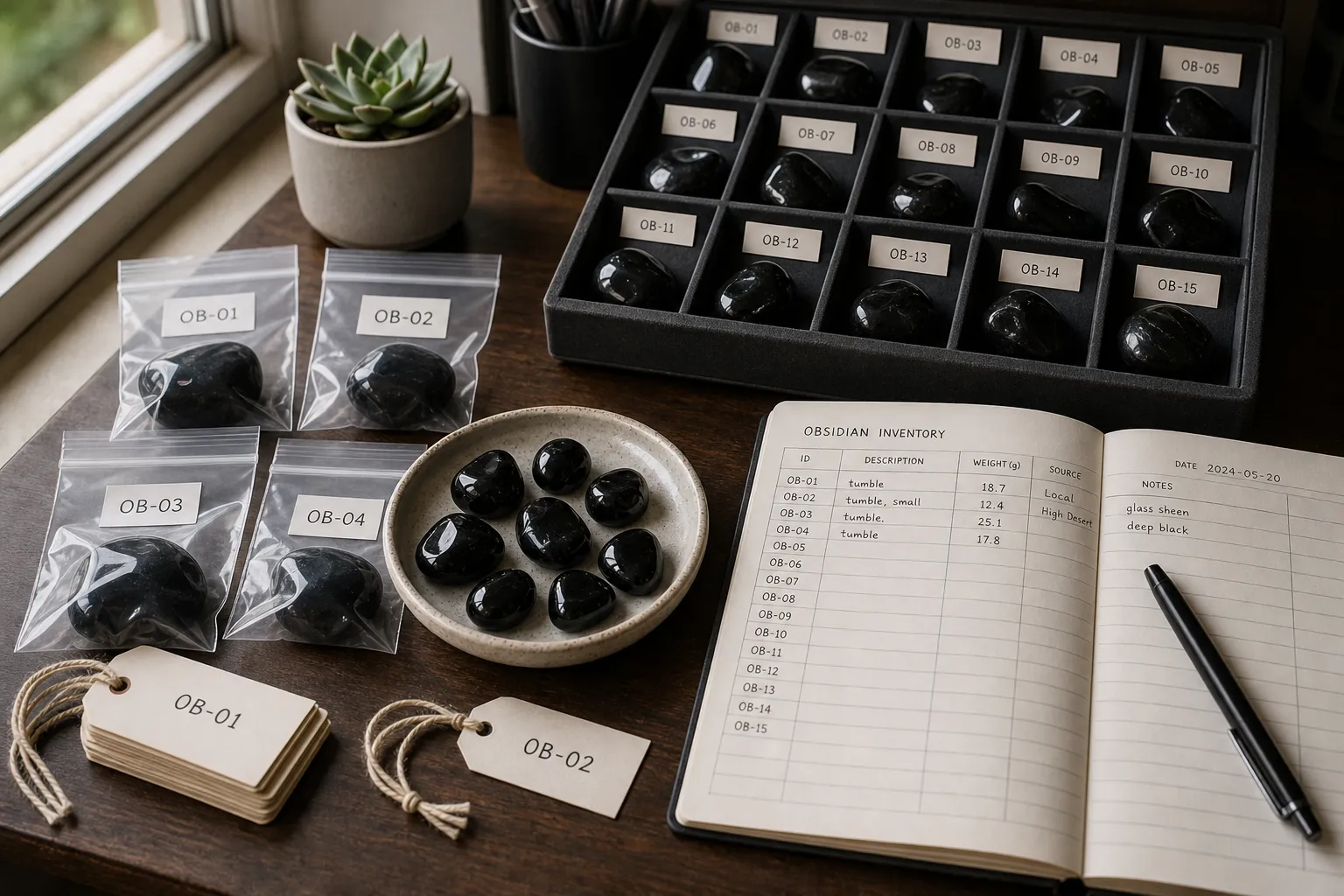
The simplest way to label tumbled obsidian stones is to label the container, tag, tray space, or inventory record—not the stone itself. Give each stone, or each clearly labeled group, a short ID that appears in the same places: on the bag or tray note, in your written record, and, when useful, in a photo.
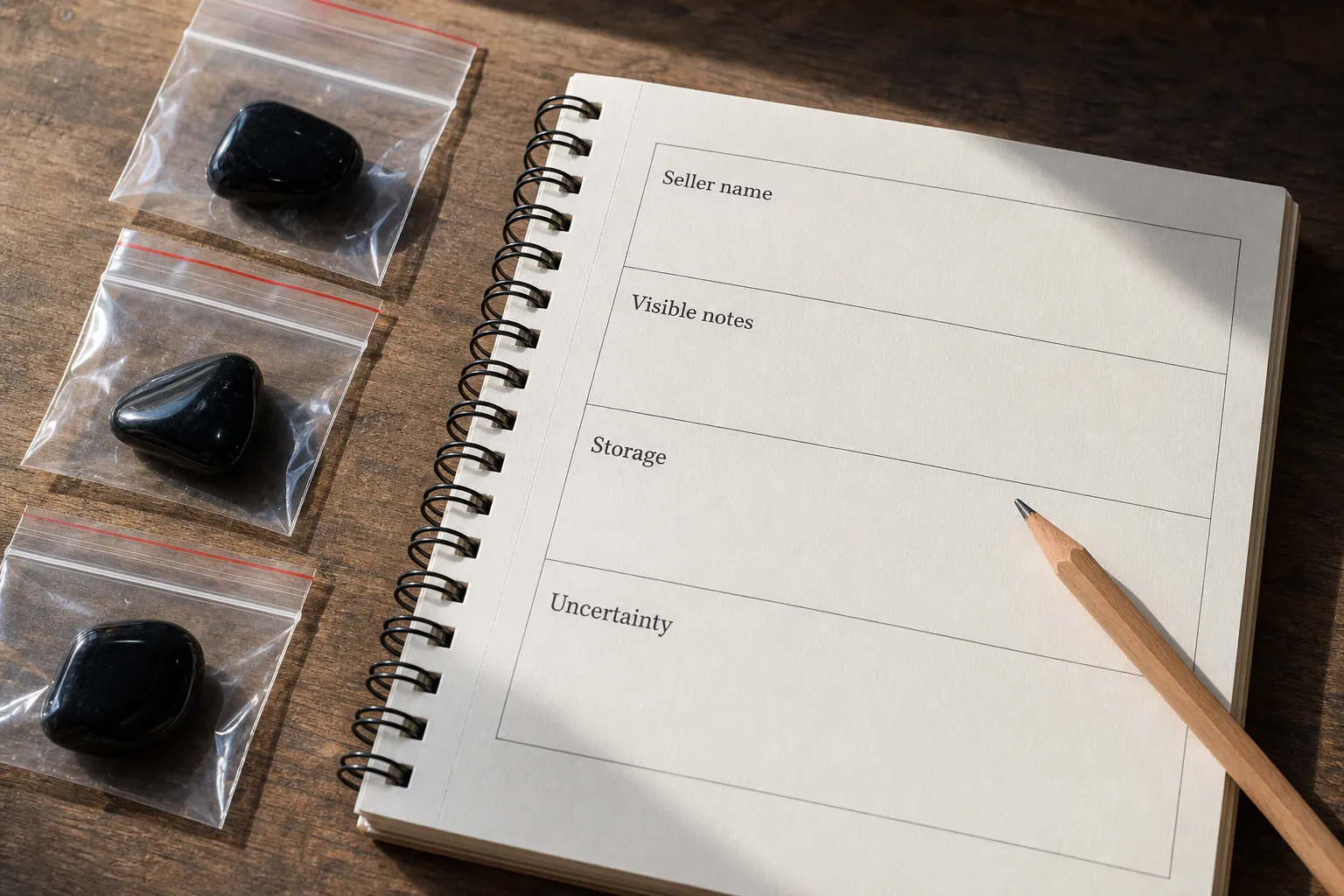
Record three things separately: the seller’s name, what you can see on the stone, and any uncertainty. A label can preserve context, but it does not prove variety, source, value, or symbolic meaning. Treat small obsidian labels as collection records, not certificates.
Core habit
Use one short ID across the physical label, the inventory note, and any photo record so the stone’s context stays connected even if storage changes.
upward
Read the full overview first
Use the broader guide first if you need the full scope before this page.
A practical label system for small tumbled obsidian
Small tumbled obsidian pieces are easy to mix up because many are similar in size, shape, polish, and color. A loose paper slip can fall away. A tray can be rearranged. A bag can be opened and combined with another bag. Once that happens, the seller name and your own notes may be hard to reconnect with the right stone.
A useful system has three parts:
A physical label near the stone
Use an outside bag label, a separate tag in the same tray compartment, or a small tray card.
A written record outside the container
This can be a notebook, spreadsheet, photo folder, or simple inventory list.
A matching ID
Use a short code such as OB-01, OB-02, or SNOW-03, then repeat that code on the bag, tray note, and inventory entry.
Clearer record example
- ID: OB-07
- Seller name: Rainbow obsidian
- Visible notes: Black polished tumble; faint curved sheen under angled light
- Storage: Small clear bag, top row tray
- Uncertainty: Seller name retained; variety not confirmed from label alone
That format keeps the original market name without turning it into a final identification. It also records what you can actually see.
This matters for polished obsidian because tumbling turns the surface into a rounded, reflective object. A label may stay visually connected to a larger display specimen, but a small tumbled stone can roll, rotate, or be swapped by mistake. The better habit is to label the storage position and keep a matching inventory note.
What to write on tumbled stone collection labels
A good label is short enough to use but specific enough to prevent confusion later. The physical label does not need every detail. Its main job is to connect the stone to a fuller record.
For the bag label or tag, include:
- Collection ID: A short code that matches your inventory record.
- Seller name: The name used when you acquired it, if known.
- Date or batch note: Useful when several similar stones were bought together.
- Storage cue: Helpful if pieces move between trays or drawers.
For the inventory note, add more detail:
- Observed color: Black, gray-black, brownish black, red-brown areas, pale inclusions, or other visible traits.
- Pattern: Snowflake-like spots, banding, sheen, mixed patches, or plain appearance.
- Surface: Polished tumble, chips, scratches, dull areas, or unusual marks.
- Lighting note: Whether sheen or color shift appears only under angled light.
- Seller wording: The exact name from the bag, invoice, tray, or listing.
- Uncertainty: Any reason the name should be treated as tentative.
This is especially useful for pieces sold under variety names. Some names describe visible traits, such as snowflake-like markings or sheen. Others may be broad market terms or simplified shop labels. Your record can preserve the seller’s wording while still saying what you personally observed.
A compact entry might look like this:
Label field
Example entry
ID
OB-12
Seller name
Snowflake obsidian
Visible traits
Black polished stone with scattered pale gray spots
Container
Small bag, drawer 2
Note
Seller name retained; pattern supports the label visually, but origin not known
This kind of tumbled obsidian stone label helps because it does not depend on memory. If two stones both look black in dim light, your notes can show which one had a faint sheen, which one came from a labeled bag, and which one was only described by appearance.
Bag labels, tray cards, and separate tags
There is no single method that fits every collection. For small stones, think in terms of workflow rather than assuming one material or label style will solve every problem.
Method
Works best when
Main caution
Bag label
Each stone stays in its own small bag
The bag and stone must stay together
Separate tag
The stone sits in a tray compartment or display box
The tag can shift if the tray is disturbed
Tray card
Several related stones are grouped together
It may identify a group, not each stone
Inventory ID
You want a backup record
It only works if the ID stays connected
Photo record
Stones have subtle visual differences
Photos need clear lighting and matching IDs
An external bag label is often easier to read than a tiny slip inside a bag. A separate tag helps when you do not want adhesive or writing near a polished surface. A tray card works for a small group, but it becomes less useful if individual stones are moved around.
For small tumbled stones, a two-part system is usually stronger than a single label. Put the short ID on the immediate container, then keep the fuller description somewhere else. If a bag label fades or becomes hard to read, the inventory note still preserves the seller name and your observations.
Avoid writing directly on the polished stone unless you have a specific reason and understand the tradeoff. Small tumbled obsidian is often collected for its polish, color, sheen, or pattern, so the label should not compete with the surface you are trying to observe.
Keep seller names separate from observations
A common mistake is treating a seller label as if it settles the identity of the stone. It does not. A seller name is useful information, especially when it is the only acquisition record you have, but it should be stored as a source note rather than a final conclusion.
A clear label separates three things:
Seller name
What the stone was called when acquired.
Visible observation
What you can see on the piece now.
Confidence note
How certain or uncertain the label is.
For example, a small black tumble sold as “gold sheen obsidian” might show only a subtle reflective flash in strong angled light. The label can preserve the seller name, while your note says the sheen is faint or lighting-dependent. Another piece sold as “snowflake obsidian” may show pale gray rounded patches across the surface. Your observation can describe the spots without making claims about source or value.
Obsidian variety names in collector settings often point to appearance: black, snowflake-patterned, mahogany-colored, rainbow-like sheen, gold sheen, silver sheen, and similar descriptions. But a small polished stone may show only part of the feature. Lighting, polish, camera angle, and surface wear can all affect what you see.
Useful wording leaves room for that:
- “Seller label: rainbow obsidian; sheen not visible in normal room light.”
- “Seller label: black obsidian; no distinct pattern observed.”
- “Seller label: mahogany obsidian; red-brown areas visible on one side.”
- “Seller label lost; black polished tumble, no confirmed variety name.”
If the original label is gone, do not invent a confident variety name just to fill the record. A plain descriptive label is often more useful than an over-specific one.
A simple workflow when new stones arrive
The best moment to label small tumbled obsidian is before it joins the rest of the collection. Once several dark polished stones sit together, the chance of mixing labels increases.
Use a short intake process:
- 1. Keep the original bag or seller slip until recorded.
Even if you later replace the bag, the original wording may be useful.
- 2. Assign an ID before sorting.
Give each stone, or each clearly labeled group, a short code.
- 3. Photograph the stone with its temporary label.
This can help if the stone is later separated from its tag.
- 4. Write the seller name exactly as given.
Do not correct it silently. If you disagree or are unsure, add a separate note.
- 5. Add visible traits in plain language.
Describe color, pattern, sheen, polish, and any marks you can actually see.
- 6. Place the stone in final storage with the matching label.
Check that the bag, tray, or compartment carries the same ID as the record.
This does not need to become a complicated database. For a small collection, a notebook page may be enough. For a larger tray of tumbled stones, a simple spreadsheet or numbered photo album may be easier to search.
The key is consistency. If you use OB-01 on one label and Black-1 somewhere else, the system becomes harder to follow. Choose one naming pattern and keep it simple.
What changes the best label choice
The right label method depends on how the stones are stored and handled.
If each piece stays in its own bag, outside bag labels and matching inventory notes are straightforward. If stones sit loose in a divided tray, separate tags or tray cards need to stay in the same compartment. If you take stones out often for photos, comparison, or display, a photo record with the label visible becomes more important.
Size also matters. Very small tumbles may not leave room for individual tags inside a compartment. In that case, the tray location and an inventory map can carry more of the work. A row might be labeled A1 through A6, with each position recorded in a notebook or file.
Collections also change over time. You may re-sort by variety, color, purchase date, or display style. A label system based only on tray position can fail when the tray is rearranged. A label system based only on bags can fail when stones are removed for viewing. A simple ID that follows the stone across storage changes is more flexible.
For mixed lots, be especially cautious. If several stones came together under one broad seller label, you may not know whether each stone was individually identified. Your record can say “sold as mixed obsidian tumbles” or “batch label retained” instead of assigning the same variety name to every piece.
What labels cannot prove
A label can preserve context, but it cannot do more than the information behind it supports.
A tumbled stone collection label cannot, by itself, establish:
- Exact geological source
- Commercial value
- Independent verification of variety
- Age of the specimen
- Personal, symbolic, or wellness-related outcome
- That a name remains correct after stones are mixed
This does not make labels unimportant. It means they should be read carefully. A label is strongest when it records where the name came from and what the stone visibly shows. It is weaker when it repeats a market name without context.
For small obsidian labels, modest wording is often the most useful:
- “Sold as…”
- “Labeled by seller as…”
- “Observed traits include…”
- “Uncertain; original label missing.”
- “Grouped with…”
- “Needs recheck in stronger light.”
Those phrases keep your collection organized without overstating what the label can establish.
Quick checklist for keeping obsidian labels clear
Before storing or moving small tumbled obsidian, check the following:
- Does each stone, bag, or tray space have a short matching ID?
- Is the seller name recorded separately from your own observation?
- Are visible traits described in plain words?
- Is uncertainty marked instead of hidden?
- Can the label still make sense if the stone moves to another tray?
- Is there a backup note or photo if the physical tag is lost?
If you only do one thing, do this: give each small tumbled obsidian stone or clearly labeled group an ID, then write that same ID on the bag or tray note and in your inventory record. That small habit prevents most label mix-ups and keeps seller names, observed traits, and uncertainty attached to the right stone.