Symbolic meaning with limits
Mahogany Obsidian Meaning: Symbolic Interpretations and Limits
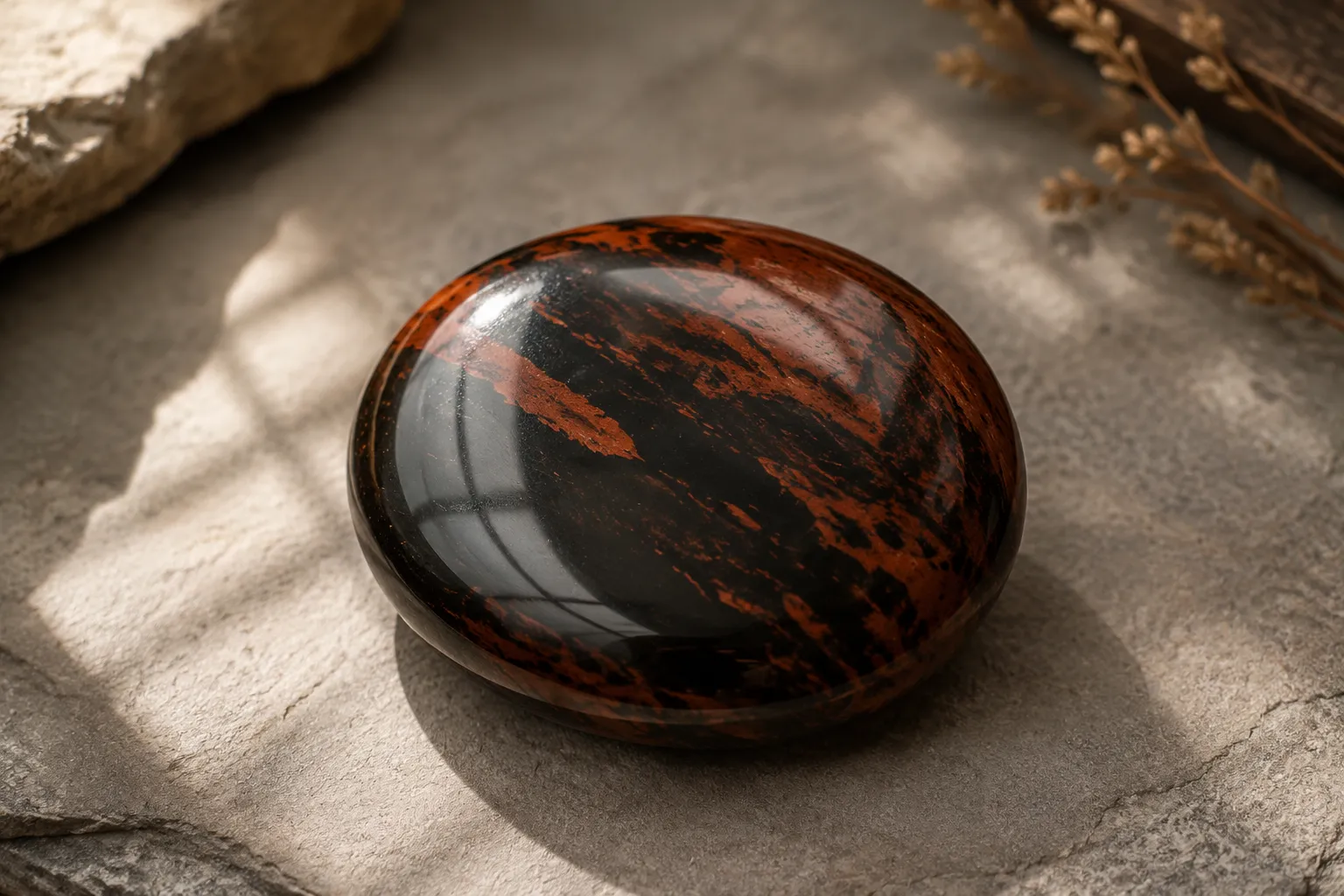
A polished piece of mahogany obsidian usually shows a black glassy base crossed by reddish-brown patches, streaks, bands, or soft swirls. The short answer: mahogany obsidian meaning is commonly linked with grounding, boundaries, steadiness, earthy strength, and protective symbolism in modern crystal language. Those are interpretations attached to the stone’s look, not verified effects of the material.
Start with the surface. Mahogany obsidian is a descriptive variety name for red-brown and black volcanic glass, not a separate mineral species. Its darker areas invite boundary and reflection language; its reddish-brown areas invite earth, wood, rust, and Root chakra associations. The meaning comes after the visible traits.
upward
Read the full overview first
Use the broader guide first if you need the full scope before this page.
What mahogany obsidian is before the symbolism
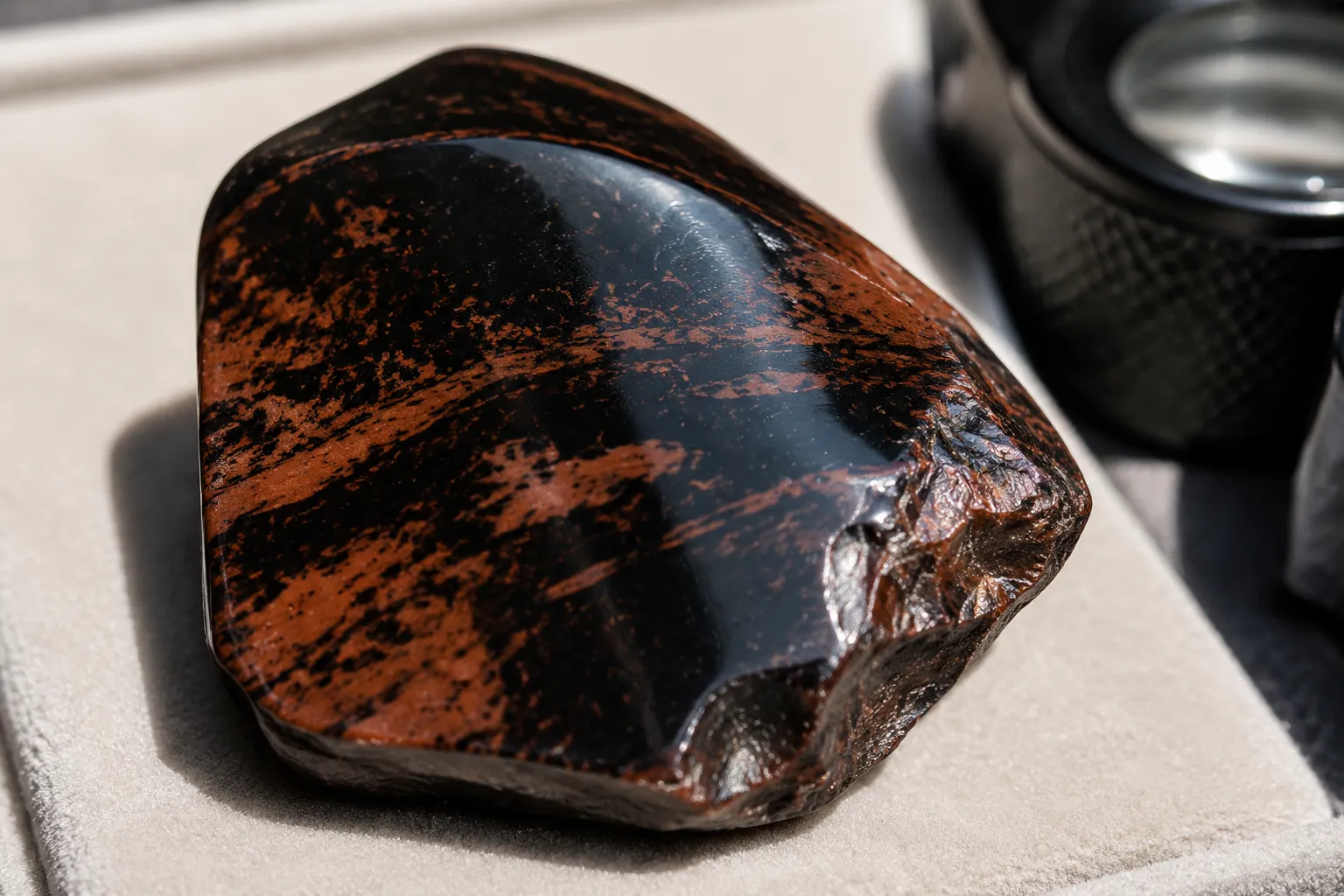
Mahogany obsidian is usually identified by contrast: dark volcanic glass with reddish-brown areas that may look mahogany, rust, brick red, wine brown, or dried wood. The pattern may appear as spots, clouds, streaks, bands, stripes, or swirls. Polished pieces show a smooth glassy luster; broken pieces may show curved fracture edges that can be sharp.
Geology references describe obsidian as natural volcanic glass formed when lava cools rapidly. It is glassy rather than crystalline in the usual mineral sense, and it can break with conchoidal fracture, a curved shell-like break. That material identity matters because “mahogany obsidian” is mostly a visual and collector label.
The red-brown color is commonly linked to iron-rich material in or around the glass. You may see seller language such as “iron oxide color” or “hematite inclusions,” but a careful description is better: iron-related inclusions, oxides, or oxidation states can influence the color of volcanic glass. A photo or listing name cannot confirm the exact mineral cause in one specimen.
For a collector, the useful description is simple: black volcanic glass with red-brown patterning. The exact inclusion story is less certain without analysis.
The common symbolic reading: black glass plus red-brown earth tones
Most mahogany obsidian symbolism starts with the color contrast.
Black volcanic glass is often interpreted as depth, boundary, shadow, privacy, reflection, or containment. Those ideas come from the dark, mirror-like look of obsidian; they are symbolic readings, not measured properties.
The red-brown areas add a different tone. Mahogany obsidian color meaning is often read as earthiness, warmth, physical presence, practical strength, rootedness, and steady action. Because the reddish-brown patches sit inside or across the black glass, modern crystal descriptions often combine the two: black for boundaries and depth, red-brown for earth and steadiness.
That is why red brown obsidian meaning often overlaps with mahogany obsidian meaning. A reader searching either phrase is usually asking what the reddish-brown pattern adds to ordinary black obsidian symbolism.
A careful summary
- Grounding meaningSome crystal traditions associate mahogany obsidian with steadiness, practical attention, and returning to ordinary reality.
- Protection symbolismIt is often framed as a boundary stone because black obsidian already carries protective imagery in popular crystal language.
- Strength and resilienceThe red-brown color may be interpreted as rooted strength, endurance, or calm action.
- Personal power languageSome sellers connect it with confidence, will, or inner limits; read that as symbolic prompt language, not a promised result.
- Root chakra beliefsSome traditions place it near Root chakra symbolism because of its earth-toned red-brown color. That is a belief framework, not a geological fact.
The stone gives people a surface to interpret. It does not prove the interpretation.
Where Root chakra, grounding, and protection language fits
Mahogany obsidian spiritual meaning is often described through Root chakra language because the stone’s color resembles soil, clay, rust, dark wood, or earth. In that framework, the Root chakra is associated with stability, survival themes, physical presence, and feeling anchored.
For this page, the useful point is not whether that system is true. The useful point is how the symbolism is being built. The dark base suggests boundary and inward reflection; the red-brown pattern suggests earth and grounded action. That makes mahogany obsidian a natural fit for “grounding” language in modern crystal culture.
The same applies to protection symbolism. Many people use black stones as reminders of boundaries, privacy, personal space, or quiet attention. Mahogany obsidian adds warmth and earth-tone imagery to that idea. Someone might keep a polished piece on a desk as a reminder to stay steady during difficult work, or choose it for jewelry because the pattern feels strong and grounded.
Mahogany obsidian may serve as a personal symbol of grounded boundaries, steady action, and earthy strength.
That sentence keeps the meaning usable without turning it into a guaranteed effect.
What the meaning cannot prove
The strongest factual sources support the material side: obsidian is volcanic glass; it has a glassy luster; it can fracture with sharp curved edges; and iron-related factors can influence red, brown, or dark coloration. They do not verify spiritual, emotional, protective, aura, chakra, sexuality, body-image, stress, or wellness results.
Commercial and metaphysical pages often use stronger language than the evidence supports. Those pages can help explain the language readers encounter, but they should not be treated as proof that a stone produces a result.
Keep the categories separate:
This is the main mahogany obsidian interpretation limit: the stone can carry meaning for a person, but the meaning remains interpretive.
Common confusion around red, brown, and “mahogany” labels
Mahogany obsidian naming is not always consistent. One seller may call a piece mahogany obsidian; another may describe similar material as red-brown obsidian, wine-red obsidian, or brown-inclusion obsidian. Those names often point toward the same visual family, but they are not all precise mineral labels.
Look at the specimen before leaning on the name:
- Is the base black, smoky black, or very dark brown?
- Are the reddish-brown areas patches, streaks, swirls, spots, or bands?
- Does the surface show glassy luster rather than a waxy or granular texture?
- Are any thin edges slightly translucent?
- Are there chips or curved fracture edges that fit volcanic glass?
Those clues can support a mahogany obsidian label, but they do not prove source, age, price, or inclusion chemistry. If a listing pairs the name with unusually strong outcome claims, treat the wording as marketing first.
Photos and identification apps can help compare color and pattern. They cannot confirm everything about a specimen. Visible traits are a starting point, not the whole answer.
A practical way to use mahogany obsidian as a personal symbol
If you like symbolic stones, mahogany obsidian can be used without overstating it. Let the visible pattern carry the meaning.
The black areas can represent boundaries, depth, privacy, or quiet attention. The red-brown areas can represent earth, warmth, physical presence, practical strength, or steady movement. Together, the stone may become a personal reminder to stay grounded while keeping clear boundaries.
For a journal, display shelf, pocket stone, or jewelry choice, you might frame it this way:
- “This piece reminds me to act steadily.”
- “The black and red-brown pattern represents boundaries with warmth.”
- “I associate it with grounded strength.”
- “Its earthy colors remind me to return to practical steps.”
Those are personal symbolism statements. They are clearer than outcome claims, and they stay tied to what you can actually see.
Handling note: beauty first, sharp edges second
Most polished mahogany obsidian pieces are ordinary collector or jewelry items, but obsidian is still glassy material. If a piece is chipped, broken, or freshly fractured, the edge can be sharp. Handle damaged edges with care, and avoid dropping the stone onto hard surfaces.
If someone is cutting, grinding, carving, or polishing obsidian, the concern shifts from display handling to workshop practice. General glass safety guidance treats dust, fragments, and eye or skin exposure as hazards to manage with proper equipment and work habits. That is a lapidary issue, not a reason to treat a smooth display piece as alarming.
For normal ownership, the rule is enough: inspect for chips, store it where it will not strike harder objects, and be careful with broken edges.
Bottom line
Mahogany obsidian is best understood as black volcanic glass with reddish-brown patterning, often linked symbolically with grounding, boundaries, earthy strength, and protection imagery. The red-brown color gives the meaning its warmer, more rooted tone; the black glass gives it depth and boundary symbolism.
The limit is part of the answer. Mahogany obsidian meaning is an interpretation, not a verified outcome. Read the surface first, use the symbolism if it fits your personal language, and keep the label, color cause, and spiritual wording in their proper places.