Collector label note
What Does Iron Colored Obsidian Mean on a Label
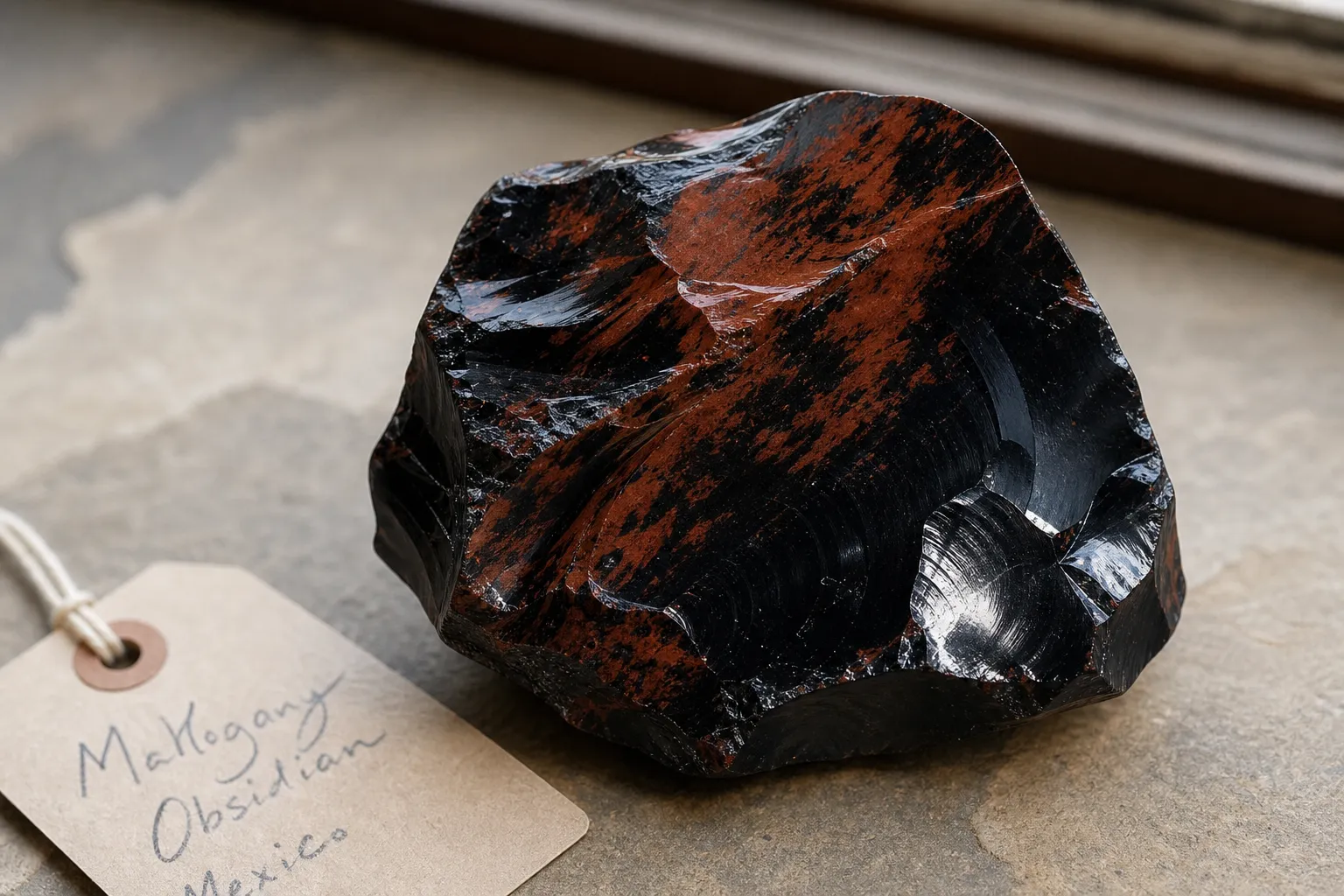
A black, glassy piece with red-brown streaks can make an “iron colored” tag sound more exact than it is. In most collector settings, iron colored obsidian is best read as descriptive wording: the seller or previous owner is pointing to a rusty, reddish brown, brick-brown, or mahogany-like look.
That label does not, by itself, prove composition, origin, treatment history, variety name, authenticity, or value. Start with the surface. Check the color in neutral light, notice whether the brown appears as patches, bands, swirls, speckles, or surface marks, and compare the wording with any more specific name on the tag.
“Iron colored” can be a useful clue. It is not the final identification.
upward
Start with the broader guide
Use the broader guide first if you need the full scope before this page.
What the Label Is Usually Trying to Say
An iron colored obsidian label usually describes appearance, not a tested mineral claim. It points to a red-brown color family: rust-brown, dark orange-brown, brick-brown, or mahogany-looking areas against a darker glassy base.
“Iron colored obsidian”
May mean the piece looks iron-like in color.
“Iron stained obsidian”
May suggest the brown is being described as staining, often near the surface.
“Red brown obsidian”
May simply be plain seller wording for color.
“Mahogany obsidian iron color”
May be trying to connect the piece with the familiar black-and-reddish pattern collectors often call mahogany-like.
Without stronger support, keep those phrases in the category of wording. They can tell you what to inspect next, but they should not outweigh what the stone visibly shows.
A careful reading is simple: the label starts the inspection. The piece still has to earn the name.
Visual Clues to Check First
Look at the color before trusting the tag. A mahogany looking obsidian piece may show dark glassy areas with red-brown patterning, but the label cannot tell you how deep, stable, or natural that appearance is.
Use steady, indirect light. Warm bulbs, shop lighting, phone flash, and edited photos can push brown areas toward orange, red, or metallic tones. If the color changes sharply between daylight, a desk lamp, and a listing photo, the label may be doing more work than the stone.
Then study the pattern.
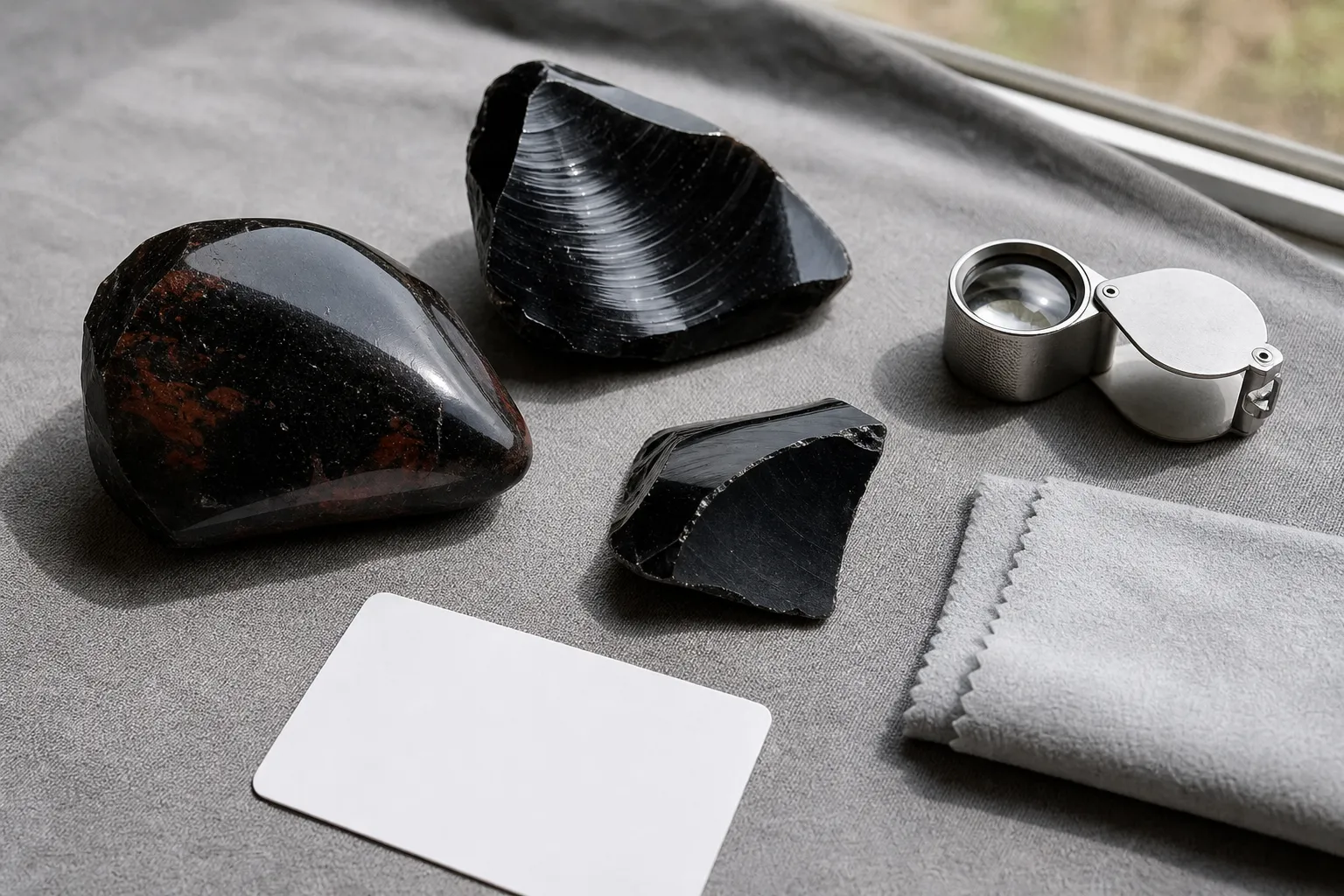
The fracture edge can help on rough or chipped pieces because obsidian is commonly handled as volcanic glass, with a glassy break and sharp-looking edges. Still, an edge alone does not settle the label. Polish, carving, tumbling, or a bead shape can hide the original surface and make color look smoother or deeper.
If the stone only looks brown in one photo, treat the description as uncertain. If the red-brown areas remain visible in person, under neutral light, and from more than one angle, the label becomes more useful as a visual note. It remains descriptive.
Iron Colored, Iron Stained, and Mahogany-Looking
“Iron colored obsidian” sounds more technical than “brownish obsidian,” but it may not be more reliable. It can describe an iron-like color without confirming why that color appears.
“Iron stained obsidian” adds a slightly different implication. It may point toward color on or near the surface, but without credible context, it should still be written as an observation: “appears iron stained,” not as a settled condition.
“Mahogany obsidian” is more familiar collector language. Many people use it for black obsidian with reddish brown patterning. But a mahogany-looking piece and a well-supported variety label are not always the same thing. If a tag says “mahogany obsidian iron color,” separate the two ideas: “mahogany” may be the intended variety-style name, while “iron color” may be visual shorthand.
Useful catalog notes
- “Sold as iron colored obsidian; red-brown patches visible in daylight.”
- “Labeled iron stained obsidian; brown strongest along surface lines.”
- “Mahogany looking obsidian; no supporting source for variety name.”
- “Red brown wording used by seller; needs in-person confirmation.”
That preserves the label without making it carry more certainty than it deserves.
What the Label Cannot Tell You
An obsidian label meaning has limits, especially when the wording is short, informal, or seller-written. “Iron colored” does not prove the cause of the color. It does not prove a region. It does not show whether the piece was dyed, coated, altered, tumbled, or polished in a particular way. It does not establish value. It does not settle authenticity from a photo.
If you are deciding whether to buy, trade, catalog, or display the piece, ask for ordinary practical details: photos in neutral light, a view of the back, a close view of any edge or chip, and the exact wording on any tag or invoice.
The safer collector reading is not “believe it” or “reject it.” It is “record the label as stated, then describe what I can actually see.”
Symbolic Meaning Comes After the Surface
Some readers search for iron colored obsidian meaning because the phrase sounds symbolic as well as visual. In that context, “iron colored” may be used to suggest strength, earthiness, heat, old lava, or a steady personal association.
Those are interpretations, not verified outcomes. If you enjoy symbolic meaning, keep it in personal or cultural language. The red-brown color may feel weighty or grounded in a collection story, but the stone should not be presented as guaranteeing a change in life, health, mood, or safety.
Visible traits first. Meaning after.
A Short Check Before You Accept the Label
Before you trust an iron colored obsidian label, slow the decision down:
- 1. Read the exact words: “iron colored,” “iron stained,” “mahogany,” or “red brown.”
- 2. Look in neutral light: does the red-brown color remain visible?
- 3. Check the pattern: patches, bands, speckles, surface marks, or crack-following lines?
- 4. Notice the finish: polish can deepen color; rough edges may show different clues.
- 5. Separate appearance from claims: color wording does not prove cause, origin, value, or effect.
- 6. Keep your own note: record both the seller label and your visible observation.
For a display tray or personal catalog, that is often enough. Write the label you received, then add your own plain-language description.
The modest reading is the strongest one: “iron colored obsidian” means the piece is being described as red-brown, rusty, or mahogany-like. Inspect the surface, pattern, polish, and lighting before relying on the name. The label is a clue, not the conclusion.