Black stone identification
Obsidian vs Onyx: Key Differences for Black Stone Identification
If you are holding a black polished stone, bead, cabochon, or jewelry piece, the main obsidian vs onyx difference is material: obsidian is natural volcanic glass, while onyx belongs to the chalcedony/quartz family. Black color alone does not identify either one.
For a quick first read, a very glassy surface, smoky thin edge, sheen effect, or existing shell-like chip can point toward obsidian. A clean, evenly black jewelry stone sold as “black onyx” may fit chalcedony-family market language, but labels can be broad and sometimes imprecise. Reflection, flashlight checks, weight, and seller names are useful clues—not proof. If the piece is valuable or the clues conflict, home inspection can narrow the answer but may not settle it.
upward
Start with the broader guide
Use the broader guide first if you need the full scope before this page.
Obsidian vs onyx: the core difference
Start with what the material is, not just how black it looks.
Obsidian should not be treated as a black quartz crystal. It is volcanic glass, which is why collectors often describe a good polish as glassy rather than simply shiny.
Onyx should not be treated as volcanic glass. In jewelry language, “black onyx” is commonly presented as a chalcedony/quartz-family black stone. The careful part is that a seller label is not the same as a mineralogical identification, especially for small beads, cabochons, and mass-market pieces.
What you can check on a polished black stone
Most readers are not looking at a fresh rock surface. They are looking at a finished object: a bead bracelet, tumbled stone, pendant, carving, ring cabochon, or polished slab. Cutting and polishing can hide many natural clues, so use several observations together.
Glassy luster and reflection
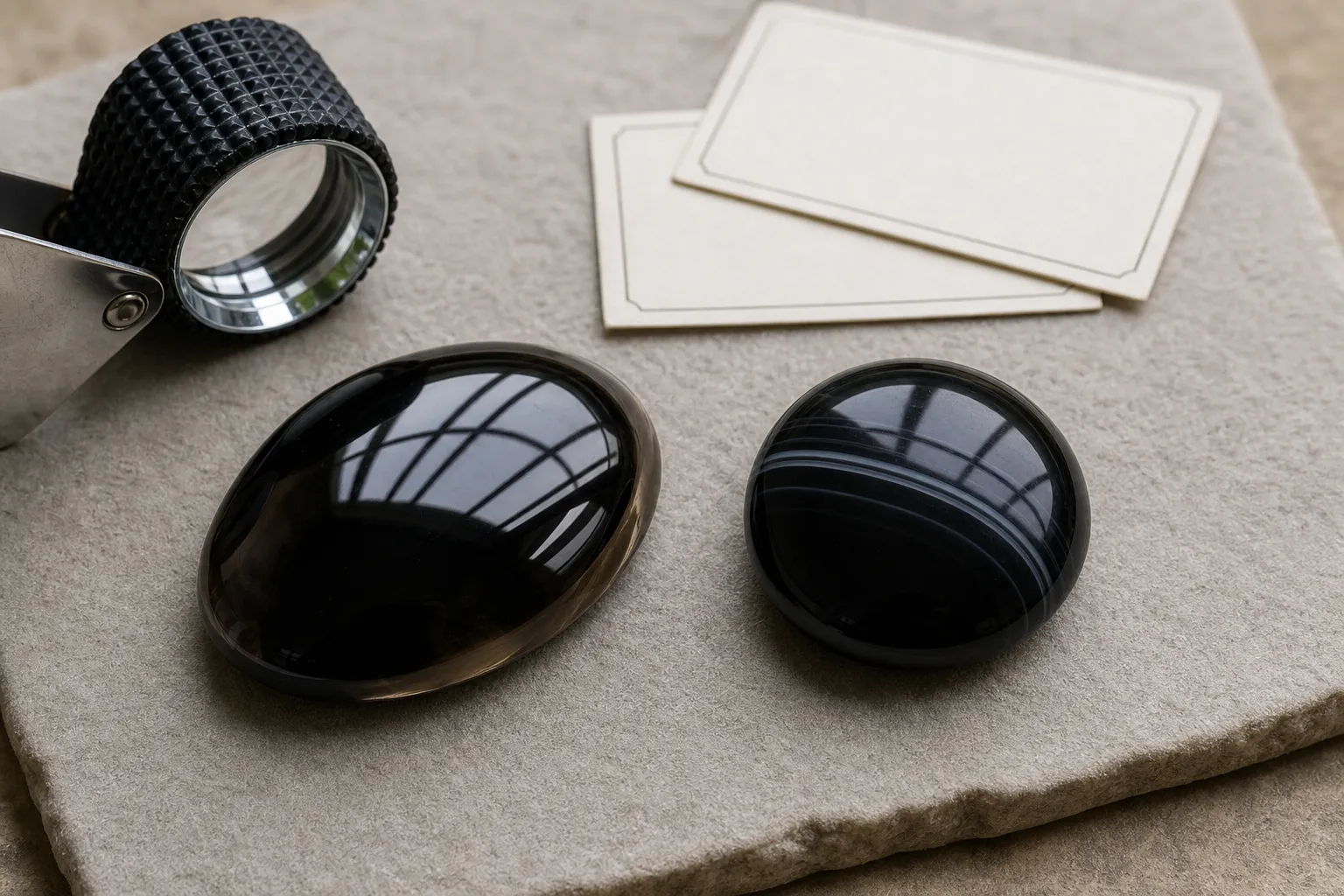
Polished obsidian can be highly reflective. Seeing a window, lamp, or faint face reflection in a black stone does not rule out obsidian; a well-polished piece of volcanic glass can look almost mirror-like.
Onyx can also take a bright polish. So “it is shiny” is not enough for black onyx identification or obsidian identification. Instead, notice the character of the shine. Obsidian often has a glass-like depth. Black onyx may look more stone-like, waxy, or evenly polished. This is a clue, not a final answer.
Existing chips and broken edges
Conchoidal fracture is one of the better obsidian identification clues, but only when the feature is already there. It looks like curved, shell-like breakage, similar to broken glass.
Do not chip, cut, scratch, or break a finished stone to test it. Obsidian can form very sharp glass-like edges, and jewelry is easy to damage. If there is already a tiny chip near a bead hole, corner, or back edge, inspect it in good light. A curved, glassy chip supports obsidian more than onyx, while a more granular or stone-like surface may make chalcedony-family material more plausible.
Banding, layers, and streaks
Black onyx is often associated with banding because onyx is part of the chalcedony/agate discussion, where banded structure matters. In finished black jewelry, though, visible banding may be subtle or absent.
Obsidian can also show flow lines, smoky zones, bubbles, microlites, or sheen effects depending on the source and variety. Some pieces show rainbow, silver, or gold sheen only at certain angles. So banding alone does not settle black onyx vs obsidian. Ask what you are seeing: stone-like layers, glassy flow lines, cloudy internal zones, or surface polish marks.
Flashlight response
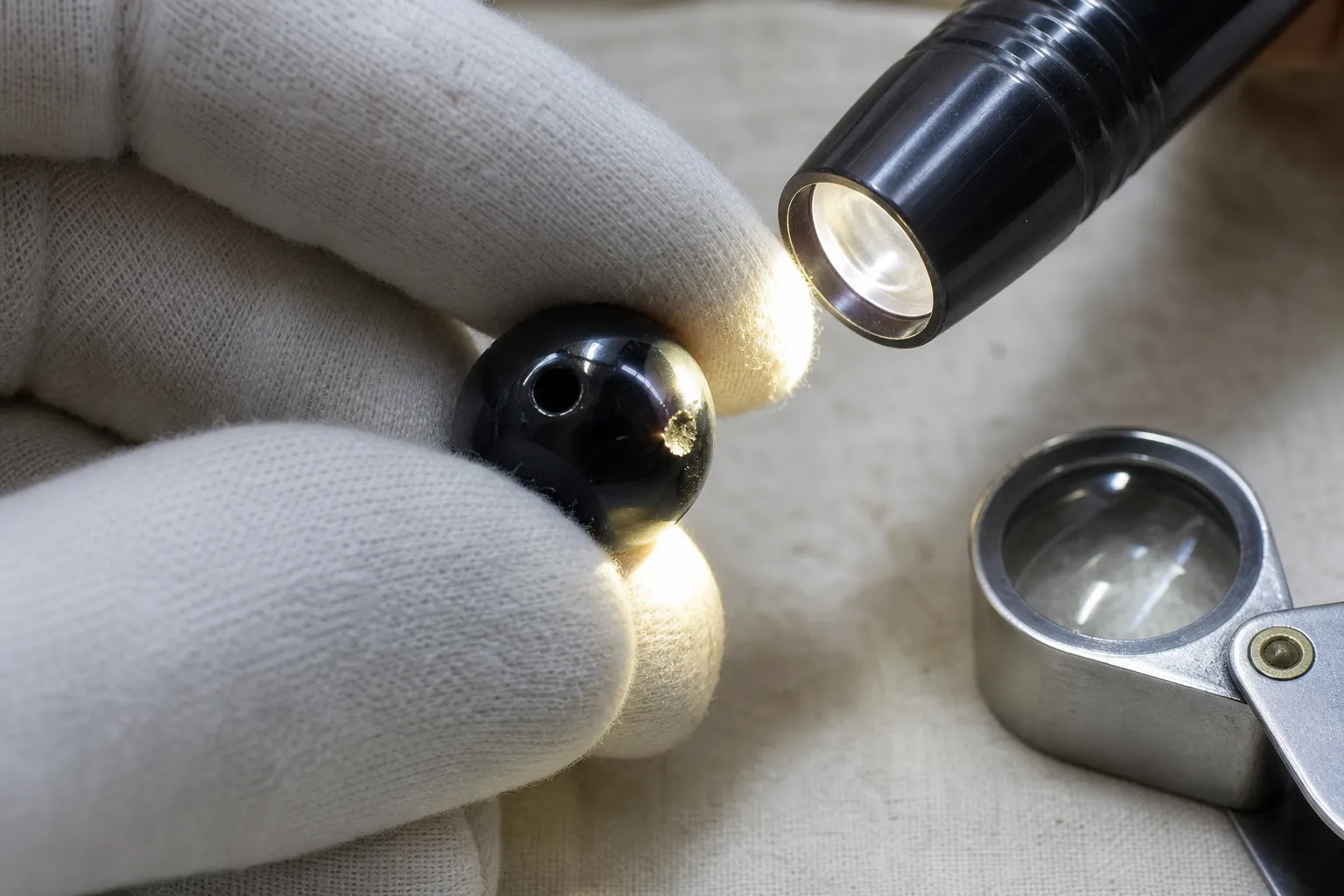
A flashlight test for black stones can sometimes reveal useful hints. Hold a small bead or thin edge near a bright light and look for brownish, smoky, gray, or slightly translucent areas. Some black obsidian may transmit light at thin edges. Some chalcedony-family black stones may also show limited translucency, depending on thickness, color concentration, and treatment.
The limit is important: a flashlight is not a proof test. Thick stones may look opaque even when thinner material would transmit light. Drilled beads, cabochon backings, strong coloration, surface polish, and lighting angle can all change what you see.
Weight and feel
Weight is a weak clue. It is only somewhat useful when comparing same-size, same-shape pieces, such as two bracelets with the same bead diameter and count. Even then, drilling, inclusions, size variation, and mixed materials can mislead you.
A stone that feels “heavy for its size” may simply be larger, less drilled, or made from another dark material. Do not use weight alone to decide between obsidian vs onyx beads.
A practical decision path
Use this sequence when you want a careful answer without damaging the stone.
-
1. Read the label, then check the object
Seller names matter because they tell you how the piece entered the market. “Black onyx,” “black obsidian,” “black agate,” and similar labels are common in beads and jewelry. But a label is only a starting point. It may be accurate, broad, repeated from a supplier, or shaped by market naming habits.
If the piece was sold as black onyx, keep onyx in the running. If it was sold as black obsidian, keep obsidian in the running. Then see whether the visible traits support that name.
-
2. Look for a glass-like character
Rotate the stone under one light source. Obsidian often gives a glassy, liquid-looking reflection when polished. A smoky edge, internal flow look, or angle-dependent sheen makes obsidian more plausible.
A uniformly black, clean, jewelry-like surface may fit black onyx, but it can also fit polished obsidian or another black material. Keep checking.
-
3. Inspect only existing chips
Use a loupe or magnifier if you have one. Curved, glassy fracture surfaces support obsidian. A more stone-like or fine-textured surface may point away from volcanic glass.
Do not create a chip for identification. The damage is not worth the extra clue.
-
4. Check for banding, sheen, or internal texture
If you see bands, decide whether they look like natural layers inside the stone or surface marks from cutting and polishing.
For obsidian, watch for flowy zones, smoky translucency, tiny bubbles, or optical sheen. Rainbow, silver, and gold sheen are obsidian variety terms, but the effect depends strongly on lighting, angle, and polish quality.
-
5. Use light as one clue
A flashlight can help you see thin-edge translucency or hidden internal features. It cannot identify the material family by itself. If the stone is thick and fully opaque, the test may tell you very little.
-
6. Stop when the clues conflict
A black, polished, reflective stone with a broad seller label may not be identifiable with confidence at home. That is a normal result. For difficult black stone identification, a gemologist, lapidary, or lab-style examination can see more than a phone photo or flashlight check.
Why black onyx, obsidian, and similar stones get confused
Black stone identification is messy because the market groups objects by appearance and use, while mineralogy groups them by material and formation.
In the same jewelry display, a buyer may see black onyx, black obsidian, black agate, jet, hematite, black tourmaline, and other dark materials. They may all be polished, rounded, drilled, and described with similar symbolic language. That makes the physical identity feel simpler than it is.
Confusions worth separating
- Black color is not enough. Many materials can be black or nearly black.
- Reflection does not rule out obsidian. Polished obsidian can reflect strongly.
- Uniform black does not automatically mean onyx. Polished obsidian can also look clean and dark.
- Banding does not automatically mean onyx. Obsidian can show flow banding or internal zones.
- Flashlight results vary. Thickness, polish, and angle can change what you see.
- Symbolic descriptions are not identification evidence. They may explain how a seller frames a stone, but they do not establish whether it is volcanic glass or chalcedony-family material.
This matters when searches mix identification with meaning language. Some traditions and sellers describe obsidian or onyx in symbolic terms, but those associations should not be used to identify a black polished stone.
When at-home inspection is not enough
A home check can support a reasonable guess when several clues point the same way. For example, a black piece with strong glassy luster, a smoky thin edge, an existing curved glass-like chip, and an angle-dependent sheen is more consistent with obsidian than with a typical black onyx jewelry label.
A uniformly black, highly polished cabochon sold as black onyx, with no glassy chipped edge and no obsidian-like sheen, may reasonably remain in the black onyx category for everyday collecting language. That is still not the same as formal identification.
More certain separation may require tools and training: optical examination, microscopy, petrographic work, or other gemological methods. These can distinguish glassy material from fine crystalline quartz textures in ways a surface photo cannot. For high-value jewelry, inherited pieces, or disputed seller claims, that is the better next step.
Quick answers
Is black onyx harder than obsidian?
In general material-family terms, chalcedony/quartz-family stones are harder than volcanic glass. Hardness testing is not a good casual home method, though, because it can damage polished stones and may still leave market-label questions unresolved.
Can obsidian and onyx look the same in beads?
Yes. Obsidian vs onyx beads can be difficult because drilling, rounding, polish, and uniform bead size remove many natural clues. Look at glassy luster, existing chip behavior, light response, banding, and seller information together rather than relying on one feature.
Is a flashlight test enough to identify black obsidian or black onyx?
No. A flashlight can show translucency or internal character, especially near thin edges, but it is only one clue. Thickness, polish, color concentration, and lighting all affect the result.