
Obsidian identification
Does a Sharp Edge Prove a Stone Is Obsidian
No. A sharp edge can fit obsidian, but it does not prove the stone is obsidian. Obsidian is natural volcanic glass, and glassy materials can break into very sharp, curved edges. The catch is that sharpness tells you how the material broke, not exactly what the material is.
For a quick collector check, treat a sharp black or glassy edge as one clue. Then look for the rest of the picture: glassy luster, conchoidal fracture, dark translucent thin edges, possible bubbles or flow bands, and the source context. Also keep lookalikes in mind, especially man-made glass, slag-like material, flint, chert, and other brittle dark rocks.
Quick answer
A sharp black or glassy edge is a useful clue, not a proof. The better question is whether sharpness appears alongside glassy luster, curved fracture scars, thin-edge translucency, internal texture, and believable source context.
upward
Start with the broader guide
Use the broader guide first if you need the full scope before this page.
Why Obsidian Can Be Sharp
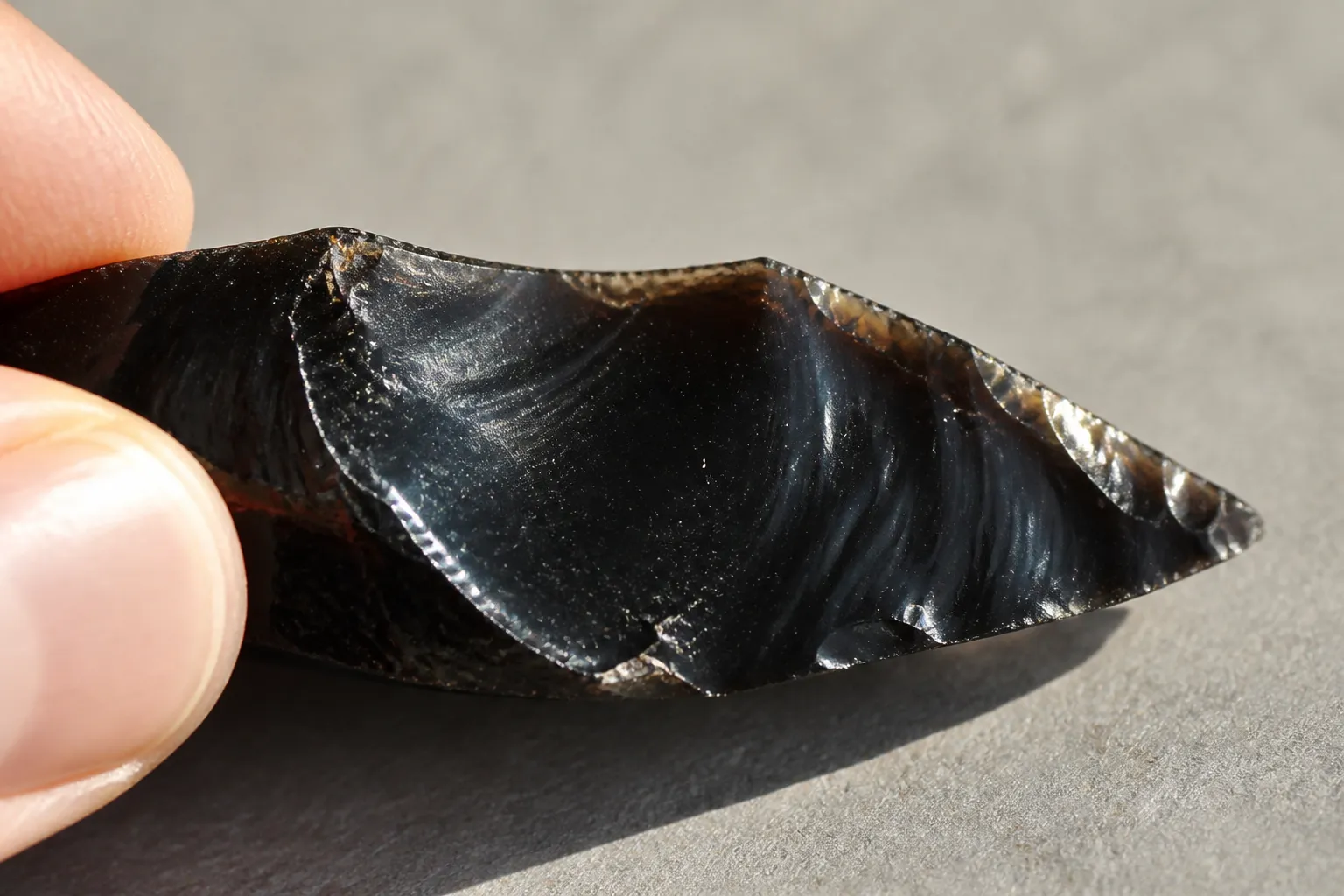
Obsidian is commonly described in geology references as natural volcanic glass. Because it lacks visible grains, it can break across smooth, curved surfaces. Those breaks may leave edges that look or feel extremely sharp.
That is why obsidian is so strongly associated with cutting edges, points, and flaked objects. The association is real, but it should not be turned backward into an identification rule. A known piece of obsidian can form a sharp edge; an unknown sharp edge does not automatically become obsidian.
The useful fracture term is conchoidal fracture. It means a shell-like curved break, similar to the rippled curves in broken glass. Obsidian often shows this pattern, but so can other glassy or fine-grained brittle materials. If your stone has a razor-like edge and a curved fracture scar, you have a meaningful clue—not proof.
What to Check Besides Sharpness
A better approach to sharp black stone identification is to combine visible clues. None is perfect alone, but together they can make “possible obsidian” more or less reasonable.
Glassy luster
Look at the surface under steady light. Obsidian usually has a glass-like shine, especially on fresh breaks. It should look glossy rather than sandy, chalky, or visibly grainy.
The limit: man-made glass can look just as glassy, and some slag-like material can be shiny too. Gloss supports the possibility of obsidian, but it does not separate natural volcanic glass from every artificial glassy material.
Curved fracture scars
Near the sharp edge, look for smooth arcs, rounded fracture scars, or ripple-like curves. These conchoidal fracture clues matter because obsidian commonly breaks this way.
The limit is built into the clue: conchoidal fracture is a break pattern, not a material name. Flint, chert, and ordinary glass can also show shell-like breaks.
Dark color with translucent thin edges
Many obsidian pieces are black or very dark brown, gray, or smoky. A helpful check is to hold a thin edge near a normal light source and see whether it shows a brownish, smoky, or dark translucent glow.
This is not universal. Not every obsidian piece shows easy translucency, and not every dark translucent edge is obsidian. But when a stone is glossy, dark, conchoidally fractured, and slightly translucent at a very thin edge, the obsidian possibility becomes stronger than sharpness alone.
Bubbles, flow bands, and internal texture
Some obsidian shows faint flow banding, wispy internal lines, streaks, or small bubbles. In collector language, it may look like dark glass with subtle movement inside it rather than a painted, plastic, or grainy object.
Read this clue carefully. Man-made glass can also contain bubbles, and slag-like material may show bubbles, swirls, or a melted appearance. These features help only when they match the rest of the specimen and its context.
Source context
Where the piece came from matters. A sharp black fragment from a known volcanic area, a labeled geology collection, or a knowledgeable rock shop carries a different kind of context than a sharp black chip found in fill dirt, near a fire pit, or around broken glass and industrial debris.
A seller label can help, but it is not proof by itself. “Black obsidian” is a common market label. If the identification is based only on appearance, a cautious tray label such as “possible obsidian” is often more honest than a certain one.
Common Lookalikes for a Sharp Black or Glassy Stone
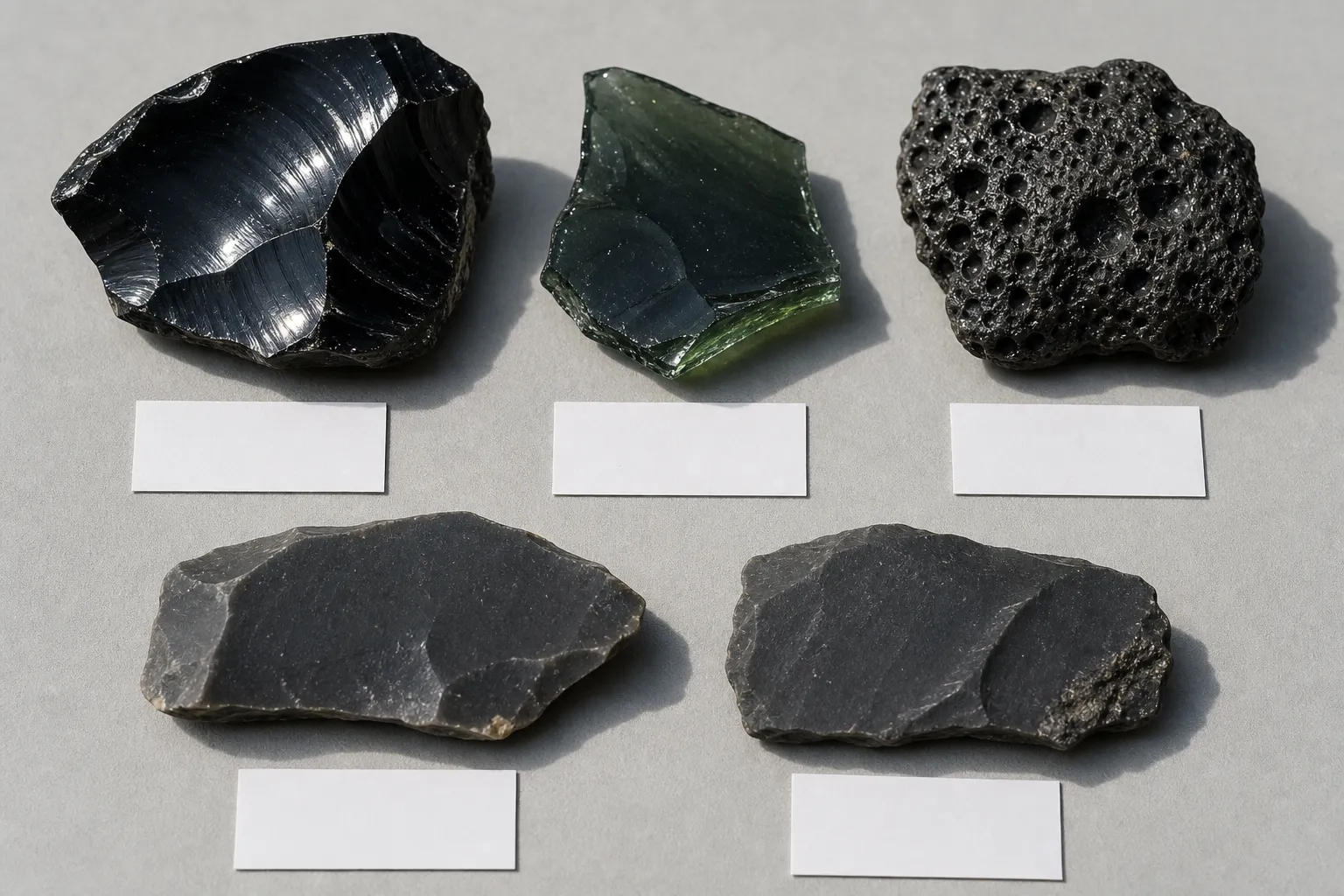
A sharp edge is not diagnostic because several materials can break sharply.
Man-made glass
Can be black, glossy, sharp, and conchoidally fractured.
Context may point to bottles, decorative glass, construction debris, or melted material; bubbles can be common.
Slag-like material
Can look dark, glassy, bubbly, or metallic in places.
Often has a melted, foamy, uneven, or industrial look.
Flint or chert
Fine-grained silica rocks can fracture sharply with shell-like breaks.
Often waxier, duller, or more stony than obsidian; may be gray, brown, cream, banded, or dark.
Other brittle dark rocks
Broken edges may form sharp points.
May show grains, crystals, rough texture, or duller fracture surfaces.
Actual obsidian
Natural volcanic glass that commonly breaks with curved fracture.
Usually glassy, often dark, sometimes translucent at thin edges, with possible flow texture.
The closest confusion is often man-made glass versus obsidian. Both can look glassy because both are glassy materials. Visual inspection may strongly suggest one over the other when the context is clear, but a single sharp edge does not settle it.
What Not to Do When Testing the Edge
Do not test the stone by dragging your finger or thumb across the edge. A sharp glassy fragment can cut skin, and a cut tells you nothing useful about whether the material is obsidian.
Also avoid striking, breaking, or trying to flake an unknown stone as a home identification test. That can create sharp chips and flying fragments. Flintknapping is a separate skill with its own precautions; it is not needed for a casual collector trying to decide whether a found piece might be obsidian.
A more sensible inspection is simple
- Hold the piece by a blunt area, or use gloves if the edge is exposed.
- Look at it under ordinary bright light from more than one angle.
- Decide whether the surface looks glassy, waxy, grainy, or dull.
- Look for curved fracture scars, not just the sharp point.
- Check a thin edge for slight translucency.
- Note bubbles, flow bands, or melted-looking textures.
- Store the piece wrapped or separated if the edge is sharp.
These steps improve your observations without turning one feature into a certain identification.
When “Possible Obsidian” Is the Better Label
For a personal collection, you may not need a laboratory-level answer. If the stone is dark, glassy, sharply fractured, shows conchoidal fracture, has translucent thin edges, and came from a plausible volcanic or collector source, “possible obsidian” or “likely obsidian” may be a reasonable working label.
Be more cautious if:
- It was found near broken bottles, burned debris, construction fill, or industrial waste.
- It has many large bubbles and a melted or foamy look.
- It looks painted, coated, or artificially tumbled.
- The surface is rough, grainy, or crystalline rather than glassy.
- The only obsidian-like feature is one sharp black edge.
If the identification matters for value, provenance, artifact status, or formal records, visual clues may not be enough. A local rock club, knowledgeable geology shop, museum contact, or appropriate testing route can be a better next step. For most casual collectors, the practical point is narrower: appearance can guide your label, but sharpness alone should not close the question.
Bottom Line
A sharp edge is compatible with obsidian because obsidian is volcanic glass and can fracture into very sharp forms. But a sharp edge is not diagnostic. It does not rule out man-made glass, slag-like material, flint, chert, or other brittle dark rocks.
For obsidian edge identification, read the edge in context. Look for glassy luster, conchoidal fracture, dark translucent thin edges, bubbles or flow bands, and a believable source story. If several of those features line up, obsidian becomes a stronger possibility. If sharpness is the only clue, the identification is still open.