
Collector color guide
What Color Is Obsidian Besides Black
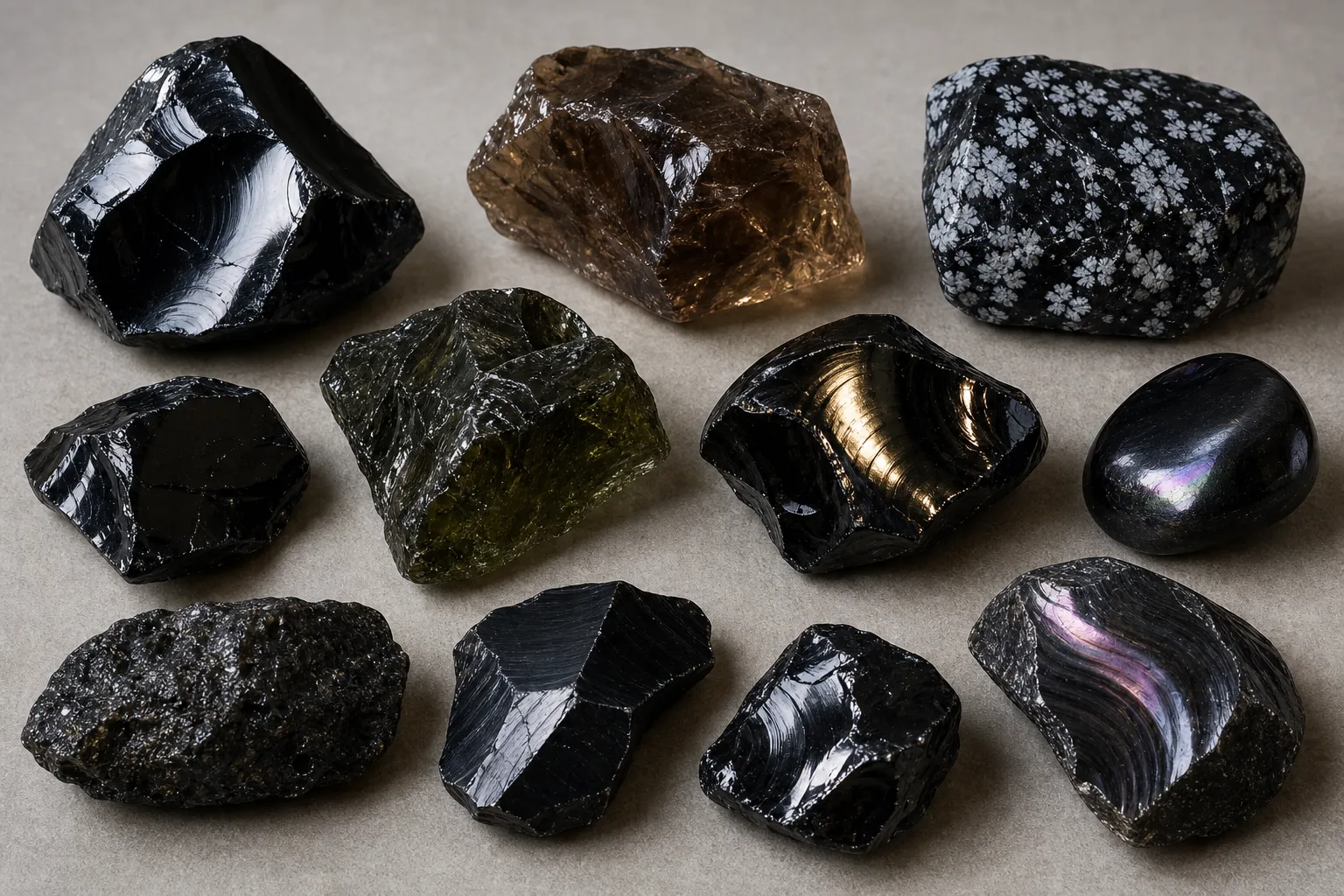
Obsidian is usually black, but its color can also appear brown or green. Less common descriptions include yellow, orange, red, blue, and nearly colorless obsidian, though those labels need careful checking.
The important part is that not every “color” name describes the glass itself. Snowflake obsidian is a pattern. Gold sheen obsidian is a reflective effect. Rainbow obsidian and fire obsidian are iridescent effects that depend on light, polish, and viewing angle.
For a collector, the better question is: what color is the obsidian body, and what part of the appearance comes from inclusions, banding, sheen, or seller language?
Quick sorting rule
Stable color from many angles is closer to body color. Color that flashes, shifts, or appears only when rotated is more likely to be sheen or iridescence.
upward
Start with the broader guide
Use the broader guide first if you need the full scope before this page.
The practical obsidian color range
Obsidian is natural volcanic glass formed when silica-rich lava cools quickly. Because it is glassy rather than crystalline, its appearance can vary with impurities, tiny inclusions, bubbles, flow textures, surface condition, polish, and light.
Here is a practical way to read common color labels:
| Label you may see | What it usually describes | What to check |
|---|---|---|
| Black obsidian | Dark body color, often glossy when polished | Does it remain black from most angles? |
| Brown obsidian | Brown, smoky, reddish brown, or mahogany-like body color or banding | Is the brown inside the glass, or only on the surface? |
| Green obsidian | Greenish body color, often dark olive, gray-green, or bottle-green | Does the green remain visible in neutral light? |
| Snowflake obsidian | Pale blotches in darker obsidian | Are the light areas a pattern rather than the whole color? |
| Gold sheen obsidian | Golden reflection over a dark base | Does the gold appear mainly when rotated? |
| Rainbow obsidian | Iridescent bands or flashes | Do the colors shift or disappear with angle? |
| Fire obsidian | Bright fire-like iridescence | Does the effect depend on polish and lighting direction? |
| Rare color labels | Yellow, orange, red, blue, or nearly colorless descriptions | Inspect carefully; do not rely on a photo alone |
This is why “obsidian color” can be confusing. In shops and collection labels, it may mean body color, a pattern, a flash, a surface effect, or a broad seller category.
Body color: brown, green, and rarer non-black obsidian
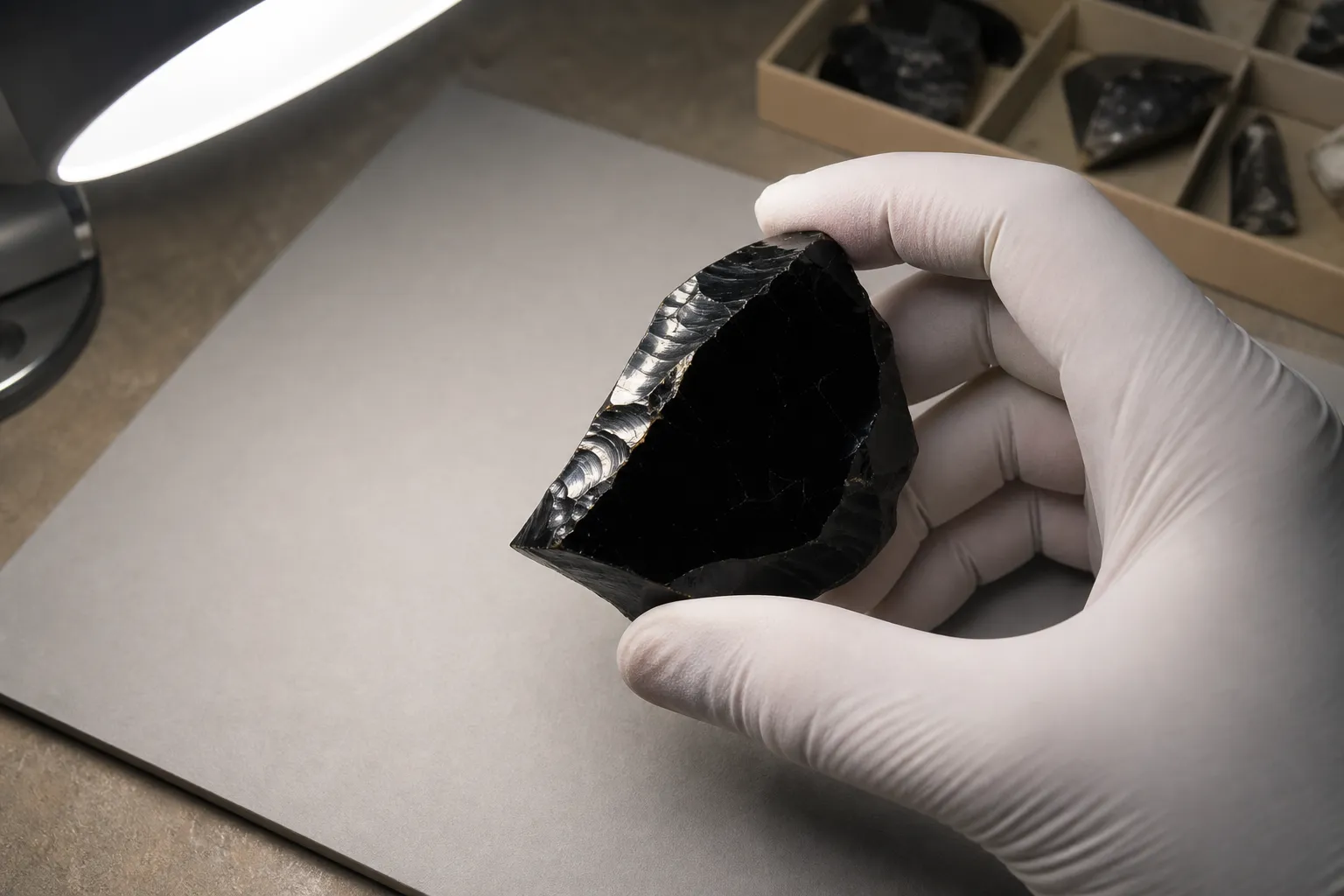
A true body color is the color you see in the glass itself, not just a reflected flash. To check it, look at the piece in neutral daylight or under a white lamp, then rotate it slowly. If the color remains visible from many angles, it is more likely to be part of the body color. If it appears only from one direction, it is more likely to be sheen or iridescence.
Brown obsidian
Brown obsidian may look smoky, tea-colored, reddish brown, or mahogany-like. In some pieces, the brown appears as bands or patches instead of an even all-over color.
Brown tones can be related to the material mixed into the volcanic glass, but visible color is not a chemical test. A collector can reasonably say, “this piece appears brown,” but color alone cannot confirm exact composition, source, treatment history, or authenticity.
Brown obsidian is also easy to misread when the surface is dull, weathered, dusty, or poorly lit. A rough exterior may look brownish while a fresh chip or polished face looks darker. If possible, compare more than one surface before deciding that the whole specimen has a brown body color.
Green obsidian
Green obsidian is a possible appearance, but it should be described with care. It may look dark green, olive green, gray-green, or green-gold depending on the specimen and lighting.
Some obsidian sources are known for greenish material, but a consumer-level visual inspection should not turn “green color” into a firm source claim. The visible green is worth noting; the exact reason for the color usually needs stronger specimen-specific information.
Green obsidian is also a category where market confusion can happen. Some decorative green glass may be sold with an obsidian label. A green glassy look is a clue to inspect, not proof by itself.
Yellow, orange, red, blue, and nearly colorless obsidian
Yellow obsidian, orange obsidian, red obsidian, blue obsidian, and nearly colorless obsidian are best treated as uncommon descriptions. They appear in broad color lists, but they are not the everyday expectation in the way black, brown, and some greenish obsidian are.
Slow down for rare color claims
- Does the color stay visible in neutral light?
- Is the color inside the glass, or only on the surface?
- Does the piece look transparent, translucent, or opaque?
- Does it show glassy luster and shell-like conchoidal fracture?
- Could lighting, background, photography, polish, or coating be changing the apparent color?
- Is the seller using “obsidian” loosely for a glass-like decorative item?
A photo can suggest color, but it cannot confirm the exact variety, source, treatment history, or identity of a specimen.
Pattern and sheen are not the same as body color
Many popular obsidian names describe what the stone does visually, not a simple all-over color. This is where beginner collectors often get tripped up.
Snowflake obsidian pattern
Snowflake obsidian is not usually “white obsidian.” It is typically dark obsidian with pale, snowflake-like blotches. Those white or grayish areas are commonly described as spherulitic inclusions, often associated with cristobalite.
So when you see “snowflake obsidian,” read it as a pattern label. The body glass is still usually dark. A useful question is: if the pale patches were not there, what color would the glass be? That answer is closer to the body color.
Gold sheen obsidian
Gold sheen obsidian usually has a dark base with a golden reflection that appears when the piece is turned under light. The effect is often connected with tiny bubbles or internal flow features in the glass.
Gold sheen is not the same as yellow obsidian. Yellow obsidian would imply a yellowish body color. Gold sheen obsidian usually means a golden flash over darker glass.
Polish matters here. A polished face may show the sheen clearly, while a rough surface may hide it or break it into small flashes.
Rainbow obsidian effect
Rainbow obsidian shows colored bands or flashes, often across a dark base. The rainbow obsidian effect may appear only when the stone is held at the right angle to the light. Rotate it, and the colors can brighten, shift, or disappear.
For identification, the practical point is simple: rainbow obsidian is an optical-effect label. It does not usually mean the whole glass body is red, green, purple, or blue.
Fire obsidian effect
Fire obsidian refers to vivid fire-like iridescence rather than a uniform orange or red body color. Strong flashes may depend on surface polish, internal structure, light direction, and viewing angle.
This is why photos of fire obsidian can be misleading. A photograph may catch the strongest angle, while the same stone looks much darker in ordinary hand viewing. That does not mean the effect is false; it means the label describes an appearance under certain conditions.
How to tell what color your obsidian actually is
You do not need laboratory equipment for a first visual sort. You do need to separate stable color from changing effects.
Start with clean, neutral light. Daylight near a window or a white desk lamp is better than colored LEDs, warm display lighting, or a phone flash. Place the piece on a plain white or gray background so the background color does not reflect into the glass.
Then rotate the specimen slowly:
- If the color stays mostly the same, you are probably seeing body color.
- If the color appears only at one angle, you are probably seeing sheen or iridescence.
- If pale areas are fixed blotches or clusters, you are probably looking at a pattern or inclusion.
- If thin edges look smoky, brown, gray, or green while the center looks black, thickness may be affecting what you see.
Look at both polished and rough areas if the piece has them. A polished face often reveals banding, translucency, internal color, and sheen more clearly. A rough or chipped area may look duller, darker, or more uneven.
Then match the label to the visible feature:
Body color
Black, brown, green, smoky, grayish, reddish brown.
Pattern
Snowflake, banded, mottled.
Sheen
Gold sheen, silver sheen.
Iridescence
Rainbow, fire.
Uncertain market term
Any color name that does not match what you can see in neutral light.
This approach will not certify a specimen, but it will help you describe it more accurately.
Why color alone cannot prove the variety
Obsidian color is useful, but it is not a complete identification method. Appearance can be affected by impurities, microlites, bubbles, flow banding, inclusions, devitrification, polish, surface weathering, and lighting. Different sources may produce pieces that look similar, and related volcanic glass may look different from piece to piece.
Specialized geochemical methods are used when researchers need to distinguish obsidian sources. That does not mean every collector needs lab work for a tumbled stone. It simply means color alone should not be used to make firm claims about source, treatment, or authenticity.
More careful wording sounds like this:
- “This appears to be dark brown obsidian.”
- “This is dark obsidian with a snowflake pattern.”
- “This piece shows gold sheen when rotated.”
- “This specimen has a greenish body color, but I cannot confirm its source from appearance alone.”
That language is more accurate than treating every shop label as a formal mineralogical variety.
A small handling note
Color does not change the basic handling concern. Obsidian is glassy and brittle, and broken or chipped pieces can have very sharp conchoidal edges. This matters most with rough chunks, fractured points, and damaged display pieces.
Handle rough or broken pieces by stable surfaces, avoid running fingers along fresh breaks, and store polished pieces where they will not knock against harder objects. For color inspection, keep cleaning gentle: remove dust, use good light, and avoid harsh treatments if you do not know whether the surface has been coated or altered.
Bottom line
Besides black, obsidian can be brown or green, and rarer pieces may be described as yellow, orange, red, blue, or nearly colorless. But many famous “colors” of obsidian are not body colors at all. Snowflake obsidian is a pattern, gold sheen obsidian is a reflective effect, and rainbow or fire obsidian depends strongly on light, polish, and viewing angle.
The most useful first step is to separate the glass’s body color from patterns, inclusions, banding, sheen, and seller wording. That gives you a clearer description without overstating what color alone can prove.