
What Is Snowflake Obsidian as a Variety
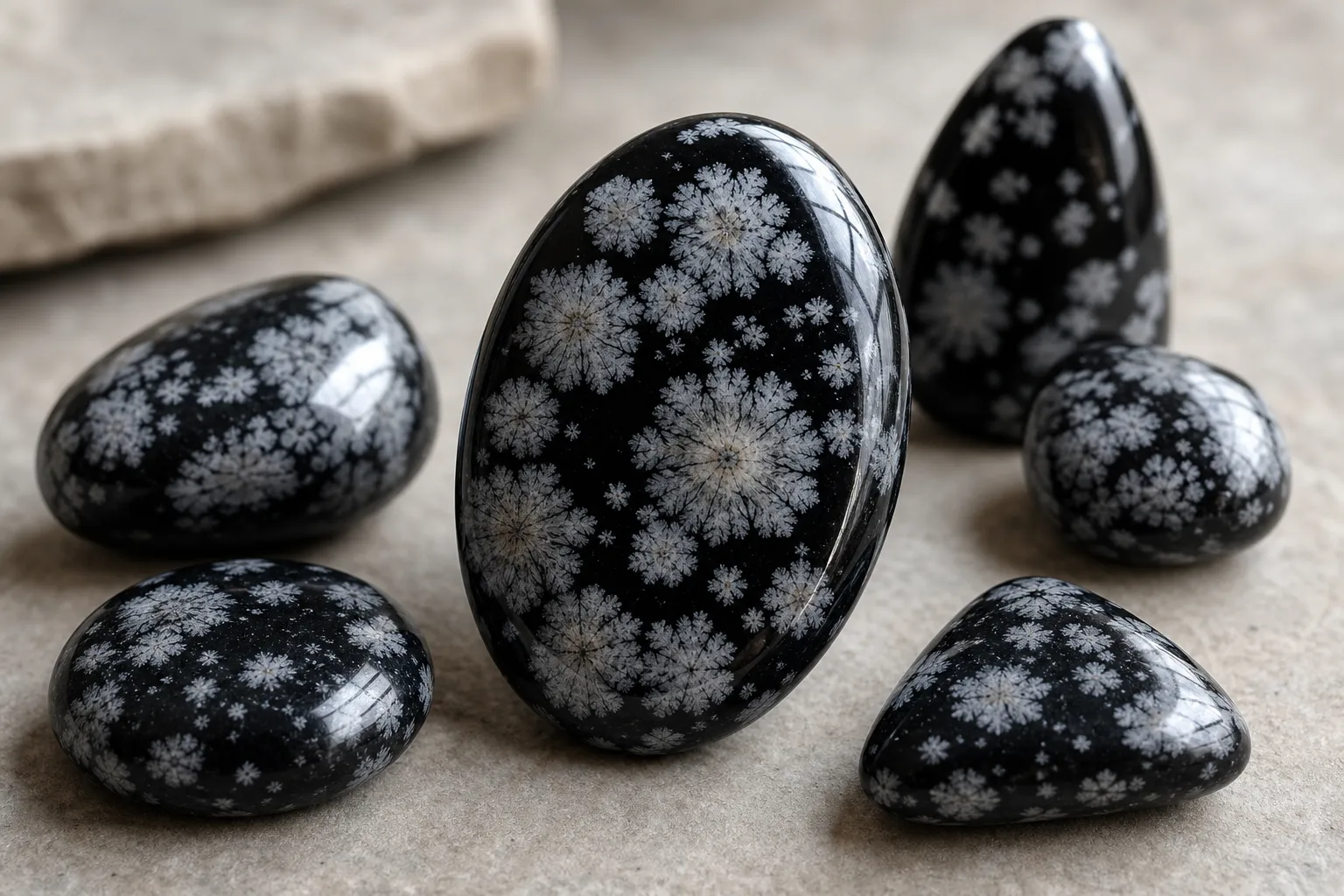
Snowflake obsidian is a patterned obsidian variety: dark volcanic glass with pale white, gray, or cream markings that resemble small snowflakes, soft flowers, or starbursts. If you are asking what is snowflake obsidian, the useful first answer is this: it is obsidian, not a separate mineral species, and the variety name comes from the contrast between the black glassy base and the pale features inside it.
Those pale markings are commonly discussed as cristobalite-related spherulitic features in obsidian. That term helps explain the pattern, but the collector check stays visual: a dark glassy surface, scattered light patches, and markings that appear within the stone rather than sitting like paint on top.
upward
Read the full overview first
Use the broader guide first if you need the full scope before this page.
What Makes It Look Like Snowflake Obsidian
The main clue is contrast. Snowflake obsidian often looks like black obsidian with white spots, although the base can read as charcoal, smoky black, or deep gray depending on polish and light. The pale areas may be round, clustered, fuzzy-edged, flower-like, or irregular. Some pieces show many small marks; others have only a few larger patches.
Look for the traits together
- A dark volcanic glass base with a glossy or waxy polished surface.
- Pale markings that look more like snowflake-like clusters than straight bands.
- White, gray, or cream spots that appear embedded in the material.
- A glassy fracture edge if a chip or broken area is visible.
- Natural variation across the surface, not a perfectly repeated print.
The name is visual. It helps collectors and sellers describe a recognizable appearance, but it does not prove origin, rarity, grade, value, or laboratory identity by itself.
Why the Pale Features Appear
Geological sources describe obsidian as natural volcanic glass formed when lava cools rapidly. Because it cools so quickly, obsidian usually lacks the obvious crystal form many people expect from minerals. Its glassy luster and sharp fracture behavior fit that volcanic glass identity.
Snowflake obsidian keeps the dark glassy parent material but adds pale internal features. Mineral terminology often connects those light areas with cristobalite and spherulitic growths. In plain collector language, spherulitic features are rounded or radiating mineral growths within the glassy material; they can create the pale spots that give this variety its snowflake name.
Keep the explanation measured. A photo can show pattern and contrast, but it cannot confirm every material detail. At collector level, “snowflake obsidian” is usually an appearance-based label: dark glass, pale rounded markings, and the familiar spotted pattern.
How to Check a Piece Without Overclaiming
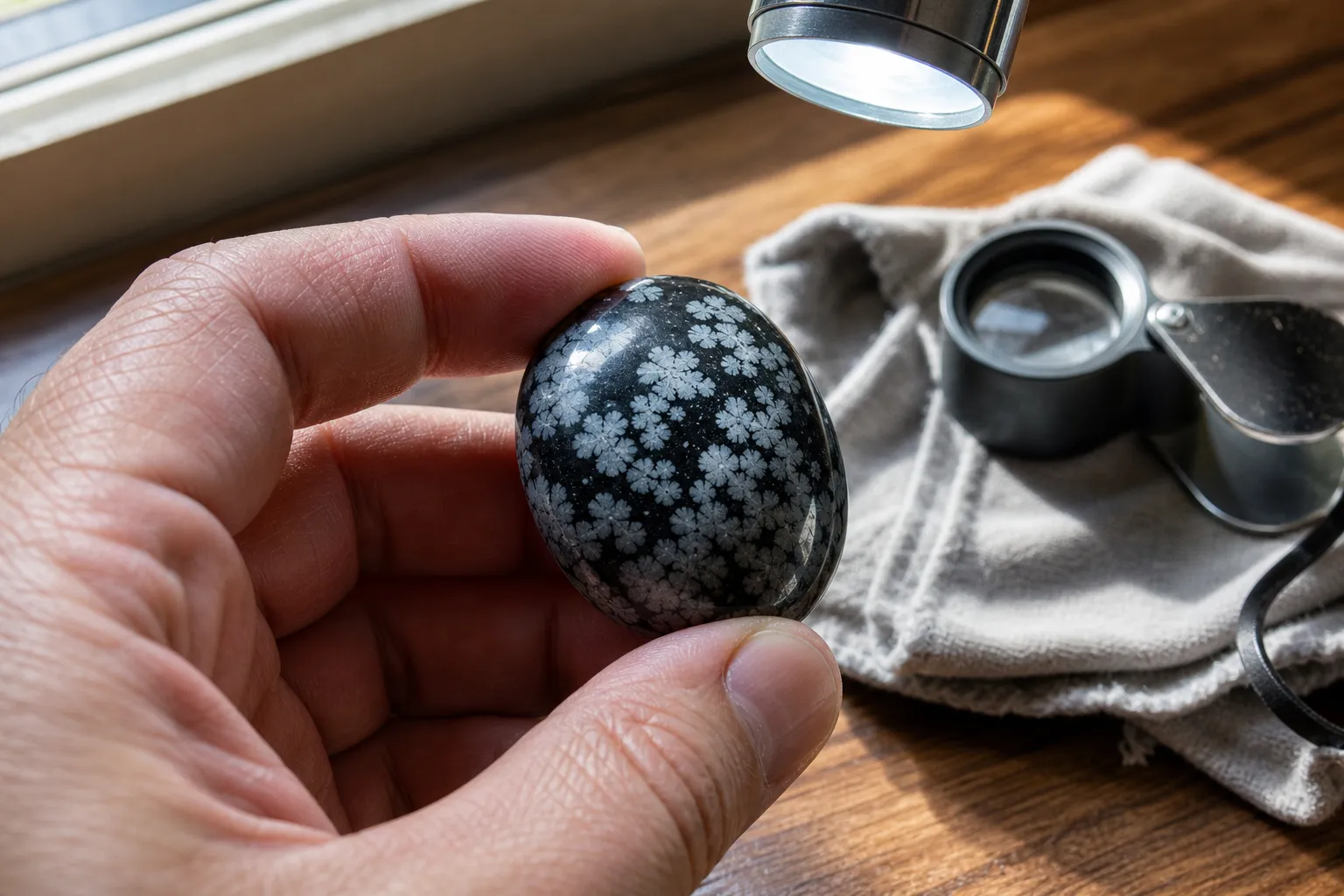
Snowflake obsidian identification works best as a set of clues, not a single yes-or-no answer from one image. Start with the surface. A polished piece should have a dark, glassy look, often with scattered pale inclusions or patches. Rotate it under steady light; glare can hide the pattern, while strong reflections can make surface marks look more important than they are.
Then check the pattern. Natural-looking snowflake markings are often uneven in size and spacing, with softer edges rather than a crisp printed look. Still, uneven patterning alone does not prove identity, and neat patterning alone does not prove imitation. The safer conclusion is either “this visually fits the snowflake obsidian variety” or “this needs closer inspection.”
Details That Affect Confidence
Lighting
Bright glare can wash out pale features or make polish marks look like inclusions.
Photo quality
A seller image may hide the edge, scale, surface texture, or true contrast.
Polish
Tumbling and cabochon cutting can make the pattern look smoother and more decorative.
Seller naming
Some listings use attractive variety names loosely, especially when the pattern is faint.
Residue or damage
Chips, scratches, wax, dust, or polish residue can change how the surface reads.
A hand specimen gives more information than a photo. You can inspect the edge, see whether the pale features continue into the material, and separate internal patterning from surface wear.
What Snowflake Obsidian Is Not
Not a separate mineral species
It remains a variety of obsidian, a volcanic glass. The “snowflake” part describes appearance, not a completely different mineral category.
Not automatically artificial
Pale markings may be worth checking, but they are too quick as a reason to assume paint or dye. Ask whether the markings appear embedded, vary naturally, and match the visible traits.
Not proof of origin or price
The pattern is not proof of origin, grade, rarity, or price. If those details matter, ask for clearer photos, size, finish, and origin information.
Not evidence of a guaranteed result
Some people connect the dark-and-light contrast with balance, reflection, or personal meaning. That belongs to belief, tradition, or personal interpretation, not material identification.
Care and Handling for a Polished Piece
For ordinary collecting, wearing, viewing, or display, polished snowflake obsidian can be treated like other polished obsidian pieces: avoid hard knocks, sharp drops, abrasive storage, and harsh cleaning. Chipped obsidian can have sharp fracture edges, so a damaged piece needs more care than a smooth tumbled stone.
A simple routine is enough for most polished pieces:
- Wipe with a soft cloth after handling.
- Use mild water cleaning when needed, then dry the piece fully.
- Store it away from harder stones that may scratch or chip the surface.
- Keep delicate carvings, points, or thin edges from knocking against other pieces.
- Inspect chips before wearing a pendant or carrying a pocket stone.
Dust-producing lapidary work is different. Cutting, grinding, sanding, drilling, or polishing silica-bearing materials can create dust exposure concerns. OSHA’s silica guidance is relevant as a narrow boundary for those work processes, not as a reason to worry about ordinary handling of a finished collector piece.
A Quick Collector Check
Use this checklist when deciding whether a piece reasonably fits the snowflake obsidian variety.
Base color
Supports the label: dark black, charcoal, or smoky volcanic glass appearance.
Limits certainty: photos may shift color or hide coatings.
Pale pattern
Supports the label: white, gray, or cream snowflake-like spots or patches.
Limits certainty: residue, glare, or surface marks can imitate contrast.
Surface character
Supports the label: glassy luster on polished areas.
Limits certainty: heavy polish can obscure fracture clues.
Pattern placement
Supports the label: pale features appear within the material.
Limits certainty: a photo may not show depth clearly.
Seller wording
Supports the label: listed as snowflake obsidian or patterned obsidian.
Limits certainty: trade names are not proof of origin, value, or testing.
If most visible traits line up, “snowflake obsidian” is a reasonable collector description. If the marks look only surface-level, the photos are unclear, or the listing makes claims beyond appearance, keep the label tentative.
Where the Evidence Is Strong—and Where It Is Limited
The strongest support is the parent-material fact: obsidian is volcanic glass associated with rapidly cooled lava. Cristobalite and spherulitic terminology helps explain why pale features may appear in dark glass. The handling boundary is also practical: a finished polished piece is not the same situation as dust-producing cutting or grinding.
The thinner area is snowflake-obsidian-specific public authority in collector language. Because of that, the best answer stays close to what can be inspected: dark glassy base, pale internal pattern, and a variety name with limits.
Snowflake obsidian is easiest to understand in this order: volcanic glass first, snowflake pattern second, meaning and market language last. Inspect the visible traits before accepting the label, and treat the label as a useful description rather than a promise.