
Collector pattern guide
Why Snowflake Obsidian Patterns Look Different from Piece to Piece
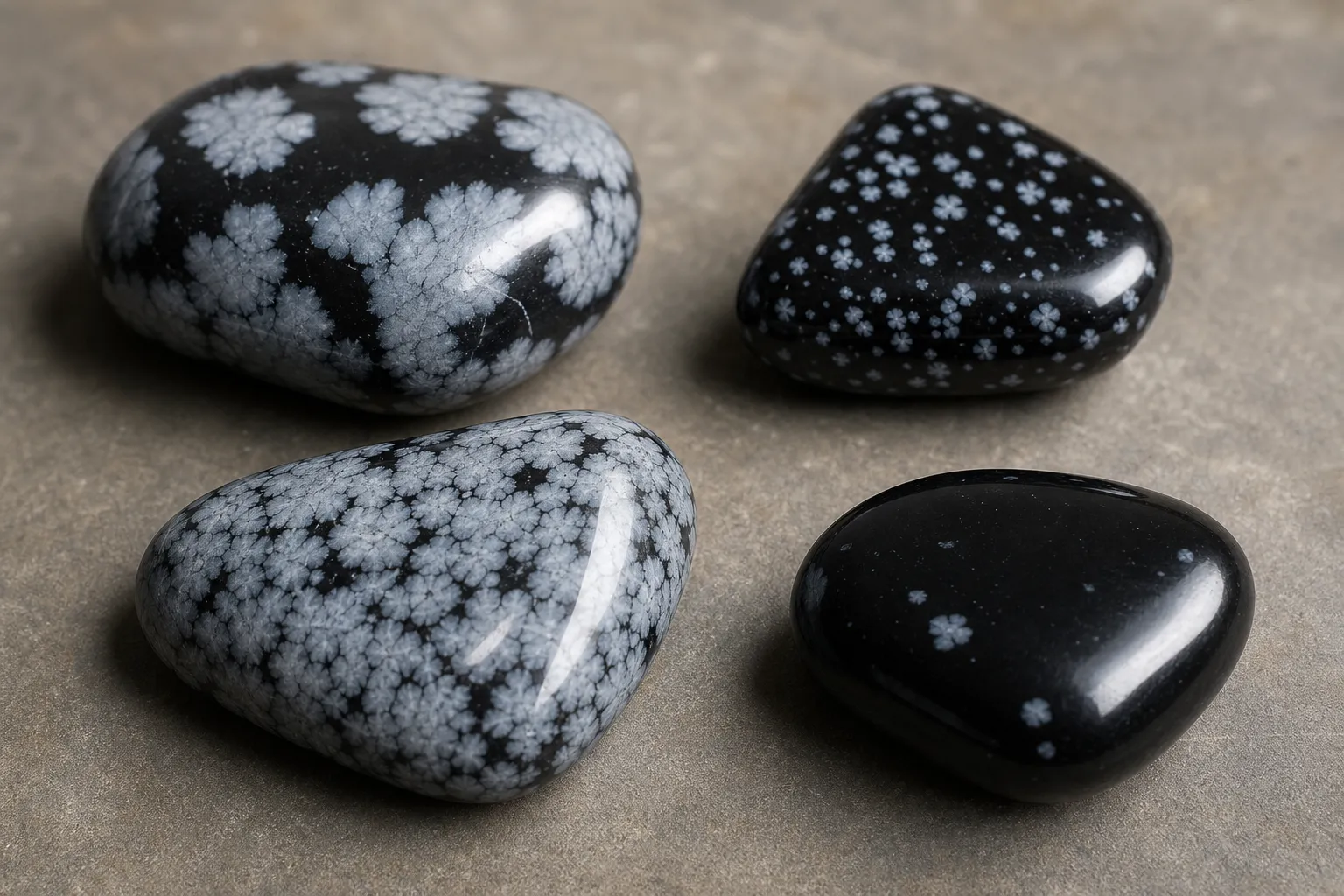
Snowflake obsidian patterns vary because each piece shows a different arrangement of pale gray-white markings in dark volcanic glass. One piece may have broad cloudy “snowflakes,” another may show fine specks, and another may look mostly black with only a few pale spots. The final look also depends on how the stone was cut, shaped, polished, photographed, and lit.
For a collector, the useful answer is visual rather than absolute: the pattern can help describe and compare a piece, but it cannot prove exact origin, formation history, value, or authenticity on its own. The best place to start is with what you can actually see: marking size, spacing, density, contrast, surface condition, and viewing angle.
Quick answer
The same variety name can cover pieces with large cloudy markings, fine specks, open black areas, dense coverage, sharp contrast, or soft gray-on-black patterning. The visible pattern is useful for comparison, but not a stand-alone verdict.
Visible traits
upward
Read the full overview first
Use the broader guide first if you need the full scope before this page.
What Changes from One Piece to Another
Most snowflake obsidian pattern variation comes down to several visible traits working together.
Marking size
Marking size is the most obvious. Some pieces show large snowflakes in obsidian that look like soft-edged bursts, flowers, or cloudy patches. Others show small specks in snowflake obsidian, closer to scattered grains or pinpoints. Many pieces sit between those extremes, with a mix of larger patches, smaller dots, and faint gray areas.
Spacing
Spacing changes the whole impression. A sparse piece may have wide black areas between markings. A dense piece may look peppered with pale spots. Neither look is automatically more “real” from appearance alone; they are different surface expressions of the material.
Contrast
Contrast affects how quickly the pattern catches the eye. Some stones have sharp gray-white markings against a dark base. Others have smoky gray areas that only show clearly when the stone is turned. A high-contrast piece may look more dramatic, while a softer piece may feel more subtle even if it has similar coverage.
Shape and edge quality
The pale areas may look round, starry, cloudlike, broken, streaked, or partly blended into the black background. On a small tumbled stone, those shapes may be interrupted by the curve of the surface. On a flat cabochon, more of the face is visible at once, so the same kind of pattern may read more clearly.
These observations are useful for comparing pieces and choosing a look you like. They should not be stretched into a detailed geological conclusion unless stronger material evidence is available.
Viewing conditions
Why Cut, Polish, and Lighting Matter
The finished object changes how snowflake obsidian patterns appear. A rounded tumble gives you a curved window into the stone. As you turn it, pale markings may appear, disappear, stretch, or break across the curve. A flat slab or cabochon gives a steadier view, making spacing and density easier to compare. A bead may show only a narrow slice of pattern, so one bead can look almost plain while another looks heavily marked.
Polish affects clarity too. A smooth, even polish usually makes the contrast easier to read because the dark surface reflects light cleanly. A dull, scratched, chipped, or worn surface can make pale patches look softer or less distinct. That does not mean the internal pattern has changed; it means the viewing surface is getting in the way.
Lighting can exaggerate or hide pattern differences. Strong direct light may create glare on polished black obsidian and obscure faint gray areas. Dim light can flatten contrast and make small specks disappear. Side lighting may reveal surface condition, while diffuse light often gives a fairer sense of overall spacing.
Better inspection setup
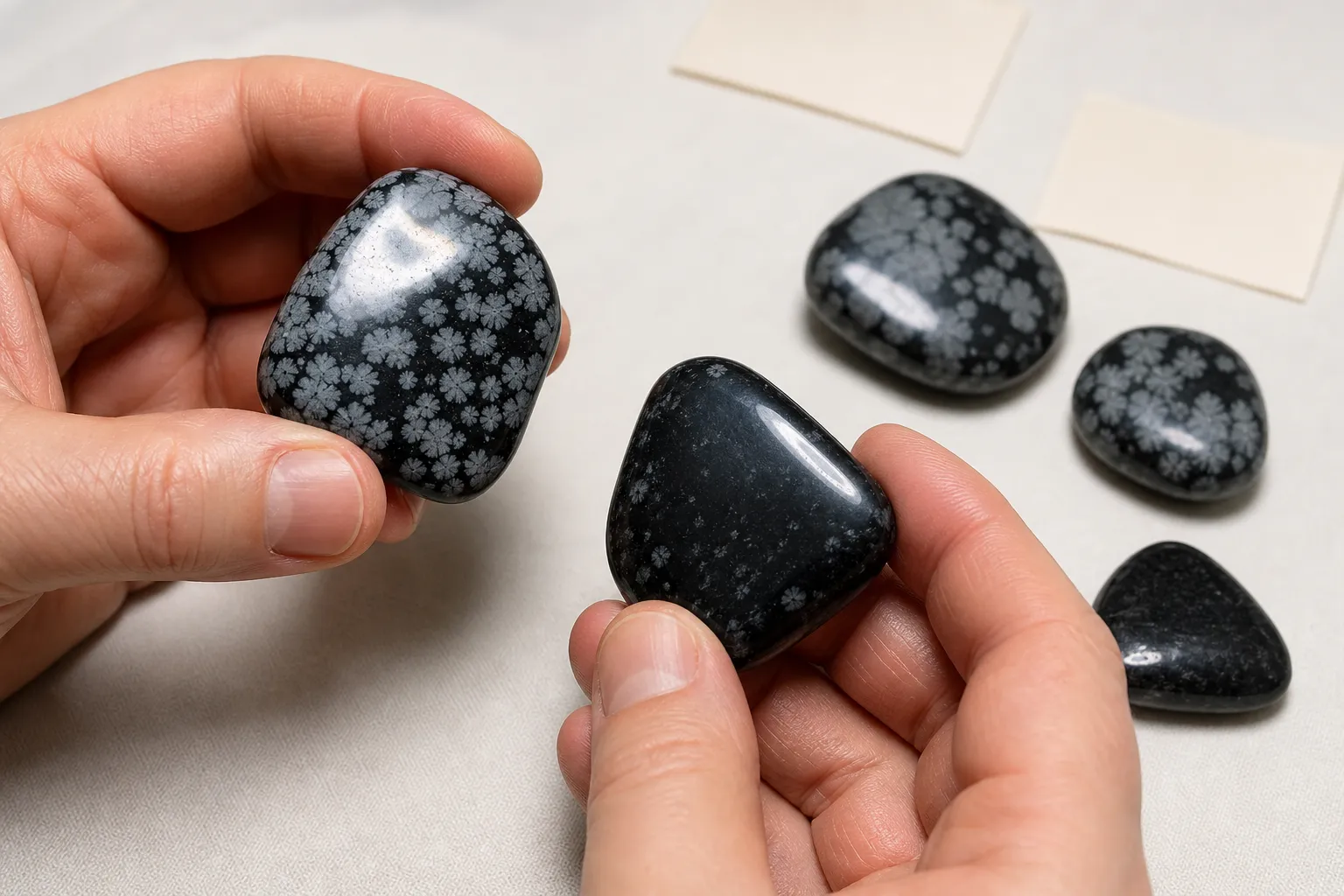
For a better inspection, place pieces under the same neutral light, turn them slowly, and compare more than one face. Look for markings that remain visible as the piece moves, not just glare, dust, or reflection.
Labels and limits
Large Snowflakes and Small Specks Are Descriptions, Not Guarantees
It is tempting to treat pattern styles as strict categories: large snowflakes, small specks, sparse fields, dense fields, high contrast, low contrast. Those labels can be helpful, but they do not guarantee a separate type, grade, source, or value.
Seller naming adds another layer. One seller may call a piece snowflake obsidian because it has obvious pale bursts. Another may use the same name for a darker piece with only a few gray flecks. Some listings emphasize dramatic contrast, while others group many appearances under one broad label. That market language can help you search, but it should not replace direct observation.
Photos can also distort the impression. A close-up may make small specks look larger. A wet-looking or highly polished surface can deepen the black background and increase contrast. Cropping may hide sparse areas. Bright display lighting may make gray markings look whiter than they appear in ordinary room light.
A clearer description includes
- Marking size: large patches, small specks, or mixed sizes.
- Spacing: open black areas, even scatter, or crowded clusters.
- Density: few markings, moderate coverage, or heavy coverage.
- Contrast: sharp gray-white marks or softer smoky gray marks.
- Surface view: flat face, rounded tumble, bead, chip, or irregular piece.
This kind of description does not answer every question about the stone, but it gives you a better basis for comparison.
Evidence boundary
Where the Material Explanation Should Stop
Snowflake obsidian is commonly described by collectors as a dark obsidian variety with pale snowflake-like markings. Obsidian itself is volcanic glass, and the pale patterning is often discussed as part of the stone’s internal texture rather than surface paint or added decoration.
For this page, however, no reliable public reference set was available to support a detailed explanation of why one individual piece has large markings while another has tiny specks. That matters. A careful answer can describe what is visible, but it should not pretend to identify exact cooling conditions, deposit history, or microscopic structure from a casual photo or listing.
A narrow, responsible way to say it is this: the visible pattern belongs to the material appearance, but the exact reason a specific marking is large, small, clustered, or faint may require stronger geological or lapidary evidence than a seller description can provide. Shop wording, short comments, and marketplace labels can show how people talk about the look; they should not be treated as proof of formation, origin, or quality.
That limit does not make the pattern useless. It simply means the pattern works best as a visual identification clue and preference guide. If a piece has a black glassy-looking base with pale snowflake-like markings, it may fit the common visual idea of snowflake obsidian. If the surface looks coated, dyed, heavily altered, unusually unclear, or too hard to judge from photos, inspect it in person when possible or seek a qualified lapidary or gemological opinion.
Inspection method
A Simple Inspection Method
- Start with the surface, not the story attached to the stone. Put the pieces under the same light and view them from the same distance. This reduces the chance that lighting, camera angle, or polish is doing more work than the actual pattern.
- Look at the dark areas first. Are they glossy, even, and continuous, or are they interrupted by scratches, chips, cloudy wear, or residue?
- Then look at the pale markings. Are they rounded snowflakes, small specks, broken islands, or soft gray clouds? Are they evenly scattered, clustered on one side, or concentrated along a band?
- Next, turn the piece. A real object rarely shows its full pattern from one face. A tumble may have one dramatic side and one nearly plain side. A pendant may have been cut to display the strongest face. A bead strand may mix pieces with different density, making the whole strand look more varied than any single bead.
- Finally, separate preference from identification. You may prefer large snowflakes, fine specks, strong contrast, or a subtle gray-on-black look. That preference is valid for collecting and display. It just should not be confused with proof of rarity, source, value, or any promised effect.
Common confusion
Common Misunderstandings
Every piece should be evenly patterned.
Not necessarily. Piece-to-piece appearance can vary widely. A stone may be mostly black with a few pale marks, heavily dotted, or somewhere between. One plain-looking side does not mean the whole piece lacks pattern.
Bigger markings mean better quality.
Large snowflakes can be visually striking, but small specks can also be attractive, especially on beads, chips, or small cabochons where fine patterning suits the scale. Collector “quality” depends on the specific goal: visual balance, polish, condition, shape, honest description, and personal taste.
A pattern name proves a specific cause.
Listing terms are often shorthand for appearance. They can help you find the look you want, but they do not replace material evidence. Treat any strong claim beyond visible traits as a separate issue.
Photos settle the question.
Photos help, but they compress a three-dimensional polished object into controlled views. They can exaggerate contrast, hide low-density areas, or make small marks look more dramatic. When buying remotely, ask for multiple angles or a short video under ordinary light.
Collector takeaway
The Practical Answer for Collectors
Snowflake obsidian pieces look different because their visible markings differ in size, spacing, density, contrast, and shape, and because cutting, polishing, lighting, and photo conditions change how those markings appear. The same variety name can cover pieces that look quite different from one another.
The most reliable approach is to describe the visible pattern plainly: large snowflakes, small specks, open spacing, dense coverage, strong contrast, or a softer gray-on-black look. Add the viewing context when it matters, such as polished tumble, flat cabochon, bead, glare, low light, or photo-only inspection.
Use the pattern as a practical observation tool, not as a final verdict. It can help you compare pieces, choose a look, and notice when a listing photo needs more context. It cannot, by itself, prove exact formation conditions, source, value, authenticity, or any guaranteed outcome.