Collector terminology
Why Do Crystal Shops Call Obsidian a Crystal
Crystal shops usually call obsidian a “crystal” because they are using crystal as a broad retail category, not as a strict geology term. In a shop, the word often covers polished stones, tumbles, spheres, towers, carvings, beads, jewelry, display pieces, and stones used for personal symbolism.
That is why why is obsidian called a crystal has a split answer:
Shop language
Obsidian is often grouped with crystals because customers browse it with other collectible stones.
Geology
Obsidian is best described as natural volcanic glass, not a true crystal.
Collector notes
“Obsidian,” “volcanic glass,” or “polished obsidian” is usually clearer than “obsidian crystal.”
The important boundary is simple: obsidian does not have the regular internal crystalline structure found in minerals such as quartz or amethyst. It forms when silica-rich volcanic material cools quickly, leaving a glassy texture instead of a fully crystalline one.
upward
Start with the broader guide
Use the broader guide first if you need the full scope before this page.
The shop label is broad; the material identity is narrower
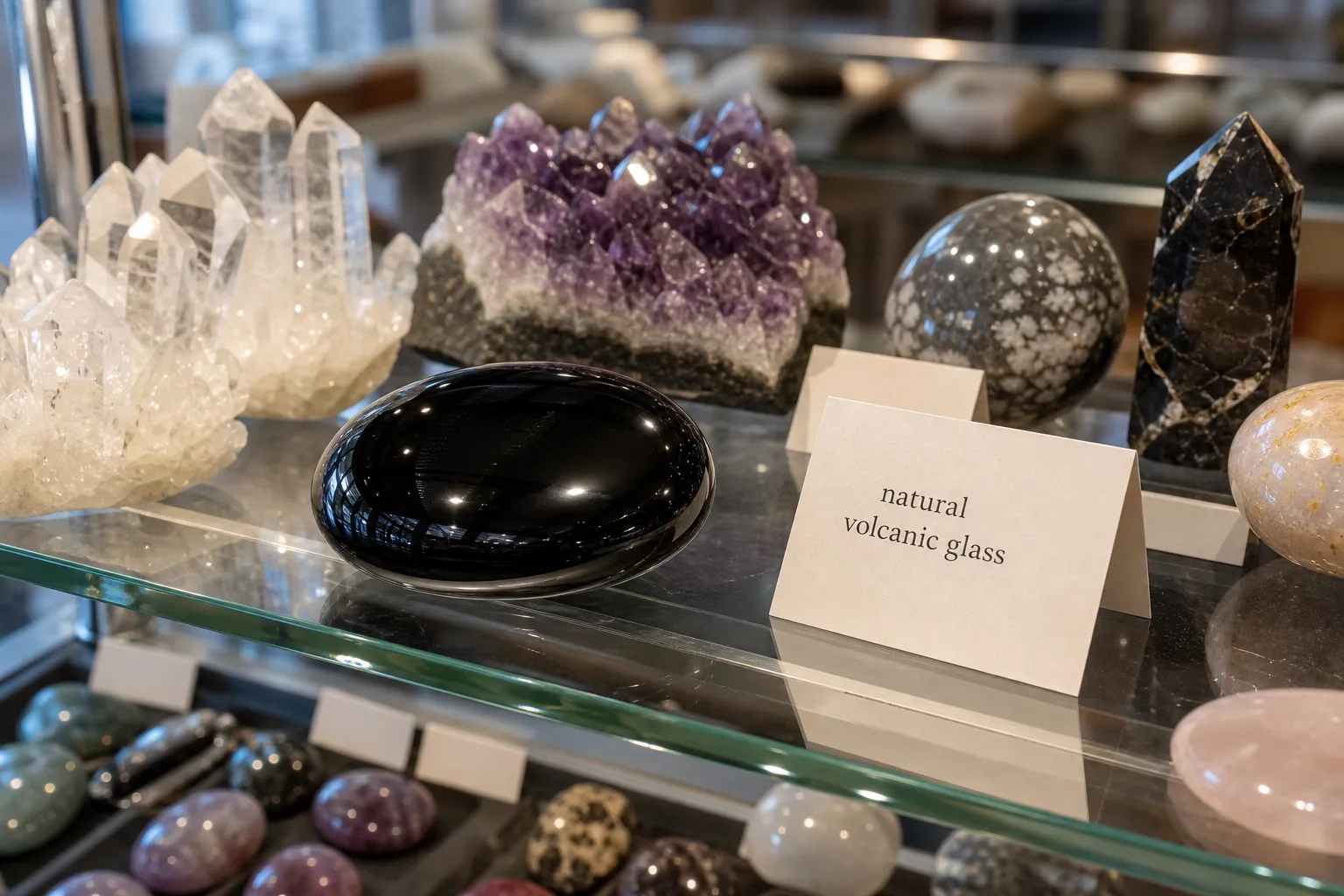
A crystal shop is usually organized for shoppers, not for a mineral classification exam. Obsidian may sit beside quartz, amethyst, jasper, labradorite, fluorite, selenite, and other popular stones because customers expect to compare those objects together.
That does not mean every shelf word is being used with laboratory precision. In many shops, crystal has become a category word for collectible, polished, decorative, or meaning-associated stones. Obsidian fits that retail environment because it can be polished to a high shine, shaped into familiar display forms, and sold in the same cases as other stones.
Crystal shop shelf
What obsidian may be called: crystal, stone, gemstone, display piece.
What the label is doing: helping shoppers find and compare items.
Collector notes
What obsidian may be called: obsidian, volcanic glass, natural glass, mineraloid.
What the label is doing: describing the material more accurately.
Mineralogy or crystallography
What obsidian may be called: non-crystalline natural glass, not a true crystal.
What the label is doing: describing internal structure.
Lapidary or ornamental use
What obsidian may be called: gem material, carving material, cabochon material.
What the label is doing: describing how it can be cut, polished, or displayed.
So when you see an obsidian crystal label, read it as shop shorthand unless the seller is making a specific scientific claim.
Why obsidian is not a true crystal
The difference comes down to internal structure.
A true crystal has atoms arranged in a regular repeating pattern. Quartz is the easy comparison: its crystalline structure is part of what makes it a mineral in the strict sense. Amethyst is purple quartz, so it belongs in that same crystalline framework.
Obsidian forms differently. It is associated with silica-rich lava or volcanic melt that cools rapidly. Because the cooling happens quickly, the material does not have enough time to grow a normal crystalline structure throughout. The result is a natural glass: hard, glossy, often dark, and smooth-looking when broken or polished.
That is why geology references commonly describe obsidian as volcanic glass rather than as a true mineral crystal. Some descriptions also use the word mineraloid. A mineraloid is mineral-like, but it does not fully meet the usual mineral requirement of an ordered crystalline structure.
“Glass” does not mean the same thing as manufactured window glass here. Obsidian natural volcanic glass is glass formed by volcanic processes. Artificial glass look-alikes are a separate identification issue.
Why obsidian still looks right at home in a crystal shop
Even though obsidian is not a true crystal, it visually fits the kinds of objects many people expect to see in crystal shops.
Polished obsidian can appear deep black, gray, brownish, or patterned depending on the piece and variety name. It often takes a smooth, glossy polish. That shine makes it popular in spheres, hearts, eggs, towers, palm stones, cabochons, beads, pendants, carvings, and pocket stones.
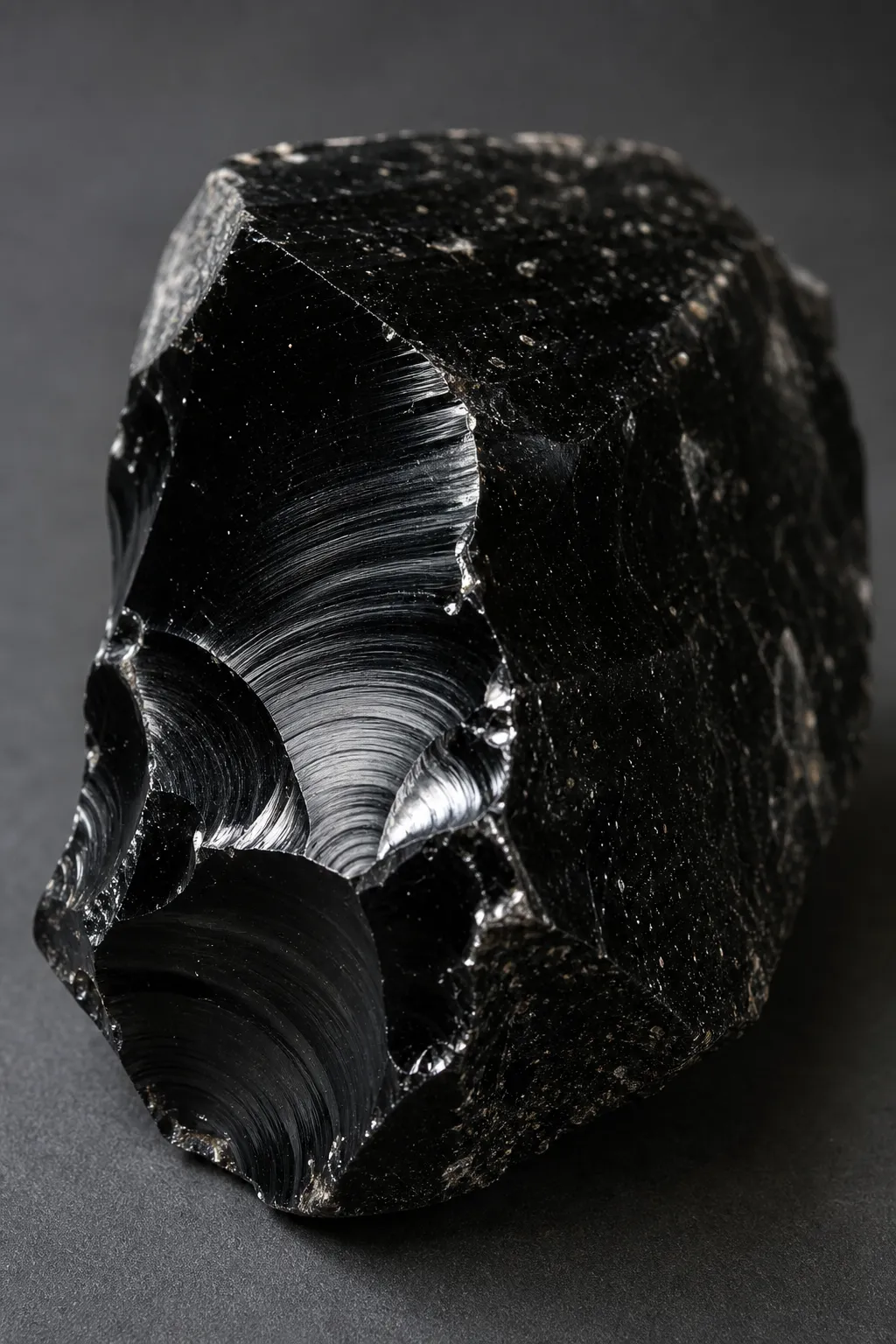
The same glassy nature that makes the label scientifically loose also makes obsidian visually striking. A polished surface may look mirrorlike. Broken or chipped areas can show curved, shell-like fracture surfaces, often called conchoidal fracture. That fracture style is common in glassy materials and explains why raw or damaged obsidian can have sharp edges.
For a shopper, the object may feel like part of the “crystal” world because it is displayed and sold alongside polished stones. For a collector, the cleaner note is: this is a polished volcanic glass object, not a crystal-grown mineral specimen.
The confusion comes from three naming systems
Most of the confusion around is obsidian a crystal comes from mixing scientific identity, retail category, and symbolic language.
Scientific identity asks
What is the material, and how is it structured? For obsidian, the answer is natural volcanic glass, generally non-crystalline overall.
Retail category asks
Where does this belong in the shop? For many sellers, obsidian belongs with crystals and stones because that is where customers expect to find it.
Symbolic language asks
What associations do people attach to it? Some shops and buyers discuss obsidian through personal meaning, tradition, or spiritual symbolism. Those associations may explain why it appears in the same retail setting as other “crystals,” but they do not change the material structure.
Simple wording
- Strict geology: obsidian is not a true crystal.
- Common shop language: obsidian may be grouped with crystals.
- Collector wording: “obsidian volcanic glass” or “polished obsidian” is clearer.
- Ornamental use: obsidian can be a decorative gem material without becoming crystalline.
The least confusing sentence is: Obsidian is a natural volcanic glass commonly sold in crystal shops.
What you can check on the piece itself
You do not need to break, scratch, heat, or damage an obsidian piece to understand the label. The naming issue is mostly terminology, not something to test at home.
A few visible traits can connect the shop label to the material:
- Glassy luster: polished obsidian often has a smooth, shiny surface.
- Dark or patterned body color: many pieces are black or dark gray, though some named varieties show pale patches, sheen, or inclusions.
- Smooth polish: obsidian is commonly sold as palm stones, beads, carvings, cabochons, or display shapes.
- Conchoidal fracture on damaged areas: chips or breaks may show curved glasslike surfaces.
- Sharp broken edges: raw chips or fractured pieces can be sharp, so handle damaged areas carefully.
These observations can support the idea that the object is glassy volcanic material, but a casual look is not the same as formal identification. If a piece is valuable, unusual, or questionable, reputable sourcing or gem/mineral identification is more reliable than home experiments.
The small exception: obsidian can contain tiny crystals
A careful explanation should not say “obsidian never has any crystals anywhere.” Natural materials are messier than that.
Some obsidian can contain tiny crystals, microlites, phenocrysts, or areas that have partly changed from glass toward more crystalline textures over time. Certain appearances, such as snowflake-like patterning, are connected to mineral growth or textural change within the glassy material.
That nuance does not overturn the main answer. Small crystalline features inside or within an obsidian mass do not make the whole material a true crystal in the same sense as a quartz point.
Practical distinction
- A quartz point is a crystal because its material has a crystalline structure.
- An obsidian tower may be called a crystal because of its shop category and shape.
- The obsidian itself is still natural volcanic glass.
How to read an “obsidian crystal” listing
When you see “obsidian crystal” on a shelf, label, or product listing, translate it into more precise wording:
- “Black obsidian crystal” usually means a black obsidian stone or polished object.
- “Obsidian crystal tower” usually means obsidian shaped into a tower form.
- “Obsidian crystal bracelet” usually means beads made from obsidian or a material being sold as obsidian.
- “Natural obsidian crystal” should ideally mean natural obsidian, but “crystal” is still being used loosely.
- “Volcanic glass obsidian” is closer to the geological identity.
This matters most if you are building a collection and want accurate notes. A shop card that says “obsidian crystal” is not automatically a problem, but your own catalog can be clearer:
Obsidian — natural volcanic glass; polished sphere
Black obsidian — volcanic glass; tumbled stone
Snowflake obsidian — obsidian with visible pale patterning; polished palm stone
That wording keeps the shop term understandable while preserving the material distinction.
Bottom line
Crystal shops call obsidian a crystal because crystal is often used as a broad retail word for collectible stones, polished pieces, jewelry, display objects, and symbolic-use inventory.
In stricter geological language, obsidian is natural volcanic glass, often discussed as a mineraloid, because it cooled too quickly to develop the regular crystalline structure of a true crystal.
So the shop label is understandable, but it is not the most precise name. If you want accurate collector wording, call it obsidian, natural volcanic glass, or polished obsidian, depending on the object in front of you.