
Material behavior
Why Obsidian Breaks in Curved Shell-Like Shapes
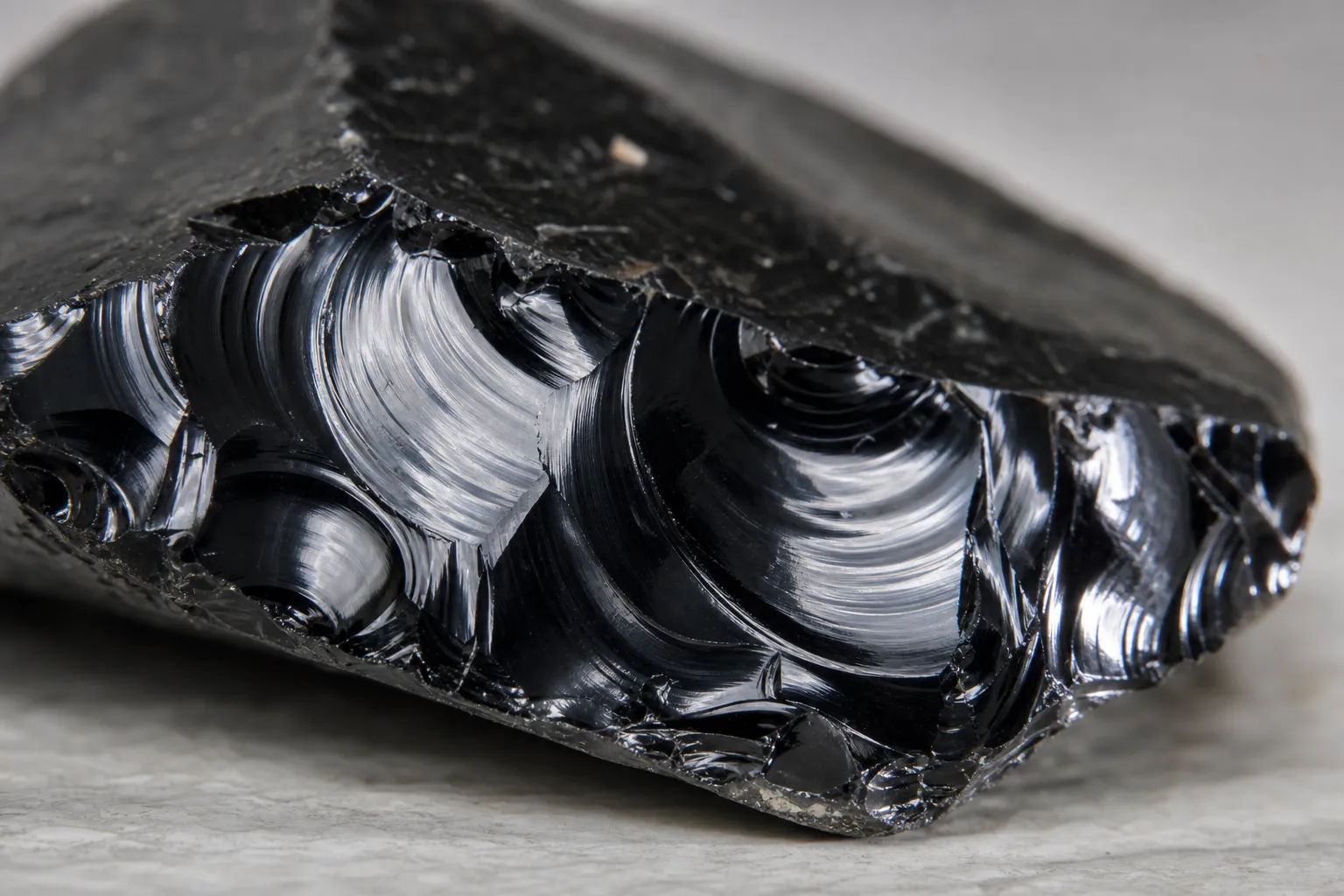
If a chipped piece of obsidian shows curved scoop marks, crescent chips, glossy arcs, or shell-like ripples, you are probably seeing conchoidal fracture. The short answer to why obsidian breaks in curved shapes is simple: obsidian is natural volcanic glass. It does not split along regular crystal cleavage planes the way many crystalline minerals can. Instead, a crack can travel through the glassy material in smooth curves, leaving rounded fracture surfaces that look like shells, bowls, waves, or overlapping scoops.
That pattern is one of the most useful clues on a broken obsidian edge. It is not a special variety feature, and it does not mean the piece was cut or polished. It is a common break style in brittle glassy materials, especially where the obsidian is fresh, clean, and glass-like.
upward
Read the full overview first
Use the broader guide first if you need the full scope before this page.
What You Are Seeing on a Broken Obsidian Edge
A fresh obsidian break often looks more like broken glass than like a grainy rock. On a small chip, you may notice:
- Curved scoop-like scars where a flake popped away
- Crescent chips along an edge or impact point
- Glossy arcs that catch light differently from the outer surface
- Shell-like ripples spreading away from the break
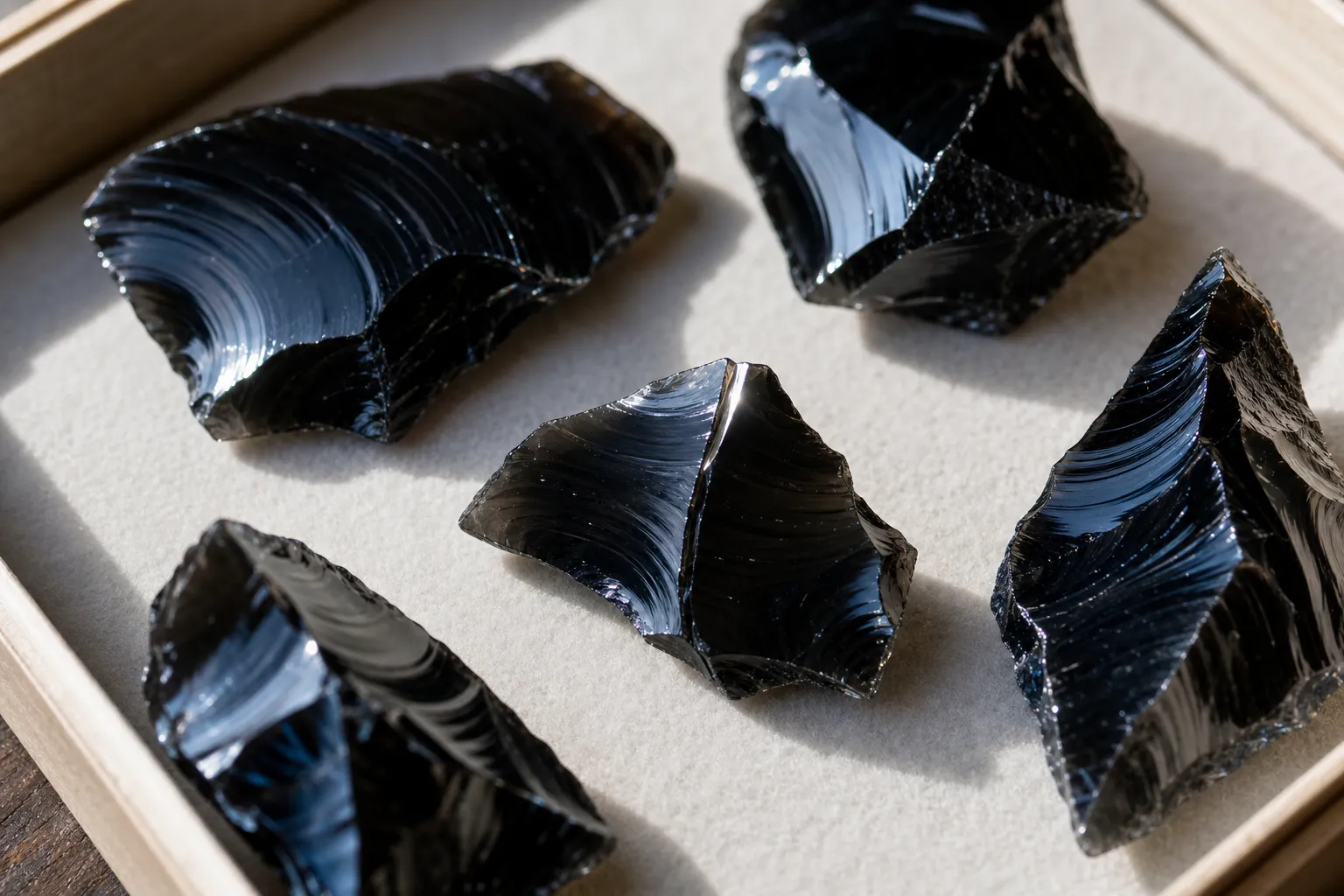
- Thin sharp edges where two curved fracture faces meet
- Smooth glassy surfaces instead of sandy, granular, or blocky faces
“Conchoidal” means shell-like. In everyday collector language, the same feature may be called a curved chip, glassy break, scoop mark, ripple, or shell fracture.
The pattern can be faint on a tumbled stone with only a tiny nick. On a rough chunk or snapped edge, it may be obvious: one part of the break may look like a smooth spoon-shaped hollow, while another part shows curved ridges or ripples.
The key point is that the curve belongs to the fracture surface, not necessarily to the original outside shape of the stone. A rounded palm stone, a flat slab, a raw nodule, and a broken point can all show conchoidal fracture if the glass breaks cleanly.
Why Volcanic Glass Breaks This Way
Obsidian forms as volcanic glass. In plain terms, its structure is not arranged as visible interlocking mineral crystals in the way many familiar rocks are. It is glassy and brittle, so when enough force is applied, the crack is not guided by neat internal cleavage planes.
Many crystalline minerals have directions of weakness. When they break, they may split along repeated flat planes. Obsidian behaves differently: it is commonly described as volcanic glass, not as a normal crystalline mineral with regular cleavage. Because of that, a crack can move through the material in curved paths instead of following flat internal planes.
| Feature | Obsidian | Mineral with clear cleavage |
|---|---|---|
| Basic structure | Glassy volcanic material | Crystalline mineral structure |
| Common break style | Curved conchoidal fracture | Flat or stepped cleavage faces |
| Surface look | Smooth arcs, shells, ripples, scoops | Repeated flat planes or blocky splits |
| Edge result | Can form very thin sharp edges | Depends on the mineral and cleavage direction |
This does not mean every obsidian piece is perfectly uniform. Natural obsidian can contain bubbles, flow bands, small crystals, weathered zones, or altered areas. But in a clean glassy piece, the lack of regular cleavage is the main reason the broken surface often curves.
Why Some Obsidian Breaks Look Rough
Not every broken piece shows a textbook shell. Some edges are glossy and curved; others look rough, dull, shattered, stepped, or crumbly. That does not automatically mean the stone is not obsidian. It usually means the break did not travel through one clean, simple glassy path.
Several factors can change the look of rough obsidian fractures.
Impact direction and force
A small chip may leave a neat crescent scar. A hard drop, crushing blow, or uneven impact can create several cracks at once. When cracks branch and overlap, the result may look jagged rather than smoothly curved.
Thickness and shape
Thin edges can flake dramatically because cracks travel across them more easily. Thick chunks may break with both smooth conchoidal areas and rougher internal faces. A tumbled stone may show only a small bite-like chip, while a raw fragment may show broad shell-like surfaces.
Bubbles, inclusions, and flow textures
Natural obsidian is not always flawless black glass. Some pieces show flow banding, tiny bubbles, mineral specks, or patterned zones. These features can interrupt or complicate the crack path. A break may curve through one area, roughen through another, and become glossy again where the material is cleaner.
This is why variety names should not be used as the main explanation. A piece sold as snowflake, mahogany, rainbow, gold sheen, or another obsidian variety may still fracture conchoidally, but the variety name usually describes color, sheen, inclusions, or pattern. The curved fracture comes from the glassy volcanic material.
Weathering and alteration
Older or weathered surfaces may look duller than a fresh break. The outside of a rough piece can be matte, dusty, pitted, or coated, while a new chip inside looks brighter and more glassy. If some zones have changed texture, the fracture may be less clean.
Devitrification
Devitrification is a process in which glass begins to develop crystalline material. In collector terms, devitrified areas may look more stony, cloudy, or speckled than fresh glass. It can be part of why some obsidian-like surfaces do not look cleanly glassy, but it should not be treated as the automatic explanation for every rough break.
A more careful reading is: the roughness may be affected by texture, inclusions, weathering, alteration, impact conditions, or mixed material. Appearance alone usually cannot assign one exact cause.
What the Curved Fracture Can and Cannot Tell You
A conchoidal break is a strong clue that a specimen is glassy. In obsidian, it fits the expected behavior of volcanic glass. But it is not a complete identification by itself.
Other materials can also show curved shell-like breaks, including some quartz, chert, flint, manufactured glass, slag glass, and other silica-rich materials. So the fracture pattern supports an obsidian identification only when it matches other visible clues.
Look for the combination
- Glassy or vitreous luster
- Smooth curved fracture scars
- Thin sharp edges on fresh chips
- No obvious repeated cleavage planes
- Color and texture consistent with obsidian
- No bubbly industrial look if slag glass is a possible confusion
- No granular crystal texture like many ordinary rocks
A photo can help compare traits, but it cannot settle every material detail. Lighting, polish, dust, coatings, and camera angle can all change the way a fracture surface appears. A glossy arc in one image may look dull in another, and a dark stone may hide texture until light hits the break at an angle.
Why the Edges Can Be So Sharp
Freshly broken obsidian can have very sharp or razor-like edges because curved fracture surfaces may meet at extremely thin points. The same break that leaves a scoop-like scar can also form a fine edge where two surfaces intersect.
For handling, the practical rule is simple: do not run your fingers along a broken edge to check it. Do not press the edge into skin, fabric, or soft material to test sharpness. If you need to move a broken piece, hold it by a thicker stable area, or use gloves when dealing with rough fragments and loose chips.
For storage, keep sharp broken pieces from tumbling freely against softer stones, cloth pouches, or hands reaching blindly into a drawer. A small labeled box, folded padding, or separate compartment is usually more sensible than leaving fresh chips loose in a mixed tray.
The issue is the fresh thin edge, not the name “obsidian” alone. A polished palm stone with no broken areas is a different handling situation from a snapped raw flake.
Common Misreadings of Shell-Like Obsidian Breaks
“The curves mean it has layers”
Obsidian can show flow bands or visual layering, but conchoidal fracture is not the same as peeling along stacked sheets. The shell-like curve comes from the crack moving through glassy material.
“The break proves the variety name”
A crescent chip does not prove rainbow obsidian, snowflake obsidian, mahogany obsidian, or any other market name. Variety names depend on visible color, sheen, inclusions, or pattern. Conchoidal fracture is broader than those labels.
“All real obsidian must break in perfect shells”
Clean glassy obsidian often shows curved fracture surfaces, but real pieces can also show rough, mixed, weathered, or shattered breaks. A perfect shell is not required. One rough damaged area does not automatically rule out obsidian.
“Obsidian cleaves like a crystal”
For this question, obsidian is better understood as volcanic glass. It commonly breaks by fracture, especially conchoidal fracture, rather than by regular crystal cleavage.
A Quick Way to Read a Broken Piece
If you are holding a chipped obsidian piece, use this short sequence:
- 1. Find the freshest break. Ignore dusty outer crust at first and look for a newly exposed surface.
- 2. Tilt it under light. Glossy arcs and scoop marks show best when light moves across them.
- 3. Look for shell geometry. Crescent chips, ripples, and spoon-like hollows point toward conchoidal fracture.
- 4. Notice rough interruptions. Specks, bubbles, cloudy patches, weathered zones, or altered texture may explain less regular areas.
- 5. Protect your hands. Treat thin fresh edges as sharp even if the chip looks small.
- 6. Avoid overreading it. A curved break supports a glassy-material reading, but it does not identify source, age, variety, or value on its own.
The simplest answer remains the most useful one: obsidian breaks in curved shell-like shapes because it is natural volcanic glass, and brittle glassy materials commonly fracture conchoidally rather than splitting along crystal cleavage planes. The visible result is the curved scoop, crescent chip, glossy arc, or shell-like ripple that catches your eye on a broken edge.