
Volcanic glass formation
Why Does Obsidian Need Fast Cooling to Form
Obsidian needs fast cooling because it forms as volcanic glass rather than as a rock packed with large, orderly mineral crystals. The simple answer to why does obsidian cool quickly is that the molten material solidifies before atoms in the lava have enough time and mobility to arrange themselves into visible crystals.
In many obsidian-forming settings, the melt is also silica-rich and very viscous. That matters because crystal growth needs movement as well as time. Rapid cooling shortens the time available; high viscosity slows the internal movement. Together, they help lock the melt into a glassy, mostly disordered structure.
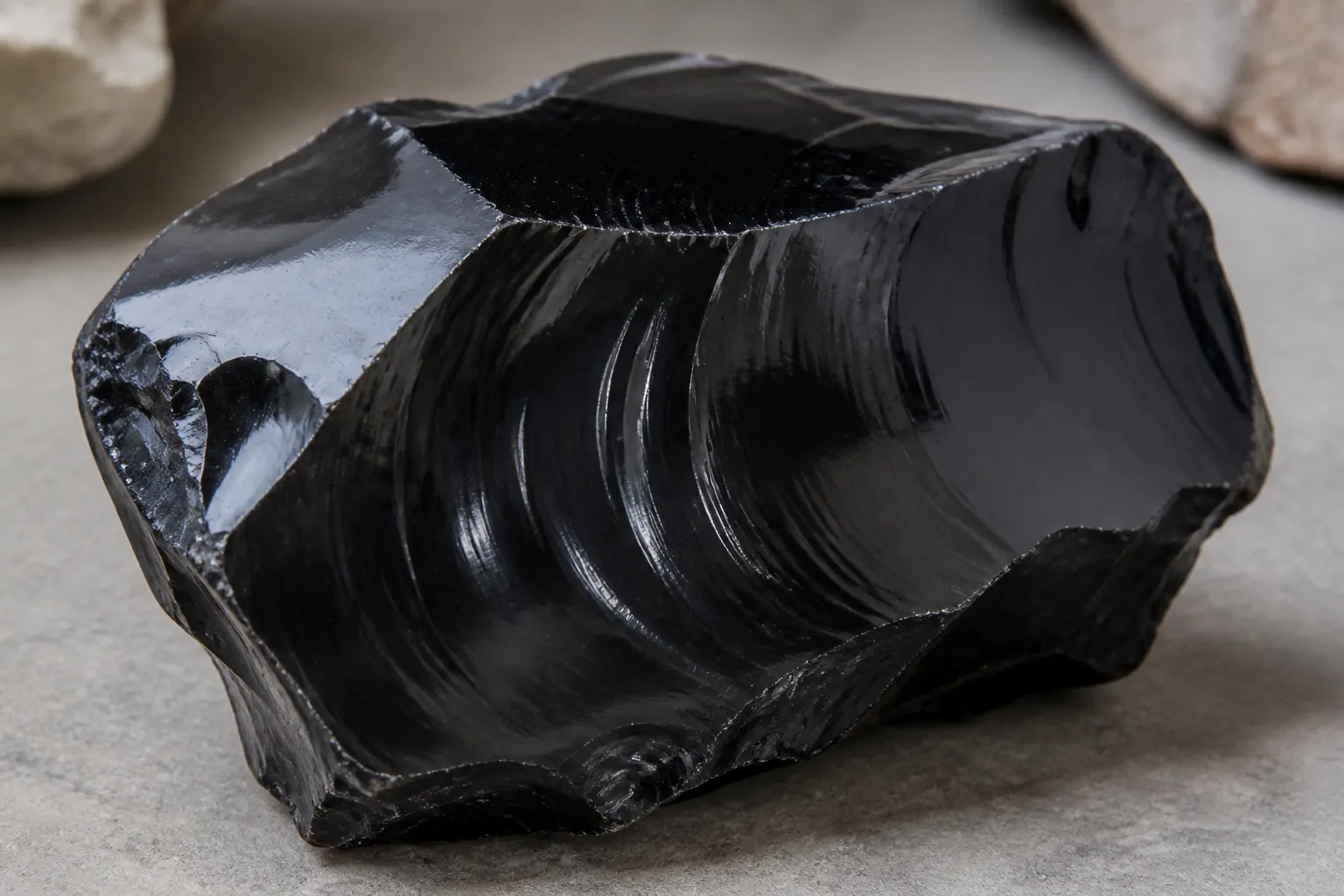
That cooling history is why a typical obsidian specimen looks smooth and glass-like, usually has few or no large visible crystals, and can break with sharp curved surfaces called conchoidal fracture.
upward
Read the full overview first
Use the broader guide first if you need the full scope before this page.
Fast Cooling Makes Volcanic Glass Before Large Crystals Grow
Crystal growth is not just “lava becoming solid.” For visible crystals to form, atoms and ions in the melt have to move into repeated, ordered patterns. That process needs time, enough atomic movement, suitable starting points, and continued growth before the melt becomes too stiff.
When lava cools quickly enough, that process is cut short. The material stiffens while its internal structure remains largely disordered. The result is volcanic glass.
So, does obsidian cool fast or slowly? The careful answer is: obsidian forms where the melt cools fast enough, relative to crystal growth, to become glass. That does not mean every part of every obsidian flow cooled instantly. Thick lava bodies can have more complex cooling histories. But the portion that becomes obsidian avoided the prolonged crystal growth that would make it look like a coarse-grained igneous rock.
Why Silica-Rich Lava Helps Obsidian Stay Glassy
Obsidian is commonly associated with felsic or rhyolitic lava, which is rich in silica. Silica-rich lava tends to be thick and sticky compared with more fluid basaltic lava. Geologists describe that stickiness as high viscosity.
For a collector, the practical meaning is simple: atoms in a viscous melt do not move around as freely. Crystal growth depends on that movement because atoms need to reach and attach to an ordered crystal structure. If movement is slow, crystal growth is harder even before cooling removes the available time.
This is why rapid cooling obsidian is not only about temperature dropping quickly. It is also about whether the melt can reorganize internally before it becomes rigid.
A useful way to picture it
- Fast cooling shortens the clock.
- High-silica lava viscosity slows internal motion.
- The melt becomes rigid before large crystals can take over.
- The visible result is fast-cooling volcanic glass.
This also explains why obsidian is often called a mineraloid rather than a true mineral. A mineral has a regular crystalline structure. Obsidian is natural glass, so its structure is mostly amorphous, meaning it lacks the regular crystal lattice expected of a mineral.
Where Obsidian Cools Quickly Enough
Obsidian does not need a perfect instant freeze to form. It needs conditions where glass formation wins over crystal growth.
Common settings include chilled margins of silica-rich lava flows, the edges of volcanic domes, and contact zones where hot lava meets much cooler air, water, or rock. The outside of a lava flow or dome can lose heat faster than the interior, so thin edges and flow margins are especially important.
Still, “lava hits air and instantly becomes black glass” is too simple. Real rhyolitic obsidian lavas can include flow, bubbles, microlites, shear textures, and later changes. Those details matter in volcanology, but they do not change the collector-level mechanism: obsidian is glassy because large-scale crystal growth was suppressed before the material fully solidified.
The more accurate wording is: obsidian forms where silica-rich volcanic melt cools fast enough, and remains viscous enough, that large visible crystals do not have time or mobility to grow.
What Fast Cooling Explains in a Hand Specimen
The cooling history of obsidian is not just background geology. It shows up in the way a specimen looks and breaks.
Glassy luster
Fresh or well-polished obsidian often has a vitreous, glass-like shine. A rough piece may look duller on weathered surfaces, while a polished piece can look highly reflective. Lighting and surface finish can change the appearance, so shine alone is not enough to identify obsidian.
Few or no large visible crystals
One of the most useful clues is what you do not see: large mineral grains. Many obsidian pieces look uniform, dense, and glassy rather than speckled with obvious crystals. That fits the story of fast cooling and limited crystal growth.
But “few or no large visible crystals” is better than “no crystals at all.” Some obsidian contains tiny crystals, microlites, inclusions, spherulites, or alteration textures. These may be too small to identify without magnification, or they may appear as patterns within the glass.
Smooth surfaces and flow bands
Some pieces show subtle bands, streaks, or lines. These can reflect movement and layering in the viscous lava before it fully solidified. Flow banding does not make a piece “not obsidian.” It simply shows that the glass formed from moving volcanic material, not from a perfectly uniform manufactured melt.
Conchoidal fracture
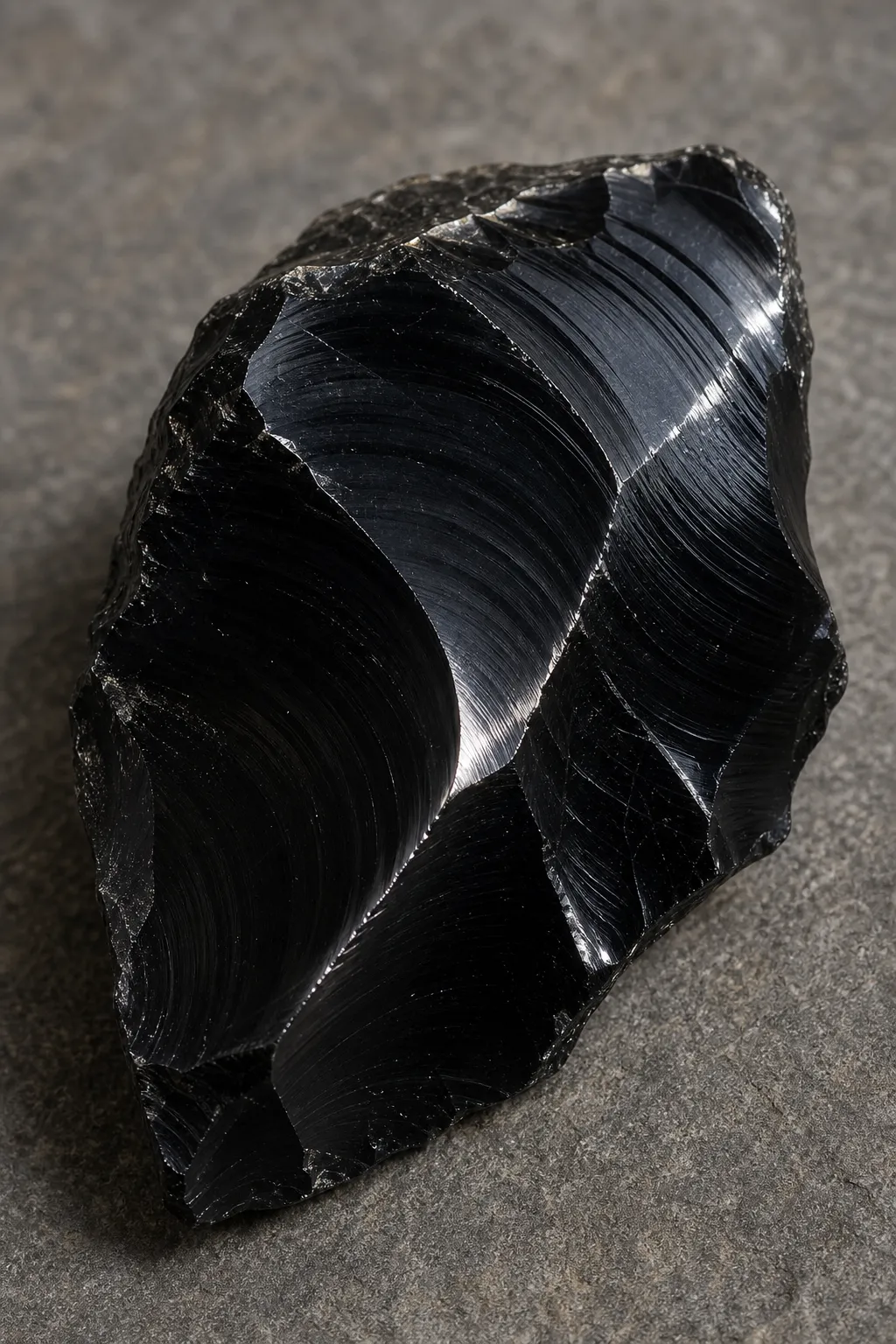
Obsidian is brittle and glassy, so when it breaks it often forms curved, shell-like fracture surfaces. This is called conchoidal fracture.
For collectors, this explains why broken obsidian can have very sharp edges. Handle raw, chipped, or freshly broken pieces with care. Conchoidal fracture is a useful visual clue, but it is not a stand-alone identification test, because other glassy materials can break in similar curved patterns.
Why Obsidian Can Be Glassy but Still Have Internal Features
A common misunderstanding is that obsidian must be perfectly featureless because it is volcanic glass. That is too strict. Glassy does not mean empty.
- Bubbles or vesicles left by gases in the lava
- Flow bands from movement in the viscous melt
- Tiny crystals or microlites that formed in small amounts
- Spherulites, which are rounded crystal growths within or associated with the glass
- Inclusions or very small internal structures that affect color, sheen, or optical effects
- Devitrification, where glass begins changing into fine-grained crystalline material over time
Snowflake obsidian is a familiar example: the pale “snowflakes” are commonly linked with spherulitic crystal growth in dark volcanic glass. Sheen, rainbow, and fire obsidian also show how internal features can affect appearance. Those variety names depend on the specimen’s structure, polish, lighting, and seller terminology, so they should be interpreted with care.
The key point is simple: obsidian usually lacks large visible crystals because it formed as glass, but it can still contain small-scale features.
Slow Cooling Versus Fast Cooling
If similar molten material had much more time to cool and crystallize, it could form a rock with a more visibly crystalline texture. In slow cooling, atoms have more opportunity to arrange into minerals. Crystals can nucleate, grow, and become large enough to see.
In fast cooling, the structure is locked in before that happens. That is why obsidian’s texture is described as glassy rather than granular.
This difference helps avoid two common mistakes
- First, black color alone does not define obsidian. Many dark rocks exist, and some are crystalline rather than glassy. Texture matters more than color.
- Second, a patterned obsidian variety is not automatically “less real” because it has visible features. The better question is whether the main material still shows volcanic glass characteristics: glassy luster, dense texture, lack of large mineral grains, and brittle glass-like fracture behavior.
How Fast Does Obsidian Cool?
There is no single cooling speed for every obsidian specimen. Cooling can vary across a lava body. Outer margins may cool much faster than interiors, and thick rhyolitic flows can preserve different histories from edge to center.
For this question, the more useful answer is relative rather than numerical: obsidian cools fast enough, or under conditions restrictive enough, that large crystals cannot grow before the melt becomes glass.
So if you are holding a glassy piece with no large visible crystals, the important clue is not a precise number of degrees per second. It is the preserved texture: the melt solidified before it became a visibly crystalline rock.
The Practical Takeaway
Obsidian needs fast cooling to form because volcanic glass develops when molten material solidifies before atoms can build large, orderly crystals. In silica-rich rhyolitic lava, high viscosity further limits atomic movement, making glass formation more likely when cooling is quick enough.
That cooling history explains the main collector-visible traits: a glassy surface, few or no large visible crystals, occasional bands or internal features, and sharp conchoidal fracture when broken.
The careful version of the answer is not that obsidian is always crystal-free or instantly frozen. It is that obsidian’s glassy texture records crystal growth being cut short.