
Listing language
What Does AAA Grade Mean on Obsidian Listings
A glassy black surface, a bright polish, and the phrase AAA grade obsidian can make a listing sound more exact than it is. In most obsidian crystal listings, “AAA grade” is best read as a seller-defined quality label, not a universal grading system for obsidian.
It usually means the seller is presenting that piece as cleaner, glossier, more visually consistent, or better finished than other items in their own stock. The letters do not, by themselves, prove authenticity, rarity, value, durability, or any symbolic effect. Treat the AAA label as a reason to inspect the listing, not as the conclusion.
upward
Start with the broader guide
Use the broader guide first if you need the full scope before this page.
Quick reading
Read “AAA” as a shop’s quality claim. Then look for the photos, condition notes, size details, and seller definition that show what the claim is actually describing.
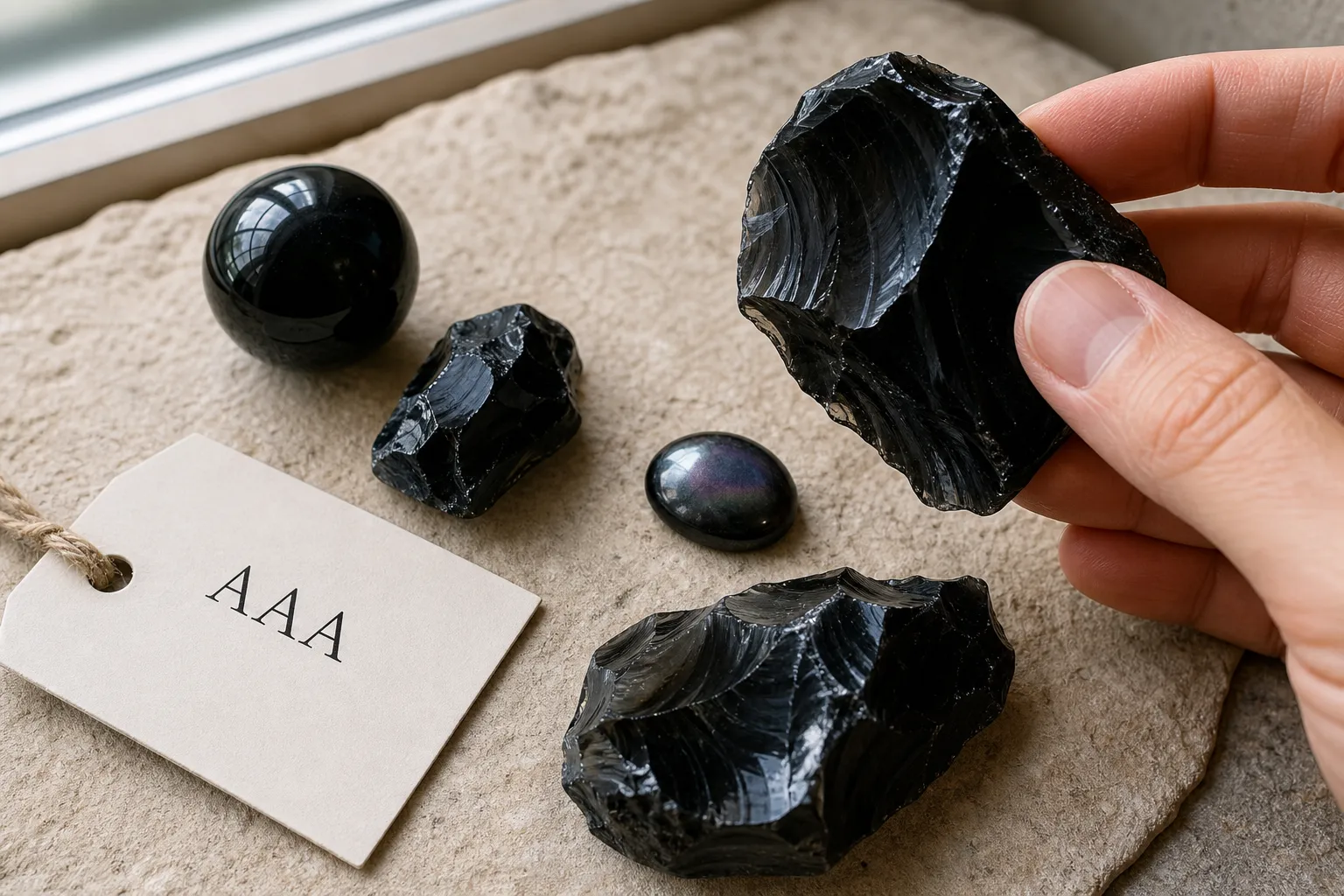
What the AAA Label Usually Signals
Crystal shop grading terms often work as shorthand. A seller may use A, AA, AAA, “premium,” or similar wording to separate ordinary pieces from pieces they consider more attractive. For obsidian, that usually points to visible presentation rather than a formal mineral category.
That is the practical reading. It is not a fixed definition.
An obsidian grade label may be trying to describe:
- Smoother polish with fewer dull areas
- Fewer obvious chips, cracks, pits, or edge marks
- More even color on black obsidian
- Stronger visible sheen on rainbow, gold sheen, or silver sheen pieces
- Cleaner shaping on a carving, sphere, palm stone, bead, or cabochon
- Fewer distracting inclusions, cloudy patches, or scuffed spots
One seller’s AAA obsidian meaning may be “very glossy black tumble stones.” Another may use the same phrase for rainbow obsidian with strong color under angled light. A third may apply it to a carved piece with a neat finish, even if the material has natural variation. Without the seller’s own explanation, the grade remains incomplete.
Why AAA Is Not Enough
The problem with “AAA” is that it sounds shared, while the listing may only be using internal shop language. The label can help if the seller explains it clearly. It becomes weak when it stands alone.
Ask what the grade is attached to. Is it describing polish, color, sheen, carving quality, lack of chips, larger size, or a matched set? The answer changes how much weight the label deserves.
A black obsidian palm stone might be called AAA because the polish is bright and the color looks even. A rainbow obsidian sphere might receive the label because the sheen appears strong in the seller’s lighting. A snowflake obsidian piece might be graded that way because the pattern is balanced and the finish is clean. Those are different qualities. The same letters cannot explain all of them.
The label also does not settle whether the item is natural, treated, dyed, imitation glass, or correctly named. A listing grade is not a substitute for clear material description, close photos, honest condition notes, and a reasonable return path if the piece arrives unlike the listing.
What to Inspect Before Trusting the Grade
Move from the word to the visible traits. A strong listing should let you inspect the stone, not just admire the adjective.
Polish
Look for bright, even reflection without cloudy or scratched patches. A good finish should be visible, not only claimed.
Chips and cracks
Check close views of edges, drill holes, points, and carved corners. Small damage can hide in dark glassy material.
Sheen visibility
For rainbow, gold sheen, or silver sheen pieces, look for photos under angled light. Sheen can appear or disappear with lighting.
Color consistency
Look for even black, brown, gray, or patterned areas depending on variety. “Consistent” means different things for different varieties.
Photos
Prefer multiple angles, normal lighting, and close-up views. One dramatic image can overstate surface quality.
Size and weight
Look for clear dimensions, not only “large” or “small” wording. Grade does not tell you scale.
Seller definition
A note explaining what AAA means in that shop makes the label more useful.
Return terms
A practical option matters if the item is misrepresented, because photos cannot answer every condition question.
For black obsidian, inspect polish and surface clarity carefully; shallow scratches may only show when the surface catches light. For sheen varieties, look for more than one angle. For shaped pieces, edges and points matter; a glossy face does not rule out a nicked corner.
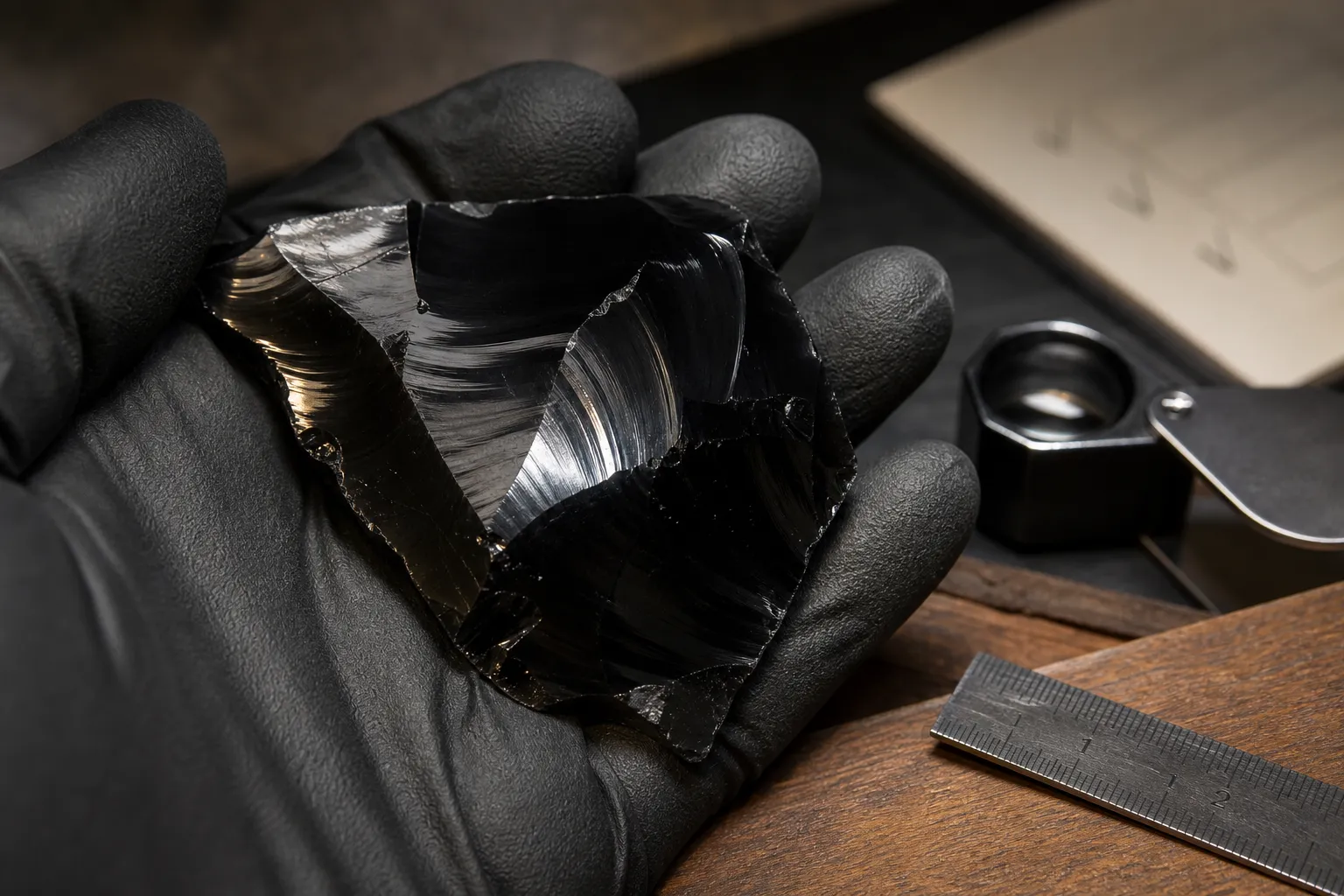
When the Label May Be Reasonable
An AAA label is not automatically suspicious. It may be a simple internal quality label used by a seller to organize inventory. It becomes more useful when the listing gives a plain explanation.
A stronger listing might say its top grade pieces are selected for bright polish, minimal visible chips, strong sheen, or consistent color. That still does not create a universal obsidian quality label, but it gives you something to compare against the photos.
The label is also easier to judge when several pieces are shown side by side. If a seller shows standard, AA, and AAA pieces from the same batch, you can compare surface finish, pattern, and condition within that seller’s own system.
The useful question is not “Is AAA a real grade?” It is: “Can I see what the seller means by it?” If the listing answers that with clear photos and specific condition language, the grade has context. If it relies only on the letters, treat the claim as decoration.
Common Misunderstandings About AAA Grade Obsidian
AAA means the same thing across shops
It usually should not be read that way. Non-standardized obsidian grading means one seller’s top tier may overlap with another seller’s middle tier.
A higher grade proves a stronger symbolic effect
Some listings connect obsidian with personal meaning, ritual use, or spiritual language, but those claims are separate from visible quality. The AAA label should not be treated as evidence of a stronger outcome.
AAA means flawless
Obsidian can show natural visual variation, and finished pieces can have tiny handling marks even when they look attractive. A high-quality presentation may still include features that matter to a careful collector.
The grade proves price fairness
A seller may price a piece by size, carving labor, visual appeal, variety name, source story, or shop positioning. Without a stated grading method and comparable listings, the letters alone cannot establish value.
The narrow reading is the safest one: AAA is a seller’s quality phrase. It may point to better appearance within that seller’s inventory, but the listing must show why.
Questions to Ask Before Buying
If the piece matters to you as a collector, ask direct questions that tie the grade to visible details.
- What does AAA mean in this specific listing?
- Is the grade based on polish, color consistency, sheen, shape, or condition?
- Are there chips, cracks, flat spots, repaired areas, or edge marks?
- Can the seller provide close photos in natural or neutral light?
- For sheen obsidian, can the seller show the piece from different angles?
- Are the photos of the exact item or a representative example?
- What are the dimensions and weight?
- What happens if the received piece has damage not shown in the listing?
These questions do not require a universal grading system. They simply move the conversation from a broad obsidian listing quality term to inspectable details.
A Practical Way to Read the Listing
First, identify the object
Tumble, sphere, bracelet bead, carving, point, slab, cabochon, or raw edge piece all set different expectations. A polished sphere should not be judged like a rough specimen.
Second, match the claimed quality to the photos
If the listing says top grade, the images should show the surface closely enough to inspect shine, edge condition, and visible marks. If the item is a sheen variety, the photos should show that sheen rather than only a dark front view.
Third, check the seller’s language
Specific condition notes are more useful than heavy adjectives. “No visible chips in the photographed piece” gives you more to work with than “best quality” without detail. “Strong gold sheen shown under angled light” is clearer than “AAA” by itself.
This keeps the label in its proper place. It may organize the listing, but it should not replace inspection.
The Bottom Line
“AAA grade” on an obsidian listing most likely means the seller is presenting the piece as one of their higher-quality items. It may refer to polish, color consistency, sheen visibility, clean shaping, or fewer visible chips and cracks. The exact meaning depends on the seller.
Do not treat the AAA label as a universal standard, proof of authenticity, a value conclusion, or a symbolic result. Treat it as a claim that needs visible support.
Useful listings let you inspect the surface, edges, sheen, dimensions, and condition before you decide. For obsidian, the glassy luster matters more than the letters beside it.