
Collector handling note
Can Polished Obsidian Still Have Sharp Edges
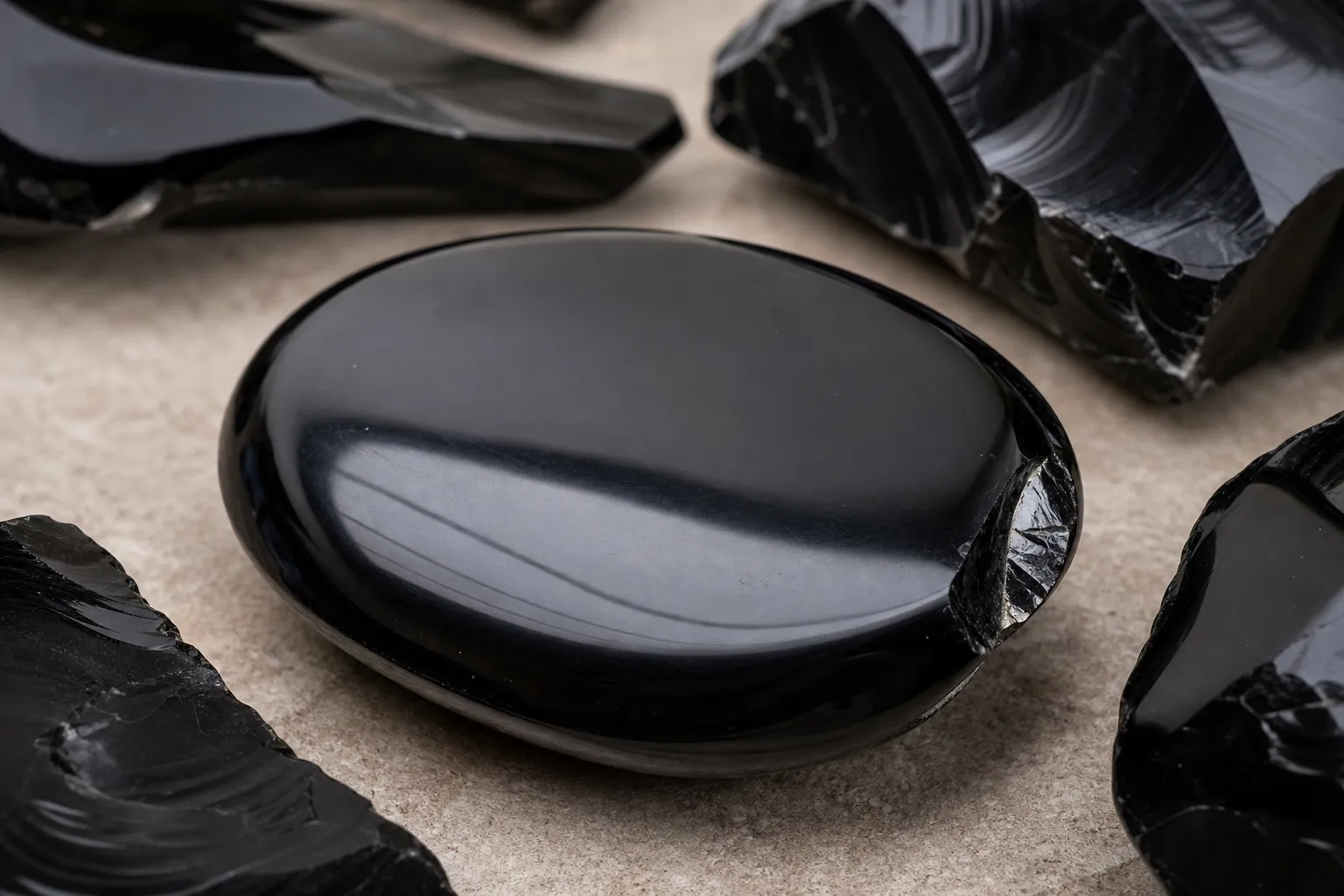
Yes. A polished obsidian piece can still have sharp edges, even when the main surface looks glossy and smooth. The important distinction is this: polish describes the surface finish; sharpness depends on the edge shape and any later damage.
A palm stone may feel rounded across the face but have a sharp chip near one side. A bead may be shiny on the outside but rough around the drilled hole. A slab may be polished on the front and back while the outer edge remains thin, crisp, or freshly nicked.
So if you are asking, can polished obsidian have sharp edges, the practical answer is yes—especially on chips, thin rims, pointed corners, drilled openings, slab edges, or breaks that happened after finishing.
upward
Read the full overview first
Use the broader guide first if you need the full scope before this page.
Why a Smooth Face Can Still Have a Sharp Edge
Obsidian is volcanic glass. That matters because glassy, brittle materials can break with thin, acute edges rather than wearing down like a soft pebble. A small chip or fresh fracture can expose a narrow glassy edge even if the rest of the piece has been polished.
Polishing and tumbling usually reduce roughness. They can round high spots, smooth surfaces, and create the glossy finish collectors expect from black obsidian, snowflake obsidian, mahogany obsidian, or sheen varieties. But polishing is not the same as making every edge blunt.
A lapidary finish may be excellent on the broad face while a corner, rim, or drilled opening remains more angular than expected. That is why a polished obsidian edge should be judged by the actual piece, not by the label alone. “Polished,” “tumbled,” “cabochon,” or “bead” tells you something about the finish, but it does not prove every contact point will be comfortable to handle.
Common places to check
- Tumbled obsidian chips with shiny faces but one thin leftover edge.
- Polished slabs with smooth fronts and crisp outer edges.
- Cabochons and pendants where the dome meets the back.
- Drilled obsidian beads with roughness around the hole.
- Towers, points, and carvings with intentional angular corners.
- Damaged polished obsidian where a fresh glassy fracture is exposed.
The polished face is not usually the issue. The small edge geometry is.
Where Sharp Spots Usually Show Up
A sharp edge on polished stone is often local. One small area can be the problem while the rest of the piece feels smooth.
Chips and Fresh Breaks
A chipped polished obsidian piece deserves a closer look. The chip may be tiny, but if it exposes a thin glassy edge, it can behave more like a shard than a rounded stone.
Look for a bright, clean-looking notch, crescent, or shell-like break along the side. Obsidian is known for conchoidal fracture—the curved, rippled break pattern also seen in glassy materials. On a collector piece, that may appear as a scooped chip or fresh-looking flake scar. The edge of that chip can be sharper than the polished surface around it.
Thin Rims
A polished obsidian thin rim can still feel sharp if the edge narrows to a crisp line. This can happen on slabs, flat pendants, cabochons with thin backs, decorative slices, and some polished bases.
This is different from a jagged break. A thin rim may be even, glossy, and intentional, but still uncomfortable for pocket carry or jewelry use.
Pointed Corners and Facets
A polished obsidian pointed corner is common on towers, pyramids, faceted pieces, freeform carvings, and display stones. The faces may be smooth, but the corner where they meet can still be acute.
Not every point is a problem. Many are simply part of the design. But if a corner catches fabric, presses sharply into your hand, or marks a storage tray, treat it as a handling concern rather than assuming the polish makes it harmless.
Drilled Bead Edges
A drilled obsidian bead edge can have tiny burrs or a ragged rim around the hole. The bead may be polished on the outside but less refined inside the perforation.
For beads and pendants, inspect both the outer edge and the hole. A rough drilled area can abrade cord over time, and it may also catch on fabric or feel irritating when worn.
Slab and Display Piece Edges
An obsidian slab edge may be squared, beveled, partly polished, or only lightly smoothed. The front can shine like a mirror while the side edge remains crisp.
This matters for display slabs, bookend-like pieces, cut bases, and flat-backed specimens. If the edge feels too crisp for loose storage, keep it away from softer stones, cloth pouches, and pieces with delicate polish.
How to Inspect Polished Obsidian Without Sliding Your Finger Along It
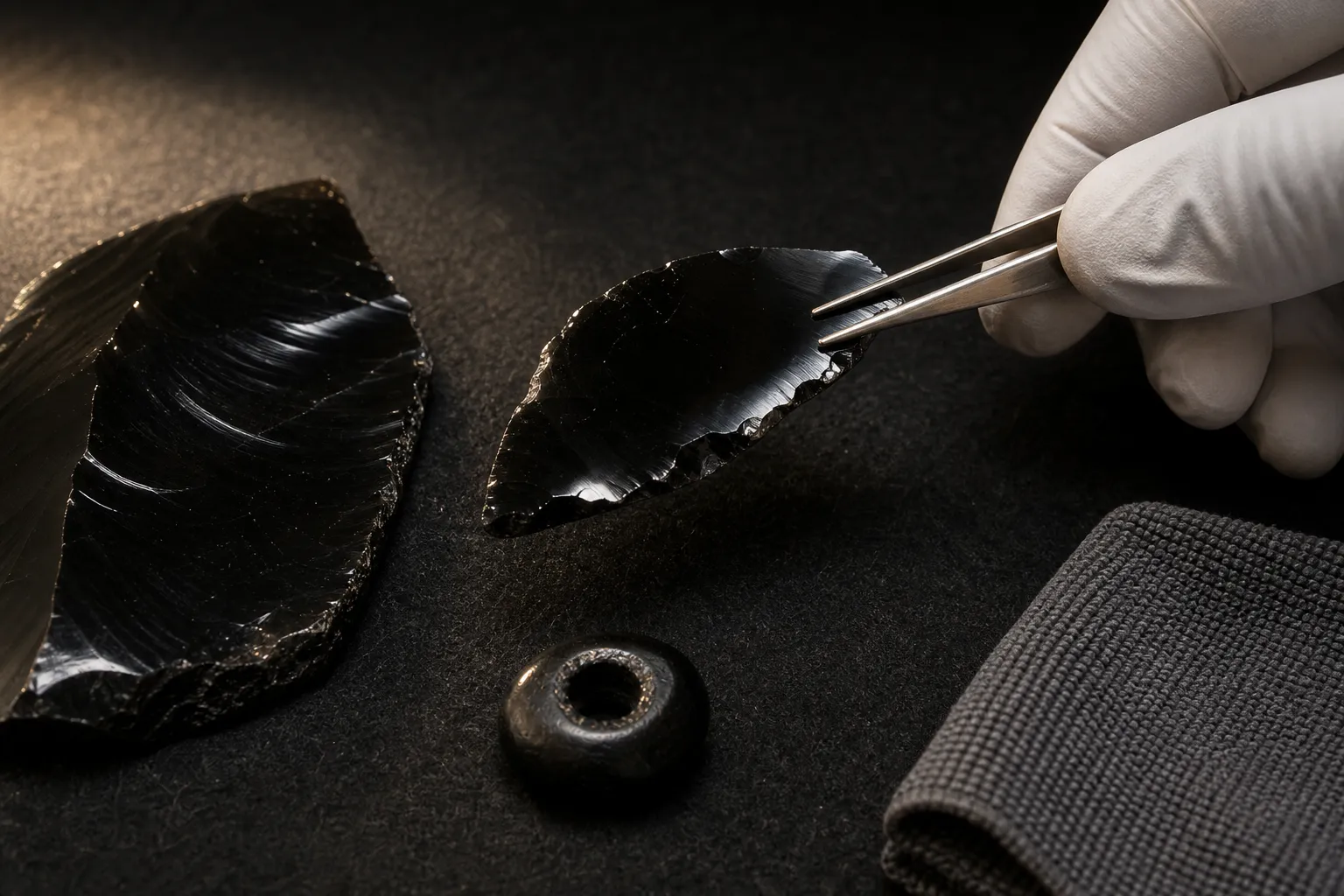
Start with your eyes, not your fingertip. Do not check a suspect edge by dragging your finger along it with pressure. A small glassy chip can be easy to underestimate.
Use this slower check instead:
- Look under angled light. Turn the piece near a window or desk lamp. Chips, thin rims, and fresh breaks often catch light differently from the polished face.
- Check the silhouette. Hold the piece so you can see its outline. Points, notches, uneven rims, and thin corners are easier to notice this way.
- Inspect holes and transitions. Beads, pendants, towers, carvings, and slabs often have sharpness where surfaces meet, not across the broad face.
- Touch lightly only if needed. If you must confirm a spot, touch near it slowly instead of sliding across it.
- Use fabric as a clue. If the piece snags a cloth pouch, jewelry cord, or sleeve, that is enough reason to treat the area as sharp or rough.
A smooth face with one sharp edge is not a contradiction. The stone can be genuinely polished and still have a problem spot.
What Polishing and Tumbling Can—and Cannot—Promise
Polishing can make obsidian more comfortable to handle, but it is not a universal guarantee. The result depends on the starting shape, how long the piece was worked, which abrasives were used, whether the edges were intentionally rounded, and whether damage occurred after finishing.
Tumbled stones are a good example. Tumbling often rounds pieces through repeated abrasion, but irregular chips can still come out with thin edges or small nicks. A tumbled stone may look glossy in a tray and still have one sharp spot along a remaining ridge, especially if it started as a thin fragment or angular chip.
Polished slabs and cabochons follow a different pattern. Their broad surfaces may be deliberately polished, while the edge treatment varies. Some edges are rounded and comfortable. Others are crisp because the maker wanted a clean outline, or because the side was not the main display surface.
The useful limit is simple: public references support the general idea that obsidian is glass-like, brittle, and capable of forming sharp fractured edges. They do not support a precise rule such as “all tumbled obsidian is blunt” or “all polished obsidian is sharp.” For a collector, the better rule is to inspect the actual piece.
What to Do If Your Polished Obsidian Has a Sharp Spot
The next step depends on how you use the piece.
Display stone
Place it where the sharp edge will not scrape shelves, snag fabric, or rub against other polished stones. A small stand, tray, or separate compartment can help.
Pocket stone or palm stone
Be stricter. If it has a chipped edge or pointed corner that presses into your hand, do not carry it loose in a pocket. It may scratch keys, tear a pouch, or feel uncomfortable when you sit or reach into the pocket.
Jewelry
Avoid wearing a sharp-edged pendant, bead, or cabochon against skin or clothing until the edge is smoothed, reset, or replaced. Pay special attention to drilled holes, back edges, and points that touch fabric. A rough bead hole can also wear down cord.
Newly broken piece
Handle the damaged area like broken glass. Keep it away from children and pets, wrap it before moving or storing, and avoid touching the fracture directly. If a piece has splintered into small fragments, do not store those fragments loose in a mixed crystal bag.
For a minor chip on a collector piece
- Store it separately with the chipped side protected.
- Use it only as a display piece, not a pocket stone or jewelry piece.
- Ask a lapidary worker whether the edge can be rounded or repolished.
- Retire it from regular handling if the chip continues to flake.
Do not assume decorative polished obsidian is suitable for cutting tasks just because obsidian can form sharp edges. Collector stones are finished for display, handling, or jewelry use, not tool performance. A glassy edge may also chip under pressure.
Common Misunderstandings About Polished Obsidian Sharpness
One common misunderstanding is that “polished” means “smooth everywhere.” It does not. It usually means the visible surface has been abraded and finished to a smoother sheen. Edges, holes, corners, and later damage can still vary.
Another misunderstanding comes from dramatic talk about obsidian sharpness. Obsidian has a long history of being shaped into cutting edges, which helps explain the association. But that does not mean every polished palm stone, bead, tower, or cabochon is blade-like. A deliberately fractured cutting edge and a polished collector object are different things.
The practical middle ground is the most useful one: polished obsidian is often comfortable to hold, but any chipped edge, fresh break, thin rim, drilled bead edge, or pointed corner should be inspected before regular handling.
Quick Answer for Collectors
Polished obsidian can still have sharp edges when the edge is thin, chipped, freshly broken, pointed, drilled, undercut, or not fully rounded during finishing. The glossy surface does not cancel the glassy fracture behavior of the material.
If the piece feels sharp, snags fabric, shows a fresh chip, or has a crisp rim, handle that area carefully and store the piece separately. If it is jewelry, avoid wearing it against skin or clothing until the edge issue is addressed. For broken obsidian, treat the damaged area like glass and avoid direct contact with the fracture.