
Practical handling guide
How to Handle Obsidian with Broken Edges
Handle broken obsidian much like broken glass: do not rub the edge with bare fingers, do not drop it back into a pouch with other stones, and do not assume a polished piece is harmless after a fresh chip. The practical answer to how to handle broken obsidian is to isolate it first, inspect it without touching the break, contain any loose flakes, wrap or box it separately, and then decide whether the piece can stay on display, needs lapidary smoothing, or should be retired because the fragments are too sharp or unstable.
Obsidian is volcanic glass. A fresh break can leave a curved, glass-like edge that is hard to judge by sight alone, so treat the sharpness as real until you have inspected it carefully.
upward
Read the full overview first
Use the broader guide first if you need the full scope before this page.
First steps when you notice a broken edge
If you are already holding the piece, slow down before turning it over in your hand. A chipped obsidian point, palm stone, rough chunk, pendant, or carving can have one obvious break and several smaller slivers nearby.
A careful first response:
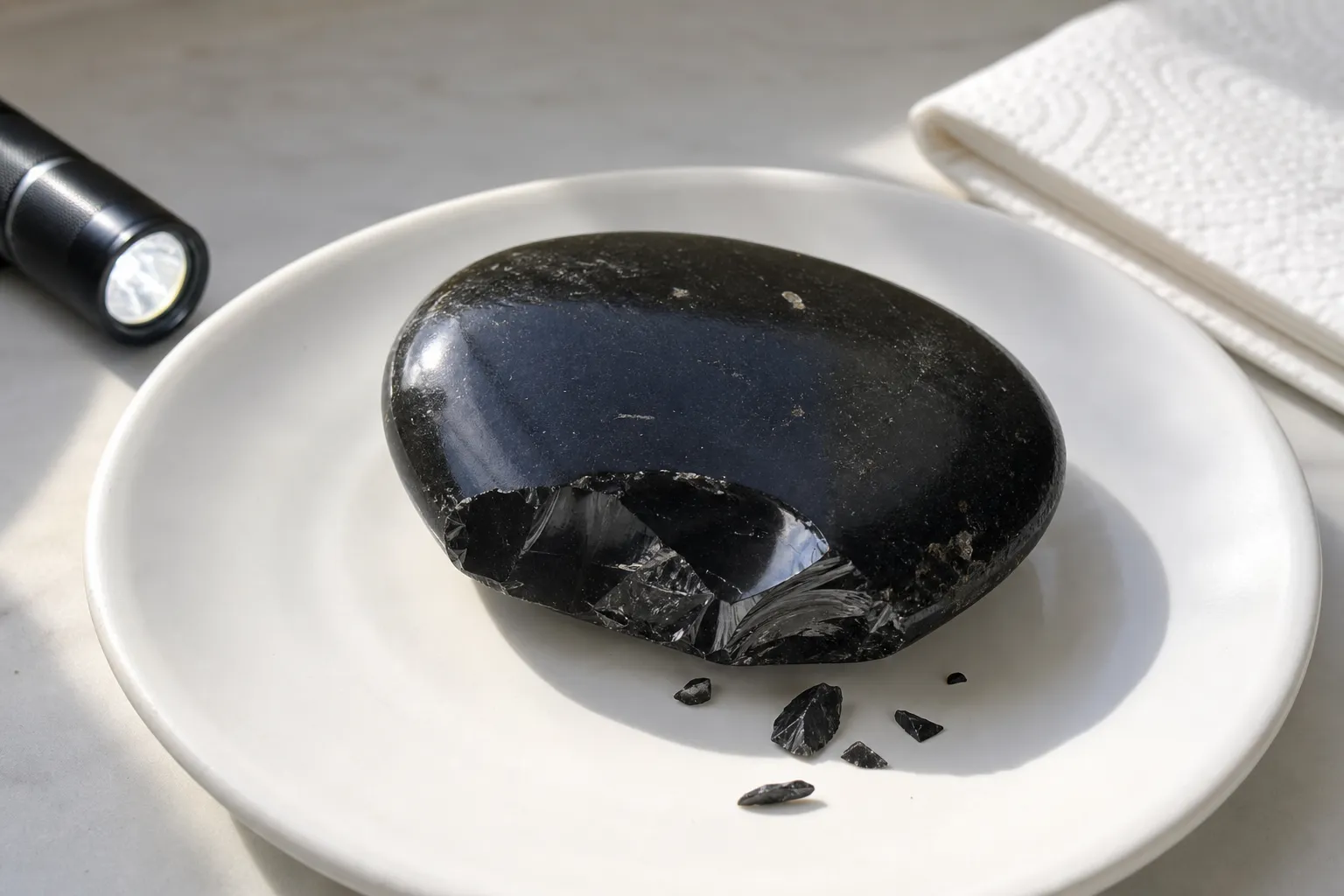
- Set it down on a clear, hard surface. Use a tray, plate, sheet of paper, or clean tabletop where tiny dark flakes are easier to see. Avoid beds, carpets, towels, and soft fabric that can hide loose obsidian slivers.
- Do not test the edge with your fingertip. Fresh obsidian chip edges can be thin and glass-like. If you need to move the piece, grip only the unbroken sides or use a folded paper towel, cardboard, or another barrier.
- Look for loose flakes before cleaning or wrapping it. Check the bag, box, shelf, or pouch where the piece was stored. Small slivers can be difficult to spot, especially on dark fabric.
- Keep it away from casual handling. Do not pass it around, leave it where a child or pet can reach it, or put it back into a mixed bowl of stones.
- Contain the damaged area. Wrap the piece in paper, bubble wrap, foam, or cardboard and place it in a separate container until you decide what to do next.
This is collector-level caution, not a professional safety procedure for every object. The point is simple: obsidian is glassy, brittle, and capable of forming sharp broken edges.
How to inspect chipped obsidian without touching the break
Inspection helps because not every chip changes what you should do with the piece. A small dull bruise on one side is different from a sharp edge exactly where your fingers naturally grip the stone.
Use light, distance, and a stable surface rather than touch.
Place the piece under bright, angled light and rotate it slowly by the intact sides. Fresh breaks often look glossier or cleaner than older, weathered, or polished surfaces. You may see curved fracture lines, thin feathered margins, or a shell-like break pattern. That curved pattern is often called conchoidal fracture, a smooth curved break commonly associated with glassy materials and chipped stone.
Look for these signs
- Fresh shiny breaks that catch light differently from the older surface
- Thin, feather-like edges along the chip
- Needle-like points or corners where two broken surfaces meet
- Loose obsidian flakes in the storage bag, box, or display area
- Black grit or tiny slivers around the piece
- A sharp edge in a grip zone
- Cracks leading away from the chip
If the piece is a polished palm stone, do not assume the whole object remains smooth. One fresh chip can expose an edge unlike the polished surface around it. If it is rough obsidian, assume the irregular high points may be sharper than they appear.
A quick handling judgment
After inspection, sort the piece into a practical category:
Small dull chip, no loose flakes, no sharp grip point
This is mostly a cosmetic or condition issue. The conservative next step is to store it separately and handle it by intact sides.
Sharp edge, but the piece is stable and worth keeping
This creates a contact hazard during casual handling. Wrap it, label it, display it without hand contact, or ask about smoothing.
Loose slivers, unstable cracks, or exposed cutting edge
There is more chance of cuts or further shedding. Isolate it in a rigid container and consider lapidary help or disposal.
This judgment does not prove the piece is harmless. It simply helps you choose a more careful next step.
Temporary containment for sharp obsidian edges
The goal is not to “fix” the stone instantly. The goal is to prevent surprise contact with the broken surface and keep small fragments from spreading into pouches, shelves, or other stone containers.
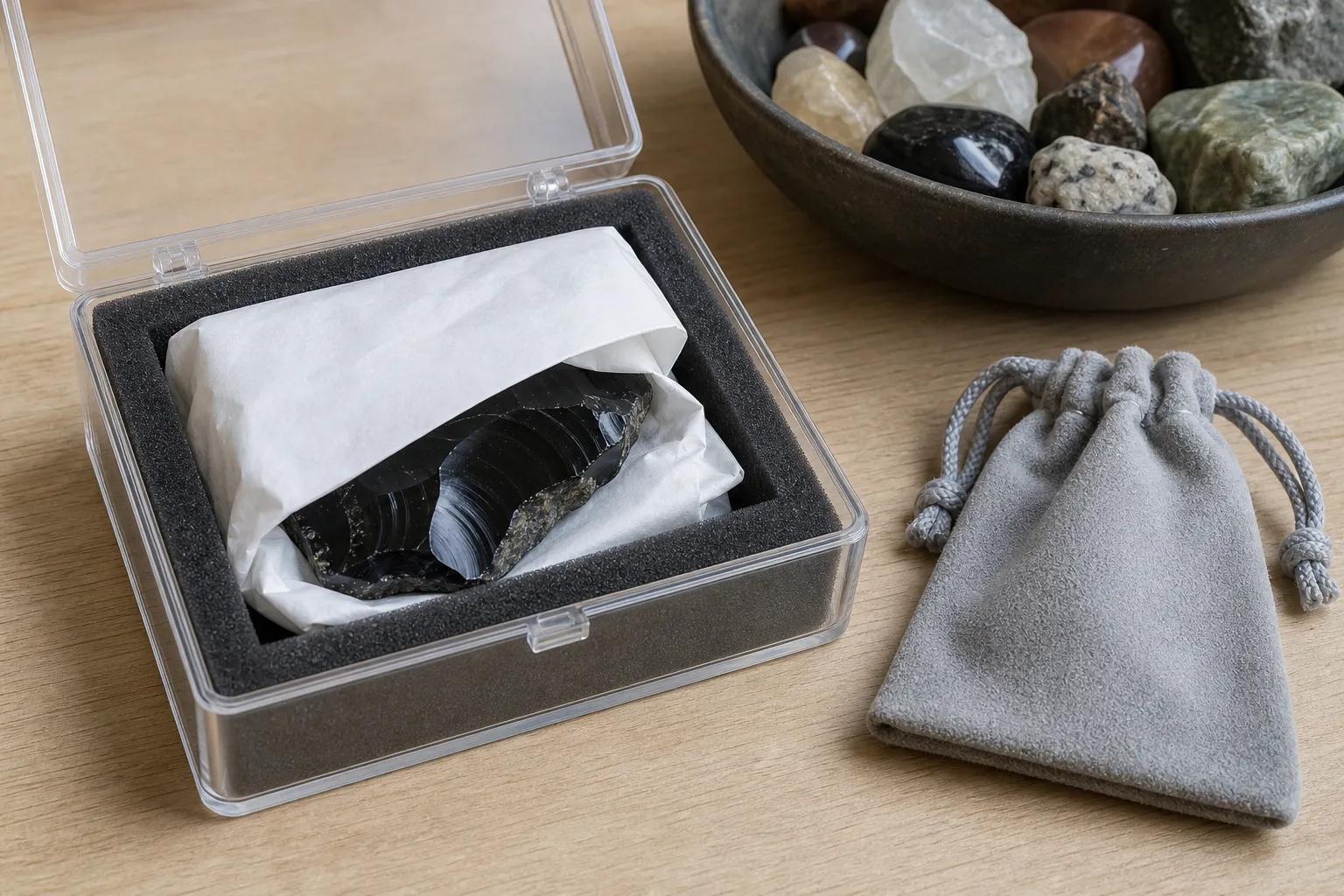
- Use a rigid container when possible. A small lidded plastic box, specimen box, structured jewelry box, or sturdy cardboard box is better than a loose cloth pouch for a piece with a cutting edge.
- Wrap the damaged area before storing it. Fold paper, bubble wrap, foam, or cardboard around the broken edge. The wrap should keep the edge from poking through during normal movement.
- Label the container. A note such as “sharp chipped edge” prevents you or someone else from reaching in casually later.
- Keep loose chips contained. If you find tiny obsidian slivers, do not brush them away with bare hands. Use paper, tape, or another careful collection method and seal them in a disposable or clearly marked container.
- Avoid fabric-only storage if the edge is sharp. Soft pouches are useful for many polished stones, but a sharp obsidian edge can catch on fabric, cut through thin material, or leave small flakes hidden in the weave.
- Separate it from other stones. Do not store chipped obsidian loose with tumbled stones, softer minerals, jewelry, or pieces you handle often. It can scratch other items, and other items can knock the chipped edge again.
If the piece has sentimental, symbolic, or collection value, containment gives you time to decide calmly. A broken specimen can still matter as a memory, display object, or personal symbol. That meaning is personal or cultural; it does not change the physical behavior of the broken glassy edge.
What not to do with broken obsidian
Many poor next steps come from treating obsidian as either ordinary rock or a quick tool project. Broken obsidian is a glassy volcanic material, and casual force can make the damage less predictable.
Do not rub the edge to “see if it is sharp”
A thin obsidian edge can cut before it feels dramatic. Inspect with light and distance instead.
Do not put it back into a mixed crystal pouch
A pouch full of stones can shift, rub, and hide fragments. If you later reach in without looking, the broken edge may be the first thing your fingers find.
Do not hammer it into a better shape
Some hobbyists work obsidian rough for tumbling or lapidary projects, but that is different from caring for an already damaged collector piece. Breaking obsidian can send fragments in unexpected directions and create more sharp edges. This page is not a knapping, saw, rotary-tool, or hammer-and-chisel guide.
Do not assume tumbling will automatically solve it
Abrasion can round glassy edges in some lapidary contexts, but that does not mean every chipped obsidian piece belongs in a tumbler. Tumbling can change the finish, damage a shaped piece, break weak edges further, or miss the exact contact point that worries you. If the piece matters to you, ask someone experienced with lapidary work before using it as an experiment.
Do not rely on a pouch, glove, or box as a complete answer
Barriers reduce direct contact, but they do not make broken obsidian suitable for careless handling. A sharp point can shift, poke through weak wrapping, or shed small slivers if the piece is knocked around.
Keep, smooth, display, or discard?
Once the piece is contained, choose the least dramatic option that fits the condition of the object.
Keep it as-is if the chip is minor
If the edge is not sharp, no flakes are loose, and the break is not in a place you touch, you may simply store it separately and handle it with more care. For a collector, the note “small chip on one edge” may be enough. Condition matters, but not every chip makes a specimen unusable.
Display it without hand contact
If the piece is meaningful but has a sharp area, display may be better than regular handling. A stand, small tray, closed display box, or labeled specimen container can keep the object visible without inviting people to pick it up. Position the broken side so it is not exposed to casual brushing or reaching.
Ask about lapidary smoothing
For a sharp but otherwise stable piece, lapidary smoothing for obsidian may be worth asking about. Treat this as a consultation, not a home repair assumption. An experienced lapidary, rock club member, or qualified craftsperson can tell you whether the shape, thickness, fracture, and finish make smoothing reasonable.
Do not expect a guaranteed result. Smoothing can remove material, alter the appearance, change a polished surface, or reveal new imperfections. For carved, drilled, sentimental, or uncommon pieces, the visual tradeoff may matter as much as the handling improvement.
Retire or discard dangerous fragments
If the piece is actively shedding flakes, has tiny sharp fragments you cannot contain, or has an edge likely to cut someone during ordinary handling, retiring it may be the most sensible choice. Discard dangerous obsidian fragments in a way that keeps them contained, much as you would contain broken glass, rather than placing loose shards where someone else might handle them unknowingly.
If a cut involves embedded glass-like fragments, eye exposure, a deep wound, signs of infection, or a wound that does not clean easily, seek appropriate medical care. This page cannot assess an injury from a photo or description.
Common confusion around broken obsidian
Search results for obsidian can be noisy. A collector trying to solve a sharp-edge problem may run into game references, crystal meaning pages, or tool demonstrations that do not answer the immediate handling question.
Real obsidian is not the indestructible block many people know from games. It is volcanic glass, and its broken edges should be treated as physical edges, not fantasy material behavior.
Likewise, symbolic language around obsidian does not answer broken obsidian safety questions. Some owners keep obsidian for personal, cultural, or reflective reasons, and a broken piece may still feel important. But meanings do not determine whether a fresh chip can cut skin, shed slivers, or damage nearby stones.
The practical test is visible and physical: Where is the edge? Is it sharp? Are there loose flakes? Can it be stored so no one reaches into it accidentally?
Answer those questions conservatively, and you can decide whether the piece remains part of your collection, becomes display-only, goes to a lapidary, or leaves the collection altogether.