
Why Broken Obsidian Edges Can Be So Sharp
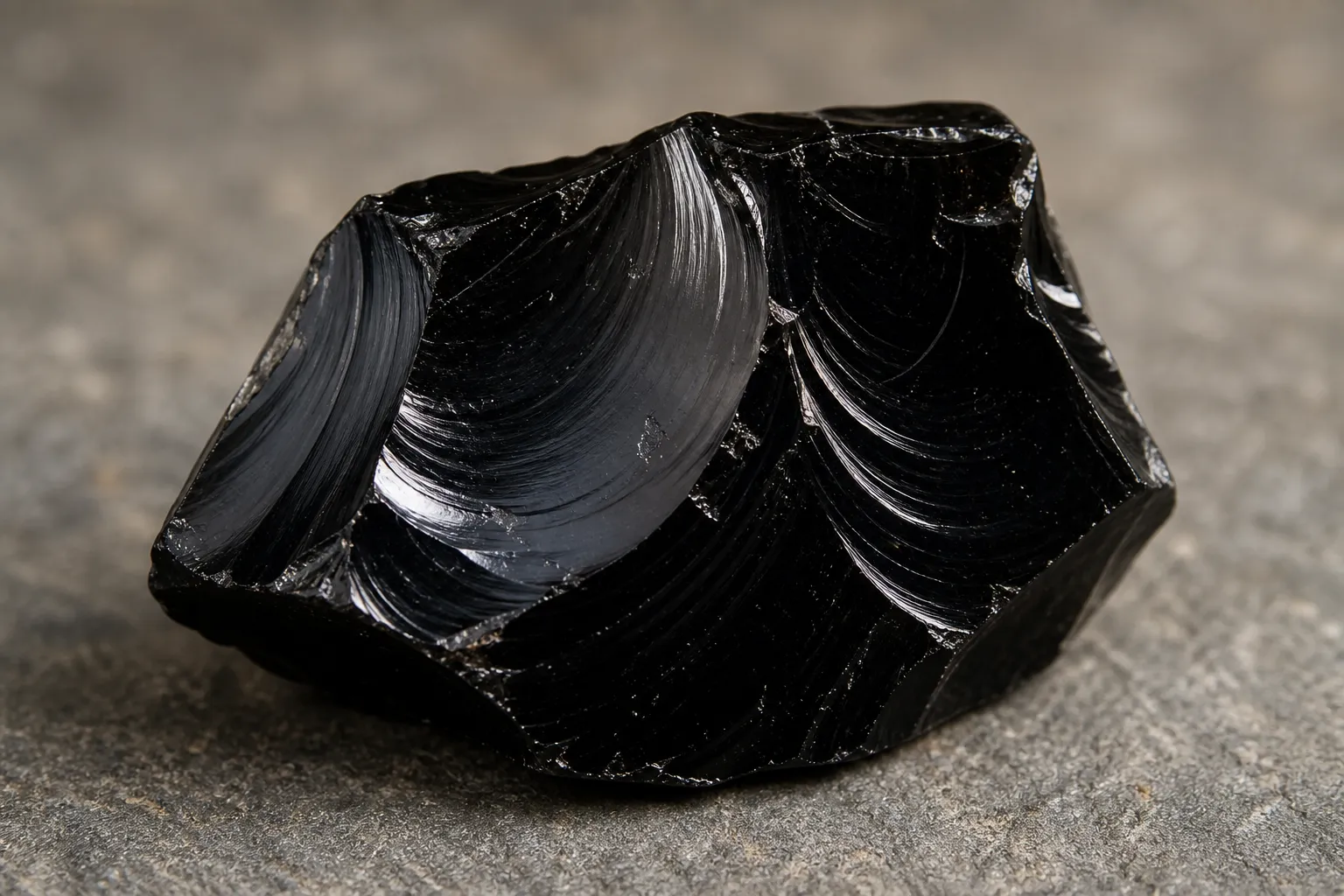
A fresh broken obsidian edge can be extremely sharp because obsidian is volcanic glass. When it breaks, it does not split around chunky mineral grains the way many crystalline rocks do. It can fracture in smooth, curved, shell-like flakes, a break pattern called conchoidal fracture.
That kind of break can leave a thin, continuous margin where two glassy surfaces meet at a very acute angle. Those obsidian sharp edges are real enough to cut skin, even on a small chip from a polished piece.
The important limit is this: sharp does not mean tough. Obsidian is brittle. A keen edge may chip, snap, or shed tiny flakes much more easily than a tougher manufactured blade material.
upward
Start with the broader guide
Use the broader guide first if you need the full scope before this page.
The short version: glassy break, thin edge
Obsidian forms when silica-rich lava cools quickly enough to become natural glass. For collectors, that matters because glass breaks differently from most visibly grainy stones. A fresh fracture can travel through the material in a smooth curve instead of stopping and starting around obvious crystals.
That curved break is why broken obsidian often shows glossy, flowing surfaces. If the fracture thins toward the margin, the edge can become narrow enough to feel razor-like. The sharpness is not necessarily made by polishing, a lapidary wheel, or a later sharpening step. It can come directly from the break.
You may notice this after:
- a polished palm stone, tower, or sphere chips at one corner;
- a tumbled piece breaks and exposes a glossy interior face;
- a natural shard shows a fresh, glassy flake scar.
The polished parts may feel smooth, while the new broken margin behaves more like broken glass. That contrast is why a damaged obsidian piece deserves different handling from an intact display stone.
Why conchoidal fracture makes sharp obsidian flakes
Conchoidal fracture means a material breaks with curved, shell-like surfaces. The term is often used for glass, flint, chert, and obsidian because these materials can produce rounded ripples, bulb-like features, and thin flake edges when struck or broken.
For this question, the useful point is simple: a conchoidal break can make a long, uninterrupted edge. Many rocks break into rough, granular, uneven surfaces. Obsidian can break into a smoother sheet-like flake, and the margin of that flake may taper to a very fine line.
Smooth glassy break surface
The fracture can pass cleanly through the glassy material.
Thin flake
Less material supports the edge, so the margin can become very narrow.
Acute edge angle
Two surfaces meet at a small angle, creating a keen cutting margin.
Continuous edge
A smooth section may cut more readily than a crushed or interrupted break.
This is also why obsidian appears in discussions of ancient flaked stone tools. It can be shaped into keen edges. But that context should not be stretched into saying every broken shard is a useful tool, or that obsidian is better than modern tool materials for ordinary use.
The same thinness that makes a fresh flake sharp also makes it easy to damage. Press it against something hard, twist it, drop it, or knock it against another stone, and the edge may chip.
Sharp does not mean tough or durable
A common misunderstanding is to treat “sharp” as if it means “strong.” With obsidian, those are separate traits.
Obsidian can form a very keen edge because it is glassy and can fracture into thin flakes. But it is still brittle volcanic glass. Brittle materials do not bend and recover like tougher metals. Under twisting, prying, impact, or hard contact, a broken obsidian edge can chip or snap.
That is why dramatic claims about obsidian knives need careful wording. It is reasonable to say that freshly fractured obsidian can be very sharp. It is not careful to repeat exact claims such as “50 times sharper,” “500 times sharper,” or “one molecule thick” without a clear measurement method and source. Those numbers circulate in hobby and market language, but they should not be treated as collector facts on their own.
It is also not very useful to turn this into a simple obsidian-versus-steel contest. Steel can be sharpened, resharpened, and supported by blade geometry designed for repeated use. Obsidian edges are renewed by flaking, and the thin glassy margin is more vulnerable to chipping. A fresh obsidian flake may be impressively keen, but that does not make a random broken piece a practical everyday knife.
For collectors, the takeaway is narrower: do not judge a broken obsidian edge by how smooth the rest of the specimen feels. The polished surface and the fresh fracture are different surfaces.
Why a polished piece can become hazardous after chipping
Polished obsidian is often sold as palm stones, spheres, towers, beads, cabochons, and display pieces. These forms are usually shaped so the surfaces feel smooth. Rounded edges reduce accidental snagging because no thin, fresh glass margin is exposed.
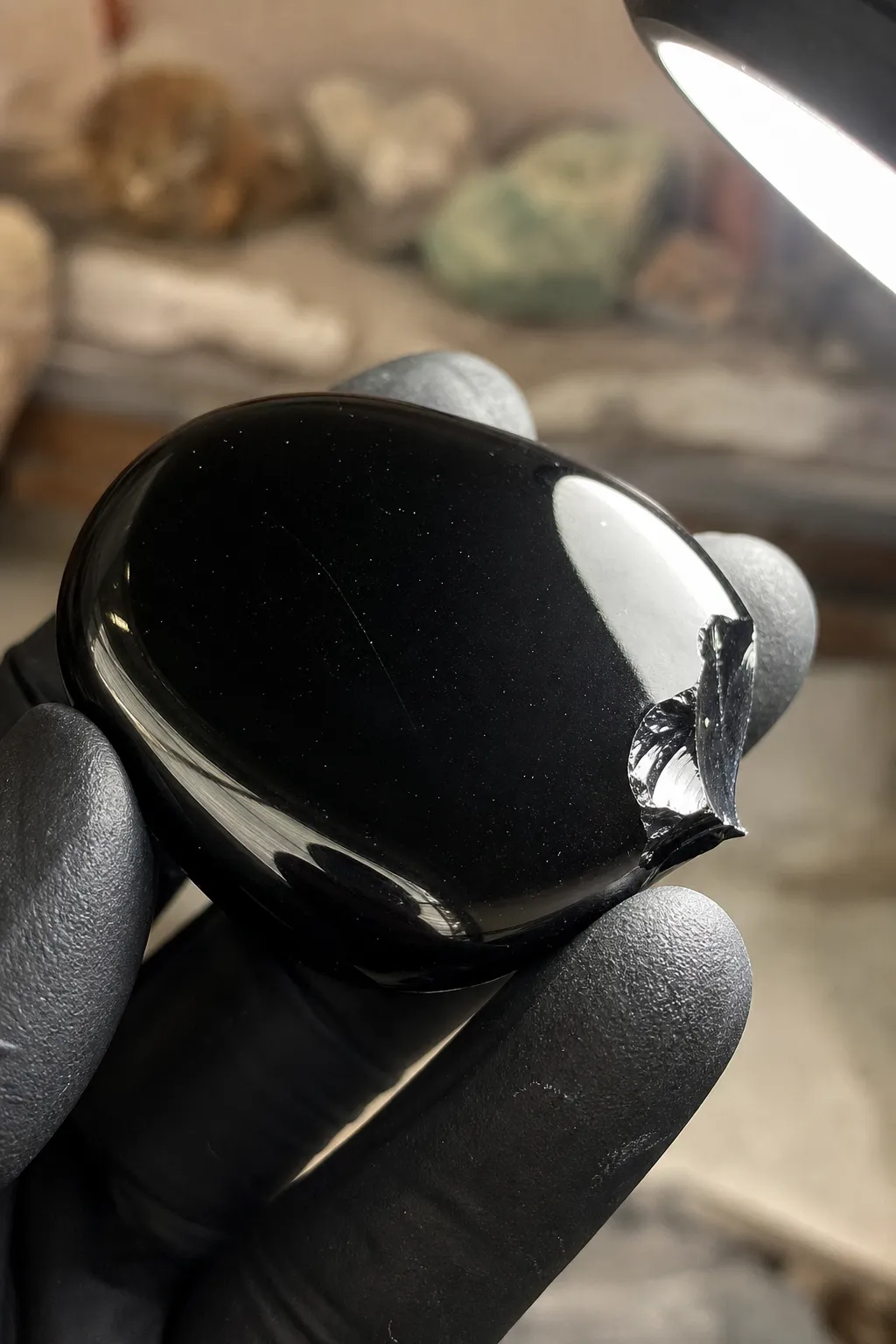
A chip changes that. When a polished piece hits a hard floor, another stone, or the edge of a shelf, the impact can remove a small flake. The new break may expose a thin glossy lip or a tiny point. On black obsidian, that point can be hard to see.
After a drop or impact, look for:
- a bright, fresh, glassy crescent at the damaged spot;
- a corner that feels snaggy compared with the surrounding polish;
- tiny splinters or flakes near the object;
- a thin edge that flashes only when tilted in light;
- a break that looks smoother and sharper than the older outer surface.
Do not test the edge on your skin. If you need to inspect it, use strong light, rotate the piece slowly, and look for reflections along the broken margin.
This matters especially with dark material. Black obsidian can hide small chips because the edge may not stand out against the body of the stone. Snowflake obsidian, mahogany obsidian, and sheen varieties can chip too, though contrast or patterning may make some breaks easier to notice.
How to handle broken obsidian
If an obsidian piece breaks, treat it more like broken glass than like an ordinary scratched crystal. Slow down before picking through the pieces.
A practical collector routine:
- Avoid the broken margin. Pick up the piece by a dull, rounded, or polished area if one is available.
- Check the surrounding surface. Small flakes can scatter after a fall.
- Use a barrier when sorting fragments. Gloves, folded paper, or a cloth can help keep thin shards away from your hands.
- Wrap sharp fragments before storage. A small box, folded paper, or separate bag keeps the edge from scratching other stones or catching a hand later.
- Keep damaged pieces away from children and pets. Small glossy chips are easy to miss.
- Do not use the shard as a tool. A sharp broken edge is not the same as a stable blade made for controlled use.
If the piece has collector value, sentimental value, or an unusual sheen pattern, store it separately until you decide whether to keep it as-is, ask a lapidary worker about re-polishing, or retire it from handling. Home grinding or “quick fixes” can create more chips, sharp fragments, and stone dust.
What changes how sharp the edge feels
Not every broken obsidian edge is equally sharp. The material, the break, and later wear all matter.
A fresh, thin flake is usually the sharpest situation people notice. A rounded old break, weathered surface, or heavily abraded edge may feel much duller. If the piece was tumbled after breaking, the margin may be softened. If it broke recently and the flake came off cleanly, the edge may be much more acute.
Several factors affect the result:
- Freshness of the break: newly exposed glassy edges are often keener than worn or weathered ones.
- Flake thickness: thinner flakes can create finer margins.
- Break angle: a narrow meeting angle creates a sharper edge than a blunt fracture.
- Edge continuity: a smooth, uninterrupted edge can cut more readily than a crushed or stepped edge.
- Later abrasion: tumbling, rubbing, storage contact, or handling can dull or chip a fine edge.
- Natural variation: obsidian may contain tiny inclusions, flow features, or altered zones, so not every piece breaks identically.
So the answer to “is obsidian sharp?” is conditional: freshly broken obsidian can be very sharp, while a rounded, polished, or weathered piece may have no exposed cutting edge at all.
Common claims to treat carefully
Obsidian sharpness is visually impressive, so it attracts exaggerated language. Some claims begin with a real observation and then go too far.
A careful version is:
Fresh obsidian flakes can have very fine edges because obsidian is volcanic glass and commonly breaks with conchoidal fracture.
Less careful versions claim that obsidian is automatically the sharpest material, always superior to steel, able to stay sharp through any use, or suitable for body-related or clinical purposes. Those claims mix sharpness with durability, cleanliness, tool design, and outcome claims that this page is not verifying.
A broken obsidian edge can cut because it is thin and glassy. That does not make a random shard appropriate for food preparation, body use, hunting, survival tasks, or improvised procedures. For a collector, the right response to a sharp break is careful handling and storage, not testing or using the edge.
Bottom line for collectors
Broken obsidian edges can be so sharp because obsidian is natural volcanic glass, and fresh conchoidal fractures can create thin, smooth, acute margins. The same glassy brittleness that allows sharp flakes also makes those edges fragile and prone to chipping.
If your polished obsidian has chipped, assume the new break may be sharp even if the rest of the piece feels smooth. Inspect it visually, avoid touching the broken margin, isolate loose fragments, and store the damaged piece where it cannot catch skin, fabric, or nearby stones. Sharpness is part of obsidian’s material character, but it is not a reason to treat a broken shard as a practical tool.