
Condition and value
How Chips, Scratches, and Cracks Affect Obsidian Value
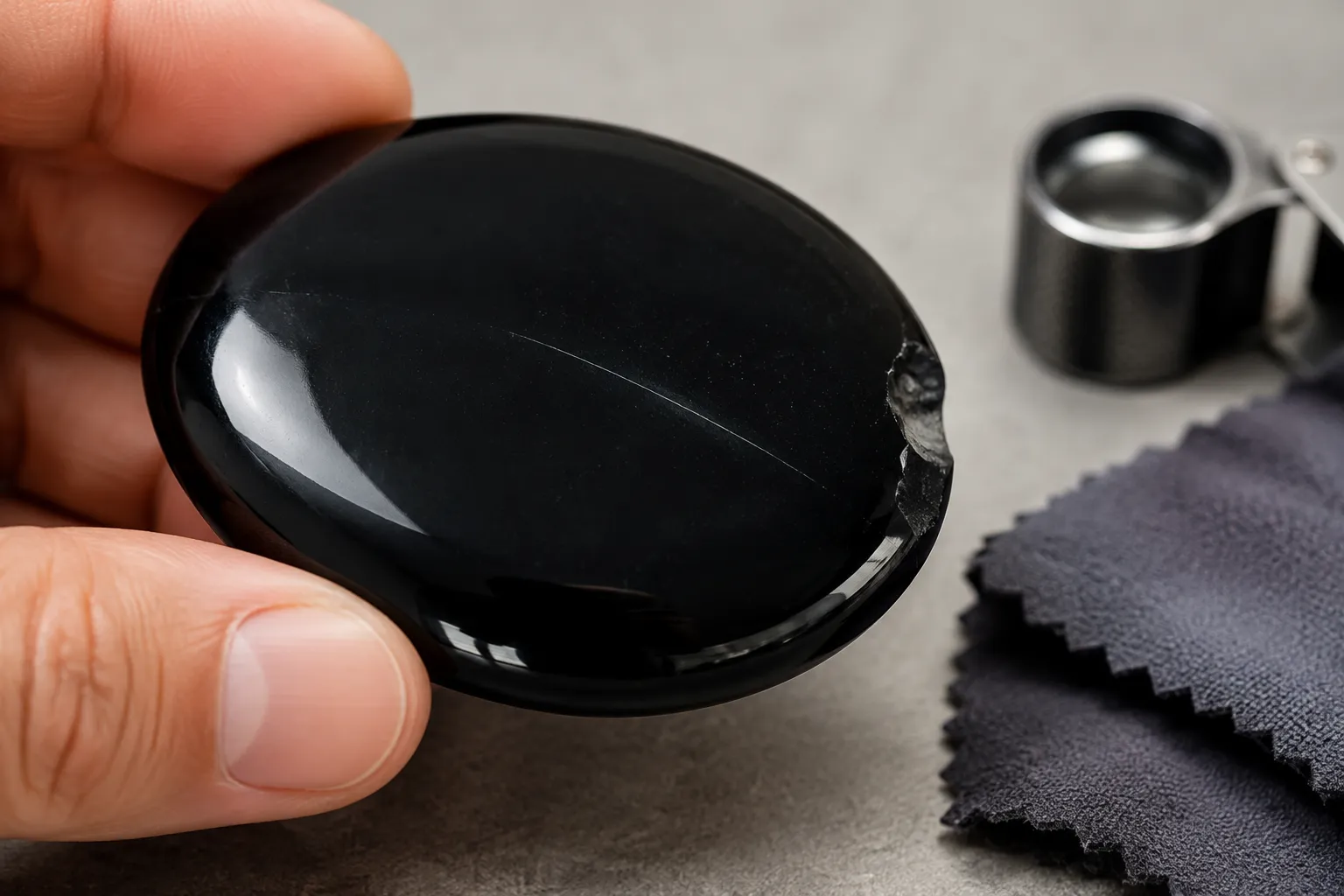
A bright chip on a glossy black edge can change an obsidian piece immediately. Chips, scratches, cracks, and visible repairs usually lower damaged obsidian value when they interrupt the display face, dull the polish, weaken the outline, create a sharp handling point, or need clear disclosure during resale. The effect is not one fixed percentage.
A tiny edge nick on rough material may be minor. The same nick on a polished sphere, cabochon, carving, jewelry stone, or high-display specimen can be much more noticeable. Cracks matter most when they reach an edge, cross the main viewing area, catch a fingernail, or suggest the piece may separate. Repairs can improve appearance, but they do not return the piece to the same condition as undamaged material.
upward
Read the full overview first
Use the broader guide first if you need the full scope before this page.
The Short Rule: Visibility, Stability, and Disclosure
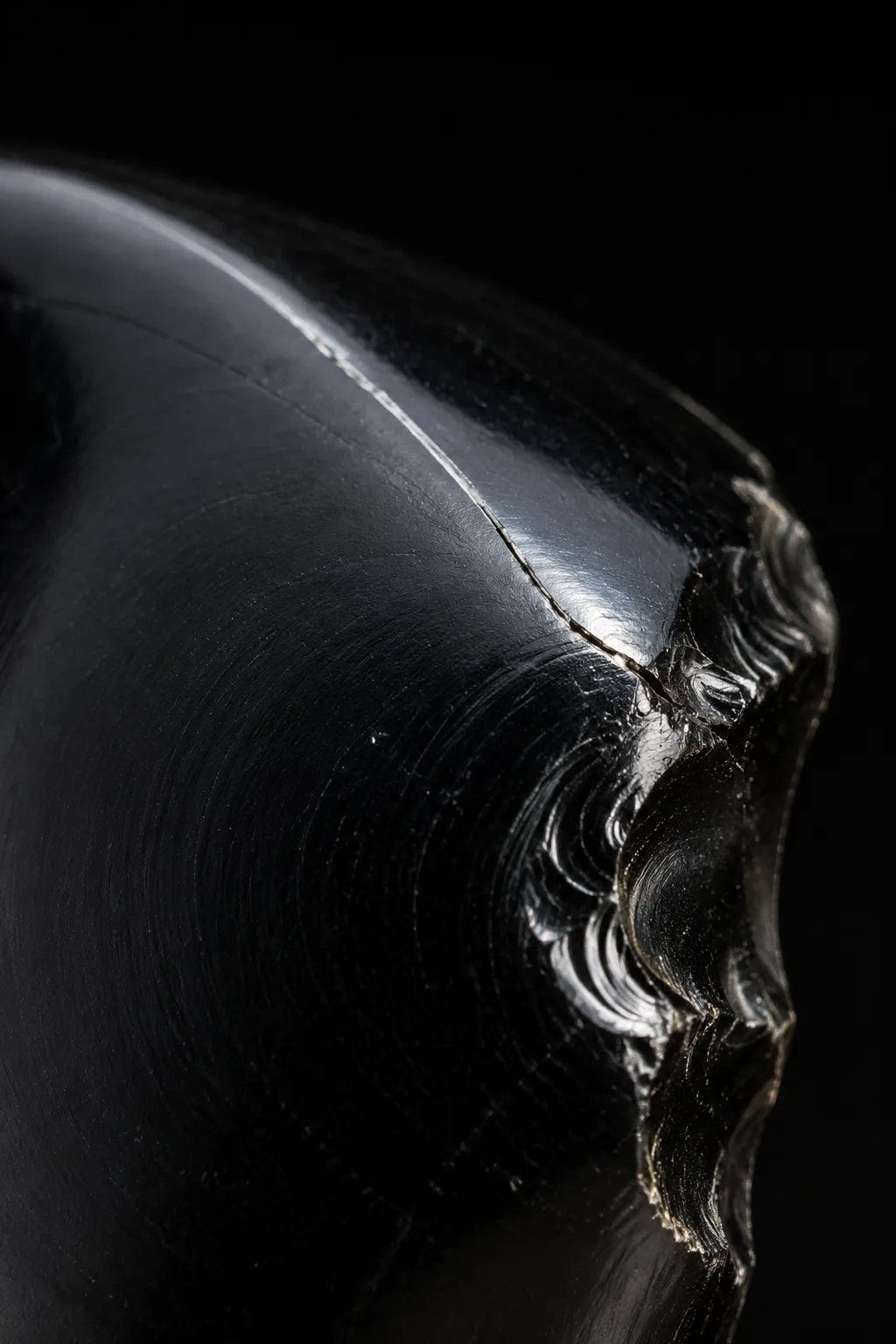
Obsidian is natural volcanic glass, not a crystal in the usual mineral-collector sense. Its glassy luster and curved fracture surfaces make condition easy to see under light. A scratch that would look faint on a dull stone can flash white or gray across polished black obsidian. A fresh break can expose a sharp, curved fracture edge that changes both appearance and handling.
Start with three questions
- Can I see the flaw from normal display distance?
- Does it affect the outline, polish, symmetry, or main viewing face?
- Would I need to mention it clearly if I sold or traded the piece?
If the answer is yes to any of these, the condition affects value. It may affect value slightly or heavily, depending on the object type, but it belongs in the description.
This is why chipped obsidian value cannot be judged by weight alone. A heavier stone with a damaged display face may be less desirable than a smaller, cleaner one. Variety, size, polish, workmanship, visual appeal, and demand still matter; condition changes how those strengths are read.
Chips: Edge Nicks, Missing Corners, and Fresh Breaks
Chips are usually the easiest damage to judge because they remove material. Look for a missing spot along the edge, a dull bite in a polished outline, or a bright fresh fracture that does not match the older surface.
On rough obsidian, chips can be harder to separate from natural fracture texture. Rough pieces often already have broken, curved, glass-like surfaces. A later chip may look fresher, cleaner, brighter, or sharper than surrounding weathered areas, but appearance alone does not reliably date a break. For rough chunks, chips matter most when they remove a visually important feature, create a loose fragment, or make the piece unpleasant to handle.
On polished pieces, edge chips usually matter more. A palm stone, sphere, cabochon, bead, pendant, or carving depends on a clean outline and continuous luster. A nick along the rim can catch light repeatedly. A missing corner can break symmetry. A chip on the front of a carving can distract from the workmanship even if the piece remains intact.
A chip is more serious when it is
- On the display face rather than the back or underside
- Large enough to interrupt the silhouette
- Fresh, bright, or sharp compared with the surrounding polish
- Near a drilled hole, thin point, setting, or carved detail
- Likely to cut, snag, or continue breaking during handling
A small edge nick on a low-cost palm stone may only be a handling and disclosure note. A sharp missing point on a carved figure, cabochon, or display specimen is a stronger condition issue. Judge the damage against the job the object is meant to do.
Scratches and Abrasion on Glossy Black Obsidian
Scratches usually affect eye appeal more than structure. They still matter because polished surface quality is part of obsidian’s appeal. Glossy black obsidian scratches can appear as pale lines, cloudy streaks, or dull patches when the stone is tilted under a lamp.
Do not inspect only straight on. Rotate the specimen slowly under one steady light source. Many scratches disappear from one angle and stand out sharply from another. That matters for buying photos, too: soft, flat lighting can hide surface damage that would be obvious in hand.
A scratched obsidian specimen is more affected when the marks cross the best viewing area, cut through sheen or color banding, or create a rubbed matte patch on a surface that should look mirror-like. On snowflake obsidian, mahogany obsidian, or rougher decorative pieces, small marks may be less visually dominant than on plain polished black material. On rainbow, gold sheen, or silver sheen pieces, surface damage can be more distracting if it interrupts the reflective effect.
Repolishing may reduce some scratches, but it removes material and can alter shape, size, edges, or carved detail. That matters for cabochons, beads, carvings, and matched jewelry components.
A practical description is better than a guessed discount: if the mark is visible only under close light, call it light surface wear. If it can be seen from display distance, crosses the main face, or dulls the luster, treat it as visible obsidian surface damage.
Cracks Need the Most Caution
Cracks deserve more attention than ordinary scratches because they may affect both appearance and stability. In obsidian, a crack may show as a dark line, pale line, internal-looking seam, open fracture, or line that reaches the edge. Some lines are part of the material or an older fracture pattern; others are later damage. The useful question is not only what to call the line, but what it does to the piece.
Obsidian crack severity rises when the crack
- Crosses the main display face
- Reaches an edge or corner
- Widens at any point
- Catches a fingernail
- Runs through a thin area, drilled hole, setting, or carved detail
- Looks connected to an existing chip or missing area
- Makes the piece feel loose or unstable during careful handling
A closed internal-looking line that does not reach an edge may be mostly a visual issue. An open crack across a polished face is more serious. A crack running into an edge chip can suggest that the piece may continue to lose material, especially if it is handled often.
Do not assume that every line means the piece is imitation material. Damage, polish marks, natural fracture features, internal-looking lines, coatings, and substitutions are different questions. A chip or scratch by itself does not prove what the material is. If the piece is expensive, unusual in color, structurally questionable, or being sold with a strong variety claim, ask for in-person review by a qualified lapidary, jeweler, or appraiser.
For ordinary collecting, record cracks plainly: location, length, whether the line reaches an edge, whether it catches a fingernail, and whether it appears on the front or back. That is more useful than a vague label such as “good condition.”
Repairs, Repolishing, and Disclosure
Repaired obsidian value is a separate condition question. A repair may make a piece more attractive than leaving a sharp break exposed, but it should not be treated as original undamaged condition.
Common repair or treatment language includes repolished, recut, filled, sealed, oiled, glued, restored, and stabilized. These words do not all mean the same thing.
Repolishing
Repolishing usually means the surface has been worked again to reduce scratches, dullness, or small chips. It may improve luster, but it can soften edges, reduce size, remove carving detail, or change the original shape. Repolished obsidian value depends on whether the work improves the display without making the piece look overworked or uneven.
Recutting
Recutting is more intrusive. It can turn damaged material into a cleaner cabochon, bead, or smaller display piece, but the original object is changed. That may be reasonable for lapidary material and less acceptable for a collectible carving or specimen where original form matters.
Filling, sealing, oiling, or gluing
Filling, sealing, oiling, or gluing raises a stronger disclosure issue. These treatments may hide cracks, darken surfaces, reduce visible dryness, or hold a damaged area together. Public reference material does not support a single rule for how much such work changes value, but collector practice generally treats repair status as part of condition. If a repair is known, suspected, or visible, state it plainly.
Look for clues such as glossy material inside a crack, a line that looks wet compared with the surrounding surface, residue along a break, mismatched polish, or a repaired corner that reflects differently. These clues are not proof by themselves. They are reasons to ask better questions before buying.
Object Type Changes the Answer
The same flaw does not affect every obsidian object equally. Object type is one of the main reasons simple formulas fail.
Rough chunks
Rough chunks can tolerate some broken surfaces because fracture texture is part of the look. Chips matter when they remove a key feature, create sharp edges, or reduce usable lapidary material.
Polished palm stones and tumbles
Polished palm stones and tumbles depend on smooth handling. A small hidden nick may be minor, while a sharp chip or obvious scratched patch changes both feel and appearance.
Spheres
Spheres show interruption easily because the eye expects a continuous curve and reflection. A flat chip, bruise, or scratch field can be obvious as the sphere turns.
Cabochons and jewelry stones
Cabochons and jewelry stones are judged by face-up appearance, polish, outline, and setting security. A chip near a girdle, drill hole, or mounting point can matter more than a similar mark on the back of a display stone.
Carvings
Carvings depend on detail and silhouette. Damage to a base may be less important than damage to a face, point, wing, leaf, animal feature, or other carved focal point.
Blade-like forms and thin edges
Blade-like forms and very thin edges need extra handling caution. Their relevance here is not performance; it is that conchoidal fracture can leave glass-like edges that should be stored and handled carefully.
Display specimens
Display specimens are judged by what the viewer sees first. Obsidian display face damage usually matters more than underside damage, unless the underside affects stability.
A Quick Inspection Path Before You Buy, Sell, or Store It
Use a simple sequence before trying to assign a number.
- First, clean only with a gentle approach suited to the object. Do not scrub a fragile, repaired, or set piece aggressively. Dust and fingerprints can mimic dullness, but pressure can worsen a weak edge.
- Second, inspect under one steady light. Rotate the stone slowly. Note scratches, chips, cracks, cloudy polish, missing areas, and any line that reaches an edge.
- Third, separate cosmetic flaws from stability concerns. Scratches and light abrasion are usually polish issues. Cracks, sharp chips, loose areas, and damage near holes or settings deserve more caution.
- Fourth, match the flaw to the object type. A back-side scratch on a rough display chunk is not the same as a front-face scratch on a glossy cabochon.
- Fifth, write the condition in plain language. “Small chip on back edge,” “visible scratch across front polish,” “crack reaches left edge,” or “repolished surface with softened outline” is more useful than “minor wear” when value is being discussed.
For storage, keep polished obsidian away from harder stones, metal jewelry, and loose sharp fragments. Use a soft pouch, lined box, or separate compartment when the piece has a polished face or vulnerable edge. This is a practical way to reduce avoidable scratches and knocks, not a promise that no further damage can occur.
What Damage Does Not Tell You
Damage does not give a full appraisal. It also does not identify a variety by itself. A chipped edge may reveal translucency or a fresh curved fracture, but that does not settle every question about origin, treatment, or seller naming.
Damage also does not erase every kind of value. A rare-looking variety, strong sheen, attractive color band, large size, good craftsmanship, or sentimental importance may still make a damaged piece worth keeping. For resale, visible condition and repair disclosure still matter.
The strongest support for this answer is material-based: obsidian is volcanic glass, glassy polish makes surface damage visible, and broken glass-like edges deserve careful handling. Public reference coverage is thin for exact damaged obsidian value, especially for fixed price effects and repair outcomes. The better answer is not a discount formula. It is a condition reading.
Inspect the face, edge, polish, crack path, repair signs, and object type. Then describe what you can see.
FAQ
Does a chip make obsidian worthless?
Usually no. A chip can reduce value, especially on a polished face, sharp edge, carving detail, jewelry stone, or display specimen. On rough material, a small chip may matter less if it does not affect appearance, handling, or usable lapidary material.
Are scratches worse on black obsidian than on other varieties?
They can be more obvious on glossy black obsidian because pale lines and dull patches contrast strongly with the mirror-like surface. On sheen, rainbow, or banded pieces, scratches may also matter if they interrupt the main visual effect.
Can repolishing restore damaged obsidian value?
Repolishing may improve the look of some scratches or small chips, but it can remove material, soften edges, change shape, or reduce carved detail. A repolished piece should be described as repolished when that work is known or visible.
Should repairs be disclosed when selling obsidian?
Yes. Known or visible repairs should be stated plainly. Repair status affects how a buyer reads condition, stability, originality, and price, even when the repair improves appearance.
Can photos confirm whether a crack is serious?
Photos can show location, direction, and visibility, but they often miss depth, movement, edge reach, and whether a line catches a fingernail. For valuable, sharp, unusual, or structurally questionable pieces, in-person review is the better next step.