
Identification guide
Obsidian vs Black Agate: How Banding and Polish Affect Identification
If you are comparing obsidian vs black agate, do not stop at the black, glossy front surface. Start with the edges, thin spots, drill holes, chips, and how the stone behaves under angled or backlighting.
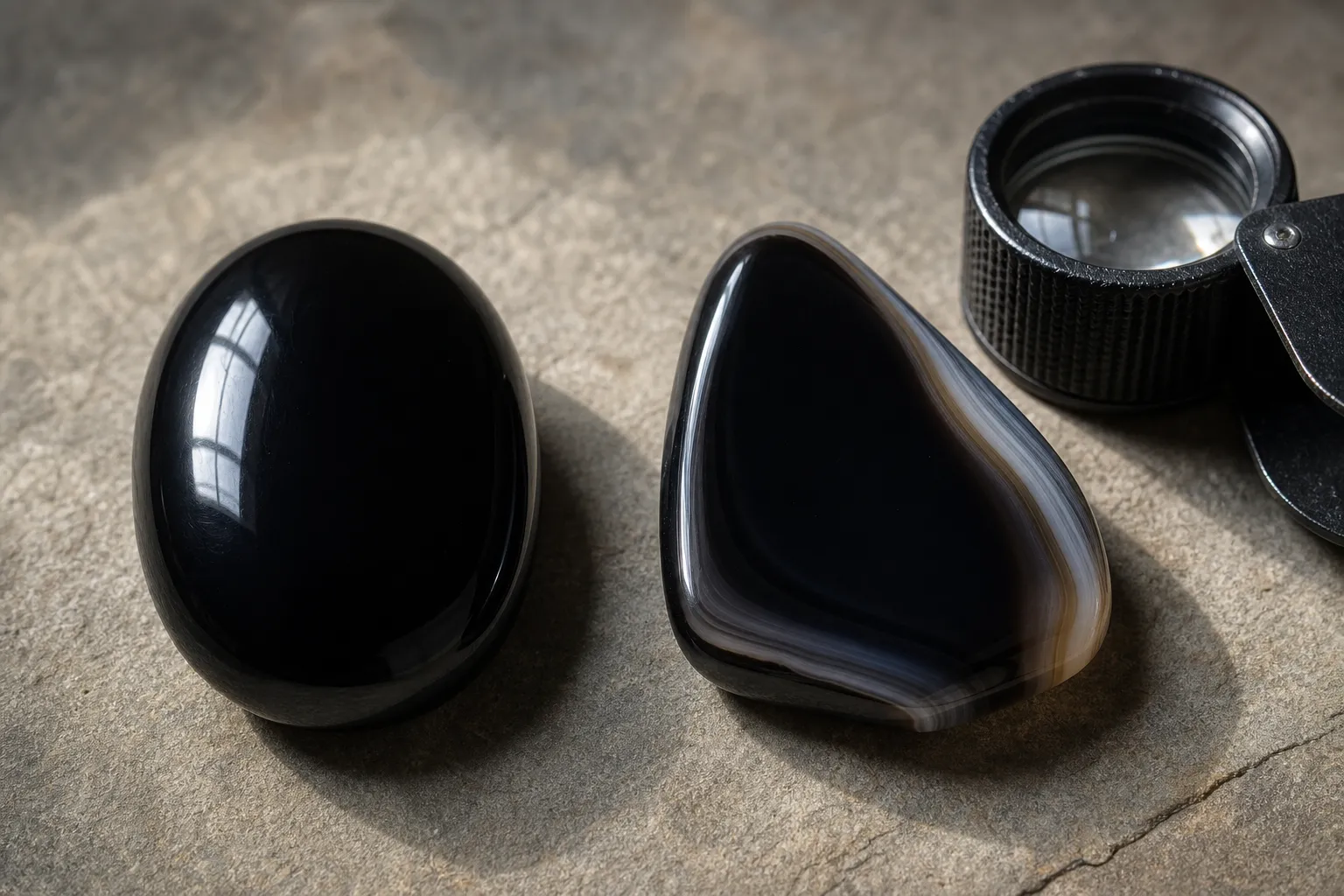
Obsidian is volcanic glass, so a polished piece often looks smooth, glassy, and visually uniform. Black agate is a chalcedony/quartz-family material, and agate is commonly associated with banding or patterned layers. Those bands may be obvious, faint, hidden by polish, or nearly impossible to see in a dark specimen.
The short answer: a plain, glassy, uniform black piece leans more toward obsidian; a black piece with repeated bands, layered translucency, or chalcedony-like zones leans more toward black agate. A shiny black surface by itself does not settle the question.
upward
Start with the broader guide
Use the broader guide first if you need the full scope before this page.
Quick comparison: what to look for first
Both stones can take a high polish, so luster alone is a weak clue. The better first question is: does the stone look like mostly uniform glass, or does it reveal layers?
| What you observe | More consistent with obsidian | More consistent with black agate |
|---|---|---|
| Face-up appearance | Smooth, glassy, often even in color | Glossy, but may show clouds, bands, or zones |
| Banding | May show flow textures, but not classic agate-style banding | Repeated banding or patterned chalcedony is a strong clue |
| Thin edges | May show smoky or brownish translucency in some pieces | Often shows uneven translucency, sometimes with layered effects |
| Chips or broken areas | Can look sharp, smooth, and glass-like | May look waxier, cloudier, layered, or microcrystalline |
| Seller label | “Obsidian” may be used loosely in listings | “Black agate,” “black onyx,” or “dyed black agate” may reflect trade naming |
This table is a sorting aid, not a final identification. Very dark stones, small beads, heavy polish, poor photos, and broad seller labels can all hide the details that matter.
Banding is the biggest clue, but not every stripe is the same
Banding is the main reason a black stone may lean toward agate instead of obsidian. Agate is commonly described as banded or patterned chalcedony, and its layers can record changes in silica structure, porosity, and coloring materials. For a collector, the practical point is simpler: agate often shows its structure as repeated bands or zones.
Look where polish is less likely to flatten the view
- Edges: Rotate the stone and inspect the rim for gray, brown, white, smoky, or dark-on-dark lines.
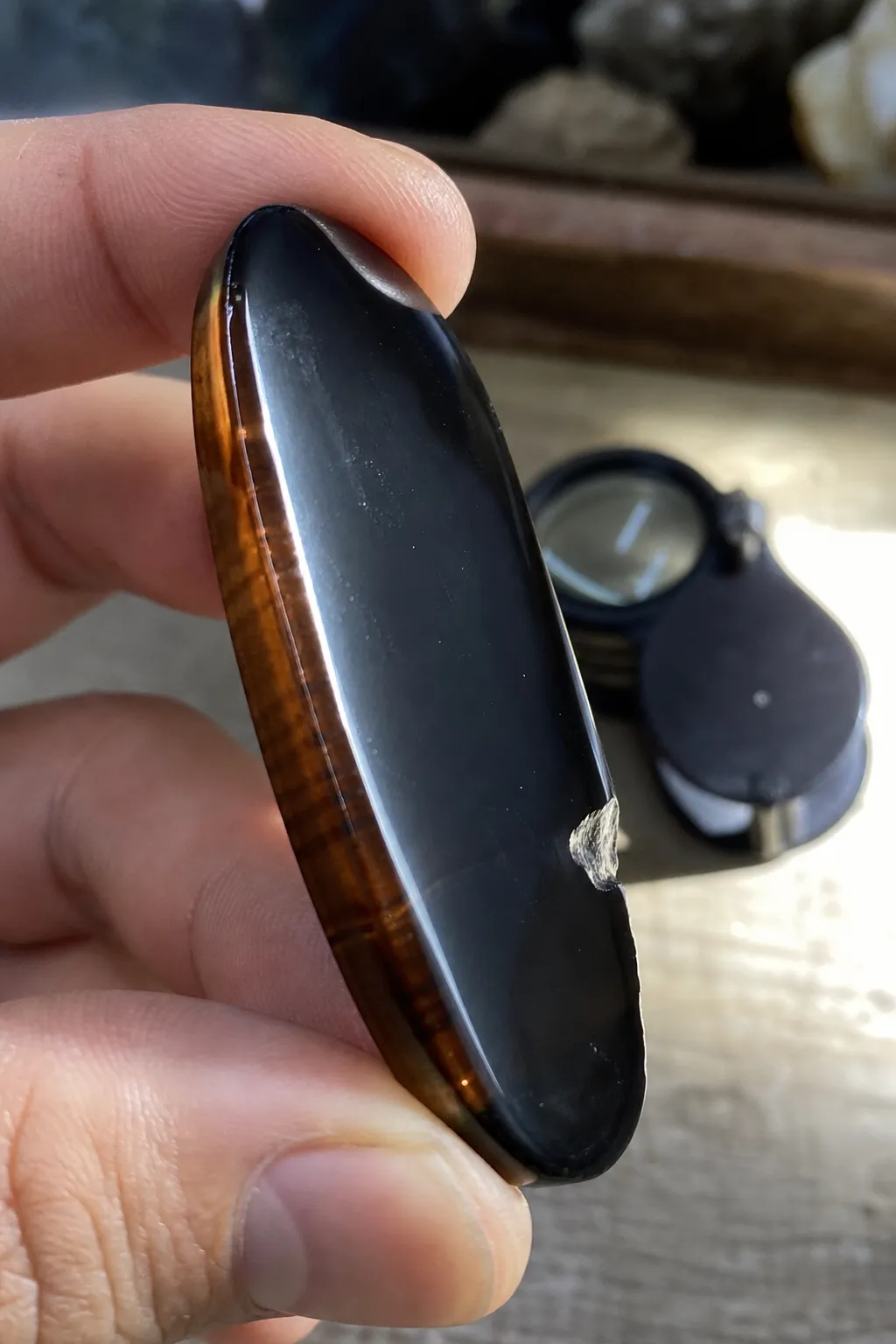
- Backlit thin areas: Hold a thin edge near a strong light source and look for narrow bands or uneven translucency.
- Side lighting: A low lamp angle can reveal stripes that overhead light hides.
- Drill holes: On beads and pendants, the inner edge may show layering better than the outer surface.
- Existing chips: A nick may expose internal layers or a glassy fracture surface.
A banded black stone is not automatically black agate. Some obsidian can show flow-related textures from its volcanic origin. The useful distinction is that agate banding often looks like repeated chalcedony layers, while obsidian flow texture tends to read more like movement within glass. In casual visual inspection, the difference can be subtle. Clear, repeated bands with layered translucency make black agate more plausible than a plain obsidian label.
Polish can make both stones look deceptively similar
Polish affects the answer because it changes what your eye notices first. A polished obsidian appearance can be very dark, reflective, smooth, and glasslike. Polished black agate can also look sleek because chalcedony takes a strong polish.
That creates the common mistake: treating “shiny black stone” as a material ID.
A black agate cabochon may look like a solid black dome from above, while the side or back shows gray striping. A bead may seem uniformly black until the drill hole catches light. A dark obsidian piece may look simple from the front but show smoky translucency at a thin edge.
A better inspection sequence
- 1. Look straight on. Note whether the surface is uniform, cloudy, spotted, or banded.
- 2. Tilt the stone slowly. Watch whether lines appear inside the stone or are just moving reflections.
- 3. Use side light. Low light can expose fine banding.
- 4. Backlight only thin areas. A thick black stone may block light regardless of material.
- 5. Use existing damage only. Chips can help, but scratching or breaking a collector piece is rarely worth it.
The more clues line up, the stronger your visual judgment becomes. Uniform glassiness, no visible layering, and sharp glass-like chips lean toward obsidian. Repeated bands, uneven translucency, and layered zones lean toward agate.
Translucency helps, but it is easy to overread
Translucency is useful in a black agate vs obsidian comparison, but it does not work as a simple yes-or-no test. Both materials can pass some light in thin sections, and both can look opaque when thick or deeply colored.
In agate, translucency often changes from band to band. One layer may pass light differently from the next, or the rim may show smoky, gray, brown, or whitish zones. If backlighting reveals repeated layers, black agate becomes a stronger possibility.
Obsidian may also transmit light at thin edges. Some black obsidian looks opaque in the hand but shows a smoky or brownish edge glow when held to light. That does not make it agate. For obsidian, the stronger pattern is thin-edge translucency combined with a glassy, mostly uniform body and glass-like fracture behavior.
Keep the test modest. You are looking for small clues: edge glow, hidden bands, layered response, and whether the stone looks internally structured or mostly glassy.
Chips and fracture clues: useful only when already visible
If the piece already has a chip, nick, or unpolished area, inspect it before relying on the polished face. Obsidian, as natural volcanic glass, is known for curved, shell-like fracture surfaces. A fresh chip may look sharp, smooth, and glassy.
Agate and other chalcedony materials can also break with curved surfaces, so fracture alone does not separate them cleanly. The difference is usually the total impression: agate may show waxy, cloudy, layered, or microcrystalline-looking areas, while obsidian often resembles broken glass.
Handling boundary: Do not damage the stone just to check. Breaking, scratching, sanding, or grinding can ruin a useful collector piece. If lapidary cutting or grinding is involved, treat that as a different setting and use proper dust precautions for silica-bearing materials. For ordinary handling and visual inspection, the practical concern is much narrower: avoid sharp chips and do not create new damage.
Dyed black agate and seller labels
A dyed black agate comparison needs careful wording. Artificial coloration of agate is a real practice, and gemological references discuss agate color and treatment language with caution. A uniformly black agate label should not automatically be read as “naturally black” unless the seller provides reliable disclosure or the specimen’s visible features support that description.
At the same time, you cannot identify dyed black agate from color alone. A dark, even color may come from treatment, natural coloring, lighting, polish, or photography. Some dark agates have natural bands or zones; some treated pieces may appear more uniform or may have color that emphasizes layering.
Seller names to read cautiously
- Black agate
- Black onyx
- Black obsidian
- Dyed black agate
- Banded black agate
- Black chalcedony
These terms can overlap in retail language more than they do in careful mineral description. “Black onyx” is especially worth reading cautiously, because it is often used as a market name for dark banded chalcedony or treated material. If your real question is “obsidian or black agate,” give more weight to visible structure than to the listing title.
A simple decision path for a polished black stone
Use this as a practical sorting sequence, not a lab conclusion.
1. Do you see repeated bands, layers, or patterned zones?
If yes, black agate becomes more likely, especially if the bands continue around edges or appear under backlight.
2. Does the stone look like uniform volcanic glass?
A smooth, glassy, mostly even body with no chalcedony-like banding leans toward obsidian.
3. What happens at thin edges?
Layered translucency supports agate. Smoky or brownish edge translucency without banding can still fit obsidian.
4. Could the polish be hiding the structure?
Check the sides, back, drill holes, and any unpolished spots before deciding.
5. Is the label doing all the work?
If the only evidence is a seller name or a single photo, keep the identification provisional.
For many collection pieces, the honest answer is not “definitely obsidian” or “definitely black agate.” It may be more accurate to say, “This leans toward obsidian,” or “This shows stronger agate clues.”
Photo identification limits
Photos can help, but they often flatten the details needed for black stone identification. A camera may turn subtle gray banding into solid black, exaggerate gloss, hide edge translucency, or make polished agate look like glass. Reflections can also mimic bands that are not actually inside the stone.
A useful photo set would include the front, back, edge, side-lit view, backlit thin edge, and any existing chip. Even then, photos can only support a visual opinion. They cannot settle treatment status, value, or identity for a stone where the details matter.
If the piece has financial, historical, or serious collection importance, the next step is better documentation or appropriate gemological testing, not a harsher home test. For ordinary collecting, careful observation is usually enough to avoid the two biggest mistakes: assuming every glossy black stone is obsidian, or assuming every dark banded stone is naturally black agate.