Collector labeling
How to Collect Obsidian Without Overrelying on Seller Names
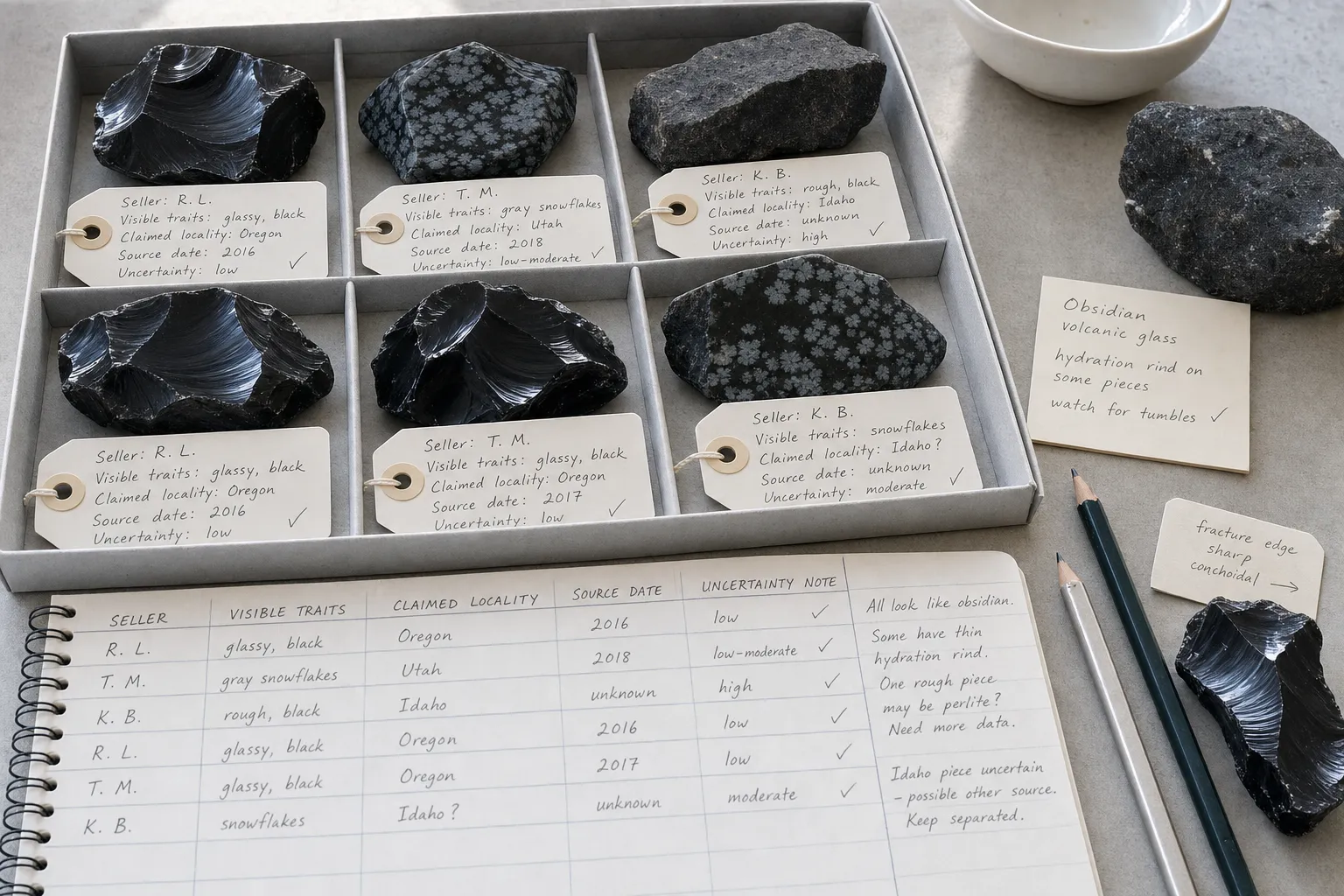
A black glassy surface, a gold flash, a gray snowflake pattern, or a green listing title can all pull your eye before the tag does. The practical answer is this: when collecting obsidian by seller names, keep the seller name, but do not let it become the whole identification. Treat it as one clue in the collection record, then add what you can inspect: color, sheen, pattern, glassy luster, fracture edge, bubbles, inclusions, polish, claimed locality, purchase source, date, photos, and an uncertainty note.
Seller names and obsidian trade names are useful because they preserve marketplace language. They are weak when they try to settle material identity, locality, rarity, value, or variety on their own.
upward
Read the full overview first
Use the broader guide first if you need the full scope before this page.
The working rule
Keep the seller name, then build the label from visible traits, source notes, photos, and uncertainty language.
Start with the Piece, Then Record the Name
Obsidian is commonly described by geology and museum references as volcanic glass, often linked with silica-rich volcanic material and rapid cooling. That matters because obsidian is not a neat crystalline mineral species with one single species label. For collectors, it is better handled as a material category with visible variety names, locality claims, and trade language layered on top.
A seller label such as “midnight lace,” “gold sheen,” “real green obsidian,” or “Glass Buttes rainbow” may contain a useful visual term, a locality claim, a marketing phrase, or all three at once. Your label should separate those parts.
The key move is not to erase obsidian seller names. It is to demote them from verdict to evidence.
Why Seller Names and Trade Names Can Mislead
Many obsidian variety names come from visible traits: snowflake-like gray patches, mahogany-brown coloring, rainbow sheen, gold or silver sheen, lace-like patterning, or a strong black glassy look. Those names can be helpful shorthand when the specimen clearly shows the trait. The problem starts when the name carries more weight than the surface.
A trade name is not automatically a standardized geological category. A seller may use a common collector term, a locality nickname, a descriptive phrase, a shop-specific label, or a search-friendly listing title. One line can collapse several different claims: “natural rare green volcanic glass obsidian from…” may include a material claim, color claim, market claim, and provenance claim that each need different support.
“Volcanic glass” also needs care. The term is broader than obsidian, so a label that only says volcanic glass does not, by itself, settle that the piece is obsidian. The relationship is useful, but not interchangeable in every collecting context.
Locality names can be valuable, especially when a clear collection record travels with the specimen. A bounded example is Glass Buttes, Oregon, which is associated in collector language with multiple obsidian appearances. That supports a simple point: locality and visual variety can overlap. It does not mean every marketplace use of a locality name is complete or reliable.
A safer label keeps the fields separate. “Sold as Glass Buttes gold sheen obsidian” is stronger than quietly shortening it to “Glass Buttes gold sheen” when you have not verified the provenance. One version preserves the claim. The other makes it sound settled.
Build Labels Around Visible Obsidian Traits
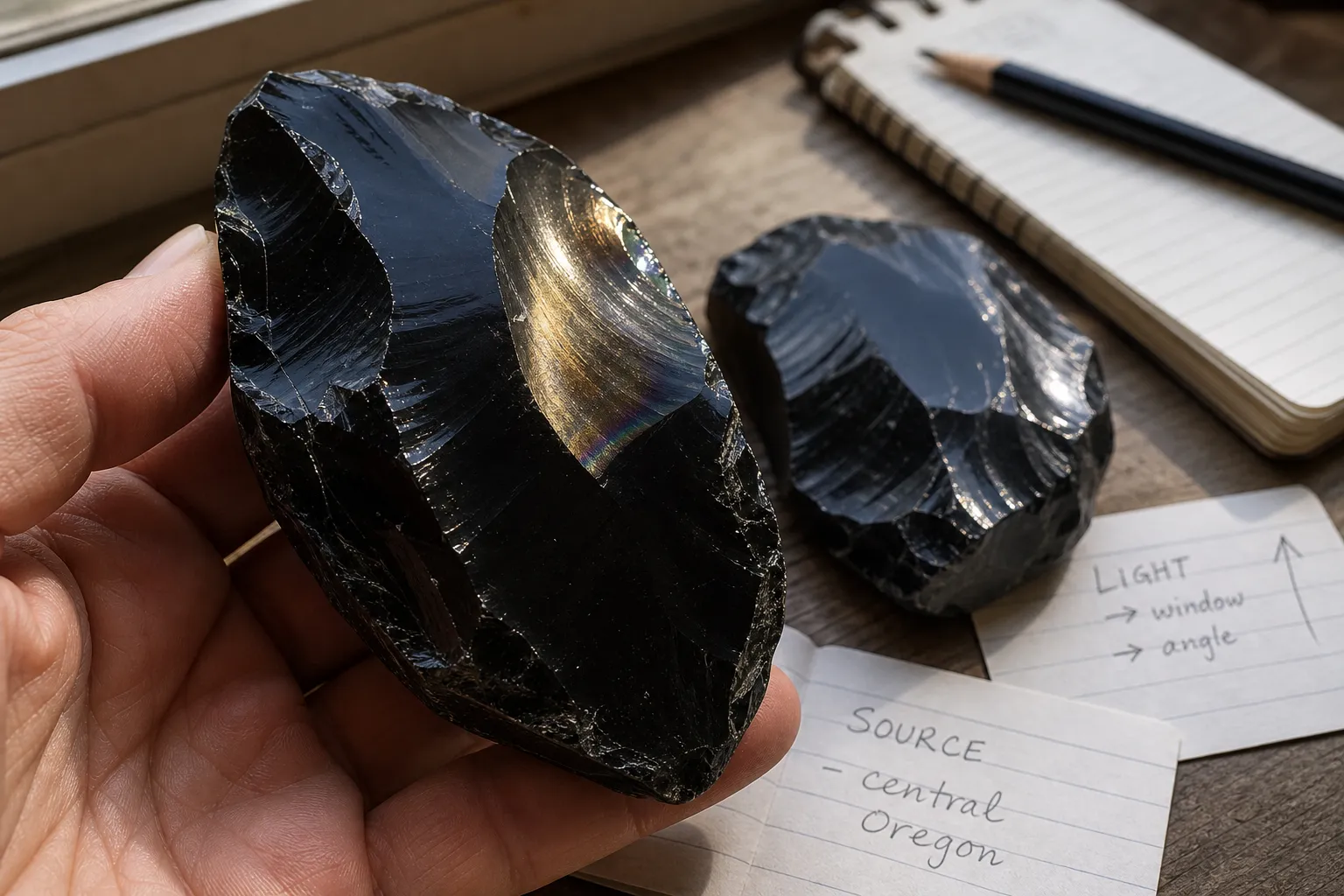
A good collection tray starts with the surface. Look at the piece under steady light, then change the angle before writing the variety name. Sheen, flow lines, and color bands can shift with lighting, polish, and viewing direction.
Useful visible obsidian traits
- Body color: black, brown, reddish, gray, greenish, smoky, or mixed tones.
- Sheen: gold, silver, rainbow, or subtle reflective flashes that appear only at certain angles.
- Pattern: snowflake patches, lace-like lines, mahogany streaks, mottling, or flow banding.
- Luster: glassy reflection on polished or freshly broken areas.
- Fracture edge: curved, shell-like fracture, common in glassy materials but not enough on its own.
- Internal features: bubbles, inclusions, cloudy zones, or suspended-looking areas.
- Finish: raw, tumbled, carved, cabochon, bead, palm stone, blade-like, or heavily polished.
None of these features alone settles identity. Color-only advice is especially weak. Green and blue obsidian listing labels show why: vivid color language can be a real collector concern, but a listing title or short video does not verify a specimen. If a piece is unusually vivid, unusually uniform, or described with strong marketplace wording, record the appearance carefully and keep the label cautious.
“Sold as green obsidian. Translucent green body color, polished oval cabochon, no locality stated, seller photo under bright light, material identity not independently confirmed.”
That label is not dramatic. It is useful. It tells a future viewer what was claimed, what was seen, and what remains uncertain.
Use Provenance Claims Without Letting Them Take Over
A claimed obsidian locality can be one of the most useful parts of a record, but only when it stays attached to its source. A locality may describe where the material was collected, where the seller believes it came from, where a style is commonly associated, or simply what the listing title said.
Write the claimed locality exactly enough to be traceable. “Oregon” is less useful than “sold as Glass Buttes, Oregon.” “Mexico” is less useful than a named region if one was supplied. If the seller gave no locality, write “not stated” rather than filling the gap from the variety name.
This matters because obsidian variety names and locality names can cross each other. A place can produce more than one appearance. A visual type can be sold from more than one source. A seller may use a famous locality name because buyers recognize it. Without a supporting record, the label should not become stronger each time it is repeated.
Three different lines for one claim
- “Seller name: Glass Buttes rainbow obsidian”
- “Claimed locality: Glass Buttes, Oregon, as stated by seller”
- “Visible traits: dark body color with angled rainbow sheen; polished surface”
That structure lets you enjoy the name without turning it into a certificate of origin.
Keep an Obsidian Uncertainty Note
An obsidian uncertainty note is not a failure. It is a sign that your collection label is honest.
Use one when the seller name is doing more work than the evidence, when the locality is unverified, when the color is unusual, when photos are the only record, or when the listing title uses broad terms such as “natural,” “rare,” “real,” “volcanic glass,” or a highly specific variety name without supporting detail.
This is where obsidian collection labels become more durable than seller tags. A future collector, family member, buyer, or curator of your own tray can see how confident the label is without guessing what you meant.
A Short Decision Path for New Pieces
When a new piece arrives, do not start by asking whether the seller name is “right.” Start by asking what kind of information the name contains.
- First, copy the exact obsidian listing label. Do not clean it up yet. If the tag says “gold sheen black volcanic glass obsidian,” write that phrase in the seller-name field.
- Second, inspect the specimen. Note body color, sheen, pattern, luster, inclusions, bubbles, polish, and fracture edge if visible. Use plain words before variety language.
- Third, separate the claim type. Is the seller name a visual label, a locality claim, a material identity claim, or a sales phrase? “Snowflake obsidian” mainly points to appearance. “Glass Buttes obsidian” points toward locality. “Natural rare green obsidian” mixes material, color, and market appeal.
- Fourth, choose a confidence phrase. Use “sold as,” “visually consistent with,” “claimed locality,” or “uncertain” when that is more accurate than a clean variety name.
- Fifth, photograph the piece under known lighting. For sheen pieces, include at least one angled view. For color-sensitive pieces, use a neutral background and note if the appearance changes under strong light.
This path keeps the record compact. It also prevents the most common mistake: letting a neat name replace visible evidence.
Common Confusions Worth Avoiding
Seller names are not taxonomy
Some names are widely recognized in collector language, but seller usage still varies. A familiar trade name can describe a look without proving source or material history.
“Natural” is not a complete claim
Natural compared with what? Natural volcanic glass, natural color, natural surface, or natural locality? Your record should still describe visible traits and the source of the claim.
Black is not the only serious form
Obsidian can appear in more than one color and pattern, and common references discuss varieties such as mahogany, snowflake, rainbow, gold sheen, and silver sheen. That variety does not make every dramatic label reliable.
Meaning notes are not identification
Some commercial pages pair obsidian variety names with personal or cultural meanings. Those meanings may matter to an owner, but they do not verify material identity, locality, or variety.
Photos support a label; they do not settle every question
Photos help, especially when lighting is controlled, but they can hide surface treatment, color shifts, scale, and angle-dependent sheen.
What a Careful Collection Label Sounds Like
A careful label does not need to be long. It needs to show which parts are observed and which parts are claimed.
Weak label
“Rare Glass Buttes rainbow obsidian.”
Stronger label
“Sold as Glass Buttes rainbow obsidian. Dark polished piece with rainbow sheen visible under angled light. Claimed locality: Glass Buttes, Oregon, from seller listing. Purchase source and date recorded. Locality not independently verified.”
Weak label
“Real green obsidian.”
Stronger label
“Sold as green obsidian. Translucent green polished piece, no locality stated. Color and polish recorded from direct inspection and photos; material identity remains uncertain.”
Weak label
“Gold sheen obsidian, authentic.”
Stronger label
“Sold as gold sheen obsidian. Black body color with gold reflective sheen at low angle; polished surface; no provenance record supplied.”
The stronger versions are not less useful because they are cautious. They are more useful because another person can understand the evidence behind the name.
The Bottom Line for Seller-Name Collecting
Seller names belong in an obsidian collection record. They preserve trade language, purchase history, and the path by which the piece entered your tray. They just should not stand alone.
For each specimen, write the name you were given, then make the visible record stronger than the name: body color, sheen, pattern, glassy luster, flow banding, bubbles, inclusions, polish, fracture, claimed locality, source, date, photos, and an uncertainty note. If the label depends mainly on marketplace wording, say so.
That habit gives you a collection that can grow without pretending every seller tag is a settled identification. The piece stays inspectable; the name stays traceable; the uncertainty stays visible.