
Collector explanation
How Do Sheen and Rainbow Effects Develop in Obsidian
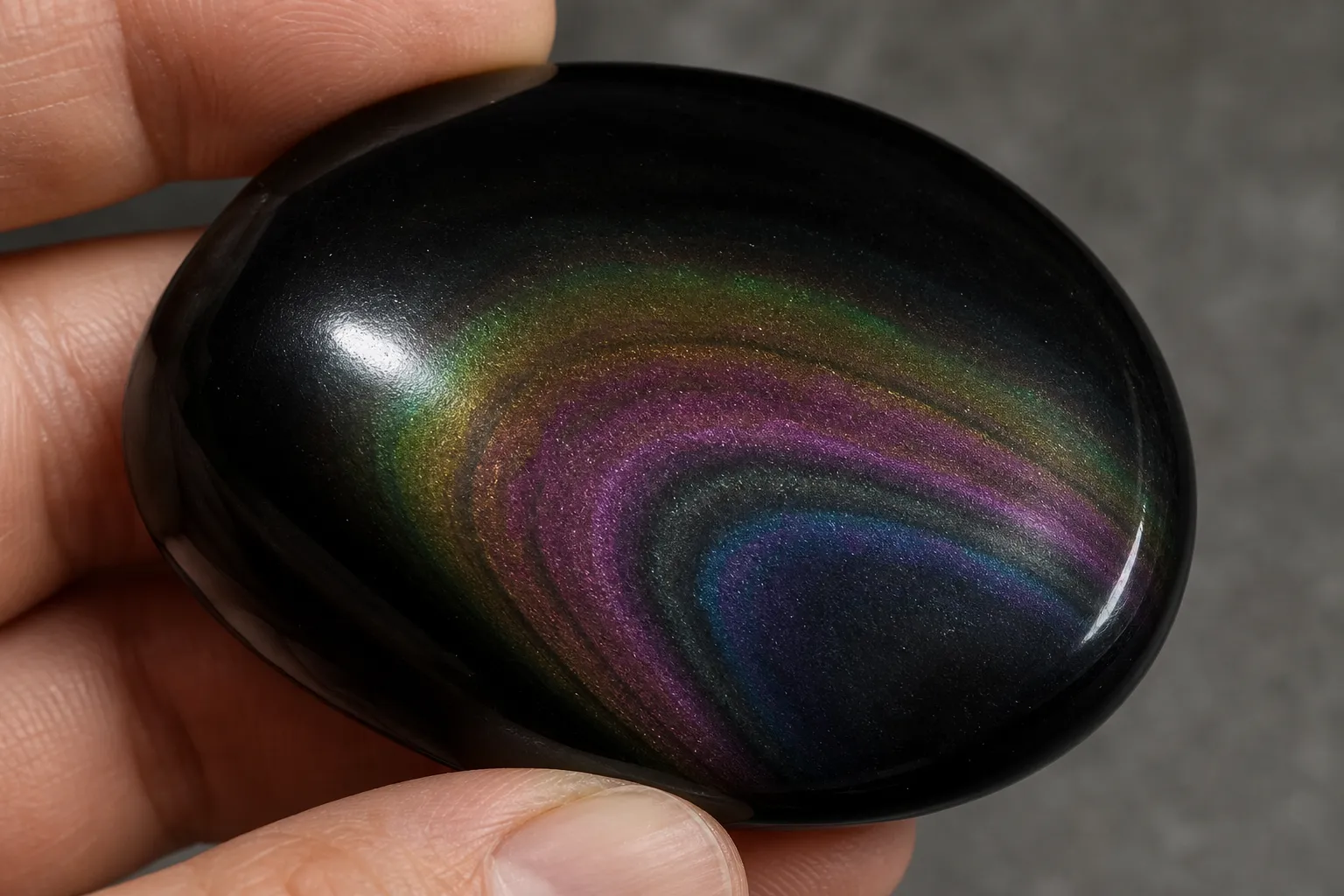
Rainbow, gold, silver, and related sheen effects in obsidian develop when light meets tiny internal structures preserved inside volcanic glass. In practical collector terms, how rainbow obsidian forms comes down to three linked conditions: silica-rich lava cools into glass, flow or gas-related textures remain trapped inside that glass, and a later cut or polish lets light catch those textures at a favorable angle.
That is why a piece can look almost black in one position, then flash green, gold, purple, blue, or layered rainbow bands when you tilt it.
One useful limit belongs near the front: the general geology of obsidian formation, flow banding, degassing, vesicles, microlites, and glassy texture is well supported. The exact microstructure behind every stone sold as “rainbow obsidian” or “gold sheen obsidian” is less settled in public geology sources. So the best answer is not a single universal formula. It is a careful visual explanation: organized internal features in volcanic glass can modify reflected light, and polish, cut direction, and viewing angle decide whether the effect is visible.
upward
Start with the broader guide
Use the broader guide first if you need the full scope before this page.
Obsidian starts as volcanic glass
Obsidian forms when silica-rich lava cools quickly enough that large crystals do not have time to grow. Instead of becoming a visibly crystalline rock, the melt solidifies as natural glass.
That glassy origin matters. Obsidian may look smooth and uniform, especially when polished black, but it can preserve details from its molten stage. Geological descriptions of obsidian flows include banding, variable bubble content, shear-related textures, microlites, fractures, and other small-scale features tied to movement, cooling, and gas loss.
For sheen varieties, the point is not that the stone contains bright paint-like color. The flash is better understood as a light effect. A dark glass body can hold subtle internal planes, layers, flattened bubbles, or textural contrasts. If those features are arranged favorably, light may reflect, scatter, refract, or interact in a way that returns a colored sheen to the viewer.
That is also why rainbow obsidian colors are angle-dependent. The color is not fixed like a surface stain. It appears, disappears, narrows into bands, or shifts as the stone, light, or viewer moves.
A likely sequence behind obsidian sheen
1. Lava moves and loses gas
Viscous silica-rich lava moves, stretches, cools, and loses gas. Different zones in the flow may be more glassy, more bubbly, more banded, or richer in tiny crystals. Gas bubbles may form, stretch, collapse, or escape through fractures and pathways while the material is still hot.
2. Texture becomes organized
Movement inside the flow can align or flatten some of those features. Flow banding in obsidian can come from differences in crystallinity, bubble content, or texture. Those bands may be visible to the eye, or they may be much smaller. Either way, organized texture helps explain why a sheen can be directional rather than evenly spread through the whole stone.
3. Rapid cooling preserves it
Rapid cooling preserves the arrangement. Once the lava becomes glass, the internal structure is largely locked in. A polished piece may therefore carry a visual record of movement, cooling, and gas behavior from the original lava flow.
For rainbow and gold sheen obsidian specifically, common collector explanations often mention microscopic gas bubbles, flattened vesicles, flow-aligned layers, or other internal microtextures. That fits the broader geological picture: obsidian can preserve bubbles, banding, and deformation-related textures. The cautious wording matters because not every specimen has been studied in the same way, and not every visible flash has to come from one identical microscopic pattern.
The simplest reliable summary is this: sheen obsidian likely develops when organized internal features in volcanic glass interact with light, and the visible result depends strongly on orientation, surface quality, and viewing angle.
Why tilting the stone changes the color
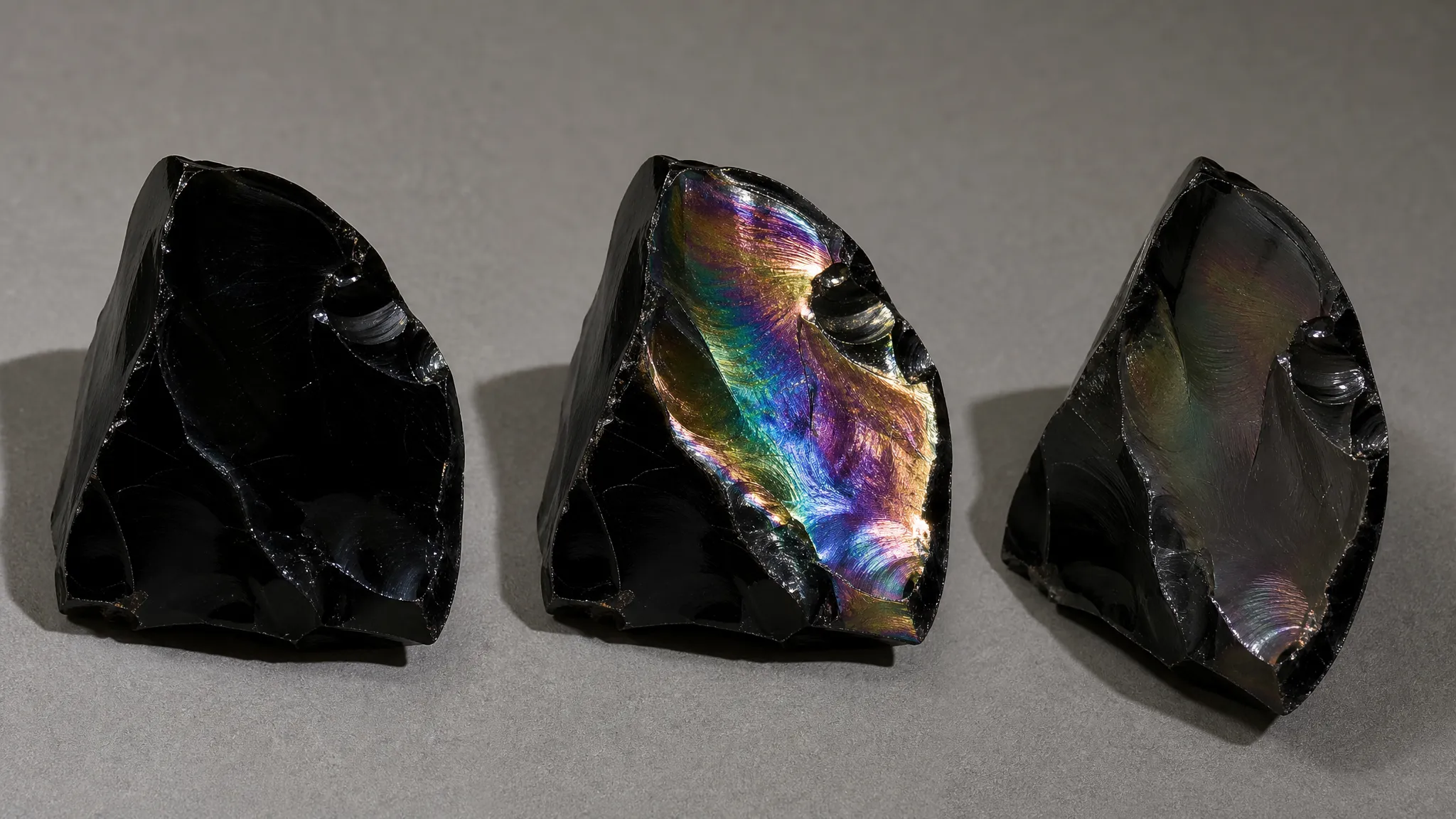
The tilt test is central because sheen is an angle-dependent effect. A piece of rainbow obsidian may look like ordinary black obsidian under flat room light. Turn it slowly, and a band may appear. Turn it farther, and the band may shift from gold to green or purple, or fade again.
The reason is the changing light path. At a poor angle, light may scatter or pass through without sending a strong colored flash back to your eye. At a better angle, the polished surface and internal structure line up well enough for the sheen to show.
When inspecting a piece, these details matter
- Use steady, directional light. A desk lamp, window light, or bright indirect light often reveals sheen better than dull ambient lighting.
- Look at polished areas first. Rough, scratched, matte, or weathered surfaces scatter light and can hide internal effects.
- Rotate the stone slowly. Do not judge from one fixed view. Sheen may appear only across a narrow angle.
- Notice direction. Bands, arcs, or flashes may follow the internal structure rather than appearing evenly everywhere.
- Compare faces. A cabochon, sphere, carving, or point may show strong sheen on one side and little on another because the cut intersects the internal texture differently.
- Be cautious with rough pieces. Rough rainbow obsidian can look plain black, smoky, or faintly banded until a suitable face is cut and polished.
Photos can mislead in both directions. A seller image may catch the strongest possible angle, making a piece look brighter than it usually appears in hand. A casual phone photo may miss the sheen entirely.
Rainbow, gold sheen, and silver sheen are collector names
Names such as rainbow obsidian, gold sheen obsidian, silver sheen obsidian, and black obsidian are useful because collectors and sellers use them. They describe the dominant visual effect, especially after cutting and polishing. They are not always strict scientific categories with lab-defined boundaries.
Collector name
What the viewer usually notices
Formation idea, cautiously stated
Rainbow obsidian
Bands or patches of shifting green, purple, blue, gold, or multicolor sheen
Angle-dependent light interaction with organized internal textures in volcanic glass
Gold sheen obsidian
Warm golden flash, sometimes broad or silky
A related sheen effect where the returned light appears mainly gold
Silver sheen obsidian
Gray, silvery, or smoky reflective sheen
Another angle-dependent sheen variety
Black obsidian
Mostly black glassy appearance with little visible color play
May lack visible sheen, or the cut and lighting may not reveal it
Snowflake obsidian
Pale gray or white “snowflake” spots in dark glass
A different texture, generally linked to crystallization patterns rather than rainbow sheen
The comparison with snowflake obsidian is useful. Snowflake obsidian is not simply rainbow obsidian without color flash. Its pale spots are a different visible feature from iridescent bands. In broad terms, snowflake patterns involve crystallization textures inside the glass, while rainbow and gold sheen are about light interacting with subtle organized structures.
Mahogany obsidian is separate again. Its reddish-brown and black patterning is not the same as a tilt-dependent rainbow flash. Different variety names may reflect different textures, oxidation-related colors, inclusions, or optical effects, so it is better not to force all obsidian colors into one explanation.
What makes one piece flash more than another
A collector often wonders why one piece of rainbow obsidian looks dramatic while another looks nearly plain. The answer is usually a mix of natural structure and lapidary work.
The internal structure has to be present in a useful arrangement. Random bubbles alone do not explain a clean rainbow band. The bubbles, layers, or microtextures need some organization, spacing, direction, or contrast that can affect light visibly.
The cut then has to meet that structure well. If a lapidary cuts across the internal layers at a favorable angle, the sheen may open across the face. If the cut misses that orientation, the same material may show only a weak flash.
Polish is another filter. Obsidian is glassy, and a smooth surface helps light enter and return cleanly. A scratched or uneven surface can hide the effect even when the material contains sheen-bearing texture.
Lighting finishes the chain. A piece that looks quiet in diffuse room light may show strong color under a focused lamp. Direct sun can reveal dramatic flashes, but it can also create glare. The best inspection method is simple and non-destructive: rotate the piece slowly under steady light and watch whether the color appears from within the stone rather than sitting as a fixed surface layer.
Common misunderstandings about rainbow and sheen obsidian
It is not ordinary pigment
One common misunderstanding is that rainbow obsidian gets its color from ordinary pigment. Natural sheen is better understood as an optical effect. The obsidian body often remains dark and glassy, while the color appears only when light catches internal structure at the right angle.
Rough pieces may hide sheen
Another misunderstanding is that a plain-looking rough piece cannot be rainbow obsidian. Rough surfaces often hide sheen. Without a polished window or favorable broken face, the internal structure may not be easy to see. At the same time, absence of visible sheen limits what you can conclude. It is fair to say, “I cannot see the effect from this surface.” It is less fair to say exactly what the material would show after cutting.
Bubbles are not a shortcut
A third confusion involves bubbles. Some people treat visible bubbles as a sign of manufactured glass, while others treat bubbles as a sign of natural rainbow obsidian. Neither shortcut is reliable. Natural volcanic glass can preserve gas-related textures, and manufactured glass can also contain bubbles. Shape, distribution, context, surface, and other observations all matter.
A label or flash is not the whole answer
Finally, a rainbow-looking surface or a seller label does not confirm natural origin. Dyed glass, coated pieces, resin, slag-like material, and other look-alikes may appear in the decorative stone market. This page is not a full authentication guide, but a cautious collector should avoid destructive home tests and should not rely on one photo, one name, or one color flash as the whole answer.
The useful collector answer
Sheen and rainbow effects in obsidian develop from the relationship between volcanic glass, preserved internal texture, and light. The lava cools quickly into glass, but that glass may retain flow bands, gas-related structures, microlites, or other microscopic variations from its formation history. When those features are organized in a way that affects light, and when cutting and polishing expose them well, the stone may show gold, silver, or rainbow flashes as it is tilted.
If you are holding a piece, start with observation rather than certainty. Use steady light. Turn the stone slowly. Look for color that appears and disappears with angle. Compare rough areas with polished faces. Notice whether bands seem directional. Treat names such as rainbow obsidian and gold sheen obsidian as practical collector terms, not absolute guarantees.
The shortest answer: rainbow and sheen obsidian are usually not about fixed surface color. They are angle-dependent light effects made visible by internal structures in volcanic glass, with cut, polish, and lighting deciding how much of that hidden structure you can actually see.